PRAI vs IMX: A Comprehensive Comparison of Two Leading AI Image Generation Platforms


Introduction: Investment Comparison Between PRAI and IMX
In the cryptocurrency market, the comparison between PRAI and IMX has become a topic that investors cannot ignore. The two differ significantly in market cap ranking, application scenarios, and price performance, representing distinct positioning within the crypto asset landscape.
Privasea AI (PRAI): Launched in 2025, this DePIN project has gained market attention by building a decentralized confidential AI infrastructure using Fully Homomorphic Encryption (FHE) to enable secure computation on encrypted data. The platform supports both Web2 and Web3 applications with particular emphasis on machine learning use cases.
Immutable (IMX): Since its inception, IMX has been positioned as a Layer 2 scaling solution for NFTs on Ethereum, offering instant transactions, massive scalability, and zero gas fees for minting and trading, all without compromising user or asset security.
This article will comprehensively analyze the investment value comparison between PRAI and IMX through historical price trends, supply mechanisms, institutional adoption, technical ecosystems, and future predictions, attempting to answer the question that investors care about most:
"Which is the better buy right now?"
I. Historical Price Comparison and Current Market Status
PRAI (Coin A) and IMX (Coin B) Historical Price Trends
- 2025: PRAI launched on May 14, 2025, reaching a price peak of $0.425, reflecting initial market enthusiasm for its decentralized confidential AI infrastructure utilizing Fully Homomorphic Encryption (FHE) technology.
- 2021: IMX experienced substantial growth, with its price climbing to $9.52 on November 26, 2021, driven by strong adoption of its Layer-2 scaling solution for NFTs on Ethereum and zero gas fee trading capabilities.
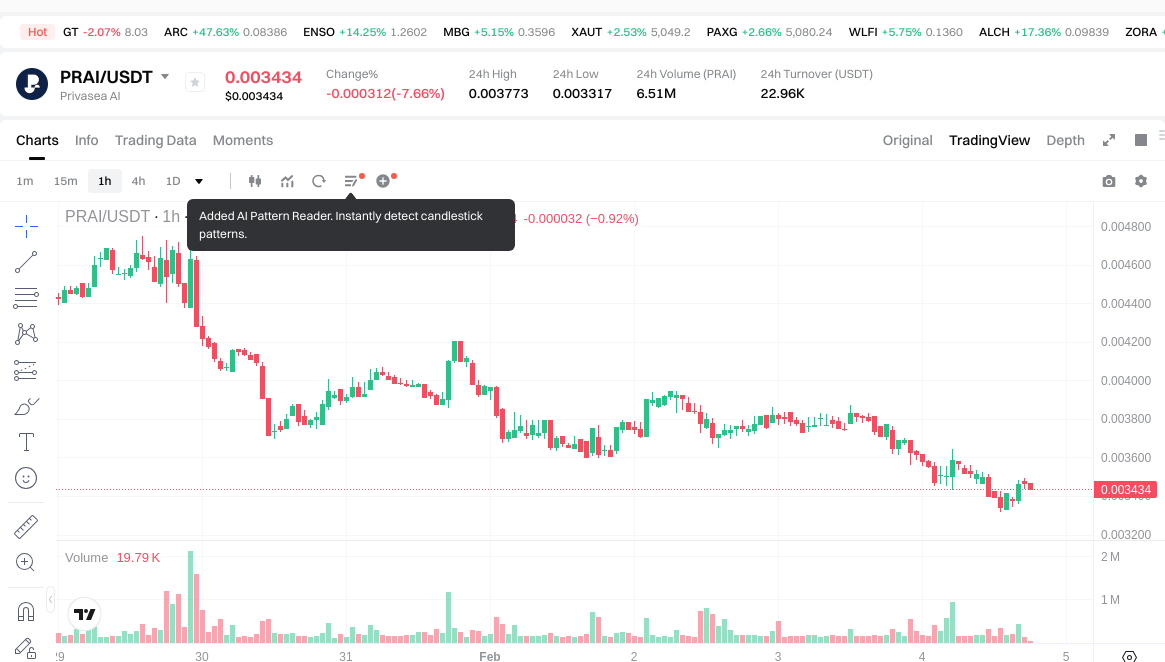
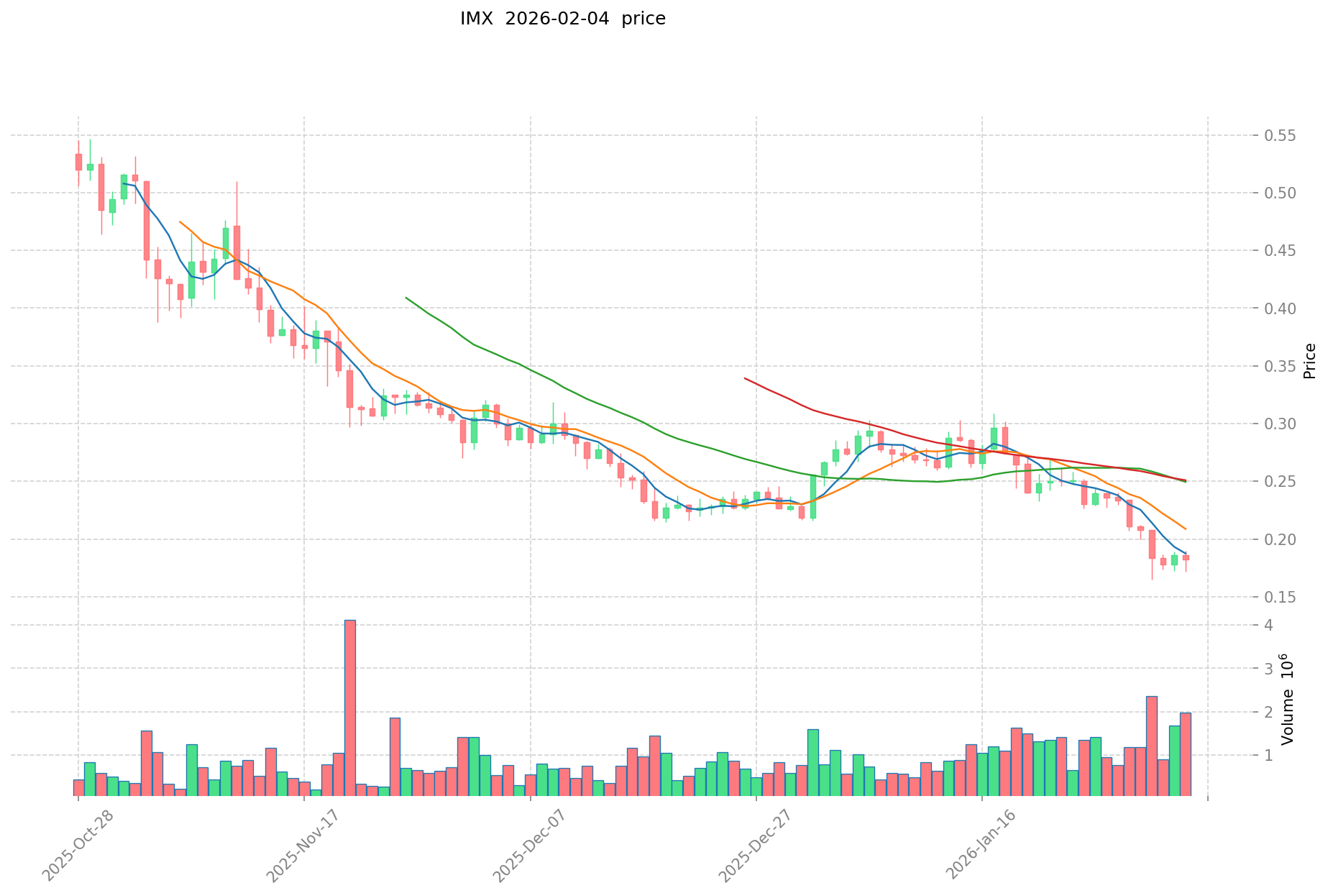
- Comparative Analysis: During recent market cycles, PRAI declined from its peak of $0.425 to a low of $0.003317, representing significant volatility in its early trading phase. In contrast, IMX has experienced a prolonged downturn from its peak of $9.52, currently trading substantially lower, reflecting broader market corrections in the Layer-2 and NFT infrastructure sectors.
Current Market Landscape (2026-02-04)
- PRAI Current Price: $0.003466
- IMX Current Price: $0.1823
- 24-Hour Trading Volume: PRAI recorded $23,044.97 compared to IMX's $379,957.50, indicating different levels of market liquidity and trading activity.
- Market Sentiment Index (Fear & Greed Index): 14 (Extreme Fear), suggesting heightened caution among market participants.
View real-time prices:
- Check PRAI current price Market Price
- Check IMX current price Market Price
II. Core Factors Influencing PRAI vs IMX Investment Value
Supply Mechanism Comparison (Tokenomics)
Due to the absence of specific tokenomics data in the provided materials, a detailed supply mechanism comparison cannot be presented at this time.
Institutional Adoption and Market Application
Institutional Holdings
The reference materials do not contain comparative data regarding institutional preference between PRAI and IMX.
Enterprise Adoption
Specific information about PRAI and IMX applications in cross-border payments, settlements, or investment portfolios is not available in the provided materials.
National Policies
Regulatory attitudes of different countries toward PRAI and IMX are not covered in the reference materials.
Technical Development and Ecosystem Building
Technical Advantages
According to the materials, companies with research and development capabilities, technical expertise, and core competitive advantages demonstrate enhanced competitiveness in the market. Global talent deployment, localized services, and deepened key technology development contribute to product integration and value creation.
Ecosystem Comparison
Specific implementation details regarding DeFi, NFT, payment systems, and smart contract deployment for PRAI and IMX are not available in the provided materials.
Macroeconomic Environment and Market Cycles
Performance in Inflationary Environments
The reference materials do not contain comparative analysis of PRAI and IMX performance characteristics during inflationary periods.
Macroeconomic Monetary Policy
According to market analysis principles outlined in the materials, technical indicators and on-chain metrics serve as important signal sources for market participants. Factors such as interest rates and dollar index movements can influence crypto asset valuations, though specific impacts on PRAI and IMX are not detailed in the provided materials.
Geopolitical Factors
The materials do not address cross-border transaction demand or international situation impacts specifically related to PRAI and IMX.
III. 2026-2031 Price Forecast: PRAI vs IMX
Short-term Forecast (2026)
- PRAI: Conservative $0.00182 - $0.00343 | Optimistic $0.00343 - $0.00374
- IMX: Conservative $0.122 - $0.182 | Optimistic $0.182 - $0.208
Mid-term Forecast (2028-2029)
- PRAI may enter a consolidation phase, with projected prices ranging from $0.00259 to $0.00540 in 2028, and $0.00304 to $0.00497 in 2029
- IMX may enter an expansion phase, with projected prices ranging from $0.157 to $0.270 in 2028, and $0.182 to $0.363 in 2029
- Key drivers: institutional capital inflows, ETF developments, ecosystem growth
Long-term Forecast (2030-2031)
- PRAI: Base scenario $0.00341 - $0.00478 (2030), $0.00341 - $0.00524 (2031) | Optimistic scenario $0.00478 - $0.00569 (2030), $0.00524 - $0.00561 (2031)
- IMX: Base scenario $0.190 - $0.306 (2030), $0.345 - $0.379 (2031) | Optimistic scenario $0.306 - $0.453 (2030), $0.379 - $0.527 (2031)
Disclaimer: Price predictions are based on historical data analysis and market trend modeling. Actual market performance may differ significantly due to various factors including regulatory changes, technological developments, macroeconomic conditions, and unforeseen events. This information should not be considered as investment advice.
PRAI:
| Year | Predicted High Price | Predicted Average Price | Predicted Low Price | Price Change |
|---|---|---|---|---|
| 2026 | 0.00374197 | 0.003433 | 0.00181949 | 0 |
| 2027 | 0.0040179832 | 0.003587485 | 0.00297761255 | 3 |
| 2028 | 0.005399882422 | 0.0038027341 | 0.002585859188 | 9 |
| 2029 | 0.00496941292188 | 0.004601308261 | 0.00303686345226 | 32 |
| 2030 | 0.005694579103813 | 0.00478536059144 | 0.003493313231751 | 38 |
| 2031 | 0.00560676773696 | 0.005239969847626 | 0.003405980400957 | 51 |
IMX:
| Year | Predicted High Price | Predicted Average Price | Predicted Low Price | Price Change |
|---|---|---|---|---|
| 2026 | 0.207708 | 0.1822 | 0.122074 | 0 |
| 2027 | 0.25928882 | 0.194954 | 0.17350906 | 6 |
| 2028 | 0.2702744779 | 0.22712141 | 0.1567137729 | 24 |
| 2029 | 0.363098998167 | 0.24869794395 | 0.1815494990835 | 36 |
| 2030 | 0.45272973716658 | 0.3058984710585 | 0.18965705205627 | 67 |
| 2031 | 0.52724660471643 | 0.37931410411254 | 0.345175834742411 | 108 |
IV. Investment Strategy Comparison: PRAI vs IMX
Long-term vs Short-term Investment Strategies
- PRAI: Suitable for investors interested in emerging decentralized AI infrastructure and FHE technology applications, with higher risk tolerance for early-stage projects
- IMX: Suitable for investors seeking exposure to established Layer-2 scaling solutions and NFT infrastructure with proven market adoption
Risk Management and Asset Allocation
- Conservative investors: PRAI 10-15% vs IMX 85-90%
- Aggressive investors: PRAI 30-40% vs IMX 60-70%
- Hedging tools: stablecoin allocation, options strategies, cross-asset portfolio diversification
V. Potential Risk Comparison
Market Risk
- PRAI: Higher volatility due to early-stage market position, limited trading volume of $23,044.97, and price fluctuations from peak of $0.425 to current $0.003466
- IMX: Moderate volatility influenced by broader Layer-2 sector performance and NFT market cycles, with current price of $0.1823 reflecting sustained correction from historical peak
Technical Risk
- PRAI: Scalability challenges in FHE-based confidential computing, network stability in early deployment phases
- IMX: Network congestion during high-volume NFT minting periods, potential security vulnerabilities in Layer-2 architecture
Regulatory Risk
- Global regulatory policies may impact both assets differently, with PRAI's AI-focused infrastructure potentially subject to emerging AI governance frameworks, while IMX faces evolving regulations around NFT marketplaces and Layer-2 solutions
VI. Conclusion: Which Is the Better Buy?
📌 Investment Value Summary:
- PRAI Advantages: Early-stage positioning in decentralized confidential AI infrastructure, FHE technology application in machine learning, support for both Web2 and Web3 ecosystems
- IMX Advantages: Established Layer-2 scaling solution with proven NFT marketplace infrastructure, zero gas fee trading model, instant transaction capabilities on Ethereum
✅ Investment Recommendations:
- Novice investors: Consider IMX for more established market position and proven use cases, with smaller allocation to PRAI for potential growth exposure
- Experienced investors: Balanced approach with IMX as core holding and PRAI as speculative allocation based on AI infrastructure adoption trends
- Institutional investors: IMX offers greater liquidity with $379,957.50 in 24-hour volume compared to PRAI's $23,044.97, enabling larger position management
⚠️ Risk Warning: The cryptocurrency market exhibits extreme volatility. This content does not constitute investment advice.
VII. FAQ
Q1: What is the main difference between PRAI and IMX in terms of their core technology and use cases?
PRAI focuses on decentralized confidential AI infrastructure using Fully Homomorphic Encryption (FHE), while IMX is a Layer-2 scaling solution for NFT transactions on Ethereum. PRAI enables secure computation on encrypted data for machine learning applications across both Web2 and Web3 ecosystems, making it particularly valuable for privacy-sensitive AI workloads. In contrast, IMX specializes in providing instant, zero gas fee NFT minting and trading capabilities, addressing Ethereum's scalability limitations specifically for the digital collectibles market. These fundamentally different technical approaches position them in distinct sectors of the cryptocurrency ecosystem.
Q2: Why is there such a significant price difference between PRAI ($0.003466) and IMX ($0.1823)?
IMX commands a substantially higher price due to its established market position since 2021 and proven adoption in the NFT infrastructure sector. IMX reached a historical peak of $9.52 in November 2021, reflecting strong market validation of its Layer-2 scaling solution. PRAI, launched in May 2025, is still in its early market phase with limited trading history and a 24-hour volume of only $23,044.97 compared to IMX's $379,957.50. The price differential reflects IMX's maturity, liquidity advantages, and established ecosystem partnerships, while PRAI represents an emerging technology with higher speculative risk but potential upside as the decentralized AI infrastructure market develops.
Q3: Which asset is more suitable for conservative investors with lower risk tolerance?
IMX is more suitable for conservative investors. The recommended allocation suggests conservative investors should maintain 85-90% in IMX versus only 10-15% in PRAI. This recommendation is based on IMX's established market position, significantly higher trading volume ($379,957.50 vs. $23,044.97), proven use cases in NFT marketplaces, and more predictable price behavior. IMX's Layer-2 infrastructure serves an existing and active market segment, reducing execution risk. PRAI's early-stage status, extreme volatility (declining from $0.425 peak to $0.003466), and unproven market adoption make it appropriate only as a small speculative allocation within a diversified portfolio for risk-averse investors.
Q4: How do the 2026-2031 price forecasts compare between PRAI and IMX?
IMX demonstrates stronger projected price appreciation in absolute terms and percentage growth. By 2031, IMX's optimistic scenario projects prices reaching $0.527 (representing a 108% increase from 2026 baseline), while PRAI's optimistic scenario forecasts $0.00561 (51% increase). In 2026, IMX's conservative range is $0.122-$0.182 versus PRAI's $0.00182-$0.00343. The mid-term outlook (2028-2029) shows IMX entering an expansion phase with institutional capital inflows potentially driving prices to $0.363, while PRAI remains in consolidation with projected ranges of $0.00304-$0.00497 by 2029. These forecasts suggest IMX offers more substantial upside potential over the forecast period, though both projections carry significant uncertainty and should not be considered investment advice.
Q5: What are the primary risks investors should consider before investing in either PRAI or IMX?
Market risk is the most immediate concern for both assets under current conditions, with the Fear & Greed Index at 14 (Extreme Fear) indicating heightened market caution. PRAI faces higher volatility risk due to limited liquidity and early-stage market position, having declined from its $0.425 peak to current levels. Technical risks differ substantially: PRAI confronts scalability challenges in FHE-based confidential computing and network stability issues in early deployment, while IMX faces potential network congestion during high-volume NFT minting and Layer-2 architecture security vulnerabilities. Regulatory risk affects both assets differently—PRAI may encounter emerging AI governance frameworks as global regulators address AI applications, while IMX faces evolving regulations around NFT marketplaces and Layer-2 solutions. Investors should implement proper risk management through diversified allocation, stablecoin hedging, and position sizing appropriate to their risk tolerance.
Q6: How does trading volume impact the investment decision between PRAI and IMX?
Trading volume significantly favors IMX, with $379,957.50 in 24-hour volume compared to PRAI's $23,044.97—a difference of approximately 16.5x. This liquidity advantage is critical for several reasons. Higher volume in IMX enables institutional investors to enter and exit positions with minimal price slippage, making it more suitable for larger capital deployment. The limited liquidity in PRAI creates execution risk, where buying or selling substantial amounts can significantly move the market price, resulting in unfavorable entry or exit prices. For retail investors, IMX's superior liquidity provides tighter bid-ask spreads and more efficient price discovery. PRAI's low trading volume also suggests limited market participation and potential difficulty in liquidating positions during market stress. These factors make IMX the more practical choice for investors prioritizing execution quality and position management flexibility.
Q7: What factors could drive future price appreciation for PRAI versus IMX?
PRAI's growth potential hinges on adoption of decentralized confidential AI infrastructure and increasing demand for privacy-preserving machine learning applications. As organizations seek FHE-based solutions for sensitive data processing across Web2 and Web3 environments, PRAI could benefit from expanding use cases in healthcare, finance, and enterprise AI. The broader trend toward decentralized computing infrastructure and AI integration in blockchain ecosystems represents a tailwind. For IMX, price appreciation drivers include continued growth in NFT marketplace activity, gaming industry adoption of blockchain-based digital assets, and expansion of its Layer-2 ecosystem partnerships. The development of Ethereum-based gaming projects and institutional adoption of NFT technology for digital ownership could strengthen IMX's value proposition. Both assets may benefit from general cryptocurrency market recovery from the current Extreme Fear sentiment, though IMX's established position provides more predictable growth catalysts while PRAI offers higher-risk, higher-reward exposure to emerging AI infrastructure trends.
Q8: Should investors choose one asset over the other, or consider holding both?
A diversified approach holding both assets may be optimal for most investors, with allocation percentages adjusted to individual risk tolerance. The recommended strategy suggests balanced portfolios: conservative investors (10-15% PRAI, 85-90% IMX) and aggressive investors (30-40% PRAI, 60-70% IMX). This approach captures different market opportunities—IMX provides exposure to established NFT infrastructure with proven adoption, while PRAI offers speculative upside in emerging decentralized AI technology. The assets have low correlation due to their distinct sectors (AI infrastructure vs. NFT Layer-2), potentially improving overall portfolio risk-adjusted returns. Rather than an either-or decision, investors should consider their investment horizon, capital size, and risk appetite. Novice investors might prioritize IMX for its lower volatility and established use cases, while experienced investors with higher risk tolerance can allocate more substantially to PRAI for potential asymmetric returns as the decentralized AI market develops. Complete concentration in either asset increases sector-specific risk.
Share
Content
Introduction: Investment Comparison Between PRAI and IMX
I. Historical Price Comparison and Current Market Status
II. Core Factors Influencing PRAI vs IMX Investment Value
III. 2026-2031 Price Forecast: PRAI vs IMX
IV. Investment Strategy Comparison: PRAI vs IMX
V. Potential Risk Comparison
VI. Conclusion: Which Is the Better Buy?
VII. FAQ
How to Buy Cryptocurrency


Trending Cryptocurrencies



Top 10 DePIN Crypto Projects to Invest in 2025

How to Participate in a DePIN Project

What is DePIN?How Does DePIN Work?
What Does Onyxcoin's DApp Ecosystem Look Like in 2025?

How to Earn with The RWA DePin Protocol in 2025
TrendX (XTTA): An Innovative Investment Platform Integrating AI and DePIN

How to Create and Sell NFTs for Free

What is LOOKS: A Comprehensive Guide to Understanding Visual Communication and Design Principles

What is SaaS: A Comprehensive Guide to Software as a Service and Its Impact on Modern Business

What is DPR: A Comprehensive Guide to Dense Passage Retrieval in Modern Information Retrieval Systems

Understanding PoS in Cryptocurrency: Proof-of-Stake Explained for Beginners