ROUTE vs FLOW: Choosing the Right Navigation Pattern for Modern Web Applications


Introduction: Investment Comparison Between ROUTE and FLOW
In the cryptocurrency market, the comparison between ROUTE vs FLOW has become a topic that investors cannot overlook. Both assets exhibit distinct differences in market cap rankings, application scenarios, and price performance, representing different positioning within the crypto asset landscape.
Router Protocol (ROUTE): Launched in July 2024, it has gained market attention through its chain abstraction protocol that enables developers to build intent-based products for seamless cross-chain transfers and messaging in a secure, decentralized environment.
Flow (FLOW): Since its launch in September 2020, it has been positioned as a next-generation platform for games, applications, and digital assets, designed specifically for mainstream adoption with usability improvements integrated into the protocol layer.
This article will comprehensively analyze the investment value comparison between ROUTE vs FLOW, focusing on historical price trends, supply mechanisms, institutional adoption, technical ecosystems, and future outlook, attempting to address investors' most pressing question:
"Which is the better buy right now?"
I. Historical Price Comparison and Market Status
Router Protocol (ROUTE) and Flow (FLOW) Historical Price Trends
-
2024: Router Protocol experienced significant price volatility, reaching an all-time high of $0.08108 on November 12, 2024. However, market conditions subsequently shifted, leading to substantial price corrections.
-
2021: Flow reached its all-time high of $42.4 on April 5, 2021, driven by strong momentum in the NFT sector and mainstream adoption through projects like NBA Top Shot. The token demonstrated early market enthusiasm for blockchain scalability solutions.
-
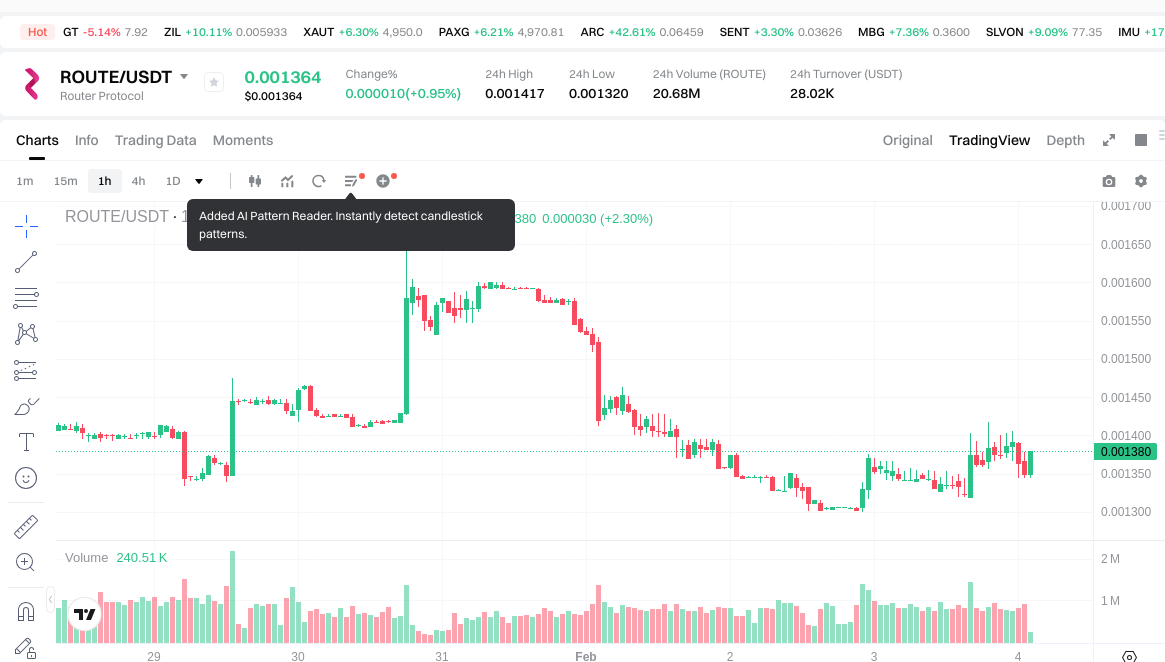
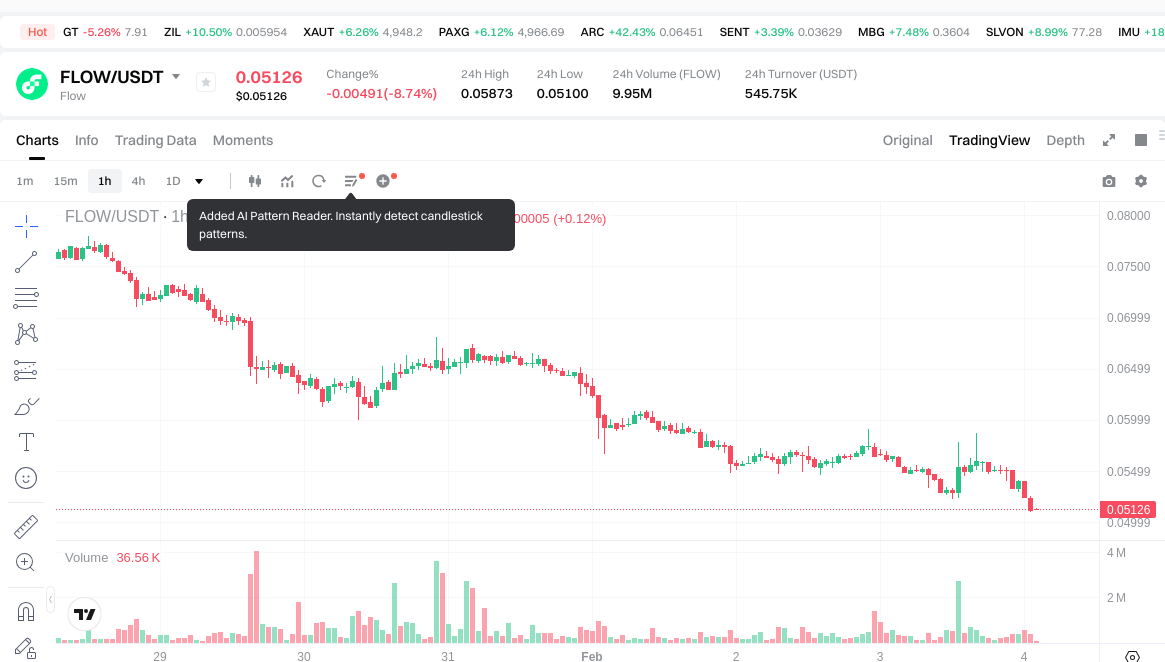
Comparative Analysis: During the recent market cycle, Router Protocol declined from its historical peak of $0.08108 to a historical low of $0.0013 on February 2, 2026, representing a decline of approximately 98.4%. Meanwhile, Flow experienced a similar trajectory, dropping from $42.4 to $0.050066 on February 3, 2026, marking a decline of approximately 99.9%. Both assets have faced considerable downward pressure in the current market environment.
Current Market Situation (February 4, 2026)
- Router Protocol Current Price: $0.001348
- Flow Current Price: $0.05129
- 24-Hour Trading Volume: Router Protocol recorded $27,981.72 compared to Flow's $552,343.18
- Market Sentiment Index (Fear & Greed Index): 17 (Extreme Fear)
View real-time prices:
- Check ROUTE current price Market Price
- Check FLOW current price Market Price
II. Core Factors Influencing ROUTE vs FLOW Investment Value
Supply Mechanism Comparison (Tokenomics)
-
ROUTE: Current reference materials do not provide detailed supply mechanism information. General blockchain token supply models include fixed caps, inflationary models, or burn mechanisms that affect long-term scarcity.
-
FLOW: Reference materials lack specific supply mechanism details. Token supply structures typically involve initial distribution, staking rewards, and potential deflationary features through transaction burns.
-
📌 Historical Pattern: Supply mechanisms significantly influence price cycles. Tokens with fixed supply caps tend to exhibit deflationary pressure during high demand periods, while inflationary models may face dilution concerns. The relationship between circulating supply growth and market adoption determines long-term value trajectory.
Institutional Adoption and Market Application
-
Institutional Holdings: Available materials do not specify comparative institutional preference between ROUTE and FLOW. Institutional adoption generally correlates with regulatory clarity, liquidity depth, and integration with traditional finance infrastructure.
-
Enterprise Adoption: Reference materials provide insufficient data on cross-border payment applications, settlement systems, or portfolio integration for either token. Enterprise-level adoption typically requires proven scalability, compliance frameworks, and established partnership networks.
-
National Policy: Regulatory attitudes vary significantly across jurisdictions. Materials emphasize that policy support (or lack of restriction) represents a critical factor in track investment frameworks. Sectors like new energy vehicles and lithium batteries demonstrate how supportive policies enable rapid market penetration.
Technology Development and Ecosystem Building
-
ROUTE Technology Upgrades: Specific upgrade details are not available in reference materials. Typical blockchain upgrades address scalability improvements, security enhancements, or interoperability features that expand use case potential.
-
FLOW Technology Development: Materials lack specific technical roadmap information. Blockchain platforms commonly pursue layer-2 scaling solutions, enhanced consensus mechanisms, or developer tooling improvements to strengthen ecosystem foundations.
-
Ecosystem Comparison: Reference materials do not provide direct comparison of DeFi integration, NFT marketplace activity, payment infrastructure, or smart contract deployment between ROUTE and FLOW. Ecosystem maturity indicators include developer activity, total value locked (TVL), transaction volume, and active user metrics.
Macroeconomic Environment and Market Cycles
-
Performance in Inflationary Environments: Materials do not address specific inflation-hedging characteristics of either token. Assets with limited supply and store-of-value narratives historically attract capital during high inflation periods, though correlation with traditional hedges like gold varies.
-
Macroeconomic Monetary Policy: Interest rates and dollar index movements affect crypto assets through liquidity conditions. Reference materials note that liquidity tightening (such as 2015 leverage fund regulation) triggered significant corrections in speculative sectors. Rising interest rates typically increase discount rates applied to future cash flows, pressuring growth-oriented assets.
-
Geopolitical Factors: Cross-border transaction demand and international tensions influence crypto adoption. Materials emphasize that policy boundaries and regulatory changes represent major risk signals for investment tracks. Geopolitical uncertainty may drive both safe-haven demand and regulatory crackdowns depending on jurisdiction.
Investment Framework Insight: Reference materials highlight the "BEAT framework" for track investment evaluation: Blueprints for Industry (confirmed industry trends), EPS Jumping (explosive earnings growth), Analyst Recommend and technical Analysis (market consensus), Targets with Liquidity (sufficient investable targets). This framework prioritizes sectors with low current penetration but high future growth potential, supported by strong consensus and large investment pools—principles applicable to comparing emerging crypto assets.
Risk Considerations: Materials identify four key risk signals for track collapse: penetration rate exceeding thresholds or logic disproof, earnings misses, unreasonable total market capitalization, and liquidity contraction. These factors apply equally to cryptocurrency sector analysis when evaluating investment sustainability.
III. 2026-2031 Price Forecast: ROUTE vs FLOW
Short-term Forecast (2026)
- ROUTE: Conservative $0.00075712 - $0.001352 | Optimistic $0.001352 - $0.00167648
- FLOW: Conservative $0.0399594 - $0.05123 | Optimistic $0.05123 - $0.0625006
Mid-term Forecast (2028-2029)
- ROUTE may enter a gradual growth phase, with projected price range of $0.001199353792 - $0.002119406016 in 2028, potentially reaching $0.0011287069248 - $0.00235147276 by 2029
- FLOW may enter an expansion phase, with projected price range of $0.05875322796 - $0.09302594427 in 2028, potentially reaching $0.06111384872625 - $0.0912633474312 by 2029
- Key drivers: institutional capital inflows, ETF developments, ecosystem growth
Long-term Forecast (2031)
- ROUTE: Baseline scenario $0.001510209865382 - $0.00235970291466 | Optimistic scenario $0.00235970291466 - $0.002595673206126
- FLOW: Baseline scenario $0.067838327729296 - $0.09976224666073 | Optimistic scenario $0.09976224666073 - $0.132683788058771
Disclaimer: Price predictions are based on historical data analysis and market modeling. Cryptocurrency markets are highly volatile and subject to various unpredictable factors. These forecasts should not be considered as investment advice. Please conduct thorough research and consult financial professionals before making investment decisions.
ROUTE:
| Year | Predicted High Price | Predicted Average Price | Predicted Low Price | Price Change |
|---|---|---|---|---|
| 2026 | 0.00167648 | 0.001352 | 0.00075712 | 0 |
| 2027 | 0.0017716608 | 0.00151424 | 0.0007722624 | 12 |
| 2028 | 0.002119406016 | 0.0016429504 | 0.001199353792 | 21 |
| 2029 | 0.00235147276 | 0.001881178208 | 0.0011287069248 | 39 |
| 2030 | 0.00260308034532 | 0.002116325484 | 0.00122746878072 | 56 |
| 2031 | 0.002595673206126 | 0.00235970291466 | 0.001510209865382 | 74 |
FLOW:
| Year | Predicted High Price | Predicted Average Price | Predicted Low Price | Price Change |
|---|---|---|---|---|
| 2026 | 0.0625006 | 0.05123 | 0.0399594 | 0 |
| 2027 | 0.083023338 | 0.0568653 | 0.042080322 | 11 |
| 2028 | 0.09302594427 | 0.069944319 | 0.05875322796 | 36 |
| 2029 | 0.0912633474312 | 0.081485131635 | 0.06111384872625 | 59 |
| 2030 | 0.113150253788361 | 0.0863742395331 | 0.050097058929198 | 68 |
| 2031 | 0.132683788058771 | 0.09976224666073 | 0.067838327729296 | 94 |
IV. Investment Strategy Comparison: ROUTE vs FLOW
Long-term vs Short-term Investment Strategies
-
ROUTE: Suited for investors focused on emerging cross-chain infrastructure and chain abstraction technology. The asset's early-stage positioning and relatively low entry price point may appeal to risk-tolerant investors seeking exposure to interoperability solutions. The significant price decline from historical highs suggests potential accumulation opportunities for long-term holders willing to withstand extended consolidation periods.
-
FLOW: Suited for investors interested in established blockchain platforms with proven track records in NFT and gaming sectors. Despite substantial drawdowns from peak levels, Flow's longer operational history and mainstream adoption focus may attract investors seeking exposure to digital asset infrastructure with existing user bases and developer communities.
Risk Management and Asset Allocation
-
Conservative Investors: ROUTE 20% vs FLOW 80%. Conservative portfolios should emphasize assets with longer operational histories and established use cases. Flow's track record since 2020 and mainstream application focus warrant higher allocation weight, while limited ROUTE exposure provides diversification into cross-chain infrastructure without excessive concentration risk.
-
Aggressive Investors: ROUTE 40% vs FLOW 60%. Risk-tolerant portfolios can increase ROUTE allocation to capitalize on potential upside from early-stage technology adoption, while maintaining majority allocation to Flow's more established ecosystem. This balance provides exposure to both emerging and proven blockchain infrastructure segments.
-
Hedging Instruments: Stablecoin allocation for liquidity preservation during volatility, options strategies for downside protection, and cross-asset combinations incorporating established cryptocurrencies to reduce portfolio-specific risk. Market conditions indicating extreme fear (Fear & Greed Index: 17) suggest elevated hedging importance.
V. Potential Risk Comparison
Market Risks
-
ROUTE: Low trading volume ($27,981.72 in 24-hour period) indicates limited liquidity, which amplifies slippage risk and price impact for larger transactions. The 98.4% decline from all-time highs demonstrates extreme volatility susceptibility. Market sentiment in extreme fear territory increases probability of continued downward pressure or prolonged consolidation phases.
-
FLOW: While trading volume ($552,343.18) exceeds ROUTE by approximately 20x, the 99.9% decline from historical peaks reflects severe market correction exposure. Despite stronger liquidity metrics, the asset remains vulnerable to broader market sentiment shifts and sector rotation away from NFT and gaming narratives that initially drove adoption.
Technical Risks
-
ROUTE: Scalability considerations for cross-chain messaging infrastructure, network stability during high transaction volumes, and security vulnerabilities inherent in bridging multiple blockchain ecosystems. Early-stage protocols face elevated risks of undiscovered bugs or attack vectors before extensive battle-testing.
-
FLOW: Network congestion during peak usage periods, potential centralization concerns in validator distribution, and smart contract vulnerabilities that could affect ecosystem applications. Platforms serving mainstream audiences require robust infrastructure to prevent service disruptions that damage user confidence.
Regulatory Risks
-
Regulatory frameworks for blockchain infrastructure vary significantly across jurisdictions. Cross-chain protocols like ROUTE face potential scrutiny over cross-border transaction facilitation and compliance requirements across multiple regulatory regimes. Flow's focus on mainstream adoption and digital assets may attract regulatory attention regarding securities classification, particularly for NFT applications and token economics.
-
Policy changes affecting cryptocurrency taxation, trading restrictions, or classification standards could disproportionately impact different blockchain infrastructure categories. Regulatory clarity improvements would benefit both assets, while adverse regulatory developments could trigger market-wide corrections exceeding historical volatility patterns.
VI. Conclusion: Which Is the Better Buy?
📌 Investment Value Summary:
-
ROUTE Advantages: Early positioning in cross-chain infrastructure sector, lower absolute price point potentially offering higher percentage gain potential from current levels, and exposure to growing interoperability demands as blockchain ecosystems expand. The chain abstraction protocol addresses genuine market needs for seamless cross-chain operations.
-
FLOW Advantages: Established operational history since 2020 provides longer track record for evaluation, proven mainstream adoption through projects demonstrating real-world usage, and higher trading liquidity reducing execution risk. The platform's focus on usability improvements integrated at protocol layer addresses key barriers to mass adoption.
✅ Investment Recommendations:
-
Novice Investors: Consider starting with FLOW due to established track record and higher liquidity, allocating small positions (5-10% of crypto portfolio) to gain exposure while limiting downside risk. Avoid concentrated positions in either asset given extreme market volatility and significant historical drawdowns. Prioritize education on blockchain fundamentals before committing substantial capital.
-
Experienced Investors: Evaluate portfolio diversification needs and risk tolerance when determining ROUTE vs FLOW allocation. Higher liquidity in FLOW supports more flexible position management, while ROUTE exposure provides diversification into emerging infrastructure segments. Consider dollar-cost averaging strategies to mitigate timing risk in current extreme fear market conditions. Monitor ecosystem development metrics, developer activity, and adoption indicators for both protocols.
-
Institutional Investors: Conduct comprehensive due diligence on governance structures, security audits, regulatory compliance frameworks, and long-term protocol sustainability before establishing positions. FLOW's longer operational history provides more extensive data for risk assessment, while ROUTE requires evaluation of early-stage protocol risks. Consider allocation sizing consistent with venture exposure guidelines given market volatility and limited institutional adoption data in reference materials.
⚠️ Risk Warning: The cryptocurrency market exhibits extreme volatility. Both ROUTE and FLOW have experienced declines exceeding 98% from historical peaks. This content does not constitute investment advice. Conduct thorough independent research and consult qualified financial professionals before making investment decisions. Only invest capital you can afford to lose entirely.
VII. FAQ
Q1: What is the fundamental difference between ROUTE and FLOW's technology architecture?
Router Protocol (ROUTE) focuses on chain abstraction and cross-chain infrastructure, enabling seamless messaging and transfers across multiple blockchain networks through intent-based products in a decentralized environment. Flow (FLOW), conversely, operates as a standalone blockchain platform specifically designed for mainstream adoption, with usability improvements integrated directly at the protocol layer to support games, applications, and digital assets. The key distinction lies in ROUTE's interoperability bridge function versus FLOW's comprehensive platform approach for end-user applications.
Q2: Why have both ROUTE and FLOW declined over 98% from their all-time highs?
Both assets have experienced severe corrections primarily due to broader cryptocurrency market cyclical downturns and sector-specific challenges. ROUTE declined approximately 98.4% from its November 2024 peak of $0.08108 to $0.0013, while FLOW dropped approximately 99.9% from its April 2021 high of $42.4 to $0.050066. These declines reflect extreme market sentiment (Fear & Greed Index: 17), liquidity contraction in speculative sectors, macroeconomic headwinds including monetary policy tightening, and cooling enthusiasm for previously hyped narratives like NFTs and cross-chain infrastructure during the extended bear market phase.
Q3: Which asset offers better liquidity for active trading?
FLOW demonstrates significantly superior liquidity with 24-hour trading volume of $552,343.18 compared to ROUTE's $27,981.72—approximately 20 times higher volume. This substantial liquidity advantage reduces slippage risk, enables larger position sizing without excessive price impact, and facilitates more flexible entry and exit strategies. For traders requiring frequent position adjustments or institutional investors managing larger capital allocations, FLOW's enhanced liquidity profile provides meaningful operational advantages over ROUTE's relatively thin trading activity.
Q4: What are the primary risks specific to investing in ROUTE versus FLOW?
ROUTE faces elevated risks associated with early-stage protocols, including potential undiscovered security vulnerabilities in cross-chain messaging infrastructure, scalability challenges during network growth, and limited liquidity amplifying volatility exposure. FLOW's primary risks include potential network congestion during peak usage, centralization concerns in validator distribution, and dependency on sustained adoption in NFT and gaming sectors that have experienced significant cooling. Both assets face regulatory uncertainty regarding classification standards and compliance requirements across multiple jurisdictions.
Q5: How should investors interpret the 2026-2031 price forecasts provided?
The forecasts represent modeled scenarios based on historical data patterns and market assumptions, not guaranteed outcomes. ROUTE's 2031 projections range from $0.001510 (baseline low) to $0.002596 (optimistic high), representing potential gains of 12-92% from current levels. FLOW's forecasts range from $0.0678 to $0.1327, suggesting potential gains of 32-159%. However, cryptocurrency markets exhibit extreme unpredictability influenced by regulatory changes, technological developments, macroeconomic conditions, and sentiment shifts that cannot be accurately modeled. These forecasts should inform risk assessment but not serve as primary investment justification.
Q6: What portfolio allocation strategy is appropriate for different investor profiles?
Conservative investors should consider 20% ROUTE and 80% FLOW allocation, emphasizing FLOW's established track record and higher liquidity while maintaining limited exposure to ROUTE's emerging infrastructure potential. Aggressive investors may adopt 40% ROUTE and 60% FLOW positioning to increase exposure to early-stage upside while retaining majority allocation to the more proven platform. All investors should limit total cryptocurrency exposure to capital they can afford to lose entirely, implement hedging strategies using stablecoins or options, and employ dollar-cost averaging to mitigate timing risk in current extreme fear market conditions.
Q7: What ecosystem metrics should investors monitor to evaluate ROUTE vs FLOW investment thesis?
Critical metrics include developer activity (GitHub commits, active contributors), total value locked (TVL) for DeFi applications, daily active users and transaction volumes, partnership announcements with established enterprises, protocol upgrade implementations, and cross-chain transaction volumes for ROUTE specifically. For FLOW, monitor NFT marketplace activity, gaming application launches, mainstream brand integrations, and network performance during peak usage periods. Additionally, track institutional adoption indicators, regulatory developments affecting blockchain infrastructure, and comparative performance against similar sector assets to assess relative positioning within the broader ecosystem landscape.
Q8: Given the extreme market drawdowns, what signals would indicate potential trend reversal?
Key reversal indicators include Fear & Greed Index migration from extreme fear (current level: 17) toward neutral or greed territory, sustained trading volume increases indicating renewed capital inflows, successful protocol upgrades or major partnership announcements driving fundamental value reassessment, and technical price action breaking above major resistance levels with confirmation. Macroeconomic factors such as monetary policy easing, regulatory clarity improvements, or renewed institutional adoption announcements could catalyze broader market recovery. However, investors should recognize that trend reversals in cryptocurrency markets often occur gradually over extended periods rather than through sudden V-shaped recoveries, requiring patience and disciplined position management.
Share
Content
Introduction: Investment Comparison Between ROUTE and FLOW
I. Historical Price Comparison and Market Status
II. Core Factors Influencing ROUTE vs FLOW Investment Value
III. 2026-2031 Price Forecast: ROUTE vs FLOW
IV. Investment Strategy Comparison: ROUTE vs FLOW
V. Potential Risk Comparison
VI. Conclusion: Which Is the Better Buy?
VII. FAQ
How to Buy Cryptocurrency


Trending Cryptocurrencies



XZXX: A Comprehensive Guide to the BRC-20 Meme Token in 2025

Survey Note: Detailed Analysis of the Best AI in 2025

Detailed Analysis of the Best 10 GameFi Projects to Play and Earn in 2025

Kaspa’s Journey: From BlockDAG Innovation to Market Buzz

Best Crypto Wallets 2025: How to Choose and Secure Your Digital Assets

Popular GameFi Games in 2025

What Does DYOR Mean in Crypto?

What Are Nodes?

Best Crypto Credit Cards in Recent Years

Top cryptocurrencies with strong potential: where to invest next

7 Essential Indicators for Beginner Traders