SHFT vs ENJ: A Comprehensive Comparison of Two Leading Gaming and NFT Platforms
Introduction: Investment Comparison Between SHFT and ENJ
In the cryptocurrency market, the comparison between SHFT vs ENJ remains a topic of significant interest among investors. These two assets exhibit notable differences in market capitalization ranking, application scenarios, and price performance, representing distinct positioning within the crypto asset landscape.
Shyft Network (SHFT): Launched in March 2021, this project has positioned itself as a public blockchain protocol focused on aggregating trust and verification into data across public and private ecosystems. It aims to transform raw data into meaningful information through context layering.
Enjin Coin (ENJ): Operating since November 2017, ENJ has established itself as a gaming-focused cryptocurrency, powering one of the largest online gaming community platforms with approximately 18.7 million registered players and supporting virtual goods transactions across 250,000 gaming communities.
This article will comprehensively analyze the investment value comparison between SHFT vs ENJ through examining historical price movements, supply mechanisms, institutional adoption patterns, technological ecosystems, and future projections. We aim to address the question most investors consider:
"Which represents a more suitable investment opportunity under current market conditions?"
By evaluating market data as of February 5, 2026, we will explore how these two projects differ in their fundamental characteristics, market positioning, and potential trajectories within the evolving cryptocurrency landscape.
I. Historical Price Comparison and Current Market Status
Price Trends of SHFT (Coin A) and ENJ (Coin B)
- 2021: SHFT reached a price level near $6.34 in March, influenced by broader market dynamics during that period.
- 2021: ENJ experienced notable price movement, reaching approximately $4.82 in November, reflecting significant market interest in NFT-related projects during that time.
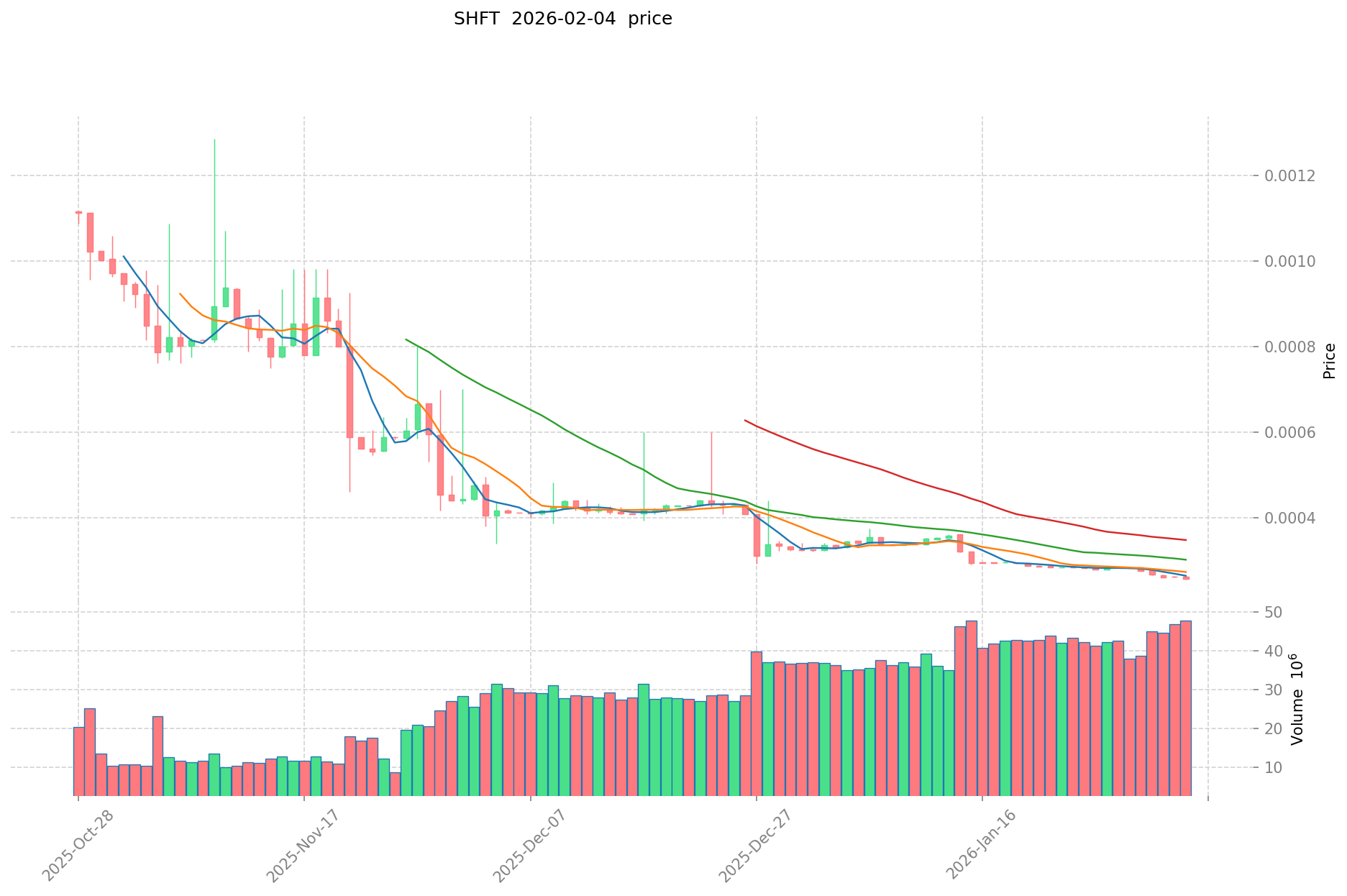
- Comparative Analysis: During the market cycle from 2021 to early 2025, SHFT declined from its peak of $6.34 to a level around $0.0002186, while ENJ decreased from its high of $4.82 to approximately $0.01865964.
Current Market Conditions (February 05, 2026)
- SHFT Current Price: $0.0002547
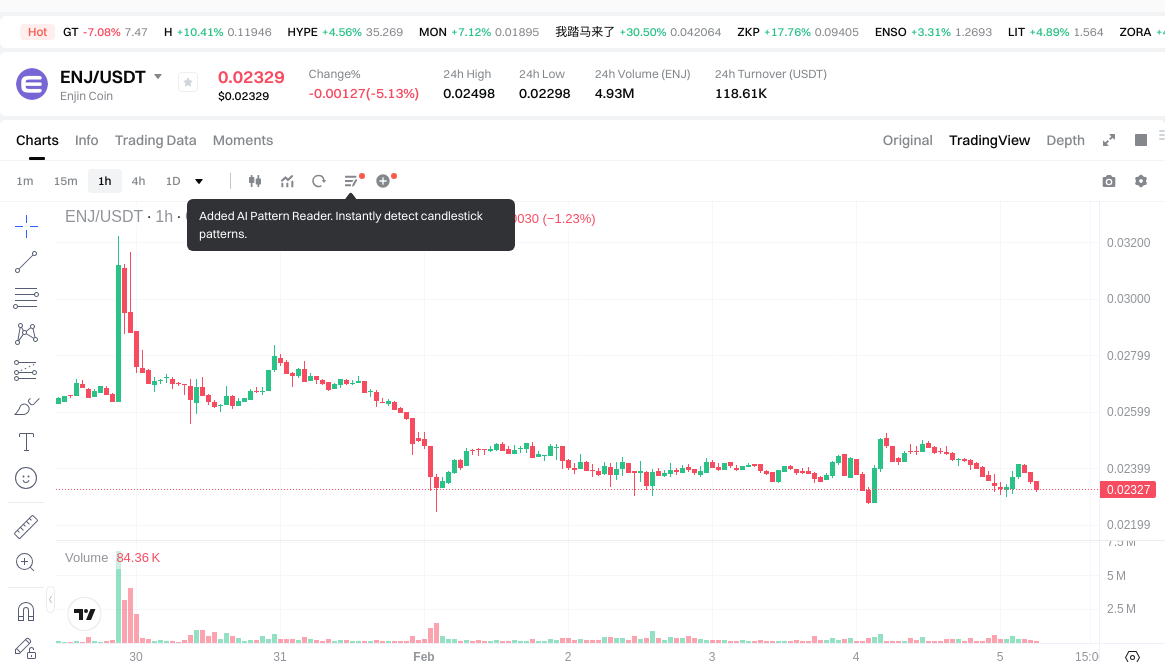
- ENJ Current Price: $0.02342
- 24-Hour Trading Volume: SHFT recorded $12,018.73 compared to ENJ's $117,879.54
- Market Sentiment Index (Fear & Greed Index): 14 (Extreme Fear)
View real-time prices:
- Check SHFT current price Market Price
- Check ENJ current price Market Price
II. Core Factors Influencing SHFT vs ENJ Investment Value
Supply Mechanism Comparison (Tokenomics)
- SHFT: The available materials do not provide specific information regarding SHFT's supply mechanism. Based on general blockchain gaming token models, such projects may employ various distribution strategies, though concrete details remain unverified.
- ENJ: Enjin operates within a functional ecosystem supporting blockchain-based gaming and NFT infrastructure. The materials indicate that Enjin's tools enable developers, businesses, and individuals to create, manage, trade, distribute, and integrate NFTs, with the technology being utilized globally. However, specific supply mechanism details (such as fixed supply or deflationary models) are not mentioned in the provided materials.
- 📌 Historical Pattern: Supply mechanisms can influence price cycles through scarcity effects and distribution dynamics, though the specific historical patterns for SHFT and ENJ require additional data for precise analysis.
Institutional Adoption and Market Application
- Institutional Holdings: The provided materials do not contain information regarding institutional preference between SHFT and ENJ.
- Enterprise Adoption: ENJ's ecosystem supports blockchain gaming and NFT applications across multiple use cases. The materials note that Enjin's technology is employed by millions of users worldwide, indicating some level of market penetration. SHFT's enterprise adoption status is not detailed in the available materials.
- National Policy: Regulatory attitudes toward SHFT and ENJ across different jurisdictions are not covered in the provided materials.
Technology Development and Ecosystem Building
- SHFT Technology Upgrades: The materials reference SHFT's focus on gaming and virtual goods, though specific technological upgrades and their potential impacts are not detailed.
- ENJ Technology Development: Enjin has developed a comprehensive ecosystem encompassing various blockchain software products. The platform provides tools for NFT creation, management, trading, distribution, and integration, supporting blockchain-based gaming applications.
- Ecosystem Comparison: ENJ demonstrates established presence in NFT and blockchain gaming sectors. The materials indicate millions of users engage with Enjin's technology. DeFi integration, payment solutions, and smart contract implementation details for both projects are not extensively covered in the available materials.
Macroeconomic Environment and Market Cycles
- Performance in Inflationary Environment: The materials do not provide comparative data on SHFT and ENJ's anti-inflation properties.
- Macroeconomic Monetary Policy: The impact of interest rates and dollar index movements on SHFT and ENJ is not addressed in the provided materials.
- Geopolitical Factors: The materials briefly mention blockchain adoption and regulatory developments in broader cryptocurrency markets, including references to legislative initiatives affecting crypto assets. However, specific implications for SHFT and ENJ regarding cross-border transaction demand and international circumstances are not detailed.
III. 2026-2031 Price Forecast: SHFT vs ENJ
Short-term Forecast (2026)
- SHFT: Conservative $0.00015282 - $0.0002547 | Optimistic $0.0002547 - $0.000323469
- ENJ: Conservative $0.0202101 - $0.02323 | Optimistic $0.02323 - $0.0274114
Mid-term Forecast (2028-2029)
- SHFT may enter a consolidation phase, with projected prices ranging from $0.00019955503035 to $0.0004599912564 in 2028, and $0.000247448237634 to $0.000470949871626 in 2029
- ENJ may enter a moderate growth phase, with projected prices ranging from $0.01968937632 to $0.03199523652 in 2028, and $0.0231432210828 to $0.0338247077364 in 2029
- Key drivers: institutional capital inflows, ETF developments, ecosystem expansion
Long-term Forecast (2031)
- SHFT: Baseline scenario $0.000442686493567 - $0.000461131764132 | Optimistic scenario $0.000461131764132 - $0.000548746799318
- ENJ: Baseline scenario $0.034144707274064 - $0.037938563637849 | Optimistic scenario $0.037938563637849 - $0.053113989092988
Disclaimer
SHFT:
| Year | Predicted High Price | Predicted Average Price | Predicted Low Price | Price Change |
|---|---|---|---|---|
| 2026 | 0.000323469 | 0.0002547 | 0.00015282 | 0 |
| 2027 | 0.00038737323 | 0.0002890845 | 0.00024861267 | 13 |
| 2028 | 0.0004599912564 | 0.000338228865 | 0.00019955503035 | 32 |
| 2029 | 0.000470949871626 | 0.0003991100607 | 0.000247448237634 | 56 |
| 2030 | 0.000487233562102 | 0.000435029966163 | 0.000226215582404 | 70 |
| 2031 | 0.000548746799318 | 0.000461131764132 | 0.000442686493567 | 81 |
ENJ:
| Year | Predicted High Price | Predicted Average Price | Predicted Low Price | Price Change |
|---|---|---|---|---|
| 2026 | 0.0274114 | 0.02323 | 0.0202101 | 0 |
| 2027 | 0.029372012 | 0.0253207 | 0.020003353 | 8 |
| 2028 | 0.03199523652 | 0.027346356 | 0.01968937632 | 16 |
| 2029 | 0.0338247077364 | 0.02967079626 | 0.0231432210828 | 26 |
| 2030 | 0.044129375277498 | 0.0317477519982 | 0.020318561278848 | 35 |
| 2031 | 0.053113989092988 | 0.037938563637849 | 0.034144707274064 | 61 |
IV. Investment Strategy Comparison: SHFT vs ENJ
Long-term vs Short-term Investment Strategies
- SHFT: May appeal to investors exploring emerging blockchain infrastructure projects focused on data verification and trust protocols, though the early-stage nature of the project suggests higher uncertainty.
- ENJ: May suit investors interested in established gaming and NFT ecosystem positions, with broader adoption patterns indicating relatively more developed market presence.
Risk Management and Asset Allocation
- Conservative Investors: SHFT 10-15% vs ENJ 85-90%
- Aggressive Investors: SHFT 30-40% vs ENJ 60-70%
- Hedging Tools: Stablecoin allocation, options strategies, cross-asset portfolio diversification
V. Potential Risk Comparison
Market Risk
- SHFT: Lower liquidity levels with 24-hour trading volume of $12,018.73 may result in increased price volatility and potential execution challenges during market movements.
- ENJ: While demonstrating higher trading volume at $117,879.54, the asset remains subject to broader gaming and NFT sector sentiment fluctuations, which have historically exhibited cyclical patterns.
Technical Risk
- SHFT: As a blockchain protocol focused on data verification, scalability considerations and network stability during growth phases represent areas requiring ongoing monitoring.
- ENJ: The gaming-focused infrastructure faces technical considerations related to network performance under high transaction volumes and security measures protecting NFT-related assets.
Regulatory Risk
- Global regulatory frameworks continue evolving regarding blockchain gaming assets and NFT-related projects. Both SHFT and ENJ may experience varying impacts depending on jurisdictional approaches to data protocols and gaming tokens, though specific regulatory positioning differs based on their respective use cases.
VI. Conclusion: Which Is the Better Buy?
📌 Investment Value Summary:
- SHFT Characteristics: Focuses on blockchain-based data verification and trust protocols, representing an early-stage project with positioning in infrastructure development. Trading at $0.0002547 with projected growth scenarios extending through 2031.
- ENJ Characteristics: Established presence in blockchain gaming and NFT sectors, supporting approximately 18.7 million registered users across gaming communities. Current price of $0.02342 with market projections indicating potential expansion aligned with gaming adoption trends.
✅ Investment Considerations:
- New Investors: Consider allocating larger portions to more established projects like ENJ while limiting exposure to early-stage assets such as SHFT. Portfolio diversification across multiple asset classes remains important.
- Experienced Investors: May explore balanced exposure between established gaming infrastructure (ENJ) and emerging protocol projects (SHFT), adjusting allocations based on risk tolerance and sector outlook.
- Institutional Investors: Focus on projects demonstrating clear use cases, established user bases, and ecosystem development. ENJ's gaming platform adoption may align with institutional criteria for blockchain infrastructure investments.
⚠️ Risk Disclaimer: The cryptocurrency market exhibits significant volatility. This content does not constitute investment advice. Investors should conduct independent research and consider their financial circumstances before making investment decisions.
VII. FAQ
Q1: What are the main differences in use cases between SHFT and ENJ?
SHFT focuses on blockchain-based data verification and trust protocols, while ENJ specializes in gaming infrastructure and NFT ecosystem development. SHFT positions itself as a public blockchain protocol designed to aggregate trust and verification into data across public and private ecosystems, transforming raw data into meaningful information through context layering. In contrast, ENJ operates as a gaming-focused cryptocurrency that powers one of the largest online gaming community platforms, supporting approximately 18.7 million registered players and facilitating virtual goods transactions across 250,000 gaming communities.
Q2: Which asset demonstrates higher liquidity based on current market data?
ENJ exhibits significantly higher liquidity compared to SHFT. As of February 5, 2026, ENJ recorded a 24-hour trading volume of $117,879.54, while SHFT's trading volume stood at $12,018.73—approximately 10 times lower. This substantial difference in trading volume suggests that ENJ offers better execution conditions and reduced slippage risk for investors, particularly during periods of market volatility. The lower liquidity of SHFT may result in increased price volatility and potential challenges when entering or exiting positions.
Q3: What is the projected price performance for SHFT and ENJ by 2031?
Based on current projections, ENJ demonstrates stronger growth potential through 2031. SHFT's baseline scenario forecasts a price range of $0.000442686493567 to $0.000461131764132, with an optimistic scenario reaching up to $0.000548746799318 by 2031. Meanwhile, ENJ's baseline scenario projects prices between $0.034144707274064 and $0.037938563637849, with optimistic scenarios extending to $0.053113989092988. These projections suggest ENJ may experience an 81% increase from current levels, while SHFT could see similar percentage gains but from a significantly lower base price.
Q4: How should conservative investors approach allocation between SHFT and ENJ?
Conservative investors should favor ENJ with an allocation of 85-90% while limiting SHFT exposure to 10-15% of their cryptocurrency portfolio. This approach reflects ENJ's established market presence, higher liquidity, broader user base of 18.7 million registered players, and more developed ecosystem compared to SHFT's early-stage positioning. Conservative investors should also consider implementing risk management strategies including stablecoin allocation, options strategies, and cross-asset portfolio diversification to mitigate downside risks inherent in cryptocurrency markets.
Q5: What are the primary regulatory risks facing SHFT and ENJ?
Both assets face evolving regulatory frameworks, though their specific risk profiles differ based on use cases. SHFT, as a blockchain protocol focused on data verification and trust across public and private ecosystems, may encounter regulatory scrutiny related to data privacy regulations, cross-border data transfer rules, and compliance requirements for trust verification systems. ENJ faces regulatory considerations specific to blockchain gaming assets and NFT-related projects, including potential classification of in-game assets, virtual property rights, and gaming token regulations that vary across jurisdictions. Investors should monitor regulatory developments in major markets as policies continue to evolve.
Q6: Which asset is more suitable for investors interested in the gaming and metaverse sector?
ENJ represents the more direct investment vehicle for gaming and metaverse exposure. The platform has established itself as gaming-focused infrastructure supporting NFT creation, management, trading, distribution, and integration across blockchain-based gaming applications. With approximately 18.7 million registered players and presence across 250,000 gaming communities, ENJ demonstrates proven adoption within the gaming sector. SHFT, while mentioning focus on gaming and virtual goods, primarily positions itself as a data verification protocol, making it less directly aligned with gaming sector trends compared to ENJ's specialized gaming infrastructure.
Q7: How have SHFT and ENJ performed during previous market cycles?
Both assets experienced significant price corrections from their historical peaks. SHFT declined from approximately $6.34 in March 2021 to around $0.0002186 by early 2025, representing a substantial retracement during the market cycle. ENJ decreased from its high of approximately $4.82 in November 2021 to around $0.01865964 by early 2025. These patterns reflect broader cryptocurrency market cycles during this period. As of February 5, 2026, with the market sentiment index showing 14 (Extreme Fear), both assets remain well below their previous peaks, though ENJ maintains a higher absolute price level and significantly greater trading volume compared to SHFT.
Q8: What technological advantages does each project offer?
ENJ has developed a comprehensive ecosystem encompassing various blockchain software products, providing tools for NFT creation, management, trading, distribution, and integration that support blockchain-based gaming applications used by millions globally. The platform's established infrastructure demonstrates proven scalability in supporting large gaming communities. SHFT focuses on blockchain-based data verification technology, aiming to transform raw data into meaningful information through context layering across public and private ecosystems. However, specific technological upgrade details and implementation specifics for SHFT require additional research, as the project operates in an earlier development stage compared to ENJ's established platform.
Share
Content
Introduction: Investment Comparison Between SHFT and ENJ
I. Historical Price Comparison and Current Market Status
II. Core Factors Influencing SHFT vs ENJ Investment Value
III. 2026-2031 Price Forecast: SHFT vs ENJ
IV. Investment Strategy Comparison: SHFT vs ENJ
V. Potential Risk Comparison
VI. Conclusion: Which Is the Better Buy?
VII. FAQ
How to Buy Cryptocurrency


Trending Cryptocurrencies



2025 Vertus daily combo code: Web3 gamers rewards guide

Today's Vertus Daily Combo Code: Boost Your Web3 Gaming Rewards (April 29, 2025)

GALA Coin (GALA) – Web3 Gaming Token Overview, Price Prediction & Trading on Gate.com
What is Gaming Crypto?How Gaming Crypto Works?

Detailed analysis of the top ten encryption game coins to be launched in 2025

Top 6 Best Gaming Currencies

Top 5 Tokens to Consider for DeFi Investment

Tax Planning for Bitcoin Investors Who Have Achieved Millionaire Status

FUD and FOMO in Crypto: Key Concepts Explained with Practical Examples

OpenSea NFT Exchange: Reviews, Advantages and Disadvantages

Top 10 Metaverse Platforms: An In-Depth Overview