Top 5 Tokens to Consider for DeFi Investment
What Is DeFi Investing?
DeFi (Decentralized Finance) represents a groundbreaking financial system that enables transactions without requiring intermediaries or centralized authorities. Built on blockchain (distributed ledger) technology, DeFi primarily leverages the Ethereum blockchain as its foundation.
The defining feature of DeFi is the use of smart contracts—self-executing programs that autonomously deliver financial services. With DeFi, users maintain complete control of their assets at all times. Unlike traditional, centralized financial systems, DeFi provides enhanced transparency, censorship resistance, anonymity, 24/7 accessibility, and composability. These features position DeFi to potentially reshape the future of finance and have drawn global attention from investors.
Key Features of DeFi
Decentralized Financial System Without Central Administrators
Traditional finance relies on central authorities such as banks and brokerages to facilitate transactions and collect fees. In DeFi, blockchain-based autonomous programs replace those intermediaries, removing the need for centralized control. This structure offers open access to financial services for anyone, anywhere, and significantly reduces intermediary fees for more efficient asset management.
Composability
Composability is one of DeFi’s most innovative aspects, allowing users to combine different services to create entirely new financial products. For example, it’s possible to borrow cryptoassets, swap them for other tokens on a decentralized exchange (DEX), and then deposit those tokens into a liquidity pool to earn interest—all in a seamless sequence. This flexibility empowers users to tailor financial products and strategies to their specific needs.
Instant Access via Wallet Connection
All you need to access DeFi is a crypto wallet. Unlike traditional banks, there’s no need for cumbersome identity checks or approvals. Simply connect your wallet to a blockchain network, and you can immediately use a full suite of decentralized financial services. This combination of convenience and privacy is a major driver of DeFi’s global popularity.
Top 5 Recommended DeFi Tokens
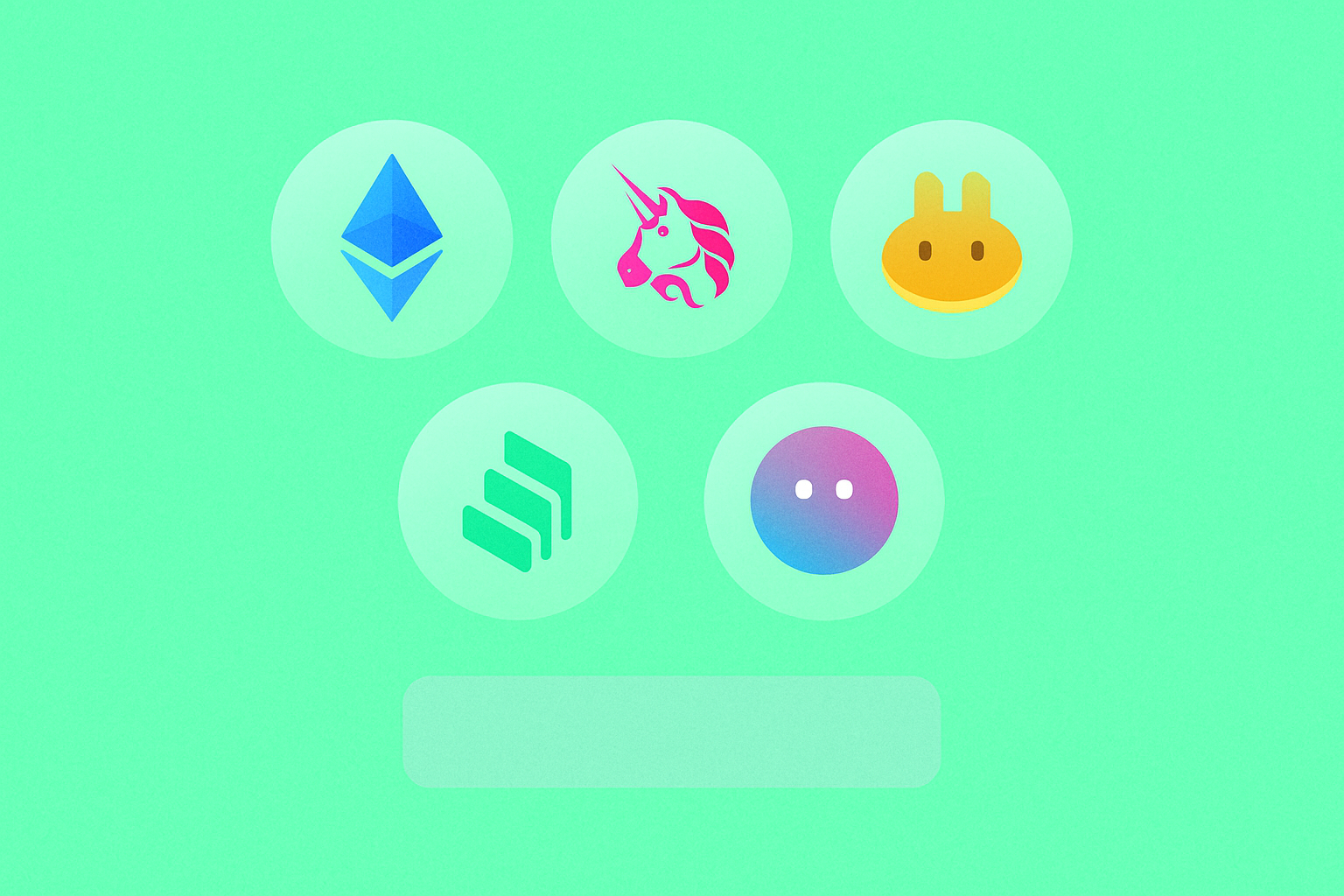
The DeFi market is home to thousands of projects, but these five tokens stand out for their technical leadership, market performance, and growth prospects.
- Ethereum (ETH): The foundational platform for the DeFi ecosystem
- Uniswap (UNI): Governance token of one of the world's largest decentralized exchanges
- PancakeSwap (CAKE): DEX token enabling fast, low-cost trading
- Compound (COMP): Governance token of a highly reliable lending protocol
- Aave (AAVE): Native token of a leading DeFi platform
Recommended DeFi Token #1: Ethereum (ETH)
Ethereum is a cornerstone of DeFi investing—often called the “King of DeFi.” Its dominance is rooted in three core strengths: pioneering smart contract functionality, unmatched market liquidity, and long-term growth potential.
Ethereum’s essential role in DeFi is its groundbreaking smart contract technology. Smart contracts are programs that execute automatically when specific conditions are met. While legacy finance requires intermediaries like banks or brokerages to process transactions, smart contracts allow DeFi to eliminate those middlemen, dramatically boosting transparency and security.
ETH is also the primary liquidity asset across most DeFi platforms. As a result, ETH is usually the first asset investors acquire when entering DeFi. With the rapid growth of DeFi and decentralized applications (DApps), demand for ETH is expected to accelerate, supporting long-term price appreciation.
Recommended DeFi Token #2: Uniswap (UNI)
Uniswap, launched in 2018, is among the world’s largest decentralized exchanges (DEXs). Its governance token, UNI, empowers users to shape the platform’s evolution. Uniswap’s breakthrough was its adoption of Automated Market Making (AMM) technology.
While centralized exchanges traditionally use order books to match buyers and sellers, Uniswap pioneered the AMM approach, letting users deposit assets into liquidity pools and enabling trades to be executed automatically. This system streamlines trading efficiency and makes asset swaps accessible to anyone.
In 2020, Uniswap introduced UNI as a governance token, giving users a direct voice in the platform’s direction. By providing liquidity, users earn UNI as rewards—participating in platform growth while benefiting financially.
Uniswap is expected to expand further as AMM technology evolves and new features are introduced. Additional utility for UNI, such as enhanced governance and staking, is under consideration, supporting expectations for long-term value growth.
Recommended DeFi Token #3: PancakeSwap (CAKE)
PancakeSwap is a decentralized exchange (DEX) built on its own high-speed smart chain. Its native token, CAKE, powers the platform’s ecosystem.
PancakeSwap’s smart chain is Ethereum-compatible while offering faster transaction speeds and significantly lower fees. This technological edge allows PancakeSwap to deliver far more affordable trading than Ethereum-based DEXs, especially appealing to users who make frequent, smaller trades.
CAKE serves multiple functions in the PancakeSwap ecosystem: part of every transaction fee is distributed as CAKE to participants, and additional CAKE can be earned by providing liquidity. These mechanisms enable users to generate passive income as they trade.
CAKE is not just a reward token—it also enables governance. Token holders can vote on platform policies and new features, directly influencing the platform’s trajectory. This community-driven governance supports sustainable growth and makes CAKE especially attractive to regular PancakeSwap users.
Recommended DeFi Token #4: Compound (COMP)
Compound, a DeFi lending protocol launched in 2018, introduced its native governance token COMP in 2020—making a major impact on the market.
Compound’s primary feature is cryptoasset lending. Users deposit assets to automatically earn interest, with rates fluctuating according to token type and market supply and demand. Users can also borrow other tokens using their deposits as collateral, providing additional capital without selling their original holdings.
Compound’s greatest strength lies in its proven track record and robust security. Despite the prevalence of DeFi hacks, Compound has never suffered a serious breach. This reliability has earned the trust of institutional and retail investors alike.
COMP is the key to protocol governance: holders can propose and vote on upgrades, new features, and parameter changes. Given Compound’s history and stability, COMP stands out as a strong long-term DeFi investment.
Recommended DeFi Token #5: Aave (AAVE)
Aave is a major DeFi platform offering a wide range of integrated financial services, including lending, liquidity provision, and staking. Its governance token is AAVE.
AAVE is central to the ecosystem: holders can propose and vote on operational changes, allowing the community to shape Aave’s future. The AAVE token also serves as a safety module—if unexpected losses occur, a portion of AAVE may be used for coverage, enhancing platform security and reliability.
Aave’s comprehensive offering extends beyond lending, with advanced tools like flash loans (instant, collateral-free borrowing and repayment) and sophisticated strategies for professional investors.
As a dominant force in DeFi, Aave is expected to see continued growth in users and transaction volumes, driving up demand—and potentially the price—for AAVE as a compelling medium- to long-term investment.
How to Identify the Best DeFi Tokens for Investment
The DeFi market is crowded with thousands of projects, making it challenging to pinpoint trustworthy investments. Here are two practical methods to select high-quality DeFi tokens.
Method 1: Top 30 Ranking on Defillama
Defillama is a trusted analytics platform that tracks Total Value Locked (TVL) for each DeFi protocol in real time and ranks them accordingly.
TVL measures the total value of cryptoassets deposited in a given protocol, signaling its scale, popularity, and reliability. High TVL indicates broad user trust in the project.
Defillama covers protocols across multiple blockchains—Ethereum, Polygon, Avalanche, and more—providing data on TVL, user counts, trading volumes, and historical growth.
Protocols in Defillama’s top 30 typically share these traits:
- Consistently high TVL and user trust
- Long-term, stable operations
- Lower relative risk of hacks
- Active development teams driving continuous improvement
Tokens affiliated with top-30 Defillama protocols are generally safer investments—but since rankings fluctuate, it’s important to check them regularly.
Method 2: Invest in Tokens of Protocols You’ve Used Yourself
Understanding your investment target is essential. That’s why it’s strongly recommended to invest in tokens of DeFi protocols you’ve personally used and managed.
Direct use provides deep insights such as:
Understanding Platform Mechanics
- How funds are lent or borrowed and the underlying technology
- Fee structures and their impact on returns
- Smart contract risks and protocol-specific constraints
- User interface usability and real trading experiences
Community Dynamics
- Active daily user levels
- Community engagement and user support quality
- Team–community relationships and transparency
- Reputation on social media and forums versus reality
Without firsthand experience, you must rely on secondary sources—news, social media, or influencer commentary—which aren’t always accurate and may be exaggerated. This increases the risk of emotional or herd-driven decisions.
Firsthand experience enables calmer, more rational investment decisions, even during market swings. You’ll also be able to accurately assess and respond to protocol issues.
For DeFi newcomers, start by experimenting with a small amount: provide liquidity to liquidity pools, swap tokens, or use lending features to truly understand a project’s value.
Conclusion: Invest in DeFi Tokens for Greater Returns
This article has examined five leading DeFi tokens in depth, outlining their features, strengths, and investment potential.
DeFi is an innovative system leveraging blockchain and smart contracts to deliver financial services without intermediaries or central operators. Compared to traditional finance, DeFi offers clear advantages:
- Potential for higher yields on assets
- 24/7 trading access from anywhere
- Full transparency, with all transactions public on the blockchain
- Equal access for all, with no verification or approval required
- Substantially lower fees and more efficient asset management
Ethereum (ETH), Uniswap (UNI), PancakeSwap (CAKE), Compound (COMP), and Aave (AAVE) have all established themselves as pillars of the DeFi market, with strong growth prospects. Uniswap and PancakeSwap, as flagship decentralized exchanges, are especially popular, with significant price appreciation anticipated.
Nonetheless, all investments entail risk. DeFi carries risks such as smart contract vulnerabilities, market volatility, and regulatory shifts. Always conduct thorough research, understand the risks, and make decisions responsibly.
Start with a small amount and use DeFi platforms directly to gain practical experience. As your knowledge and expertise grow, you’ll be able to make better investment decisions and capture greater rewards as DeFi evolves. The sector’s rapid development means early entrants may benefit most from its growth. Use the knowledge gained here to take your first step into DeFi investing.
FAQ
What Is DeFi? How Does It Differ from Traditional Financial Products?
DeFi, or decentralized finance, uses blockchain-based smart contracts to deliver financial services without intermediaries. It provides high transparency, low fees, and 24/7 global access. Traditional finance depends on central institutions for management and regulatory oversight, but typically has higher fees and limited hours.
What Are the Main Risks and Safety Measures for Beginners in DeFi Investing?
Main risks in DeFi include project failure and smart contract bugs. Essential precautions are diversifying investments, choosing reputable platforms, and practicing strict capital management.
What Are the Key Metrics or Factors When Selecting DeFi Tokens?
Total value locked (TVL), trading volume, user base, protocol security audits, team transparency, and the utility of governance tokens are critical considerations.
How Do DeFi Protocols Like UNI, AAVE, and CURVE Differ?
UNI is focused on token swaps, AAVE is a lending platform, and CURVE is optimized for stablecoin exchanges. Each protocol offers unique features and gives investors diverse options.
What Are the Main Ways to Earn Profits in DeFi (Staking, Liquidity Mining, Trading, etc.)?
The main DeFi profit methods are liquidity mining, lending, and staking. Liquidity mining earns fees by providing capital to DEXs, lending produces annual interest of 4–8% by loaning assets, and staking supports PoS blockchains in exchange for rewards.
Share
Content
What Is DeFi Investing?
Top 5 Recommended DeFi Tokens
Recommended DeFi Token #1: Ethereum (ETH)
Recommended DeFi Token #2: Uniswap (UNI)
Recommended DeFi Token #3: PancakeSwap (CAKE)
Recommended DeFi Token #4: Compound (COMP)
Recommended DeFi Token #5: Aave (AAVE)
How to Identify the Best DeFi Tokens for Investment
Conclusion: Invest in DeFi Tokens for Greater Returns
FAQ
How to Buy Cryptocurrency


Trending Cryptocurrencies



How to Mine Ethereum in 2025: A Complete Guide for Beginners

Ethereum 2.0 in 2025: Staking, Scalability, and Environmental Impact

What is Ethereum: A 2025 Guide for Crypto Enthusiasts and Investors

How does Ethereum's blockchain technology work?

What are smart contracts and how do they work on Ethereum?

Ethereum Price Analysis: 2025 Market Trends and Web3 Impact

WRT vs VET: Understanding the Key Differences Between Warrant and Veterinary Education Certifications

WNDR vs ICP: A Comprehensive Comparison of Two Emerging Blockchain Platforms and Their Impact on the Decentralized Internet
Bitcoin Dominance: A Comprehensive Guide to BTC.D in Trading
Top Cold Wallets for Cryptocurrency: Rankings
Who is Satoshi Nakamoto, the Legendary Creator of Bitcoin?