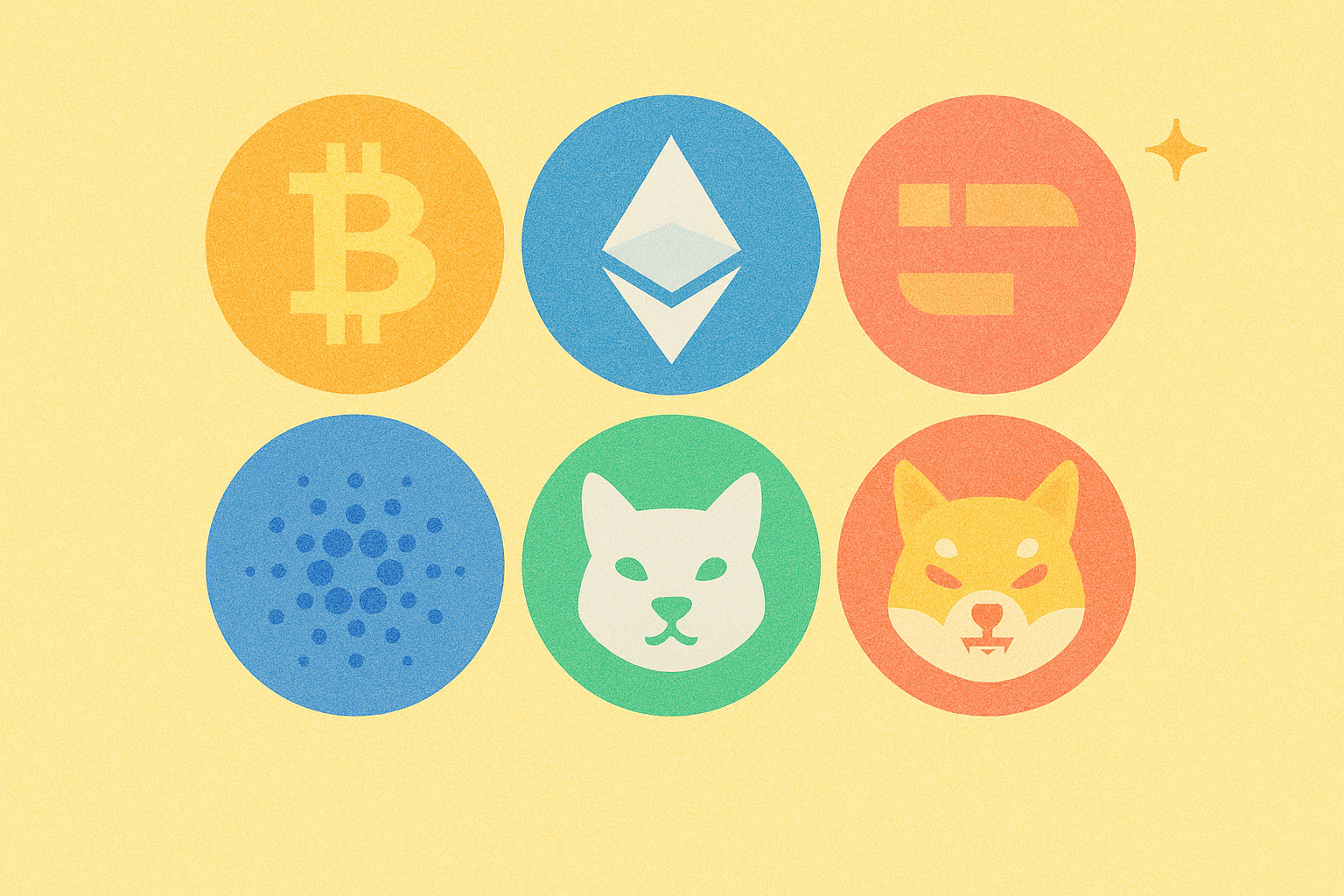
Beginner’s Guide to Selecting Altcoins: Gate provides an in-depth overview of six tokens—including BTC, ETH, Cardano, and others—that have each achieved over 1,000x growth. Explore their key characteristics, investment strategies, low-risk approaches, and a ranking of tokens with high long-term potential. A must-read for Web3 and DeFi investors.
Introduction
Over the past decade, the cryptocurrency market has experienced phenomenal growth, with numerous tokens surging hundreds or even thousands of times from their initial prices. Bitcoin, in particular, has seen its value skyrocket by at least 1,000,000x to its all-time high—by some measures, even tens of millions of times.
Many other cryptocurrencies have also achieved substantial growth, thanks to technological advancements, robust community support, and changing market conditions. Each of these tokens has brought unique features and growth drivers, contributing to the overall evolution of the crypto market.
This article highlights six major cryptocurrencies that have grown more than 1,000x in price between 2009 and 2025. We’ll explore the detailed growth histories and key factors behind their remarkable performance.
Overview of the Six Leading Tokens (Initial Price, All-Time High, Growth Multiple)
The table below presents a summary of six standout tokens that each achieved over 1,000x growth. It details the launch year, initial price, all-time high, and the extraordinary growth multiple for each token.
| Token (Ticker) |
Launch Year |
Initial Price |
All-Time High (Date) |
Growth Multiple (vs. Initial) |
| Bitcoin (BTC) |
2009 |
$0.0008 (2010 estimate) |
$109,350 (Jan 20, 2025) |
Approx. 136,687,500x |
| Ethereum (ETH) |
2015 |
$0.31 (2014 ICO price) |
$4,878 (Nov 2021) |
Approx. 15,736x |
| Major Exchange Token |
2017 |
$0.15 (2017 ICO price) |
$690 (May 2021) |
Approx. 4,600x |
| Cardano (ADA) |
2017 |
$0.0024 (2015–17 ICO price) |
$3.10 (Sep 2021) |
Approx. 1,291x |
| Dogecoin (DOGE) |
2013 |
$0.0004 (Dec 2013 trading start) |
$0.74 (May 2021) |
Approx. 1,850x |
| Shiba Inu (SHIB) |
2020 |
$0.00000000051 (Aug 2020 trading start) |
$0.0000885 (Oct 2021) |
Approx. 173,529x |
Despite their distinct backgrounds and characteristics, all of these tokens have captured significant market attention and delivered substantial returns for investors.
Bitcoin (BTC): The Rise of Digital Gold
Introduced in January 2009 by Satoshi Nakamoto, Bitcoin is the world’s first cryptocurrency and serves as the anchor of the digital asset market—earning the moniker “digital gold.”
With a strictly capped supply of 21 million BTC, Bitcoin’s scarcity and secure decentralized network have attracted global attention as a long-term store of value. Its significance now extends beyond speculation, with many seeing it as a blueprint for the future of finance.
Price History (Initial Price, All-Time High, Growth Multiple)
When first released, Bitcoin was virtually worthless, with no exchanges or established monetary value in 2009. The first exchange rate with the US dollar emerged in October 2009, when 5,050 BTC sold for around $5—about $0.0009 per BTC.
After exchanges launched in July 2010, Bitcoin traded between roughly $0.0008 and $0.08. By the end of 2010, it jumped to about $0.5, broke $1 for the first time in 2011, and soared to nearly $29.6 in June 2011 amid major volatility.
Bitcoin’s price continued to follow a roughly four-year cycle, crossing $1,000 in late 2013 and reaching about $19,000 in December 2017. Its most recent all-time high came on January 20, 2025, at $109,350. That’s an increase of at least 1,000,000x—and potentially tens of millions of times—from its initial trading price of $0.0008–$0.08.
This remarkable performance marks Bitcoin’s evolution from an experimental project to a globally recognized asset class.
Major Drivers of Bitcoin’s Growth
Market Maturity and Benchmark Status
As the first cryptocurrency, Bitcoin remains the centerpiece of the market, long standing as the “first choice” for institutions and corporations. It has consistently accounted for over half of the total crypto market capitalization.
This dominance makes Bitcoin the most liquid and accessible crypto asset. Most exchanges use it as the benchmark asset, and it serves as a key intermediary when trading other cryptocurrencies.
Supply Limits and Scarcity Created by Halving
One of Bitcoin’s defining features is its “halving” event every four years, which halves new issuance and reduces inflation. The halving cycles in 2012, 2016, and 2020—especially the third, which intersected with global monetary easing—have enhanced Bitcoin’s reputation as an “inflation hedge.”
With limited supply, rising demand leads directly to price increases—mirroring the scarcity principle that makes gold valuable and supporting Bitcoin’s “digital gold” narrative.
Macroeconomic Trends and Safe-Haven Appeal
Following the COVID-19 shock, fiscal stimulus and quantitative easing spurred capital inflows worldwide. In early 2021, Bitcoin attracted attention as a risk asset, climbing from $29,000 at the end of 2020 to over $64,000 within months.
This shift highlights Bitcoin’s increasing correlation with traditional financial markets, and more institutions are adding Bitcoin to their portfolios.
Institutional and Corporate Entry
Since 2020, major corporations have accumulated large BTC holdings. In 2021, a leading automaker announced a $1.5 billion BTC purchase. Payments and banking giants also entered the sector, as traditional financial institutions rolled out crypto services.
These moves have helped redefine Bitcoin as a strategic asset in corporate treasury management. Institutional participation has boosted market liquidity, stability, and trust in Bitcoin.
Legal Tender Status at the National Level
In 2021, a Central American nation made Bitcoin legal tender, distributing digital wallets to all citizens—a groundbreaking initiative at the state level. As a result, Bitcoin’s practical use as a payment method expanded, becoming a historic milestone for the cryptocurrency.
This move has influenced global debate, with more countries discussing the adoption of crypto as legal tender.
Widespread Recognition as Digital Gold
The concept of Bitcoin as “digital gold” is firmly established worldwide. In 2021, its market capitalization briefly exceeded $1 trillion, rivaling gold. Its capped supply and decentralization make it especially attractive for long-term holding.
Bitcoin is increasingly viewed as an inflation hedge and a portfolio diversification tool by investors worldwide.
Policy Support (April 2025)
In April 2025, the US administration indicated it might add BTC to its foreign currency reserves, citing both “dollar supremacy” and the need to counter other countries’ digital asset policies. Bitcoin set a new all-time high immediately after the news, reaffirming the impact of policy on price action.
This development signals Bitcoin’s emergence as a strategic asset at the national level, and more countries may include BTC in their foreign reserves in the future.
Ethereum (ETH): Revolutionizing Smart Contracts
Launched in July 2015, Ethereum is a blockchain platform second only to Bitcoin in scale. While Bitcoin is dubbed “digital gold,” Ethereum is seen as the “protocol for a decentralized internet,” serving as the foundation for smart contracts and DApps.
Its flexible design places Ethereum at the center of DeFi (decentralized finance) and NFT (non-fungible token) trends, supporting a wide array of projects and tokens. Ethereum has expanded the possibilities of blockchain, laying the foundation for a new digital economy.
Price History (Initial Price, All-Time High, Growth Multiple)
During Ethereum’s 2014 ICO, ETH was offered at about $0.31, raising roughly $18 million. At mainnet launch in July 2015, ETH began trading for a few dollars.
The 2017 ICO boom drove demand, with ETH reaching $1,400 in January 2018 before plummeting below $80 later that year—demonstrating the market’s volatility.
Interest surged again after 2020, with DeFi and NFTs fueling rapid price gains. On November 10, 2021, ETH hit an all-time high of $4,878.26. That’s more than 15,000x its ICO price, underscoring Ethereum’s role as digital infrastructure.
Major Drivers of Ethereum’s Growth
Smart Contract and DApp Innovation
Ethereum’s greatest strength is enabling anyone to create custom tokens or applications through smart contracts. Since 2016, countless projects have launched on Ethereum, powering the ICO boom.
Smart contracts allow for automated, trustless transactions, unlocking entirely new possibilities for financial services and beyond.
The Rise of DeFi (Decentralized Finance)
Since around 2020, major DeFi protocols built on Ethereum have grown rapidly. Yield farming has locked up ETH, helping drive price gains. Ethereum serves as the “financial infrastructure” for DeFi.
DeFi allows lending, borrowing, and trading without banks or brokers, democratizing access to financial services worldwide.
NFT Boom and Surging Demand
Early 2021 saw a rapid expansion of NFT marketplaces. ETH became the currency of choice for digital art and collectibles, bringing in new users and driving up network usage and gas fees.
NFTs have attracted attention as a way to certify ownership of digital assets—art, gaming items, music, and more. Ethereum’s support for NFT standards (ERC-721, ERC-1155) has cemented its position as the primary NFT platform.
Technical Progress: Migration to Ethereum 2.0
The London upgrade in August 2021 introduced EIP-1559, which burns a portion of transaction fees. September 2022’s “The Merge” shifted Ethereum from proof-of-work (PoW) to proof-of-stake (PoS), dramatically improving energy efficiency and boosting long-term investor confidence.
This change slashed Ethereum’s environmental footprint and established it as a sustainable blockchain. PoS also lets ETH holders earn rewards through staking, increasing the incentive to hold long-term.
Enterprise Adoption and Ecosystem Expansion
Ethereum has become the “next investment asset” after Bitcoin. In 2017, the Enterprise Ethereum Alliance (EEA) was formed by major IT and financial leaders. Since 2020, ETH futures and custody services for institutions have expanded.
These moves confirm Ethereum’s viability for enterprise use, and more companies are expected to roll out Ethereum-powered services in the future.
Major Exchange Tokens: The Core of the Ecosystem
Major exchange tokens are native utility tokens issued by the world’s largest crypto exchanges. Launched alongside the exchanges in July 2017 via ICO, they were initially ERC-20 tokens.
They’ve since migrated to their own blockchains, becoming utility tokens used throughout the ecosystem for trading fee discounts, gas payments, and more. Token demand rises in tandem with user growth on the exchanges.
Price History (Initial Price, All-Time High, Growth Multiple)
The ICO sold tokens at $0.15 each, distributing roughly 100 million. After initially trading for a few dollars, the token surged in early 2021, reaching an all-time high of $690.93 on May 10, 2021—a 4,605x increase over the ICO price.
In 2024, ecosystem expansion and regulatory relaxation propelled the token to a new record of $705 on November 15, 2024, a 7,016x gain. It now trades steadily in the $500–$700 range as the market matures.
Major Drivers of Exchange Token Growth
Rapid Exchange Growth and User Surge
Since 2018, these exchanges have led the world in trading volume. Users get trading fee discounts with the token, ensuring consistent, real demand. After 2019, scandals at rival exchanges accelerated user and capital inflows.
High liquidity and a wide range of trading pairs have won global support. More users directly fuel higher token demand and price appreciation.
Trading Fee Discounts and Expanding Use Cases
Beyond spot trading discounts, the token is used for IEOs, staking, lending, and more. Holding the token is required to join Launchpad IEOs, driving up demand. As the user base grows, so do the token’s utility and value.
These expanding use cases have transformed the token from a fee-discount tool into a versatile asset at the ecosystem’s core.
Success of Proprietary Chains
In 2019, exchanges launched their own blockchains, making these tokens native assets. In 2020, Ethereum-compatible smart chains enabled low-fee DeFi and gaming development. The network now hosts numerous dApps and stands as the second-largest smart contract platform after Ethereum.
These proprietary chains offer a compelling alternative to Ethereum’s high gas fees, attracting many developers.
Deflationary Impact from Regular Token Burns
The token’s supply will eventually be reduced to 100 million. Every quarter, exchanges buy back and burn tokens using part of their profits, reducing supply and benefiting long-term holders.
Burning increases scarcity and supports the token’s long-term value as a store of value.
Brand Power and Community Strength
Charismatic founders and user-focused marketing have built global loyalty. Frequent use in airdrops and IEOs, as well as compensation for hacks, has fostered a base of long-term holders and increased confidence in the token.
A strong community helps stabilize prices and builds resilience against market swings.
Cardano (ADA): The Pinnacle of Academic Development
Cardano is a third-generation blockchain platform launched in 2017. Its ADA token supports smart contracts and DApps as a platform-based cryptocurrency.
Led by a former Ethereum co-founder, Cardano’s development is grounded in academic peer review and formal methods. It uses the Ouroboros proof-of-stake consensus algorithm and evolves through staged upgrades (Byron, Shelley, Goguen, etc.).
Cardano’s scientific approach ensures high security and reliability, supporting a long-term vision for the project.
Price History (Initial Price, All-Time High, Growth Multiple)
In January 2017, Cardano’s ICO, mainly targeting Japan and South Korea, sold ADA for about $0.0024 each. After the mainnet launched in October, the altcoin boom sent prices close to $1.
Cardano slumped during the 2018 crypto winter but rebounded in 2020–2021. The Shelley staking rollout and Alonzo smart contract upgrade reignited interest, and ADA hit an all-time high of $3.1 on September 2, 2021—a gain of over 1,300x from its ICO price.
This growth is a testament to Cardano’s technical progress and strong community support.
Major Drivers of Cardano’s Growth
Milestone Upgrades as Catalysts
The 2020 Shelley upgrade introduced decentralization and staking, while 2021’s Alonzo upgrade brought smart contracts. Each milestone has fueled price rallies.
In 2023, the Hydra upgrade dramatically improved scalability, enabling thousands of transactions per second. By 2025, DeFi and NFT adoption on Cardano has rapidly expanded.
These upgrades show Cardano’s commitment to ongoing evolution and market relevance.
Academic Approach and Reliability
Cardano’s peer-reviewed, theory-driven design has won long-term support for its security and stability. As of 2025, this approach remains central, with the latest cryptographic innovations incorporated.
The community’s cohesion and the prevalence of long-term holders continue to underpin Cardano’s value. Its academic roots set it apart from other projects.
“Ethereum Killer” Potential
Cardano’s energy efficiency, low fees, and robust security positioned it as an alternative during Ethereum’s gas fee crisis in early 2021. In 2025, with Ethereum’s scaling challenges unresolved, Cardano’s “Hydra” fast processing has further solidified its status as an alternative platform.
Cardano enjoys strong brand recognition in Japan as “Eida Coin,” and local exchange listings have provided additional momentum. Many see Cardano as a next-gen platform that addresses Ethereum’s shortcomings.
Emergence of Real-World Utility
Cardano partnered with an African government to provide digital IDs and academic records for over 5 million students. By 2024, this project expanded nationwide, reaching more than 10 million users in the education system.
By 2025, Cardano has also been deployed for agricultural traceability, educational certification, and notary services, making national-scale adoption increasingly realistic. These real-world examples show Cardano’s technology is being used beyond speculation.
Long-Term Staking Incentives
ADA holders earn annual rewards of several percent through PoS staking. As of 2025, about 75% of circulating ADA is staked—up from 70% in 2022—limiting liquidity.
Staking rewards encourage long-term holding and reduce selling pressure, contributing to price stability and ADA’s appeal as a long-term store of value.
Dogecoin (DOGE): From Meme to Mainstream Asset
Dogecoin was created in 2013 as a joke cryptocurrency by engineers Billy Markus and Jackson Palmer, inspired by the Shiba Inu meme “Kabosu.” Launched as an “infinite supply joke coin” with no clear purpose or technical breakthrough, it quickly gained a following.
Its friendly logo and playful culture won over a devoted community, and in 2021 Dogecoin surged into the top five cryptocurrencies by market cap—transforming from a meme into a legitimate asset.
Price History (Initial Price, All-Time High, Growth Multiple)
DOGE debuted in December 2013 at around $0.0004. It went viral on Reddit, tripling in value within days. After hitting a record low of $0.000086 in 2015, Dogecoin resurfaced in the 2017–2018 altcoin boom.
In 2021, celebrity endorsements and retail investor enthusiasm pushed DOGE to an all-time high of $0.74 on May 8—a 1,850x (or +185,000%) increase from its debut price.
Additional momentum developed heading into late 2024, with major corporate adoption driving DOGE to a new record of $1.23 (Dec 15, 2024)—a 3,075x gain from its initial price. DOGE now trades mainly in the $0.80–$1.00 range.
Major Drivers of Dogecoin’s Growth
Meme Culture and Community Power
The Shiba Inu logo and lighthearted style make Dogecoin especially approachable for newcomers. It’s widely used for tipping and donations, particularly on Reddit, and has carved out a niche as a “currency for fun.”
The mantra “No highs, no lows, only Doge” has become a cultural touchstone. The community’s unity continues to support the price, and Dogecoin is now recognized as a social phenomenon, not just a speculative asset.
Celebrity and Influencer Endorsements
Notably, high-profile entrepreneurs have wielded enormous influence—one adopted the “Dogefather” nickname and drove price rallies with payment adoption in 2024. Other celebrities have voiced support, and social media helped propel both the 2021 and 2024 all-time highs.
In 2025, applications for a DOGE ETF by major asset managers, with celebrity backing, have drawn further attention. This high-profile support has boosted Dogecoin’s visibility and attracted new investors.
Alignment with Retail Investor Movements
In January 2021, retail investors rallied around Dogecoin, chanting “To the Moon!” and driving grassroots buying. On April 20 (“Doge Day”), DOGE briefly became the fifth-largest cryptocurrency by market cap.
By 2025, ETF anticipation has reignited retail buying, keeping Dogecoin in the top 10 by market cap. Retail power remains central to Dogecoin’s price movements.
Broader Platform Access
Listings on major platforms have made Dogecoin more accessible, especially for younger investors. At times, surging trading volumes even caused temporary system outages.
In 2025, ETF applications and broader exchange access have helped attract institutional investors. More platforms have increased DOGE’s liquidity and trading convenience.
Brand Built on Publicity and Virality
Dogecoin’s appeal is rooted in its fun and viral nature—not necessarily its utility or technical progress. In 2023, a celebrity switched a major social media logo to a Shiba Inu, sparking renewed buzz. In December 2024, payment trials sent DOGE to $1.23, and the 2025 ETF process has kept it in the spotlight. Talk of making DOGE the “currency of Mars” continues to fuel speculative interest.
This persistent visibility is Dogecoin’s greatest asset, setting it apart from other cryptocurrencies.
Shiba Inu (SHIB): The Dogecoin Killer’s Ascent
Shiba Inu Coin was introduced in August 2020 by anonymous developer “Ryoshi” as a meme token explicitly aiming to surpass Dogecoin, with the tagline “Dogecoin Killer.”
SHIB is an ERC-20 token on Ethereum, known for its extremely low price and massive supply, allowing anyone to own millions. The 2021 meme coin boom brought explosive attention, and SHIB quickly became famous as a “dream coin” that minted millionaires worldwide.
Price History (Initial Price, All-Time High, Growth Multiple)
SHIB started trading on decentralized exchanges in 2020 at $0.00000000051. Initially obscure, its listing on major exchanges in May 2021 sent it soaring to an all-time high of $0.00008845 in October 2021.
This was a gain of over 500,000x from its original price. Afterward, SHIB entered a consolidation phase and now trades in the $0.00001–$0.00003 range—still exponentially higher than its debut price.
Major Drivers of SHIB’s Growth
Meme Power and “Dogecoin Killer” Hype
Using the Shiba Inu breed, SHIB positioned itself as “the next Dogecoin.” The “millionaire if it hits $0.01” dream spread widely on social media, fueling explosive rallies in spring and fall 2021.
SHIB’s meme strength remains a driving force, with continued annual price surges and FOMO-fueled speculation.
Viral Community and Social Buzz
The SHIB Army community leads ongoing viral promotion. Celebrity tweets and the massive SHIB burn (90%) by an Ethereum co-founder have amplified attention.
Celebrity involvement triggers sharp price swings, and the 410 trillion token burn in 2025 has helped support the price. Community enthusiasm remains a core pillar of SHIB’s value.
Rapid Listings on Major Exchanges
In 2021, SHIB was listed on numerous major exchanges, boosting liquidity and transforming its image from “micro-cap” to “mainstream token.” Its accessibility drew many new investors.
Today, SHIB is listed on over 100 exchanges, with each new listing expanding liquidity and investor access.
Affordability and Speculative Appeal
The ability to buy millions of SHIB for a few hundred dollars has attracted speculative buyers. Hopes of “what if SHIB reaches $1” have inspired many, with viral stories of $1,000,000 investments turning into several million, fueling FOMO.
As of April 2025, SHIB trades at $0.00001252—$100 buys about 8 million tokens—maintaining its speculative appeal.
Project Evolution and Expanding Utility
Since launching its own decentralized exchange in 2021, SHIB has announced Layer 2 development and metaverse plans. The introduction of token burns is also designed to support prices.
These initiatives show SHIB is evolving from a pure meme coin to a project with real-world applications.
Conclusion: Looking Ahead
Reviewing the six leading tokens (BTC, ETH, major exchange tokens, ADA, DOGE, SHIB) that each achieved over 1,000x growth between 2009 and 2025 reveals a diverse set of drivers—technological innovation, macroeconomic trends, and the impact of social media.
Bitcoin has cemented its role as “digital gold,” Ethereum continues to evolve as the foundation for smart contracts and DeFi, exchange tokens serve as ecosystem mainstays, and Cardano has built trust through its academic approach. Dogecoin and Shiba Inu have sparked speculative booms through meme culture and community power.
While similar trends could emerge again, past success does not guarantee future results. Crypto remains highly volatile and sensitive to regulatory shifts, technical hurdles, and macroeconomic influences.
Investors should maintain a rational perspective and long-term horizon. It’s vital to assess each token’s technology, use cases, community strength, and market conditions holistically, and to invest with personal responsibility. As the crypto market evolves, new growth leaders will emerge. The ability to identify projects with sustainable growth will be crucial for future investors.
FAQ
What types of crypto projects are most likely to achieve 1,000x growth?
Early-stage projects with genuine use cases have the highest potential. Small market caps offer more room for expansion as adoption increases. Projects that feature early investor allocations, completed audits, and implemented features are best positioned for major growth.
Which cryptocurrencies have achieved over 1,000x growth in history?
Bitcoin (approx. 136,687,500x), Ethereum (approx. 15,736x), BNB (approx. 7,016x), Cardano (approx. 1,291x), and Dogecoin (approx. 3,075x) have all surpassed 1,000x growth, delivering standout performance and attracting significant investor interest.
How can I identify and evaluate crypto projects with high growth potential?
Look for strong teams, innovative technology, and an active developer community. Confirm clear use cases, market demand, funding trends, and completed security audits. Monitor on-chain activity and development progress regularly.
What risks should I be aware of when investing in cryptocurrencies that have achieved 1,000x growth?
Market volatility is extremely high, and you could lose your entire investment. Other risks include low liquidity, project failure, and regulatory changes. High returns require a full understanding and acceptance of high risk.
Why do small-cap altcoins have greater growth potential than large-cap coins?
Small-cap altcoins have lower market caps, so successful projects can deliver larger percentage returns. Large-cap coins are mature and have limited growth potential, while small caps offer more opportunities for innovation and higher upside.
Which emerging crypto projects have high growth potential in 2024?
In 2024, Layer 2 solutions, stablecoins, and DeFi projects are showing strong growth prospects. Newcomers such as Stacks and Solana Layer 2 could see significant gains thanks to technical innovation and market demand.
* The information is not intended to be and does not constitute financial advice or any other recommendation of any sort offered or endorsed by Gate.