TREAT vs ADA: Understanding the Key Differences Between Two Major Disability Rights Frameworks


Introduction: TREAT vs ADA Investment Comparison
In the cryptocurrency market, the comparison between TREAT vs ADA continues to draw investor attention. The two assets differ significantly in market cap ranking, application scenarios, and price performance, representing distinct positioning within the crypto asset landscape. TREAT (TREAT): Launched in January 2025, TREAT positions itself as the final token in the Shiba Inu Ecosystem, designed to provide transactional rewards and access to advanced technologies including DeFi innovations, decentralized incubators, AI agentic frameworks, and fully homomorphic encryption. It also serves as a governance token for the Shiba Network State. ADA (ADA): Since its launch in October 2017, ADA has established itself as the native currency of the Cardano protocol, a layered blockchain platform designed to run financial applications for individuals, organizations, and governments globally. The platform enables secure digital fund transfers and smart contract functionality. This article will provide a comprehensive analysis of TREAT vs ADA investment value comparison, examining historical price trends, supply mechanisms, institutional adoption, technological ecosystems, and future projections, while addressing a key question for investors:
"Which is the better buy right now?"
I. Historical Price Comparison and Current Market Status
TREAT (Coin A) and ADA (Coin B) Historical Price Performance
- 2021: ADA experienced notable growth, reaching an all-time high of $3.09 on September 2, 2021, driven by ecosystem developments and the implementation of smart contract functionality through the Alonzo upgrade.
- 2025: TREAT launched in January 2025 with an initial price of $0.02, reaching its peak of $0.04551 on January 14, 2025, shortly after its introduction to the market as the final token in the Shiba Inu ecosystem.
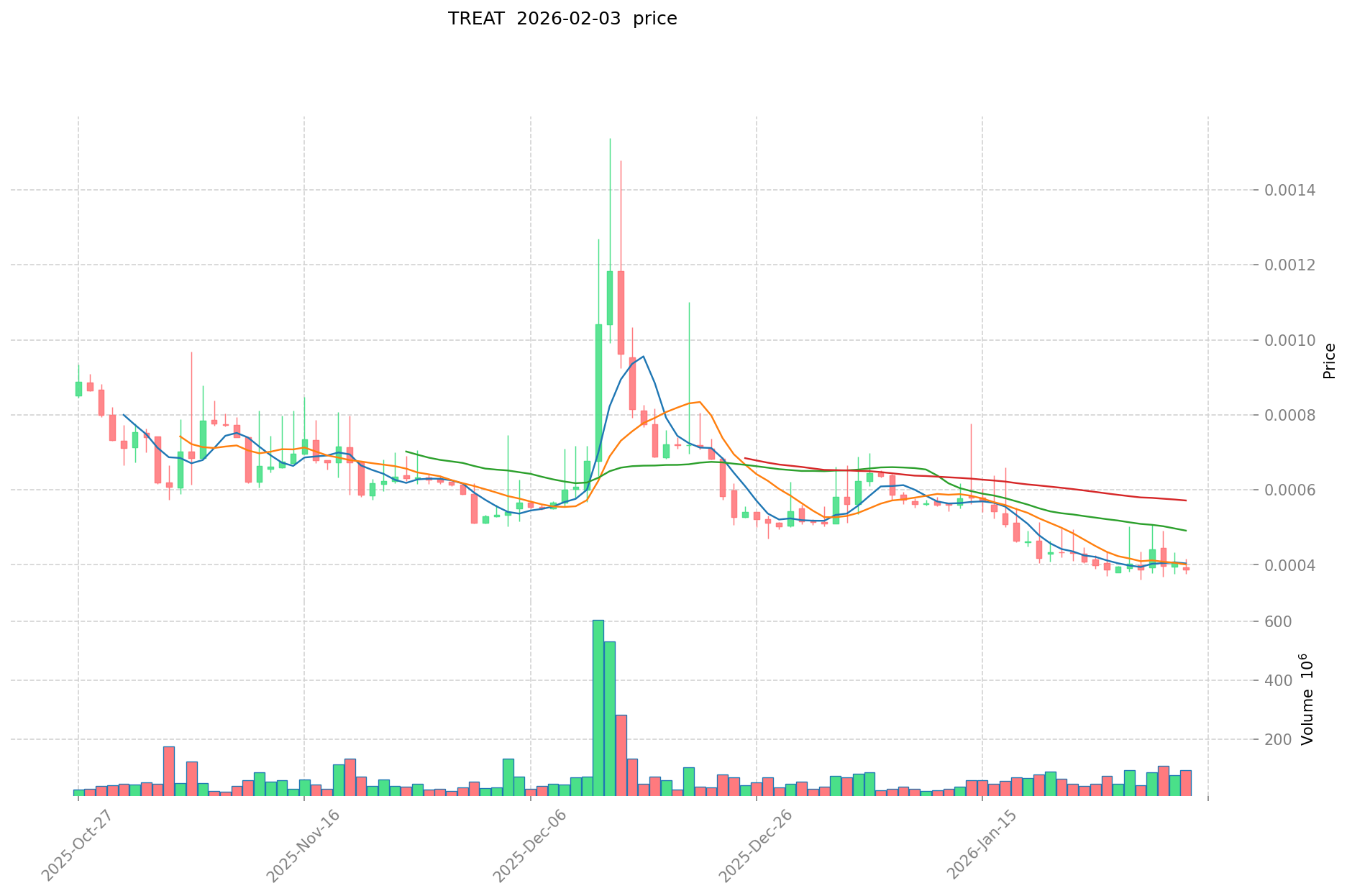
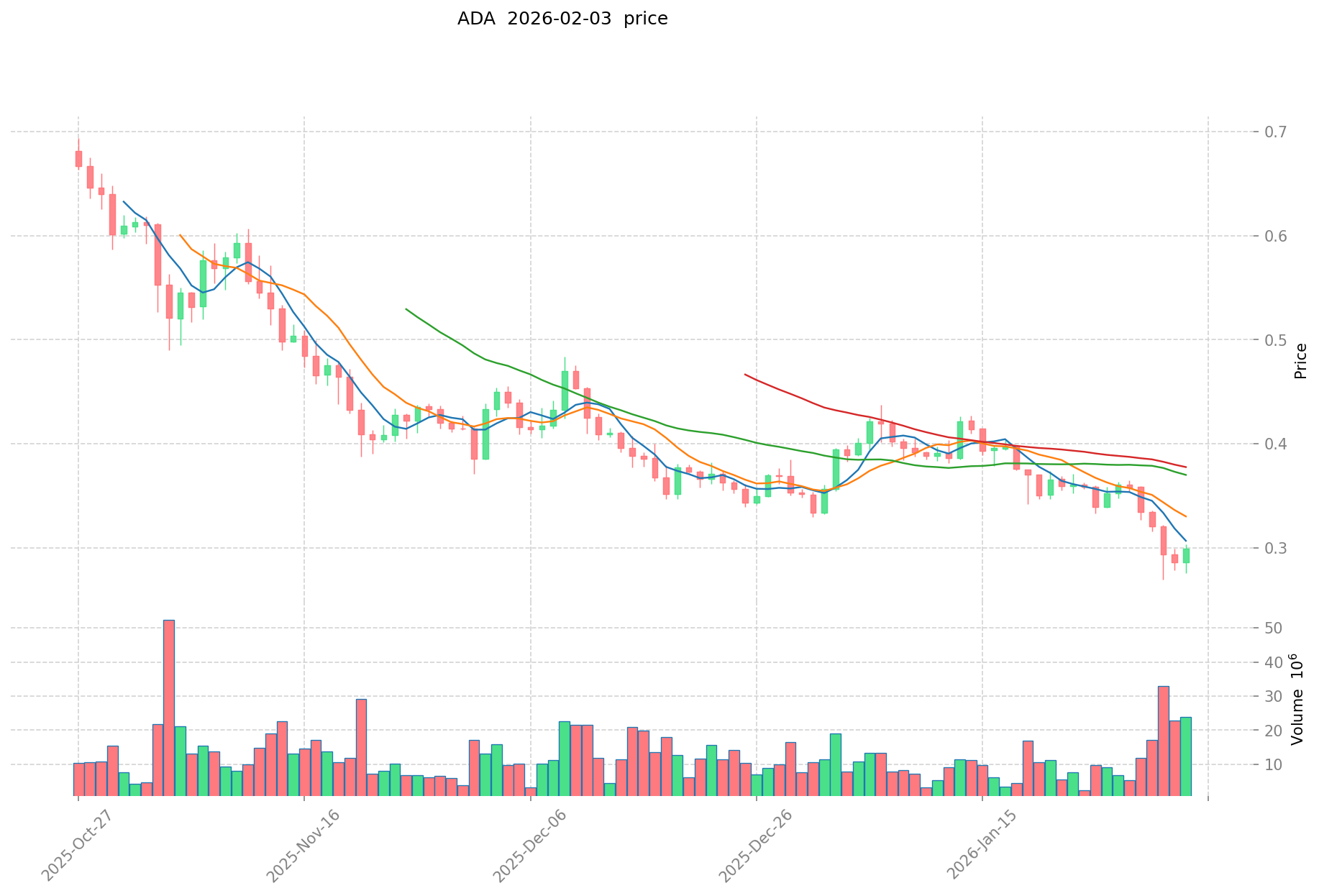
- Comparative Analysis: During recent market cycles, TREAT has declined from its high of $0.04551 to a low of $0.0003603, representing a decline of over 99%, while ADA has experienced a decline from its peak of $3.09 to current levels around $0.29, reflecting a decrease of approximately 91% from its historical high.
Current Market Status (2026-02-04)
- TREAT current price: $0.0004017
- ADA current price: $0.2933
- 24-hour trading volume: TREAT $52,911.92 vs ADA $5,507,050.78
- Market sentiment index (Fear & Greed Index): 17 (Extreme Fear)
View real-time prices:
- Check TREAT current price Market Price
- Check ADA current price Market Price
II. Core Factors Affecting TREAT vs ADA Investment Value
Supply Mechanism Comparison (Tokenomics)
- ADA: Operates with a capped supply model under the Ouroboros Proof-of-Stake (PoS) consensus mechanism. Token holders can participate in staking to earn rewards while maintaining network security and governance rights.
- TREAT: Information regarding supply mechanism is not provided in available materials.
- 📌 Historical Pattern: Supply mechanisms influence price cycles through staking incentives and governance participation, which can affect token circulation and demand dynamics.
Institutional Adoption and Market Application
- Institutional Holdings: Data comparing institutional preference between TREAT and ADA is not provided in available materials.
- Enterprise Adoption: ADA focuses on government projects, enterprise financial applications, and academic collaborations, aiming to enhance Cardano's usage demand. The token serves multiple functions including payment, staking, and governance in financial applications with emphasis on cross-border inclusive finance.
- National Policy: Available materials indicate that interest rate increases and strong US dollar typically reduce investor interest in risk assets including cryptocurrencies, while accommodative monetary policies tend to be more favorable for assets like ADA.
Technical Development and Ecosystem Building
- ADA Technical Development: Cardano employs a dual-layer architecture combining an academic-oriented approach with PoS consensus to create a highly secure and scalable public chain. The platform enables smart contracts and decentralized applications while maintaining sustainable ecosystem growth through staking and governance mechanisms.
- TREAT Technical Development: Information regarding technical upgrades and potential impacts is not provided in available materials.
- Ecosystem Comparison: ADA supports DeFi, payment systems, and governance applications through the Cardano Improvement Proposal (CIP) voting mechanism. Token holders can influence network upgrades and development direction. Real-world case studies related to government projects and enterprise financial applications contribute to strengthening market adoption.
Macroeconomic Environment and Market Cycles
- Performance in Inflationary Environment: Specific comparative data on inflation-hedging properties between TREAT and ADA is not provided in available materials.
- Macroeconomic Monetary Policy: Rising interest rates and strengthening US dollar typically weaken investor appetite for risk assets including cryptocurrencies. Conversely, accommodative monetary policies tend to create more favorable conditions for assets like ADA.
- Geopolitical Factors: Cardano's emphasis on cross-border inclusive finance and international collaborations may position ADA to benefit from cross-border transaction demands, though specific geopolitical impact analysis is not detailed in available materials.
III. 2026-2031 Price Forecast: TREAT vs ADA
Short-term Forecast (2026)
- TREAT: Conservative $0.000208 - $0.0004 | Optimistic $0.0004 - $0.000448
- ADA: Conservative $0.149 - $0.293 | Optimistic $0.293 - $0.404
Mid-term Forecast (2028-2029)
- TREAT may enter a consolidation phase, with projected price range of $0.000422 - $0.000743
- ADA may enter an expansion phase, with projected price range of $0.225 - $0.571
- Key drivers: institutional capital inflows, ETF developments, ecosystem growth
Long-term Forecast (2030-2031)
- TREAT: Baseline scenario $0.000377 - $0.000740 | Optimistic scenario $0.000679 - $0.000834
- ADA: Baseline scenario $0.305 - $0.648 | Optimistic scenario $0.442 - $0.753
Disclaimer
TREAT:
| Year | Predicted High Price | Predicted Average Price | Predicted Low Price | Price Change |
|---|---|---|---|---|
| 2026 | 0.000447552 | 0.0003996 | 0.000207792 | 0 |
| 2027 | 0.00063112824 | 0.000423576 | 0.00022449528 | 5 |
| 2028 | 0.0006802842348 | 0.00052735212 | 0.000421881696 | 31 |
| 2029 | 0.000742696358202 | 0.0006038181774 | 0.000489092723694 | 50 |
| 2030 | 0.000740582994581 | 0.000673257267801 | 0.000377024069968 | 67 |
| 2031 | 0.000834165754805 | 0.000706920131191 | 0.000678643325943 | 75 |
ADA:
| Year | Predicted High Price | Predicted Average Price | Predicted Low Price | Price Change |
|---|---|---|---|---|
| 2026 | 0.404202 | 0.2929 | 0.149379 | 0 |
| 2027 | 0.40083365 | 0.348551 | 0.24747121 | 18 |
| 2028 | 0.49084694575 | 0.374692325 | 0.35595770875 | 27 |
| 2029 | 0.571255918695 | 0.432769635375 | 0.225040210395 | 47 |
| 2030 | 0.64759648237515 | 0.502012777035 | 0.4417712437908 | 71 |
| 2031 | 0.752994064913648 | 0.574804629705075 | 0.304646453743689 | 95 |
IV. Investment Strategy Comparison: TREAT vs ADA
Long-term vs Short-term Investment Strategies
-
TREAT: May appeal to investors seeking exposure to the Shiba Inu ecosystem with higher risk tolerance, focusing on emerging DeFi innovations and governance participation within the Shiba Network State. The asset's recent market introduction and ecosystem positioning suggest a speculative profile suitable for those comfortable with elevated volatility.
-
ADA: May suit investors prioritizing established blockchain infrastructure with focus on institutional adoption, government partnerships, and cross-border financial applications. The platform's academic-oriented development approach and proven track record since 2017 may attract those seeking exposure to scalable smart contract platforms with demonstrated real-world use cases.
Risk Management and Asset Allocation
-
Conservative Investors: A potential allocation framework might consider 10-20% TREAT vs 80-90% ADA, emphasizing the more established asset with demonstrated institutional interest and longer operational history.
-
Aggressive Investors: A potential allocation framework might consider 40-50% TREAT vs 50-60% ADA, accepting higher exposure to emerging ecosystem tokens while maintaining significant position in proven infrastructure.
-
Hedging Tools: Investors may consider stablecoin reserves for portfolio stability, options strategies for downside protection, and cross-asset diversification to manage concentration risk across different blockchain ecosystems.
V. Potential Risk Comparison
Market Risks
-
TREAT: The token has experienced significant price decline exceeding 99% from its peak in early 2025, indicating substantial volatility risk. As a recently launched asset with relatively lower trading volume ($52,911.92 in 24-hour period), liquidity constraints may amplify price fluctuations during market stress periods.
-
ADA: While experiencing substantial decline from historical peaks, ADA maintains considerably higher trading volume ($5,507,050.78 in 24-hour period) and established market presence. The asset remains subject to broader cryptocurrency market cycles and macroeconomic factors including interest rate policies and US dollar strength, which historically impact risk asset appetite.
Technical Risks
-
TREAT: Information regarding network scalability, infrastructure resilience, and potential technical vulnerabilities is not detailed in available materials, presenting uncertainty around operational stability and long-term technical viability.
-
ADA: The Cardano protocol employs dual-layer architecture and Ouroboros PoS consensus mechanism designed for security and scalability. However, like all blockchain networks, potential risks include network congestion during high activity periods, validator participation dynamics, and ongoing requirements for protocol upgrades to maintain competitive positioning.
Regulatory Risks
- Global regulatory developments may impact both assets differently based on their functional classifications and jurisdictional interpretations. ADA's focus on government collaborations and financial applications may subject it to enhanced regulatory scrutiny in certain jurisdictions, while potentially benefiting from clearer regulatory frameworks for established blockchain platforms. TREAT's governance and ecosystem positioning within the Shiba Inu network may face evolving regulatory considerations as authorities develop frameworks for DeFi and governance tokens.
VI. Conclusion: Which Is the Better Buy?
📌 Investment Value Summary:
-
TREAT Characteristics: Represents exposure to the Shiba Inu ecosystem with focus on DeFi innovations, governance participation, and emerging technologies including AI frameworks and encryption developments. The asset presents higher risk-reward profile as a recently launched token with substantial price volatility and developing ecosystem infrastructure.
-
ADA Characteristics: Offers exposure to established blockchain infrastructure with proven operational history since 2017, institutional partnerships, government collaborations, and academic-oriented development approach. The platform demonstrates real-world application focus in financial services, smart contracts, and cross-border transactions with emphasis on scalability and security.
✅ Investment Considerations:
-
New Investors: May consider prioritizing established assets with demonstrated market presence and institutional interest. ADA's longer operational history and higher liquidity may provide more accessible entry point for those building initial cryptocurrency exposure. Starting with smaller position sizes and gradual accumulation strategies may help manage volatility risk.
-
Experienced Investors: May evaluate portfolio allocation based on risk tolerance and investment thesis. Those with conviction in Shiba Inu ecosystem development might allocate measured exposure to TREAT while maintaining positions in established infrastructure tokens like ADA. Diversification across different blockchain ecosystems and use cases may help manage concentration risk.
-
Institutional Investors: May focus on assets with clearer regulatory positioning, demonstrated real-world adoption, and established liquidity profiles. ADA's emphasis on government partnerships, enterprise applications, and academic collaborations may align with institutional investment criteria, while TREAT's emerging status may require additional due diligence around governance structures and ecosystem maturity.
⚠️ Risk Warning: Cryptocurrency markets exhibit extreme volatility. This content does not constitute investment advice. Investors should conduct independent research and consult qualified financial advisors before making investment decisions.
VII. FAQ
Q1: What are the main differences in market maturity between TREAT and ADA?
ADA is a significantly more mature asset with over 8 years of operational history since October 2017, while TREAT launched in January 2025 as a new entrant to the market. ADA demonstrates substantially higher liquidity with 24-hour trading volume of $5,507,050.78 compared to TREAT's $52,911.92, indicating deeper market participation and lower liquidity risk. ADA has established institutional partnerships, government collaborations, and real-world financial applications, whereas TREAT is still developing its ecosystem within the Shiba Inu network. The maturity difference is further evidenced by price stability patterns—while both have declined from peaks, TREAT has experienced over 99% decline from its January 2025 high of $0.04551, compared to ADA's approximately 91% decline from its 2021 peak of $3.09.
Q2: How do the technical architectures of TREAT and ADA differ?
ADA operates on Cardano's dual-layer blockchain architecture utilizing the Ouroboros Proof-of-Stake consensus mechanism, which separates the settlement layer from the computation layer to enhance scalability and security. This academic-oriented design enables smart contract functionality, decentralized applications, and governance through the Cardano Improvement Proposal (CIP) voting mechanism. TREAT positions itself as a governance and transactional token within the Shiba Inu ecosystem, providing access to DeFi innovations, decentralized incubators, AI agentic frameworks, and fully homomorphic encryption technologies. However, detailed technical specifications regarding TREAT's underlying infrastructure, scalability mechanisms, and consensus model are not extensively documented in available materials, presenting uncertainty around its technical architecture compared to ADA's well-established protocol design.
Q3: What are the primary use cases for TREAT versus ADA?
ADA serves multiple functions within the Cardano ecosystem, including native currency for protocol operations, staking to earn rewards and secure the network, governance participation through voting mechanisms, and facilitating smart contract execution for financial applications. The platform emphasizes cross-border inclusive finance, government projects, enterprise financial systems, and payment infrastructure for individuals, organizations, and governments globally. TREAT functions as the final token in the Shiba Inu ecosystem, designed to provide transactional rewards and governance rights for the Shiba Network State, with stated access to advanced technologies including DeFi innovations, AI frameworks, and encryption developments. The primary distinction lies in ADA's established real-world financial applications versus TREAT's emerging ecosystem positioning focused on governance and access rights within the Shiba Inu network.
Q4: How do the supply mechanisms of TREAT and ADA impact investment considerations?
ADA operates with a capped supply model under the Ouroboros Proof-of-Stake consensus mechanism, where token holders can participate in staking to earn rewards while contributing to network security and governance. This design creates predictable tokenomics with clear incentive structures for long-term holding and network participation. The staking mechanism influences circulating supply dynamics and demand patterns through reward distribution and governance rights. For TREAT, detailed information regarding supply cap, emission schedule, staking mechanisms, or deflationary features is not provided in available materials, creating uncertainty around tokenomics design and long-term supply dynamics. This information gap makes comparative analysis of inflationary or deflationary characteristics difficult, which represents an important consideration for investors evaluating long-term value accrual mechanisms between the two assets.
Q5: What price forecasts exist for TREAT and ADA through 2031?
Price predictions through 2031 show substantially different trajectories. For 2026, TREAT forecasts range from $0.000208-$0.0004 (conservative) to $0.0004-$0.000448 (optimistic), while ADA forecasts range from $0.149-$0.293 (conservative) to $0.293-$0.404 (optimistic). By 2031, TREAT baseline scenarios project $0.000377-$0.000740 with optimistic scenarios reaching $0.000679-$0.000834, whereas ADA baseline scenarios project $0.305-$0.648 with optimistic scenarios reaching $0.442-$0.753. These forecasts reflect ADA's established market position and higher absolute price levels, while TREAT's fractional pricing indicates early-stage valuation. However, these predictions should be interpreted with caution as cryptocurrency markets exhibit extreme volatility, and forecasts become increasingly uncertain over longer time horizons, particularly for recently launched assets like TREAT with limited historical data.
Q6: What are the key risk differences between investing in TREAT versus ADA?
TREAT presents significantly higher volatility risk, having declined over 99% from its January 2025 peak, with substantially lower trading volume creating potential liquidity constraints during market stress. As a recently launched asset, TREAT lacks operational track record, and limited information exists regarding technical infrastructure resilience and long-term viability. ADA, while subject to broader cryptocurrency market cycles and macroeconomic factors, maintains considerably higher liquidity and established market presence since 2017. ADA's technical risks center on network scalability during high activity and ongoing protocol upgrade requirements, but benefit from proven dual-layer architecture and academic-oriented development approach. Regulatory risks differ based on functional positioning—ADA's government collaborations may attract enhanced scrutiny but benefit from clearer frameworks for established platforms, while TREAT's governance token status faces evolving regulatory considerations for DeFi and governance tokens.
Q7: How should portfolio allocation differ between TREAT and ADA based on investor profile?
Conservative investors might consider 10-20% TREAT versus 80-90% ADA allocation, emphasizing the more established asset with demonstrated institutional interest, longer operational history, and higher liquidity profile. This approach prioritizes capital preservation while maintaining limited exposure to emerging ecosystem opportunities. Aggressive investors comfortable with elevated risk might consider 40-50% TREAT versus 50-60% ADA allocation, accepting higher exposure to speculative positioning while maintaining significant presence in proven infrastructure. This strategy suits those with conviction in Shiba Inu ecosystem development and tolerance for substantial volatility. Institutional investors may focus predominantly on ADA given its clearer regulatory positioning, demonstrated real-world adoption through government partnerships and enterprise applications, established liquidity, and academic-oriented development approach that aligns with institutional due diligence criteria, while TREAT may require additional evaluation of governance structures and ecosystem maturity.
Q8: What macroeconomic factors most significantly impact TREAT versus ADA investment performance?
Both assets face common macroeconomic pressures including interest rate policies and US dollar strength, which historically reduce investor appetite for risk assets including cryptocurrencies. Rising interest rates typically strengthen traditional fixed-income alternatives, drawing capital away from speculative crypto assets, while accommodative monetary policies create more favorable conditions for both TREAT and ADA. However, impact magnitude differs based on asset characteristics—ADA's established position and institutional adoption may provide relative resilience during tightening cycles compared to TREAT's emerging status. ADA's emphasis on cross-border inclusive finance and international collaborations may position it to benefit from trends toward digital payment infrastructure and financial inclusion initiatives, particularly in regions with currency instability. The current market sentiment index showing extreme fear (17) suggests challenging near-term conditions affecting both assets, though liquidity differences mean TREAT may experience more pronounced volatility during macroeconomic stress periods.
Share
Content
Introduction: TREAT vs ADA Investment Comparison
I. Historical Price Comparison and Current Market Status
II. Core Factors Affecting TREAT vs ADA Investment Value
III. 2026-2031 Price Forecast: TREAT vs ADA
IV. Investment Strategy Comparison: TREAT vs ADA
V. Potential Risk Comparison
VI. Conclusion: Which Is the Better Buy?
VII. FAQ
How to Buy Cryptocurrency


Trending Cryptocurrencies



Cardano (ADA) Price Prediction 2025 & 2030 – Is ADA Set to Soar?

Cardano (ADA): A History, Tech Overview, and Price Outlook

How Does Cardano's Proof of Stake (PoS) Mechanism Work?
What is Cardano?
Cardano (ADA) Price Analysis and Outlook for 2025

Factors Affecting Cardano's Price
Investigating the True Identity of Bitcoin Founder Satoshi Nakamoto

How to Participate in Cryptocurrency Airdrops and Essential Security Measures
Top 7 Hardware Picks for Cryptocurrency Mining

What Does DYOR Mean in Crypto?

What Is a Cryptocurrency Airdrop: Where to Find Them and How to Profit