Discover DAOs — What Are Decentralized Autonomous Organizations? This in-depth guide explains DAO operations, governance structures, and the strengths and weaknesses of DAOs in web3 and blockchain. Find out how to participate in a DAO for transparent, decentralized financial management and cryptocurrency investment.
What Is a Decentralized Autonomous Organization?
A Decentralized Autonomous Organization (DAO) is an innovative structure designed to solve longstanding governance challenges, such as corruption and abuse of power that can occur when individuals make decisions on behalf of others.
To illustrate how a DAO works, imagine a scenario where one hundred shipwreck survivors must live together on a deserted island, following basic rules to survive and build a community. In a traditional model, elected leaders enforce these rules but may prioritize their own interests or those of a small group over the broader community.
DAOs address this problem by removing intermediaries and substantially lowering both risk and operational costs. Instead of relying on people, DAOs automate governance rules using blockchain technology and smart contracts, ensuring all decisions are transparent and applied fairly.
How Do DAOs Operate?
A DAO uses blockchain technology to enable self-executing rules or protocols without third-party involvement. Creating a DAO generally involves three key steps:
Step 1: Develop the Smart Contract
Developers must thoroughly understand the governance issue to create an effective smart contract. This smart contract serves as the DAO’s technological foundation and "rulebook," clearly defining operational rules, voting mechanisms, and criteria for executing decisions.
Step 2: Design Tokenomics
Developers set the tokenomics for the governance system, including how tokens are distributed, voting rights, and reward or penalty systems. Well-designed tokenomics balance participation incentives with member responsibility, while mitigating manipulation risks.
Step 3: Launch and Distribute Tokens
Developers officially launch the DAO on the blockchain, ideally distributing tokens fairly so that developers and other stakeholders hold equal amounts. This prevents early power imbalances and ensures genuine decentralization.
Once the DAO is deployed, a participant’s voting power is proportional to their token holdings. Governance proposals are approved and executed only when a majority of stakeholders (typically over 50% or as defined) confirm approval through voting.
Everything You Need to Know About DAOs
The first DAO was launched in 2016 as "The DAO" on Ethereum. It was a bold experiment that provided valuable lessons. The DAO suffered a critical smart contract vulnerability, exploited by hackers to steal a large amount of ETH. This incident locked roughly $150 million worth of ETH and sparked intense debate in the Ethereum community.
To address the fallout and return funds to investors, a group of developers initiated a hard fork, creating a new blockchain. This new chain became the Ethereum we use today, while the original chain continues as Ethereum Classic, maintained by those who adhere to the "code is law" principle.
After a quiet period, DAOs became the backbone of decentralized finance (DeFi) as the space experienced rapid growth. Modern DeFi protocols widely use DAOs to guarantee transparency and empower communities to participate in critical decision-making.
Comparing DAOs to Other Platforms
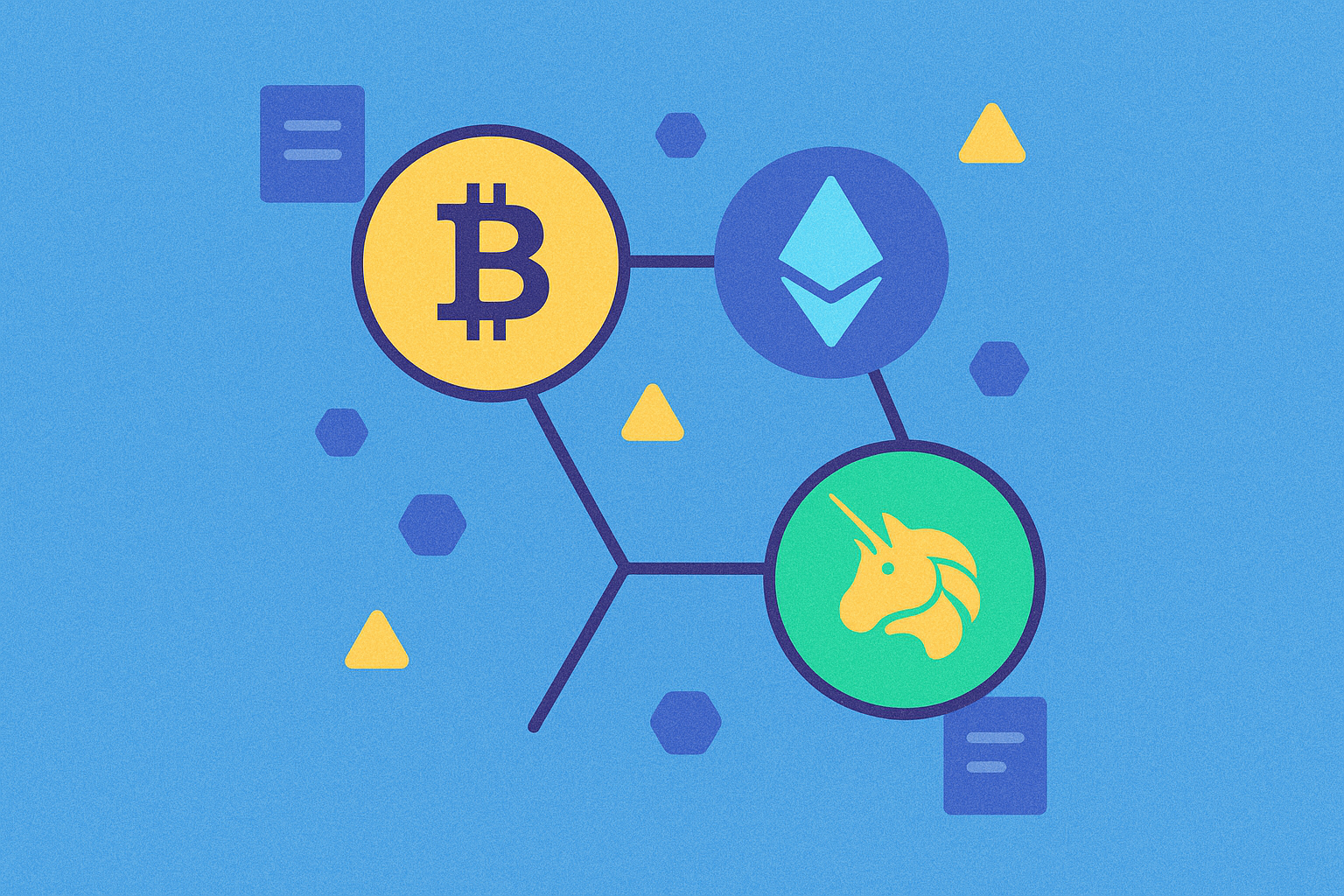
Bitcoin — The Original DAO
Bitcoin represents the earliest DAO-like rule set in blockchain history. Its network operates through decentralized consensus among miners and nodes, without a central authority. However, Bitcoin is not a full DAO because it lacks complex governance rules and an official voting process for protocol changes.
Ethereum — The DAO Platform
Ethereum is a second-generation blockchain that introduced programmability through smart contracts. Smart contracts are essential for DAO operation. However, Ethereum itself is not a DAO; it’s an infrastructure platform that enables developers to build and deploy DAO projects.
Uniswap — DAO in DeFi
Uniswap pioneered the Automated Market Maker (AMM) model in DeFi. It operates as a full DAO using the UNI governance token, allowing community-driven protocol development. However, to submit new governance proposals, a participant must hold at least 1% of all UNI—an intentionally high threshold to ensure only serious proposals go to vote.
MakerDAO — A Comprehensive DAO Model
MakerDAO is considered the most comprehensive and sophisticated DAO in DeFi. Running on Ethereum, MakerDAO uses two tokens: DAI (a stablecoin) and MKR (a governance token). The platform’s long-term goal is complete decentralization, gradually transferring all control to the community and ultimately dissolving the founding team’s authority by distributing all governance tokens to stakeholders.
How Does a DAO Work?
To understand DAOs in practice, consider a blockchain game development studio as an example.
Suppose a studio wants to prevent arbitrary or community-unapproved changes to game features. They implement a DAO to manage the development budget transparently and democratically.
Establishing Governance:
The studio creates a DAO on Ethereum with clear funding rules, sets budget thresholds for each task, and locks all funding in a smart contract. Each task—such as 3D modeling, feature programming, or sound production—has its costs automatically calculated based on the approved budget.
Distributing Voting Power:
All community members—from players to investors—receive governance tokens for voting on new feature proposals. Lead developers or major contributors receive more tokens based on their input, ensuring fairness according to the value provided.
Decision-Making Process:
When a new feature is proposed, the community votes with tokens. If the total cost of approved features exceeds the defined budget, the vote fails automatically per the smart contract. This system helps both developers and the community control growth within budget, preventing overextension and ensuring efficient, high-quality results.
DAO Advantages and Disadvantages
Advantages
Decentralized and Democratic Decision-Making
DAOs eliminate centralized leadership or management. Members directly participate in decision-making through voting, ensuring that important decisions are made quickly and reflect the will of the majority, not just a select few.
Efficiency and High Automation
Most rules, policies, and operational procedures are set and coded into smart contracts from the start. Once launched, these rules self-execute without human intervention, reducing operational costs and minimizing fraud or human error.
Maximum Transparency
All transactions, decisions, and organizational changes are permanently recorded on the blockchain and can be verified by anyone. This transparency builds trust and accountability, making corruption and abuse of power nearly impossible.
Disadvantages
Risk of System Manipulation
Token incentives can unintentionally encourage manipulative or self-serving actions. Large token holders may collude to pass proposals that benefit themselves but harm the DAO’s long-term prospects. "Whale" dominance over voting power is a real concern.
Potential Lack of Expertise in Decision-Making
DAO members vote based on token holdings, not necessarily expertise. This can allow non-experts to make decisions on complex technical matters, potentially lowering decision quality or causing unwanted consequences.
Legal Risks and Regulatory Uncertainty
No clear, comprehensive legal framework exists for DAOs. This creates compliance, liability, and financial integration risks, and the lack of regulation exposes investors and participants to significant uncertainty.
Conclusion
DAOs and blockchain technology are emerging as powerful new organizational models for the future. As the world moves toward decentralization and transparency, demand is growing for structures that empower individuals to make their own decisions.
However, DAOs are already having a profound impact on traditional organizations—and will continue to do so. Transforming centuries-old governance models, especially when governments and lawmakers are involved, is a complex process that will take time for broad acceptance.
The ideal future may feature hybrid models combining the flexibility and transparency of DAOs with the stability and legal compliance of traditional organizations. By leveraging the advantages of both, organizations can become more efficient and trustworthy, serving communities more effectively in the digital age.
FAQ
What Is a DAO? How Does a DAO Differ from a Traditional Company?
A DAO is a decentralized, self-governing organization that does not require a traditional office. Unlike conventional companies, DAOs operate via smart contracts, with members making decisions through consensus mechanisms instead of centralized management.
How Does a DAO Operate? What Are Its Governance and Decision-Making Processes?
DAOs run on automated smart contracts on the blockchain. Token holders vote on proposals. When enough votes are gathered, the system automatically executes the decision, ensuring transparency and eliminating centralized authority.
What Are the Requirements to Join a DAO? How Can You Participate in DAO Governance?
To join a DAO, you must hold its governance token and participate in the community. Governance happens by voting on proposals using tokens. Some modern DAOs allow participation without requiring token ownership.
What Are Some Real-World DAO Applications and Use Cases?
DAOs are widely used in DeFi projects such as Uniswap (decentralized trading), Aave (lending), and Maker (stablecoin issuance). There are investment DAOs like MetaCartel Ventures, grant DAOs such as Gitcoin supporting open-source development, and collector DAOs like PleasrDAO managing digital assets.
What Risks Come with Investing in or Participating in a DAO? What Should You Consider?
DAOs involve legal and technical risks: smart contract errors that could lead to fund loss, and regulatory compliance challenges. Before joining, check the project’s transparency, code security, and ensure proper tax handling.
How Are Tokens and Voting Power Distributed in a DAO?
In a DAO, tokens represent ownership or participation. Voting rights are proportional to token holdings—those with more tokens have greater voting power. This structure ensures democratic decentralization on the blockchain.
How Do DAOs Differ from Traditional Decentralized Organizations (Such as Open-Source Communities)?
A DAO is a self-governing blockchain-based organization using smart contracts for automatic execution of decisions, while traditional decentralized groups rely on human leadership and coordination. In DAOs, token holders vote on decisions; traditional organizations typically have clear leadership tiers.
* The information is not intended to be and does not constitute financial advice or any other recommendation of any sort offered or endorsed by Gate.