KTON is a derivative commitment token within the Darwinia Network ecosystem, designed to address liquidity loss and incentivize long-term staking participation in the Polkadot ecosystem. Launched in 2020, KTON compensates users for locking RING tokens while enabling governance influence and cross-chain infrastructure access. This comprehensive guide explores KTON's technical architecture built on Substrate blockchain, market performance with current circulation of 149,914 tokens, and its critical role in NFT markets, stablecoin transfers, and decentralized asset exchanges. The article covers KTON's decentralized consensus mechanisms, secure cryptographic transactions, and ecosystem applications, alongside market challenges including volatility and liquidity constraints. Readers gain insights into KTON's community engagement, participation methods via Gate trading, and future roadmap focused on expanding cross-chain interoperability and infrastructure development.
KTON's Positioning and Significance
In 2020, the Darwinia Network team introduced KTON (KTON), designed to address liquidity loss and incentivize long-term commitment within blockchain staking ecosystems.
As a derivative commitment token within the Darwinia Network ecosystem, KTON plays a crucial role in cross-chain infrastructure, governance participation, and DeFi applications.
As of 2026, KTON operates within the Darwinia Network, which focuses on connecting Polkadot parachain ecosystems with external heterogeneous chains. It serves users interested in non-fungible token (NFT) markets, stablecoin cross-chain transfers, and asset exchanges.
This article explores its technical architecture, market performance, and future potential.
Origin and Development History
Birth Background
KTON was created by the Darwinia Network team in 2020, aiming to solve the challenge of incentivizing long-term token locking in staking mechanisms while compensating users for liquidity loss.
It emerged during the growth phase of Polkadot ecosystem development and increasing demand for cross-chain solutions, with the goal of providing users with governance influence and economic rewards through commitment-based staking.
The launch of KTON brought new possibilities for users engaging in staking and governance within cross-chain networks.
Key Milestones
- 2020: KTON was introduced as a commitment token within the Darwinia Network, rewarding users who lock RING tokens for specified periods.
- The Darwinia Network, built on Substrate, established itself as a cross-chain bridge connecting Polkadot parachains with external chains, offering full EVM compatibility.
- KTON enabled staking participation on the mainnet, allowing holders to gain governance influence and earn rewards.
- The network focused on building infrastructure for future asset internet applications, emphasizing NFT auction markets, stablecoin cross-chain functionality, and asset trading.
With support from the Darwinia Network community and development team, KTON continues to evolve its utility within the cross-chain ecosystem.
How KTON Works
Decentralized Control
KTON operates within the Darwinia Network, which runs on a decentralized network of nodes distributed globally, independent of centralized banks or government control.
These nodes collaborate to validate transactions, ensuring system transparency and resistance to attacks, granting users greater autonomy and enhancing network resilience.
Blockchain Foundation
KTON functions on the Darwinia Network blockchain, built using Substrate technology. This blockchain serves as a public, immutable digital ledger recording every transaction.
Transactions are grouped into blocks and linked through cryptographic hashes to form a secure chain.
Anyone can view the records, establishing trust without intermediaries.
The Darwinia Network's cross-chain bridge architecture and full EVM compatibility enhance its interoperability with multiple blockchain ecosystems.
Ensuring Fairness
The Darwinia Network employs consensus mechanisms derived from Substrate's framework to validate transactions and prevent fraudulent activities such as double-spending.
Network participants maintain security through node operations and staking activities, receiving rewards for their contributions.
KTON holders can stake their tokens on the mainnet to gain influence in governance decisions.
Secure Transactions
KTON utilizes public-private key cryptography to protect transactions:
- Private keys (similar to secret passwords) are used to sign transactions
- Public keys (similar to account numbers) are used to verify ownership
This mechanism ensures fund security while maintaining transaction integrity within the network.
The Darwinia Network's architecture supports secure cross-chain asset transfers and interactions across different blockchain ecosystems.
Circulation Overview
As of February 08, 2026, KTON has a circulating supply of 149,914 tokens, with a total supply of 149,914 tokens. The maximum supply is unlimited, indicating an inflationary token model.
KTON tokens enter the market through a commitment-based staking mechanism. When users commit to locking RING tokens for a specified period during the staking process, the system issues a corresponding amount of KTON as compensation and reward for liquidity loss. This mechanism influences the supply-demand dynamics of KTON in the market.
Price Fluctuations
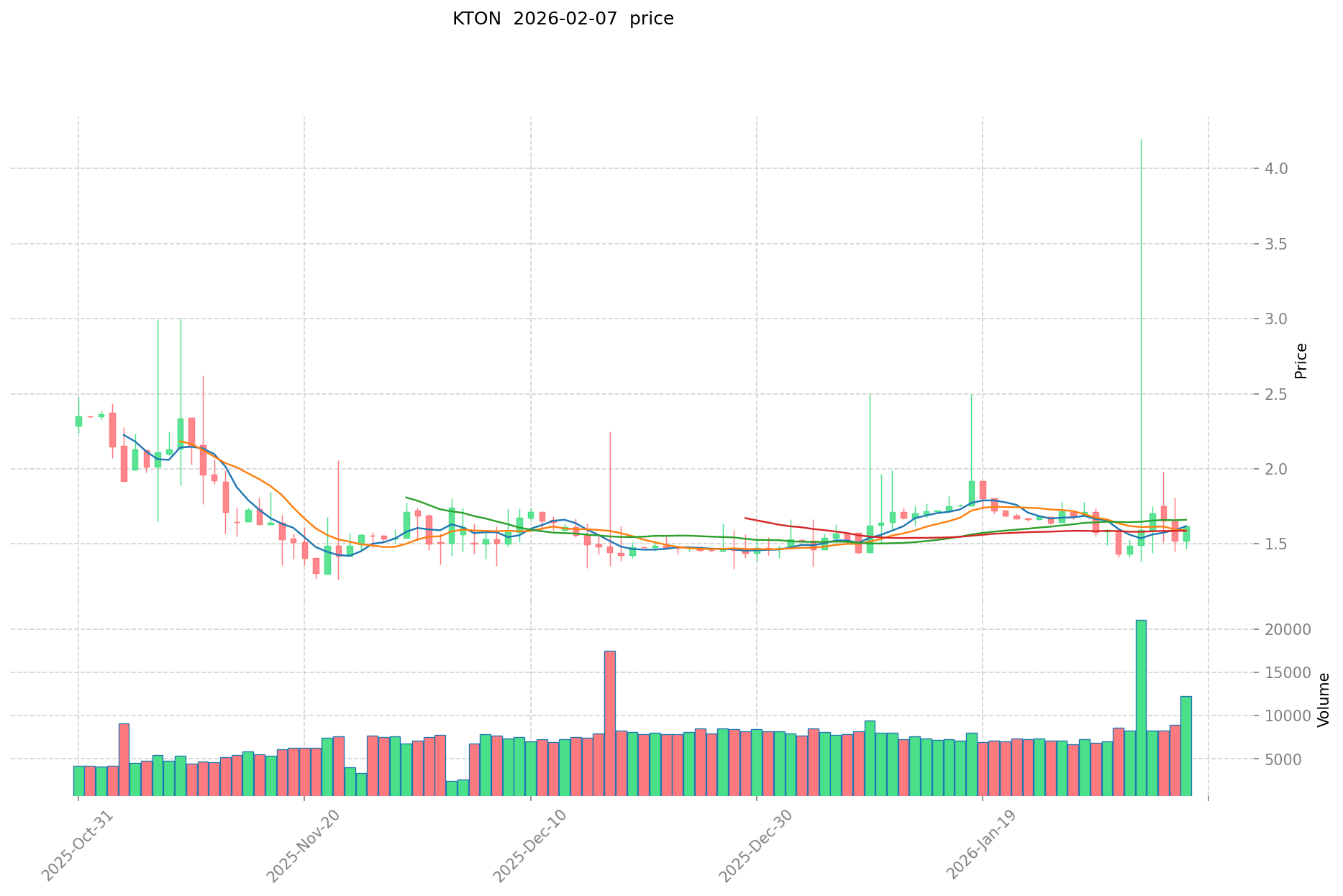
KTON reached a notable price of $416.09 on September 01, 2020, influenced by early market enthusiasm and network adoption dynamics during that period.
The lowest recorded price was $1.28, occurring on November 21, 2025, reflecting broader market conditions and potential shifts in network activity or investor sentiment.
These price movements demonstrate the impact of market sentiment, adoption trends, and external factors on KTON's valuation.
Click to view current KTON market price
On-Chain Metrics
- Holders: 2,304 addresses hold KTON tokens, indicating the current level of token distribution among users
- 24-Hour Trading Volume: $20,635.79, reflecting recent market activity and trading interest
- Market Capitalization: $247,358.10, representing the current total market value of circulating KTON tokens
KTON Ecosystem Applications and Partners
Core Use Cases
KTON's ecosystem supports multiple applications:
- Cross-chain Infrastructure: Darwinia Network provides decentralized bridge services connecting Polkadot parachain ecosystem with external heterogeneous chains.
- Asset Management: The network focuses on non-standard asset NFT auction markets, stablecoin cross-chain transfers, and asset exchange, driving innovation in digital asset interoperability.
Strategic Collaborations
KTON operates within the Darwinia Network ecosystem, which is built on Substrate and maintains compatibility with EVM virtual machines.
These technical foundations provide a solid base for KTON's ecosystem expansion.
Controversies and Challenges
KTON faces the following challenges:
- Market Volatility: The token has experienced significant price fluctuations, with a one-year price change of -54.36%.
- Liquidity Concerns: With a 24-hour trading volume of approximately $20,635.79, market liquidity remains relatively limited.
- Competition Pressure: The cross-chain bridge sector faces intense competition from established blockchain networks and emerging infrastructure projects.
These issues have sparked discussions within the community and market, while also driving KTON's continuous innovation.
KTON's community demonstrates steady activity, with approximately 2,304 token holders.
On X platform, discussions about Darwinia Network and KTON occasionally trend, particularly during significant network updates or feature releases.
Factors such as cross-chain functionality improvements and governance participation opportunities have sustained community interest.
Sentiment on X shows diverse perspectives:
- Supporters praise KTON's staking rewards mechanism and governance participation features, viewing it as an innovative approach to incentivizing long-term commitment.
- Critics focus on price volatility and limited exchange availability, with concerns about market depth.
Recent trends indicate cautious optimism within the community regarding the network's cross-chain infrastructure development.
Trending Topics
X users discuss KTON's commitment token model, staking mechanisms, and its role within the Darwinia Network ecosystem,
showcasing both its innovative potential and the challenges in achieving broader market adoption.
- Official Website: Visit KTON official website for features, use cases, and latest updates.
- X Activity: On X platform, Darwinia Network uses @DarwiniaNetwork to share updates,
with posts covering technical upgrades, community activities, and cross-chain infrastructure developments.
KTON Future Roadmap
- Infrastructure Development: Continue enhancing cross-chain bridge capabilities and EVM compatibility
- Ecosystem Goals: Expand support for multi-chain applications and decentralized asset exchange platforms
- Long-term Vision: Establish a comprehensive infrastructure for the future asset internet, focusing on cross-chain interoperability
How to Participate in KTON?
- Purchase Options: KTON is available for trading on Gate.com
- Storage Solutions: Use compatible Ethereum wallets to securely store KTON tokens
- Participate in Governance: Engage in staking on the Darwinia mainnet to gain influence and participate in network governance
- Build the Ecosystem: Visit the Darwinia GitHub repository to contribute code or develop applications
Summary
KTON redefines commitment mechanisms in blockchain through its innovative staking reward system, providing liquidity compensation, governance participation, and long-term value alignment.
Its integration within the Darwinia Network ecosystem and focus on cross-chain infrastructure position it uniquely in the cryptocurrency landscape.
Despite facing market volatility and liquidity challenges, KTON's innovative approach and clear technical foundation give it an important role in the future of decentralized cross-chain technology.
Whether you are a newcomer or experienced participant, KTON presents interesting opportunities for engagement in the evolving blockchain ecosystem.
FAQ
What is KTON and what is its purpose?
KTON is a liquid staking protocol token built for the TON ecosystem, designed to unlock liquidity for retail and institutional users. It enables participants to engage in TON's growing DeFi ecosystem while earning staking rewards.
KTON与Darwinia Network的关系是什么?
KTON is the derivative token of Darwinia Network's native token RING, designed to incentivize long-term participation. By locking RING tokens, users can earn KTON, which plays a crucial role in the Darwinia ecosystem.
How to acquire and purchase KTON tokens?
You can purchase KTON tokens on Gate.com. Store them securely using an ERC-20 compatible wallet. KTON holders can participate in Darwinia Network governance and ecosystem activities.
KTON's total supply and inflation mechanism?
KTON has a total supply of 5 billion tokens, with 1.45% allocated to testers and developers. KTON is an inflationary token, which will impact its long-term price performance.
Where can KTON be traded?
KTON is available for trading on multiple major cryptocurrency exchanges, providing users with accessible liquidity and advanced trading tools across different platforms.
What are the main risks and security considerations of KTON?
KTON's primary risks include man-in-the-middle attacks and replay attacks during cross-contract communication. Implementing timestamp and nonce protection measures is essential for securing async contract interactions and preventing data tampering.
What is the difference between KTON and tokens from other Layer 2 or cross-chain projects?
KTON differs through its unique distribution model with 98.55% allocated via Proof of Work, ensuring more decentralized distribution compared to other Layer 2 and cross-chain projects that typically use different allocation mechanisms.
* The information is not intended to be and does not constitute financial advice or any other recommendation of any sort offered or endorsed by Gate.