What is PAI: A Comprehensive Guide to Platform for Artificial Intelligence and Its Applications in Modern Technology
ParallelAI's Positioning and Significance
In 2024, the ParallelAI team launched ParallelAI (PAI), aiming to address GPU bottlenecks and high computational costs that hinder AI development. As a decentralized AI infrastructure platform leveraging parallel processing solutions, ParallelAI plays a key role in AI development and blockchain ecosystems.
As of 2026, ParallelAI has established itself as an innovative platform integrating AI and blockchain technologies, with over 10,000 token holders and an active developer community. This article will provide an in-depth analysis of its technical architecture, market performance, and future potential.
Origin and Development History
Background
ParallelAI was created by its development team in 2024, aiming to solve GPU bottlenecks and the prohibitively high costs of computational resources for AI developers. It emerged during the rapid expansion of AI applications and blockchain technology, with the goal of making computation faster and GPU costs negligible through decentralized resource allocation. ParallelAI's launch brought new possibilities to AI developers and blockchain ecosystems globally.
Key Milestones
- September 2024: Token launched, introducing a transparent platform powered by the $PAI token.
- December 2024: Price reached $1.518, marking significant market recognition.
- 2025-2026: Continued ecosystem development with rapid progress in decentralized AI infrastructure.
With the support of its development team and community, ParallelAI continues to optimize its technology, security, and real-world applications.
How ParallelAI Works?
Decentralized Control
ParallelAI operates on a decentralized network of computing resources distributed globally, eliminating dependence on centralized cloud providers. These nodes collaborate to process AI workloads, ensuring the system is transparent and resistant to single points of failure, giving users greater autonomy and enhancing network resilience.
Blockchain Foundation
ParallelAI's blockchain serves as a public, immutable digital ledger that records transactions and resource allocation. Transactions are grouped into blocks and linked through cryptographic hashes to form a secure chain. Anyone can view the records, establishing trust without intermediaries. The platform's decentralized approach integrates AI and blockchain ecosystems to unlock untapped global computational resources.
Ensuring Fairness
ParallelAI utilizes ERC-20 standard on the Ethereum blockchain to manage its token ecosystem and facilitate transparent transactions. Network participants maintain security through contributing computational resources and validating operations, receiving PAI rewards in return. Its innovation includes cost-effective GPU utilization optimization through parallel processing solutions.
Secure Transactions
ParallelAI uses public-private key cryptography to protect transactions:
- Private keys (similar to secret passwords) are used to authorize transactions
- Public keys (similar to account numbers) are used to verify ownership
This mechanism ensures fund security while transactions maintain transparency on the blockchain. The platform provides a transparent, cost-effective infrastructure that optimizes GPU utilization for developers worldwide.
ParallelAI (PAI)'s Market Performance
Circulation Overview
As of February 03, 2026, PAI's circulating supply is 100,000,000 tokens, with a total supply of 100,000,000 tokens, indicating a fixed supply model with 100% of tokens already in circulation.
Price Volatility
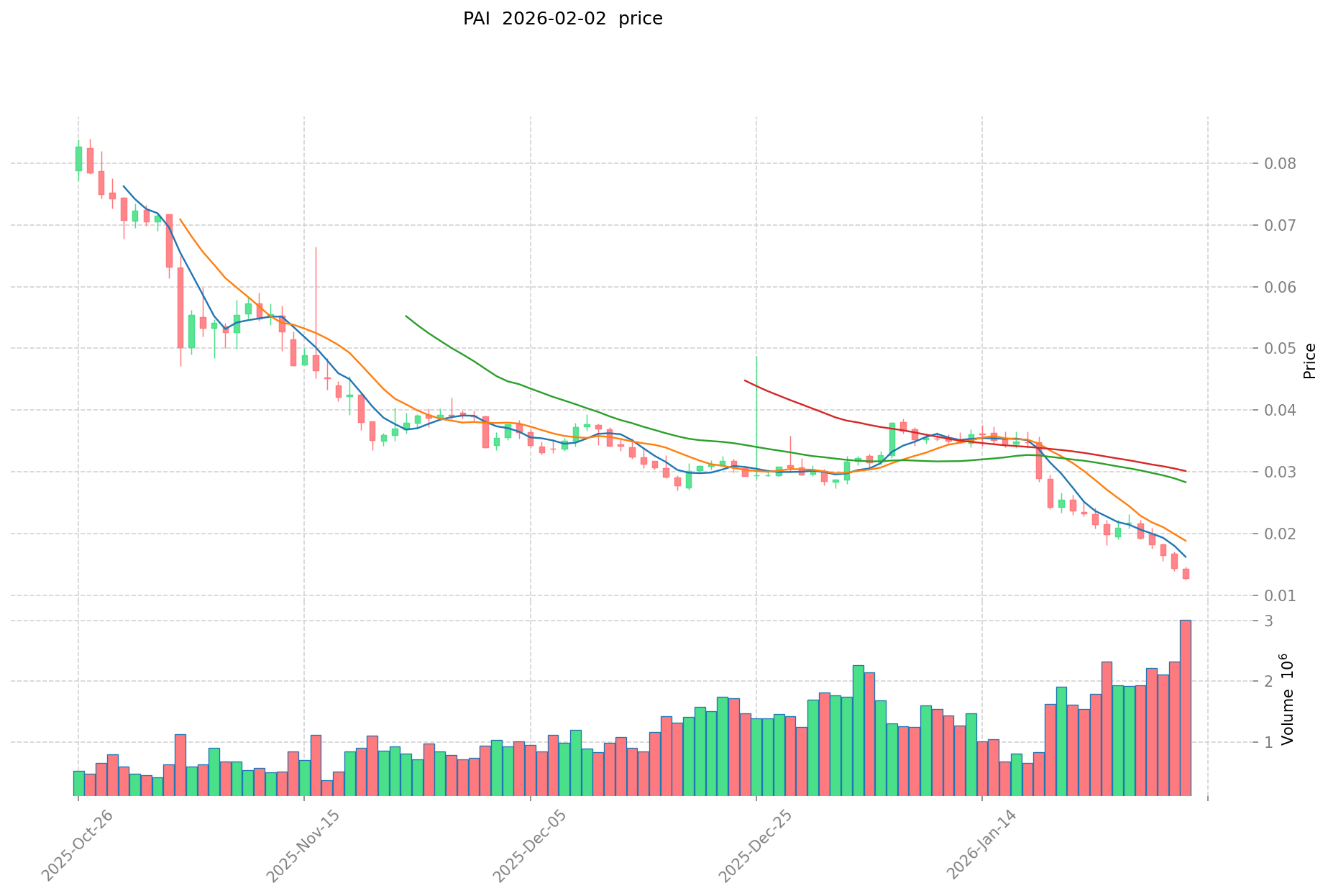
PAI reached a notable price point of $1.518 on December 12, 2024, driven by market dynamics during its initial listing phase. Its lowest price was $0.01189, occurring on February 02, 2026, reflecting broader market adjustments and volatility in the cryptocurrency sector. These fluctuations demonstrate the impact of market sentiment, adoption trends, and external factors on the token's valuation.
Click to view current PAI market price
On-Chain Metrics
- Holders: 10,724 addresses (reflecting user participation and token distribution)
- 24H Trading Volume: $31,691.07 (indicating current market activity levels)
- Market Cap to FDV Ratio: 100% (showing complete token circulation)
ParallelAI Ecosystem Applications and Strategic Partners
Core Use Cases
ParallelAI's ecosystem supports multiple applications:
- Decentralized AI Computing: The platform provides developers with access to distributed GPU resources, enabling scalable AI model training and inference at reduced costs.
- Blockchain Integration: ParallelAI connects AI development with blockchain infrastructure, offering transparent and cost-effective computational resource allocation.
Strategic Partnerships
While specific partnership details are not extensively documented in available materials, ParallelAI's decentralized approach positions it to collaborate with projects across AI and blockchain ecosystems. These potential collaborations aim to enhance its technical capabilities and expand market reach, providing a foundation for ecosystem growth.
Challenges and Controversies
ParallelAI faces several challenges:
- Market Volatility: The token has experienced significant price fluctuations, with a notable decline of approximately 94.81% over the past year.
- Competition Pressure: The project operates in a competitive landscape with other blockchain-based AI computing platforms.
- Adoption Challenges: Building developer trust and achieving widespread platform adoption remain ongoing efforts.
These issues have generated discussion within the community and continue to drive the project's innovation efforts.
ParallelAI Community and Social Media Atmosphere
Community Engagement
ParallelAI's community shows active participation, with the token holding approximately 10,724 holders as of February 2026. The project maintains presence on X platform through its official handle, where updates about platform development and ecosystem news are shared regularly.
Social Media Sentiment
Sentiment on X presents mixed perspectives:
- Supporters praise ParallelAI's decentralized approach to AI computing and cost reduction potential, viewing it as an innovative solution to GPU accessibility challenges.
- Critics focus on price volatility and the need for proven real-world adoption, expressing concerns about market performance.
Recent trends indicate cautious optimism as the project continues development efforts.
Popular Topics
X users discuss ParallelAI's GPU optimization technology, token economics, and competitive positioning in the decentralized AI computing space, highlighting both its innovation potential and the challenges of achieving mainstream adoption.
ParallelAI Additional Information Sources
- Official Website: Visit ParallelAI Official Website for features, use cases, and latest developments.
- Whitepaper: ParallelAI Documentation details its technical architecture, objectives, and vision for decentralized AI computing.
- X Updates: On X platform, ParallelAI maintains an active presence at @ParallelAIx, sharing content covering technical updates, community activities, and platform developments.
ParallelAI Future Roadmap
- Platform Development: Continue enhancing parallel processing solutions to improve GPU utilization efficiency and reduce computational costs for developers.
- Ecosystem Goals: Expand the global network of computational resources and increase developer adoption of the platform.
- Long-term Vision: Establish ParallelAI as a foundational infrastructure for accessible and democratized AI innovation worldwide.
How to Participate in ParallelAI?
- Purchase Options: PAI tokens can be acquired on Gate.com and other supported exchanges.
- Storage Solutions: Securely store PAI using compatible wallets that support ERC-20 tokens.
- Stay Informed: Follow official channels including the project website and X account for updates on platform development and ecosystem growth.
- Ecosystem Building: Developers can access platform documentation to explore integration opportunities and contribute to the decentralized AI computing ecosystem.
Summary
ParallelAI aims to transform AI development through blockchain technology, offering cost-effective GPU access, transparent resource allocation, and decentralized computing infrastructure. Its innovative approach to solving GPU bottlenecks and active development efforts position it as a notable project in the intersection of AI and blockchain technology.
Despite facing market volatility and adoption challenges, ParallelAI's clear mission and ongoing platform development demonstrate commitment to making AI computing more accessible. Whether you are new to decentralized AI or an experienced participant in the crypto space, ParallelAI represents an interesting project addressing real computational challenges in the AI development landscape.
FAQ
What is PAI (Project PAI) and what is its main purpose?
Project PAI is a web3 AI initiative pioneering small-model efficiency through open-source innovations. Its main purpose is to advance web3 applications by combining AI models and data technologies in the decentralized ecosystem.
How does PAI cryptocurrency work and what technology does it use?
PAI operates on blockchain technology using the Stellar Consensus Protocol (SCP), an energy-efficient alternative to traditional proof-of-work. It emphasizes low energy consumption and community-driven consensus mechanisms for secure transactions.
Where can you buy and trade PAI tokens?
PAI tokens are available on major cryptocurrency exchanges. Visit popular platforms, create an account, complete verification, and start trading. Check current market listings for real-time pricing and liquidity information.
What are the key features and advantages of PAI compared to other cryptocurrencies?
PAI focuses on decentralized economic systems with innovative market adjustment mechanisms, offering superior scalability and significantly lower transaction fees than traditional cryptocurrencies. Its enhanced efficiency and user experience provide distinct advantages in the crypto landscape.
Is PAI safe and secure? What are the potential risks?
PAI employs advanced blockchain technology with robust security protocols and smart contract audits. Like all crypto assets, risks include market volatility, regulatory changes, and technical vulnerabilities. Users should conduct thorough research before participating.
What is the tokenomics and supply of PAI?
PAI has a total supply of 100 million tokens with zero tokens currently in circulation. The fully diluted valuation is $3.59 million, with an all-time high price of $1.19.
What is the future roadmap and development plan for Project PAI?
Project PAI's roadmap focuses on local model support, enabling users to run PAI with local models. Development prioritizes enhanced local processing capabilities and seamless integration of advanced AI features for improved user experience.
Share
Content
ParallelAI's Positioning and Significance
Origin and Development History
How ParallelAI Works?
ParallelAI (PAI)'s Market Performance
ParallelAI Ecosystem Applications and Strategic Partners
Challenges and Controversies
ParallelAI Community and Social Media Atmosphere
ParallelAI Additional Information Sources
ParallelAI Future Roadmap
How to Participate in ParallelAI?
Summary
FAQ
How to Buy Cryptocurrency


Trending Cryptocurrencies



Survey Note: Detailed Analysis of the Best AI in 2025

What Is the Best AI Crypto in 2025?

What is the Best AI Now?

Why ChatGPT is Likely the Best AI Now?

How Does Solidus Ai Tech's Market Cap Compare to Other AI Cryptocurrencies?

MomoAI: AI-Powered Social Gaming Revolution on Solana
How to Select a Cryptocurrency Exchange: Top 5 International Recommendations
Top 7 Bitcoin Mining Machines for Profitable Operations

Comprehensive Guide to Token Offerings
Trading Patterns: A Beginner’s Guide
What is a node in cryptocurrency and how do you set one up