What is PDEX: A Comprehensive Guide to the Cardano DEX Platform and Its Features
Polkadex's Positioning and Significance
In 2021, the Polkadex team launched Polkadex (PDEX), aiming to address challenges in decentralized trading, such as poor user experience and limited liquidity in traditional DEX models.
As an open-source decentralized exchange built on the Substrate blockchain framework, Polkadex plays a key role in the DeFi trading sector.
As of 2026, Polkadex has established itself as a specialized trading platform within the Polkadot ecosystem, serving a community of over 4,200 token holders and maintaining active development efforts.
This article will explore its technical architecture, market performance, and future potential.
Origins and Development History
Background of Creation
Polkadex was developed by its founding team in 2021, aiming to solve the trade-off between decentralization and user experience in cryptocurrency exchanges.
It emerged during the rapid expansion of DeFi infrastructure, with the goal of providing traders with a centralized exchange-like experience while maintaining decentralized custody and transparency.
Polkadex's launch brought new possibilities to DeFi traders seeking order book-based trading.
Key Milestones
- 2021: Platform launch with initial trading functionality, implementing the Fluid Swap Protocol (FSP) as its core innovation.
- Ongoing development: Continuous improvements to the order book mechanism and trading infrastructure to enhance performance and user experience.
- 2026: Maintains listings on major platforms including Gate.com, with a circulating supply of 7.46 million PDEX tokens out of a maximum supply of 20 million.
With support from its development team and community, Polkadex continues to refine its technology, security measures, and practical applications.
How Polkadex Works
No Central Control
Polkadex operates on a decentralized network of computers (nodes) distributed globally, free from control by banks or governments.
These nodes collaborate to validate transactions, ensuring system transparency and attack resistance, granting users greater autonomy and enhancing network resilience.
Blockchain Foundation
Polkadex's blockchain is a public, immutable digital ledger that records every transaction.
Transactions are grouped into blocks, linked through cryptographic hashes to form a secure chain.
Anyone can view the records, establishing trust without intermediaries.
Built on the Substrate framework, it benefits from modular architecture and potential interoperability within the Polkadot ecosystem.
Ensuring Fairness
Polkadex employs a consensus mechanism to validate transactions and prevent fraudulent activities such as double-spending.
Network participants maintain security through node operation and validation activities, receiving PDEX rewards for their contributions.
Its innovation includes combining order book functionality with decentralized architecture, aiming to provide efficient trading experiences.
Secure Transactions
Polkadex uses public-private key cryptography to protect transactions:
- Private keys (like secret passwords) are used to sign transactions
- Public keys (like account numbers) are used to verify ownership
This mechanism ensures fund security while transactions maintain pseudonymous privacy.
The platform's architecture is designed to provide secure custody while enabling efficient order matching and execution.
Polkadex's Market Performance
Circulation Overview
As of February 08, 2026, Polkadex's circulating supply stands at 7,460,000 PDEX tokens, with a total supply of 7,460,000 tokens and a maximum supply cap of 20,000,000 tokens. The current circulation ratio is approximately 37.3% of the maximum supply, indicating a controlled token release schedule that may impact supply-demand dynamics over time.
Price Volatility
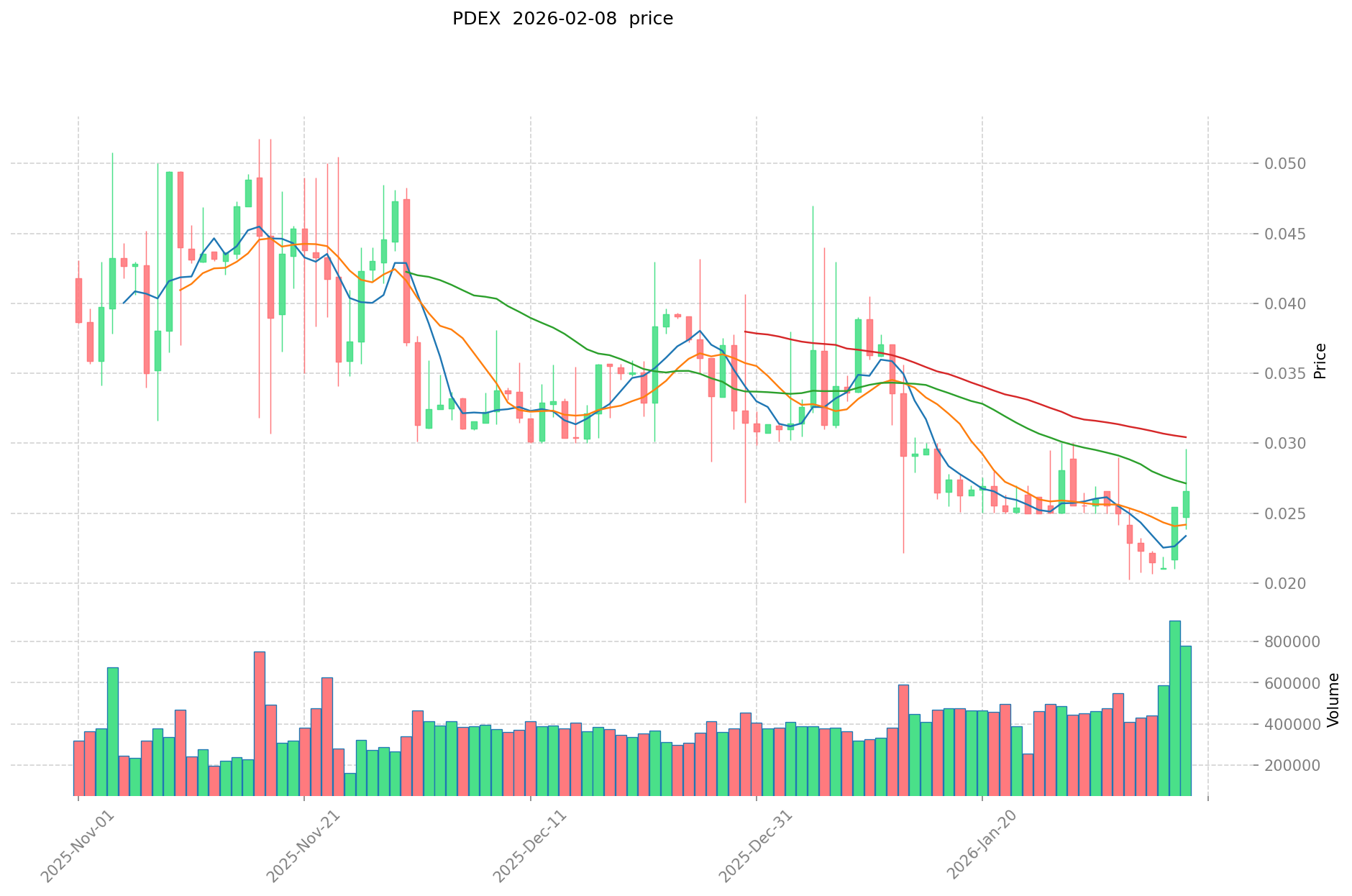
Polkadex reached its peak price of $39.38 on May 16, 2021, during a period of heightened market activity in the cryptocurrency sector. The token experienced its lowest recorded price of $0.01842911 on February 04, 2026, reflecting significant market correction and broader industry challenges.
Recent price movements show mixed signals: the token has experienced a -10.2% decline over the past 24 hours, with the current trading price at $0.02658. However, it demonstrated a 5.27% recovery over the 7-day period. The 30-day performance shows a -31.75% decrease, while the 1-year trajectory indicates a substantial -79.79% decline, illustrating the volatile nature of the asset and its sensitivity to market conditions.
Click to view the current PDEX market price
On-Chain Metrics
- 24-Hour Trading Volume: Approximately $7,877.39 in trading activity, indicating current market liquidity levels
- Market Capitalization: $198,286.80, representing a 0.0000078% share of the total cryptocurrency market
- Holder Count: 4,258 addresses hold PDEX tokens, reflecting the current distribution of ownership across the network
Polkadex Ecosystem Applications and Partners
Core Use Cases
Polkadex's ecosystem is built around its decentralized exchange infrastructure:
- Decentralized Trading: Polkadex provides an order book-based DEX experience that combines the user interface familiarity of centralized platforms with decentralized security, powered by its Fluid Swap Protocol (FSP).
- Substrate Framework Integration: As a Substrate-based blockchain, Polkadex leverages the Polkadot ecosystem's interoperability features to enable cross-chain trading capabilities.
Strategic Collaborations
While specific partnership details are not extensively documented in the available materials, Polkadex's foundation on the Substrate framework positions it within the broader Polkadot ecosystem, providing technical infrastructure and potential collaboration opportunities with other parachains and DeFi protocols.
Controversies and Challenges
Polkadex faces several challenges in its development:
- Market Competition: The decentralized exchange space includes numerous established platforms, requiring Polkadex to continuously innovate its Fluid Swap Protocol and user experience.
- Price Volatility: With 24-hour price fluctuations reaching -10.2% and a one-year decline of -79.79%, the token has experienced significant market pressure.
- Limited Exchange Availability: Currently listed on only 2 exchanges, which may impact liquidity and accessibility for potential users.
These challenges have sparked ongoing discussions within the community regarding ecosystem expansion and technical development priorities.
Polkadex Community and Social Media Atmosphere
Community Engagement
Polkadex maintains an active community presence with approximately 4,258 token holders. The project communicates through its official Telegram announcements channel and maintains visibility on X (formerly Twitter) through its official account.
Social Media Sentiment
The community discourse around Polkadex reflects diverse perspectives:
- Supporters emphasize the platform's innovative approach to combining order book functionality with decentralized infrastructure, viewing the Fluid Swap Protocol as a potential bridge between traditional and decentralized trading experiences.
- Critics point to significant price decline from its historical high of $39.38 to current levels around $0.02658, raising questions about market adoption and competitive positioning.
Recent trends show mixed sentiment, with 7-day performance showing a 5.27% increase, though longer timeframes reflect more challenging market conditions.
Discussion Topics
Community discussions frequently address topics including the platform's technical development roadmap, trading volume growth, and strategies for increasing ecosystem adoption in a competitive DEX landscape.
More Information Sources for Polkadex
- Official Website: Visit Polkadex official website for detailed information about platform features, trading mechanisms, and ecosystem updates.
- Blockchain Explorer: Monitor network activity and transactions through PDEXmon Explorer.
- X Updates: Follow Polkadex on X platform via @polkadex for announcements regarding technical developments, community initiatives, and platform milestones.
- Development Resources: Access technical documentation and contribute to the project through Polkadex GitHub.
How to Participate in Polkadex?
- Purchase Options: Acquire PDEX tokens through Gate.com and other supporting exchanges
- Storage Solutions: Securely store PDEX using compatible wallets that support Substrate-based tokens
- Platform Utilization: Access the Polkadex trading platform to experience its order book-based decentralized exchange functionality
- Ecosystem Contribution: Developers can explore the GitHub repository to contribute to protocol development or build applications leveraging the Polkadex infrastructure
Summary
Polkadex represents an innovative approach to decentralized trading by combining order book functionality with blockchain security through its Fluid Swap Protocol. Built on the Substrate framework, the platform aims to deliver centralized exchange user experience while maintaining decentralization principles.
With a circulating supply of 7.46 million tokens out of a maximum supply of 20 million, and a market capitalization around $198,286, Polkadex operates as a specialized project within the broader DeFi ecosystem. Despite facing challenges including price volatility and competitive market conditions, the project's technical foundation and focus on improving decentralized trading experience position it as a noteworthy participant in the DEX space.
Whether you're interested in decentralized trading infrastructure or exploring alternatives to traditional exchange models, Polkadex offers a distinct approach worth monitoring as the platform continues its development journey.
FAQ
What is PDEX and what problem does it solve in the cryptocurrency market?
PDEX is a decentralized exchange platform combining centralized and decentralized features. It solves liquidity fragmentation and trading inefficiency by offering seamless cross-chain trading with high performance and user control over assets.
How does PDEX work and what are its main features and use cases?
PDEX enables standardized payer data exchange using FHIR APIs, allowing real-time information sharing between healthcare organizations. Main features include transparent data interoperability and automated information exchange. Use cases support value-based care initiatives and enhanced healthcare data collaboration.
What is the difference between PDEX and other decentralized exchange tokens?
PDEX operates on the Polkadot network with superior cross-chain interoperability and scalability. Unlike other DEX tokens, PDEX leverages smart contracts for secure, automated trading without intermediaries, offering faster settlement and lower fees.
How can I buy, store, and trade PDEX tokens?
Purchase PDEX on exchanges like AscendEX, Gate.com, Uniswap V2, or Uniswap V3. Store tokens in a secure Web3 wallet. Trade on these platforms or other DEX protocols supporting PDEX pairs.
What are the risks and security considerations when using PDEX?
PDEX risks include smart contract vulnerabilities, liquidity risks, and market volatility. Security considerations involve wallet protection, private key management, and using audited protocols. Always verify contract authenticity and employ multi-signature wallets for large holdings.
What is the tokenomics and future roadmap of the PDEX project?
PDEX incentivizes trading and liquidity provision through tokenomics. The roadmap focuses on expanding the decentralized trading platform, enhancing the Fluid Exchange Protocol, and driving broader ecosystem adoption and growth.
Share
Content
Polkadex's Positioning and Significance
Origins and Development History
How Polkadex Works
Polkadex's Market Performance
Polkadex Ecosystem Applications and Partners
Controversies and Challenges
Polkadex Community and Social Media Atmosphere
More Information Sources for Polkadex
How to Participate in Polkadex?
Summary
FAQ
How to Buy Cryptocurrency


Trending Cryptocurrencies



What will be the market capitalization of USDC in 2025? Analysis of the stablecoin market landscape.

How is DeFi different from Bitcoin?

What is DeFi: Understanding Decentralized Finance in 2025

USDC stablecoin 2025 Latest Analysis: Principles, Advantages, and Web3 Eco-Applications
Development of Decentralized Finance Ecosystem in 2025: Integration of Decentralized Finance Applications with Web3
2025 USDT USD Complete Guide: A Must-Read for Newbie Investors
Comprehensive Guide to Optimism: Ethereum Layer 2 Scaling Solutions
Top 9 AI Solutions for Exchange Trading: Software and Trading Bots
NFT Creation Costs: A Complete Analysis Guide
CFD Regulations in Poland and Worldwide – Are Contracts for Difference Legal?

Which Crypto Trading Bot to Choose?