SatLayer (SLAY) is a Bitcoin economic layer protocol launched in 2025 to transform Bitcoin from idle capital into programmable collateral infrastructure. Operating as a decentralized network through public-private key cryptography, SLAY enables Bitcoin utility across DeFi, AI infrastructure, real-world assets (RWA), and stablecoin ecosystems. The SLAY token, trading on Gate.com since February 2026, has a circulating supply of 546 million out of 2.1 billion total tokens, with current market capitalization around $1.15 million and 1,790 active holders. The protocol addresses Bitcoin's limited programmability by establishing it as productive collateral while maintaining decentralization and transaction security through consensus mechanisms. Despite market volatility and competitive pressures, SatLayer's vision positions Bitcoin as an asset capable of generating yield across multiple financial applications, attracting both developers and investors seeking Bitcoin-backed financial innovation.
SatLayer's Positioning and Significance
In 2025, SatLayer launched SatLayer (SLAY) to address Bitcoin's underutilization as idle capital. As Bitcoin's economic layer, SatLayer plays a key role in DeFi, RWA, AI infrastructure, and stablecoin ecosystems.
As of 2026, SatLayer has become a programmable collateral infrastructure within the Bitcoin economy, with 1,790 holders and an active development community. This article will provide an in-depth analysis of its technical architecture, market performance, and future potential.
Origin and Development History
Birth Background
SatLayer was created in 2025 to solve Bitcoin's limited programmability and lack of productive utility in emerging financial systems. It emerged during Bitcoin's transition toward becoming a global reserve asset, with the goal of transforming BTC from dormant capital into programmable collateral for AI, DeFi, RWA, stablecoins, and traditional finance. SatLayer's launch brought new possibilities to Bitcoin holders and DeFi protocols seeking Bitcoin-backed liquidity.
Key Milestones
- 2025: Mainnet launch, enabling Bitcoin to function as programmable collateral.
- February 2026: Trading began on Gate.com, expanding accessibility for global users.
With support from its foundation and developer community, SatLayer continues to optimize its technology, security, and real-world applications.
How SatLayer Works?
No Central Control
SatLayer operates on a decentralized network of global nodes, free from bank or government control. These nodes collaborate to validate transactions, ensuring transparency and attack resistance while granting users greater autonomy and enhancing network resilience.
Blockchain Core
SatLayer's blockchain is a public, immutable digital ledger that records every transaction. Transactions are grouped into blocks and linked through cryptographic hashes to form a secure chain. Anyone can view the records, establishing trust without intermediaries.
Ensuring Fairness
SatLayer employs a consensus mechanism to validate transactions and prevent fraud such as double-spending. Network participants maintain security through validation activities and receive SLAY rewards. Its innovation includes enabling Bitcoin to serve as collateral across multiple financial applications.
Secure Transactions
SatLayer uses public-private key cryptography to protect transactions:
- Private keys (like secret passwords) sign transactions
- Public keys (like account numbers) verify ownership
This mechanism ensures fund security while maintaining transaction pseudonymity.
Circulation Overview
As of 03 February 2026, SLAY has a circulating supply of 546,000,000 tokens, with a total supply of 2,100,000,000 tokens and a maximum supply capped at 2,100,000,000 tokens, indicating a fixed supply model.
The current circulating supply represents approximately 21% of the total supply, with the remaining tokens potentially subject to future release schedules that may influence market dynamics through supply-side pressure.
Price Volatility
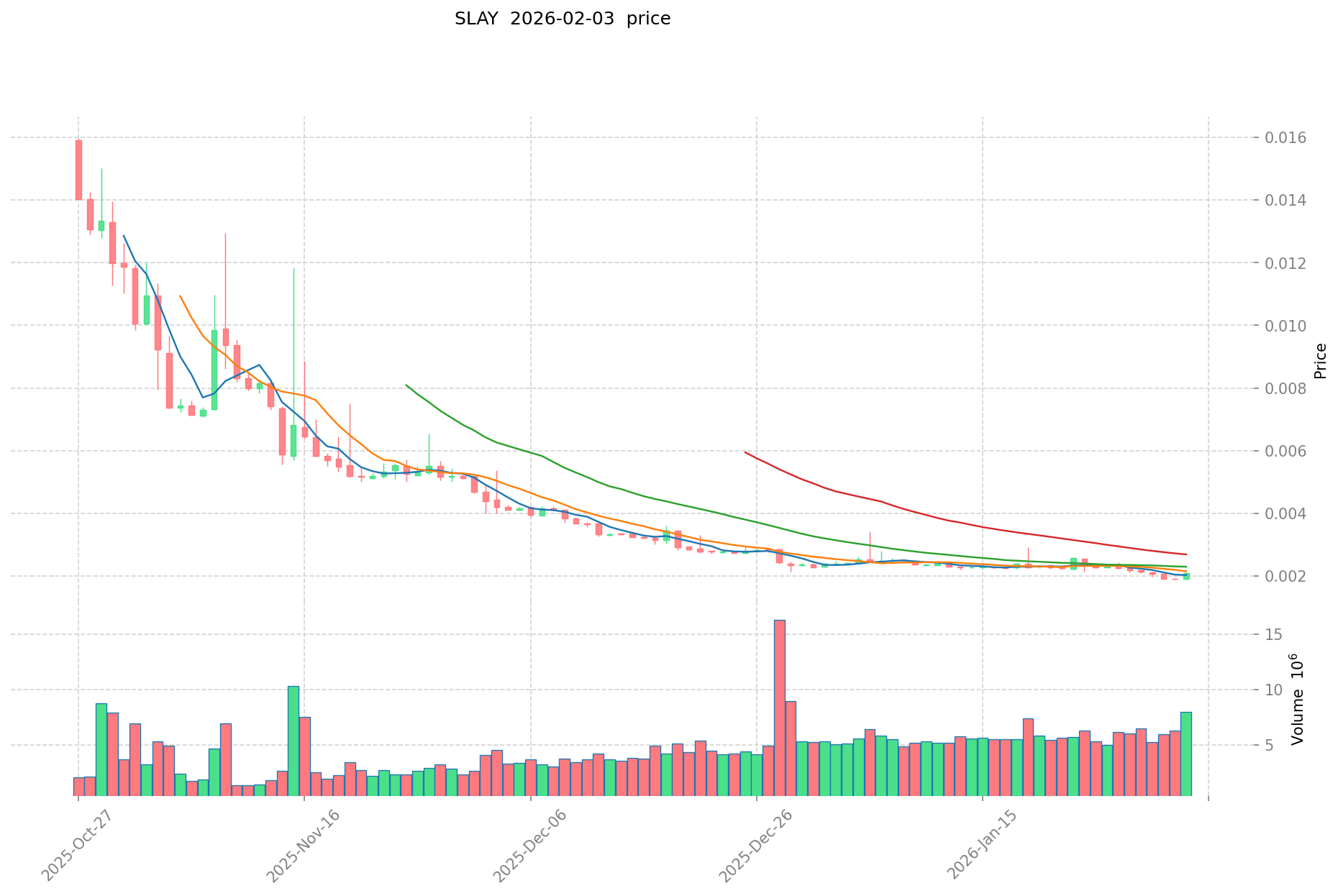
SLAY reached an all-time high of $0.13933 on 11 August 2025, reflecting a period of market interest following its launch.
The token recorded its lowest price of $0.001879 on 01 February 2026, representing significant downward movement from its peak.
As of the latest update, SLAY is trading at $0.002108, showing a 24-hour increase of 10.91% and a 1-hour gain of 0.71%. However, the token has experienced declines of -5.14% over the past 7 days and -14.05% over the past 30 days, indicating recent market volatility and price consolidation.
Click to view the current SLAY market price
On-Chain Metrics
- 24-Hour Trading Volume: The token recorded a trading volume of $15,564.11 over the past 24 hours
- Market Capitalization: SLAY currently maintains a market capitalization of approximately $1,150,968
- Token Holders: The network has 1,790 token holders, reflecting the community distribution
- Exchange Listings: SLAY is available on 8 exchanges, providing multiple liquidity channels for traders
SatLayer Ecosystem Applications and Partners
Core Use Cases
SatLayer's ecosystem supports multiple applications across the crypto landscape:
- DeFi: SatLayer transforms Bitcoin into programmable collateral for decentralized finance protocols, enabling liquidity provision and lending mechanisms.
- AI Integration: The platform facilitates Bitcoin-backed AI applications, allowing BTC to serve as productive collateral for artificial intelligence infrastructure.
- RWA (Real World Assets): SatLayer enables tokenization of traditional assets, bridging Bitcoin with real-world financial instruments.
- Stablecoins: The protocol supports Bitcoin-backed stablecoin issuance, providing stable value mechanisms anchored by BTC collateral.
Strategic Partnerships
SatLayer continues to expand its ecosystem through strategic collaborations, enhancing its technical capabilities and market presence.
These partnerships provide a solid foundation for SatLayer's ecosystem expansion.
Challenges and Considerations
SatLayer faces several industry-wide challenges:
- Technical Complexity: Implementing Bitcoin programmability while maintaining security standards
- Market Volatility: Price fluctuations affecting collateral value and ecosystem stability
- Competitive Landscape: Evolution of Bitcoin Layer 2 solutions and programmability protocols
These considerations drive ongoing innovation within the SatLayer ecosystem.
SatLayer's community shows active participation, with the token holder base reaching 1,790 addresses.
On X platform, discussions around SatLayer and its vision for Bitcoin programmability generate regular engagement.
Key developments such as ecosystem updates and partnership announcements energize community participation.
X platform discussions present diverse perspectives:
- Supporters emphasize SatLayer's innovative approach to Bitcoin utility, viewing it as infrastructure for Bitcoin's economic evolution.
- Analysts monitor token performance metrics, ecosystem development progress, and adoption trends.
Recent trends reflect mixed sentiment influenced by broader market conditions and project milestones.
Trending Topics
X users actively discuss SatLayer's Bitcoin programmability vision, DeFi integration potential, and tokenomics structure,
highlighting both opportunities and considerations for Bitcoin-based economic infrastructure.
- Official Website: Visit SatLayer Official Site for features, use cases, and latest updates.
- Documentation: SatLayer Litepaper details its technical architecture, goals, and vision for Bitcoin's economic layer.
- X Updates: SatLayer maintains an active presence on X platform at @satlayer,
sharing updates on technical developments, ecosystem growth, and community initiatives.
- Community Hub: Join discussions on Discord to engage with the community.
SatLayer Future Roadmap
- Ecosystem Expansion: Develop Bitcoin programmability infrastructure for AI, DeFi, and RWA applications
- Technical Enhancement: Advance collateralization mechanisms and smart contract capabilities
- Long-term Vision: Establish Bitcoin as productive programmable collateral across multiple sectors including traditional finance
How to Participate in SatLayer?
- Purchase Options: SLAY tokens are available on Gate.com and other cryptocurrency exchanges
- Storage Solutions: Use ERC-20 compatible wallets such as MetaMask or hardware wallets for secure storage
- Community Engagement: Follow official channels and participate in Discord discussions
- Ecosystem Development: Visit developer documentation to explore integration opportunities
Summary
SatLayer redefines Bitcoin's utility through programmable collateral infrastructure, offering economic layer functionality for AI, DeFi, RWA, and stablecoin applications.
Its innovative approach and technical architecture position it within the evolving Bitcoin ecosystem.
Despite facing market volatility and competitive pressures, SatLayer's vision for transforming Bitcoin from idle asset to productive collateral presents an interesting proposition in decentralized finance.
Whether you're new to crypto or an experienced participant, SatLayer's approach to Bitcoin programmability merits attention and consideration.
FAQ
What is SLAY? What kind of cryptocurrency or blockchain project is it?
SLAY is the token of SatLayer protocol, designed to transform Bitcoin into a programmable asset. It's a blockchain project focused on unlocking new use cases for Bitcoin by converting it from a passive store of value into a productive, programmable asset.
What are the uses and value of SLAY? What are its core functions?
SLAY token serves three core functions: staking for network security, governance for community decisions, and dividend distribution for token holders. It enables participants to earn rewards while actively shaping protocol development.
How to buy and hold SLAY tokens? Which exchanges support trading?
Purchase SLAY tokens through decentralized exchanges with direct on-chain transactions. No custodial wallet required. Access optimal market prices through aggregated liquidity pools. Hold tokens securely in your personal crypto wallet.
What are the risks of investing in SLAY? What should I pay attention to?
SLAY is a high-risk investment that may result in losses. Understand the tokenomics thoroughly, monitor market volatility, and only invest capital you can afford to lose. Conduct due diligence before participation.
What are the differences and advantages of SLAY compared to other mainstream cryptocurrencies?
SLAY distinguishes itself through its unique financing structure that merges users and investors early on, combined with efficient creative networks. Key advantages include lower transaction costs and enhanced capital liquidity compared to mainstream cryptocurrencies.
What is the development prospect and future plan of SLAY?
SLAY, as a Bitcoin economic layer, demonstrates strong growth potential. Market analysis indicates continued price appreciation through 2026. Future roadmap includes technical upgrades, ecosystem expansion, and enhanced Bitcoin integration to strengthen its position in the crypto industry.
* The information is not intended to be and does not constitute financial advice or any other recommendation of any sort offered or endorsed by Gate.