This comprehensive guide compares WLTH and ICP, two distinct tokens operating within the cryptocurrency ecosystem. WLTH, launched in 2024, functions as an early-stage investment vehicle offering exposure to diversified digital assets including USDC, Bitcoin, and Ethereum. ICP, since 2019, operates as a decentralized cloud blockchain infrastructure platform. The analysis examines critical differentiators including market capitalization ($2.26 million vs $1.29 billion), trading volume, tokenomics, and institutional adoption patterns. Current market positioning shows WLTH at rank 3,077 with limited liquidity, while ICP ranks 62 with substantially higher trading activity. The article evaluates price trajectories through 2031, investment strategies for conservative and aggressive investors, technical ecosystems, and regulatory considerations. Both assets present distinct risk-return profiles suited to different investor types, with comprehensive guidance for portfolio allocation decisions and detailed risk assessm
Introduction: Investment Comparison Between WLTH and ICP
In the cryptocurrency market, the comparison between WLTH vs ICP has become a topic of interest for investors. The two projects differ significantly in market cap ranking, application scenarios, and price performance, representing distinct positioning within the crypto asset landscape.
WLTH (WLTH): Launched in 2024, this token is designed as an early-stage investment system aimed at democratizing access to venture capital opportunities for retail investors through Web3 principles.
ICP (ICP): Since its introduction in 2019, Internet Computer has been recognized as a decentralized cloud blockchain, supporting secure applications, websites, and enterprise systems with multi-chain capabilities.
This article will provide a comprehensive analysis of WLTH vs ICP investment value comparison, focusing on historical price trends, supply mechanisms, institutional adoption, technical ecosystems, and future outlook, attempting to address investors' most pressing question:
"Which is the better buy right now?"
I. Historical Price Comparison and Current Market Status
WLTH and ICP Historical Price Trends
- 2024-05-30: WLTH reached a notable price level of $0.2945, representing a significant milestone in its early trading history.
- 2021-05-11: ICP experienced substantial price activity, with its price reaching $700.65 during the initial market enthusiasm phase.
- 2025-04-18: WLTH recorded its lower price point at $0.002111, reflecting a period of market adjustment.
- 2025-10-11: ICP marked its lower price point at $2.23, indicating a phase of market recalibration.
- Comparative Analysis: During the market cycle from 2021 to 2026, ICP demonstrated significant volatility, moving from $700.65 to current levels around $2.358, while WLTH has shown a different trajectory with more recent market entry and fluctuation from $0.2945 to $0.00231.
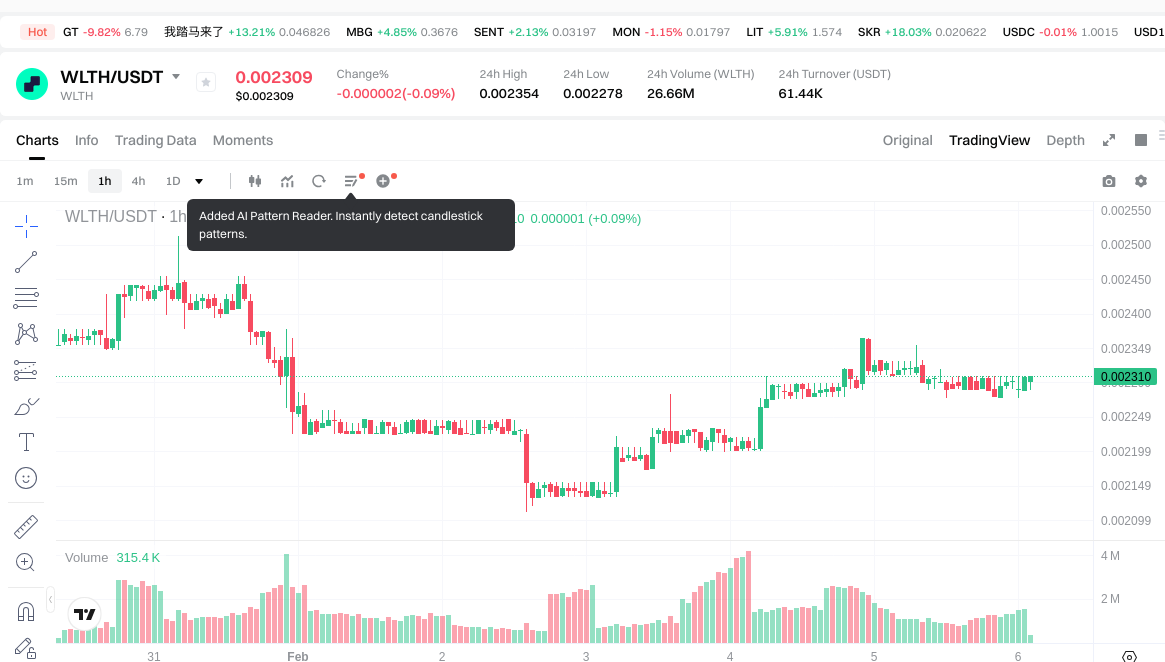
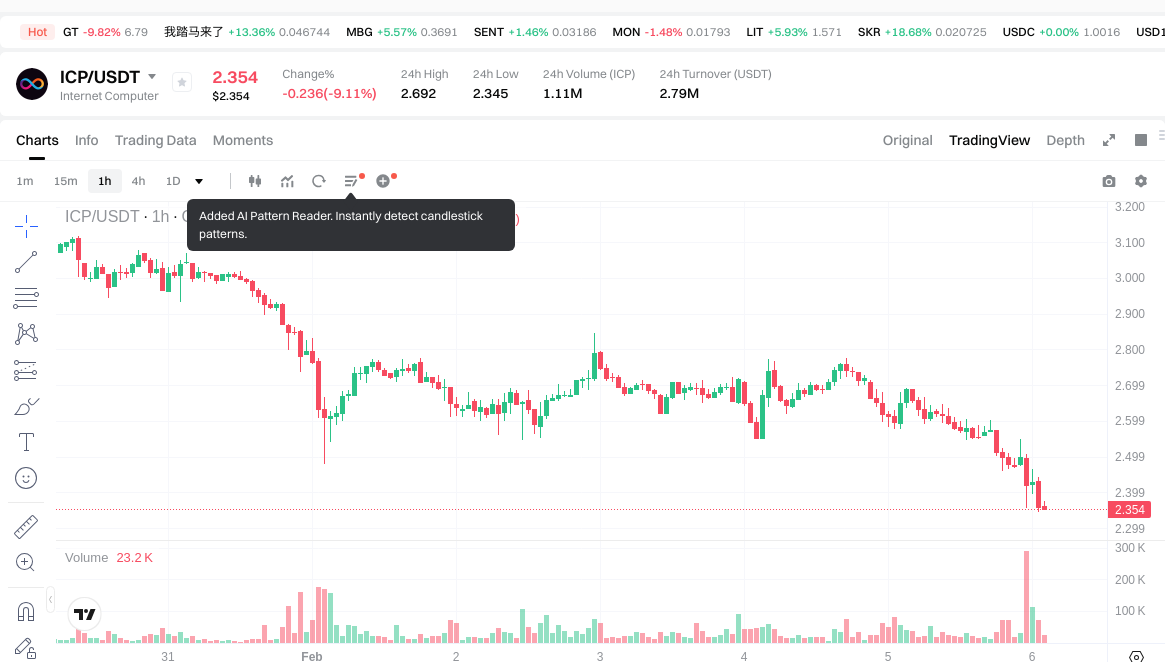
Current Market Status (2026-02-06)
- WLTH Current Price: $0.00231
- ICP Current Price: $2.358
- 24-Hour Trading Volume: WLTH recorded $61,384.83 compared to ICP's $2,763,200.62
- Market Sentiment Index (Fear & Greed Index): 12 (Extreme Fear)
- 24-Hour Price Changes: WLTH decreased by 0.68%, while ICP decreased by 9.26%
- Market Capitalization: WLTH ranks at position 3,077 with a market cap of approximately $2.26 million, while ICP ranks at position 62 with a market cap of approximately $1.29 billion
- Circulation Ratio: WLTH has 20.0% of tokens in circulation (200 million out of 1 billion maximum supply), while ICP has approximately 100% circulation (547.8 million tokens)
View real-time prices:
II. Core Factors Influencing WLTH vs ICP Investment Value
Tokenomics Comparison
-
WLTH: According to available information, WLTH's investment portfolio primarily consists of USD-backed stablecoin USDC, followed by Wrapped Bitcoin (BTC) and Ether (ETH), with the top 13 assets accounting for nearly $100 million of the company's $103 million portfolio. The supply mechanism details are not extensively documented in the reference materials.
-
ICP: As an innovative blockchain platform, ICP has demonstrated notable market performance with a market capitalization exceeding $3.1 billion as of 2025. The specific supply mechanism characteristics require further technical documentation for comprehensive analysis.
-
📌 Historical Pattern: Supply mechanisms play a significant role in driving price cycle variations, though specific historical correlations for these assets require additional market data analysis.
Institutional Adoption and Market Application
-
Institutional Holdings: WLTH demonstrates institutional preference through its structured allocation toward established digital assets including USDC, Wrapped Bitcoin, and Ether. ICP has attracted attention as a blockchain platform with growing market capitalization, though specific institutional holding data was not detailed in the reference materials.
-
Enterprise Adoption: The reference materials indicate WLTH focuses on major cryptocurrencies and stablecoins within its investment framework. ICP positions itself as an innovative blockchain platform with potential applications across various industries, though specific cross-border payment and settlement implementations require additional documentation.
-
National Policy: Regulatory attitudes vary across different jurisdictions. Investors should balance enthusiasm with rationality, conducting thorough research (DYOR) to understand core project value rather than pursuing short-term gains alone.
Technology Development and Ecosystem Building
-
WLTH Technology Development: As an investment vehicle, WLTH's technological focus centers on portfolio management of established digital assets rather than proprietary blockchain development.
-
ICP Technology Development: ICP demonstrates competitive positioning through leading performance indicators and market share growth, with differentiation factors supporting its competitive advantage. The platform aims to advance FPGA innovation and business growth to meet AI-driven market demands, though specific technical upgrade details require additional technical documentation.
-
Ecosystem Comparison: Reference materials suggest ICP pursues decentralized applications across various industries. Specific implementations in DeFi, NFT, payment solutions, and smart contract deployment require comprehensive ecosystem analysis beyond the provided materials.
Macroeconomic Environment and Market Cycles
-
Performance in Inflationary Environment: The anti-inflation properties of both assets require evaluation based on their respective characteristics. WLTH's heavy allocation to stablecoins may provide different inflation response mechanisms compared to ICP's blockchain platform model.
-
Macroeconomic Monetary Policy: Interest rates and dollar index movements can influence both assets differently based on their underlying mechanisms and market positioning. Comprehensive analysis requires monitoring policy developments and their sector-specific impacts.
-
Geopolitical Factors: Cross-border transaction demand and international developments may affect adoption patterns. Investors should consider how regional policies and global market dynamics influence both investment approaches and blockchain platform development.
III. 2026-2031 Price Forecast: WLTH vs ICP
Short-term Forecast (2026)
- WLTH: Conservative scenario suggests a range between $0.0015708 and $0.00231, with optimistic projections reaching up to $0.0026103
- ICP: Conservative scenario indicates a range between $2.24295 and $2.361, with optimistic projections potentially reaching $2.43183
Mid-term Forecast (2028-2029)
- WLTH may enter a gradual expansion phase, with anticipated price ranges between $0.002066279985 and $0.003741642135 in 2028, potentially extending to $0.002711573639775 - $0.00385500830715 by 2029
- ICP may enter a consolidation and growth phase, with projected ranges between $1.95008270625 and $2.7561168915 in 2028, potentially reaching $2.5442079040875 - $3.6154533373875 by 2029
- Key drivers: institutional capital flows, ETF developments, ecosystem expansion
Long-term Forecast (2030-2031)
- WLTH: Baseline scenario projects a range of $0.003347323314835 - $0.003560982249825 by 2030, with optimistic scenarios potentially reaching $0.004593667102274; by 2031, baseline estimates suggest $0.003547272468163 - $0.004077324676049, with upside potential to $0.005708254546469
- ICP: Baseline scenario anticipates a range of $2.7691694450805 - $3.14678346031875 by 2030, with optimistic scenarios potentially reaching $3.996414994604812; by 2031, baseline projections indicate $2.92871136651866 - $3.571599227461781, with upside potential to $4.357351057503373
View detailed price predictions for WLTH and ICP
Disclaimer: These forecasts are based on analytical models and historical data patterns. Cryptocurrency markets remain highly volatile and subject to numerous unpredictable factors. Price projections should not be considered as investment advice or guarantees of future performance.
WLTH:
| Year |
Predicted High Price |
Predicted Average Price |
Predicted Low Price |
Price Change |
| 2026 |
0.0026103 |
0.00231 |
0.0015708 |
0 |
| 2027 |
0.0031243905 |
0.00246015 |
0.0020419245 |
6 |
| 2028 |
0.003741642135 |
0.00279227025 |
0.002066279985 |
20 |
| 2029 |
0.00385500830715 |
0.0032669561925 |
0.002711573639775 |
41 |
| 2030 |
0.004593667102274 |
0.003560982249825 |
0.003347323314835 |
54 |
| 2031 |
0.005708254546469 |
0.004077324676049 |
0.003547272468163 |
76 |
ICP:
| Year |
Predicted High Price |
Predicted Average Price |
Predicted Low Price |
Price Change |
| 2026 |
2.43183 |
2.361 |
2.24295 |
0 |
| 2027 |
2.80380555 |
2.396415 |
1.41388485 |
1 |
| 2028 |
2.7561168915 |
2.600110275 |
1.95008270625 |
10 |
| 2029 |
3.6154533373875 |
2.67811358325 |
2.5442079040875 |
13 |
| 2030 |
3.996414994604812 |
3.14678346031875 |
2.7691694450805 |
33 |
| 2031 |
4.357351057503373 |
3.571599227461781 |
2.92871136651866 |
51 |
IV. Investment Strategy Comparison: WLTH vs ICP
Long-term vs Short-term Investment Strategies
-
WLTH: May appeal to investors seeking exposure to diversified digital asset portfolios with significant stablecoin allocation, potentially suitable for those prioritizing capital preservation alongside cryptocurrency market participation. The token's early-stage positioning and lower market capitalization suggest higher volatility characteristics that may attract certain risk-tolerant investors.
-
ICP: May appeal to investors interested in blockchain infrastructure development and decentralized cloud computing applications, potentially suitable for those seeking exposure to platform-layer technology with established market presence. The project's longer operational history and larger market capitalization suggest different risk-return characteristics compared to earlier-stage assets.
Risk Management and Asset Allocation
-
Conservative Investors: A balanced approach might consider limited exposure to both assets as part of a diversified cryptocurrency portfolio, with WLTH representing approximately 5-10% and ICP representing approximately 10-20% of the crypto allocation, complemented by major market cap assets and stablecoins.
-
Aggressive Investors: Higher risk tolerance portfolios might allocate WLTH at approximately 15-25% and ICP at approximately 20-30% of crypto holdings, while maintaining awareness of volatility risks associated with both assets.
-
Hedging Tools: Portfolio risk management may incorporate stablecoin positions for liquidity preservation, options strategies where available for downside protection, and cross-asset diversification across multiple blockchain ecosystems and use cases.
V. Potential Risk Comparison
Market Risks
-
WLTH: The token faces substantial market risks including limited trading volume ($61,384.83 in 24-hour volume as of 2026-02-06), lower market capitalization ranking (position 3,077), and limited liquidity which may result in price volatility. The early-stage nature of the project introduces uncertainty regarding long-term market acceptance and sustainability.
-
ICP: Market risks include significant historical price volatility (from previous levels around $700.65 to current $2.358), ongoing market sentiment challenges reflected in recent price decline (9.26% decrease in 24 hours), and competitive pressures within the blockchain infrastructure sector. The asset remains subject to broader cryptocurrency market cycles and investor sentiment shifts.
Technical Risks
-
WLTH: As an investment vehicle focused on portfolio allocation rather than proprietary technology development, technical risks primarily relate to the underlying assets held within the portfolio structure. The concentration in specific assets (USDC, Wrapped Bitcoin, Ether) introduces dependency on those protocols' technical stability.
-
ICP: Technical considerations include blockchain scalability requirements, network performance consistency, and ongoing development challenges associated with maintaining a decentralized cloud computing infrastructure. Platform complexity and competitive technological advancement in the blockchain space present ongoing technical adaptation requirements.
Regulatory Risks
-
Regulatory frameworks continue evolving across different jurisdictions, potentially affecting both investment vehicle structures (WLTH) and blockchain platform operations (ICP) differently. Changes in securities regulations, tax treatment of digital assets, and cross-border transaction policies may influence operational viability and market accessibility for both projects.
-
Compliance requirements for tokenized investment products and decentralized infrastructure platforms vary significantly across regions, introducing uncertainty regarding future regulatory treatment and potential operational constraints.
VI. Conclusion: Which Is the Better Buy?
📌 Investment Value Summary:
-
WLTH Characteristics: The token presents as an early-stage investment vehicle with substantial stablecoin allocation, offering a different approach to cryptocurrency market participation through portfolio diversification. Current market positioning reflects early development phase with associated volatility and liquidity considerations.
-
ICP Characteristics: The project represents established blockchain infrastructure with longer operational history, larger market capitalization, and positioning within the decentralized cloud computing sector. The platform demonstrates ongoing development efforts and ecosystem expansion initiatives within the competitive blockchain landscape.
✅ Investment Considerations:
-
Beginning Investors: May consider starting with established, higher market cap digital assets before exploring either WLTH or ICP, ensuring thorough understanding of cryptocurrency fundamentals, risk management principles, and only allocating capital that can be sustained through market volatility.
-
Experienced Investors: Should conduct comprehensive due diligence on both projects' fundamentals, team backgrounds, development roadmaps, and competitive positioning. Portfolio allocation decisions should align with individual risk tolerance, investment timeframes, and overall portfolio diversification strategy.
-
Institutional Investors: Require detailed analysis of regulatory compliance frameworks, liquidity characteristics, custody solutions, and risk management infrastructure before considering allocation to either asset. Both projects present different risk-return profiles requiring careful evaluation within institutional investment mandates.
⚠️ Risk Disclosure: Cryptocurrency markets demonstrate substantial volatility and uncertainty. This analysis does not constitute investment advice, financial recommendations, or guarantees of future performance. Investors should conduct independent research, consult qualified financial advisors, and only invest capital they can afford to lose. Past performance does not indicate future results.
VII. FAQ
Q1: What are the main differences between WLTH and ICP as investment options?
WLTH functions as an early-stage investment vehicle focusing on portfolio allocation across established digital assets (primarily USDC, Wrapped Bitcoin, and Ether), while ICP operates as a decentralized blockchain infrastructure platform for cloud computing applications. WLTH ranks at position 3,077 with a market cap of approximately $2.26 million and limited trading volume ($61,384.83 in 24 hours), representing a higher-risk, early-stage opportunity. ICP ranks at position 62 with a market cap of approximately $1.29 billion and substantially higher liquidity ($2,763,200.62 in 24-hour volume), offering exposure to established blockchain infrastructure development. The fundamental difference lies in their operational models: WLTH provides diversified cryptocurrency portfolio exposure through a token structure, while ICP delivers direct participation in a decentralized cloud computing platform's growth potential.
Q2: How do the price volatility patterns differ between WLTH and ICP?
ICP has demonstrated extreme volatility throughout its history, declining from approximately $700.65 in May 2021 to current levels around $2.358, representing a significant correction phase. WLTH, launched in 2024, has shown volatility from $0.2945 to $0.00231, with more recent market entry and different trajectory patterns. As of February 6, 2026, WLTH experienced a 0.68% decline while ICP decreased 9.26% in 24 hours, reflecting different market response mechanisms. ICP's longer operational history provides more extensive volatility data, showing susceptibility to broader market cycles and sentiment shifts. WLTH's limited trading history and lower liquidity suggest potential for higher percentage swings, though with less established pattern recognition for investors.
Q3: Which asset offers better liquidity for investors?
ICP provides significantly superior liquidity with 24-hour trading volume of $2,763,200.62 compared to WLTH's $61,384.83, representing approximately 45 times higher trading activity. ICP's market capitalization of $1.29 billion versus WLTH's $2.26 million indicates substantially deeper market depth and easier entry/exit capabilities for investors. The liquidity difference becomes particularly relevant during market volatility, where WLTH's limited trading volume may result in wider bid-ask spreads and potential slippage on larger orders. For investors prioritizing execution efficiency and position flexibility, ICP's established liquidity profile presents considerable advantages. However, investors should note that both assets remain subject to cryptocurrency market conditions, and liquidity can contract significantly during periods of extreme market stress.
Q4: What are the tokenomics considerations for WLTH versus ICP?
WLTH demonstrates a circulation ratio of 20.0% (200 million out of 1 billion maximum supply), indicating substantial token supply yet to enter circulation, which may create future selling pressure or unlock events requiring monitoring. The project's portfolio allocation heavily weights USD-backed stablecoins (USDC), followed by Wrapped Bitcoin and Ether, with top 13 assets comprising nearly $100 million of the $103 million portfolio. ICP maintains approximately 100% circulation (547.8 million tokens), suggesting full supply distribution and reduced concerns about future unlock events. The supply mechanism differences significantly impact investment considerations: WLTH's lower circulation percentage introduces uncertainty regarding token release schedules and potential dilution effects, while ICP's complete circulation provides clearer supply dynamics for valuation purposes.
Q5: How should conservative versus aggressive investors approach WLTH and ICP allocation?
Conservative investors might consider limited exposure with WLTH representing approximately 5-10% and ICP representing approximately 10-20% of their cryptocurrency portfolio allocation, complemented by major market cap assets and stablecoins for risk balance. This approach prioritizes capital preservation while maintaining moderate exposure to both portfolio-based and infrastructure-focused cryptocurrency opportunities. Aggressive investors with higher risk tolerance might allocate WLTH at approximately 15-25% and ICP at approximately 20-30% of crypto holdings, accepting increased volatility for potential higher returns. Both strategies require maintaining awareness that WLTH's early-stage positioning and limited liquidity present substantially different risk profiles compared to ICP's established market presence. Regardless of risk tolerance, investors should implement proper diversification across multiple blockchain ecosystems and use cases while only allocating capital they can sustain through market cycles.
Q6: What regulatory risks should investors consider for both assets?
Both WLTH and ICP face evolving regulatory frameworks that may affect their operational viability differently across jurisdictions. WLTH, structured as an investment vehicle holding diversified cryptocurrency portfolios, encounters potential securities regulation scrutiny regarding tokenized investment products, fund structure compliance, and investor protection requirements. ICP, operating as a decentralized blockchain infrastructure platform, faces regulatory considerations around platform liability, data privacy compliance, cross-border transaction policies, and potential classification under varying cryptocurrency regulatory frameworks. Changes in tax treatment of digital assets, securities regulations, and jurisdiction-specific compliance requirements introduce uncertainty for both projects. Investors should recognize that regulatory developments remain unpredictable and may significantly impact market accessibility, operational constraints, and overall investment viability for both WLTH and ICP.
Q7: What are the projected price trajectories for WLTH and ICP through 2031?
Analytical models suggest WLTH may trade between $0.0015708 and $0.0026103 in 2026, potentially expanding to $0.003547272468163 - $0.005708254546469 by 2031 under optimistic scenarios, representing approximately 76% cumulative growth from current levels. ICP projections indicate a range of $2.24295 to $2.43183 in 2026, potentially reaching $2.92871136651866 - $4.357351057503373 by 2031 under favorable conditions, suggesting approximately 51% cumulative growth potential. These forecasts incorporate historical patterns, supply mechanisms, and adoption trajectories but remain subject to substantial uncertainty given cryptocurrency market volatility. Mid-term forecasts (2028-2029) suggest both assets entering consolidation and gradual expansion phases, though actual performance will depend on institutional capital flows, ecosystem development, regulatory developments, and broader macroeconomic conditions. Investors should treat these projections as analytical frameworks rather than guaranteed outcomes.
Q8: How do technical development approaches differ between WLTH and ICP?
WLTH's technical focus centers on portfolio management and allocation strategies across established digital assets rather than proprietary blockchain development, positioning it as an investment vehicle leveraging existing cryptocurrency infrastructure. The project's technical risks primarily relate to underlying protocols supporting USDC, Wrapped Bitcoin, and Ether within its portfolio structure. ICP pursues active blockchain infrastructure development, focusing on decentralized cloud computing capabilities, scalability improvements, and ecosystem expansion for supporting applications, websites, and enterprise systems. ICP's technical roadmap involves ongoing platform enhancements addressing performance optimization, network reliability, and competitive positioning within the blockchain infrastructure sector. The fundamental technical distinction reflects different value propositions: WLTH provides diversified exposure through portfolio construction expertise, while ICP delivers direct participation in blockchain technology advancement and infrastructure development.
* The information is not intended to be and does not constitute financial advice or any other recommendation of any sort offered or endorsed by Gate.