WING vs LTC: A Comprehensive Comparison of Two Leading Cryptocurrency Platforms
Introduction: Investment Comparison Between WING and LTC
In the cryptocurrency market, the comparison between WING vs LTC has consistently been a topic that investors cannot bypass. Both exhibit significant differences in market cap ranking, application scenarios, and price performance, representing distinct crypto asset positioning.
WING (WING): Launched in 2020, it has gained market recognition through its positioning as a decentralized lending platform based on credit scoring and supporting cross-chain asset interactions.
Litecoin (LTC): Since its launch in 2011, it has been regarded as a peer-to-peer cryptocurrency alternative, becoming one of the globally traded cryptocurrencies with substantial trading volume and market capitalization.
This article will comprehensively analyze the investment value comparison of WING vs LTC around historical price trends, supply mechanisms, institutional adoption, technical ecosystems, and future predictions, attempting to answer the question that investors are most concerned about:
"Which is the better buy right now?"
I. Historical Price Comparison and Current Market Status
WING and LTC Historical Price Performance
- 2020: WING reached a notable price level of $140.81 following its launch in September, reflecting initial market interest in the decentralized credit-based lending protocol.
- 2021: LTC experienced significant price movement, with the token reaching $410.26 in May, driven by broader market momentum and increased adoption of established cryptocurrencies.
- Comparative Analysis: During the 2020-2025 market cycle, WING declined from its peak of $140.81 to a lower range near $0.07, while LTC demonstrated relatively stronger price retention, trading in a range between $1.15 and $410.26 across its trading history.
Current Market Conditions (2026-02-06)
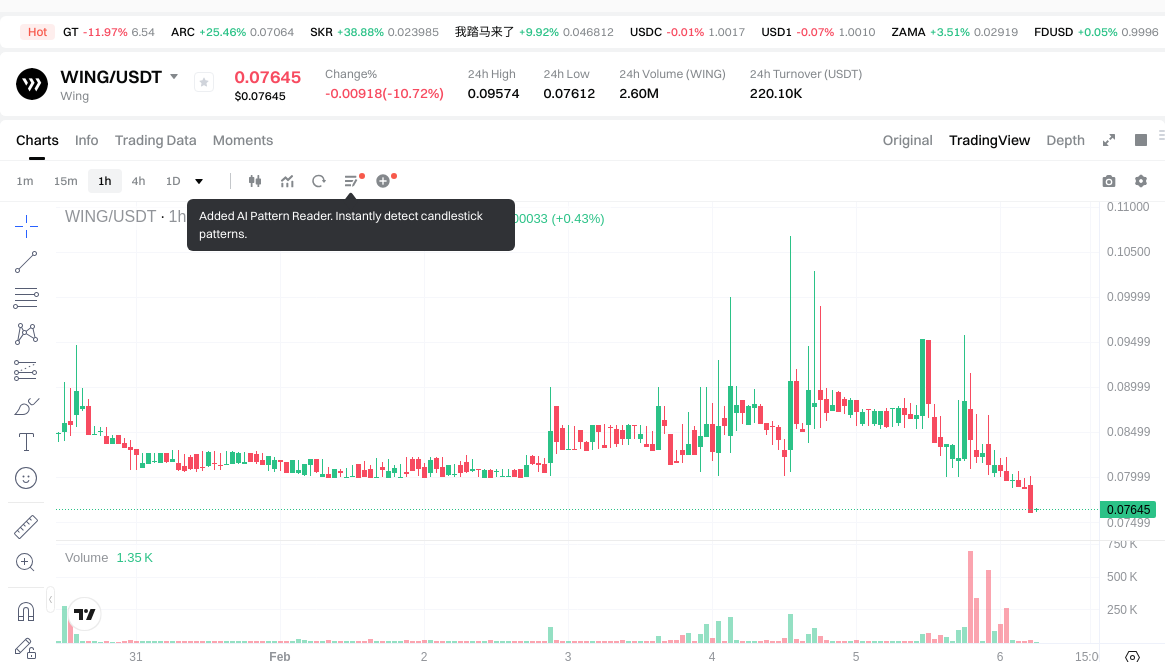
- WING Current Price: $0.07612
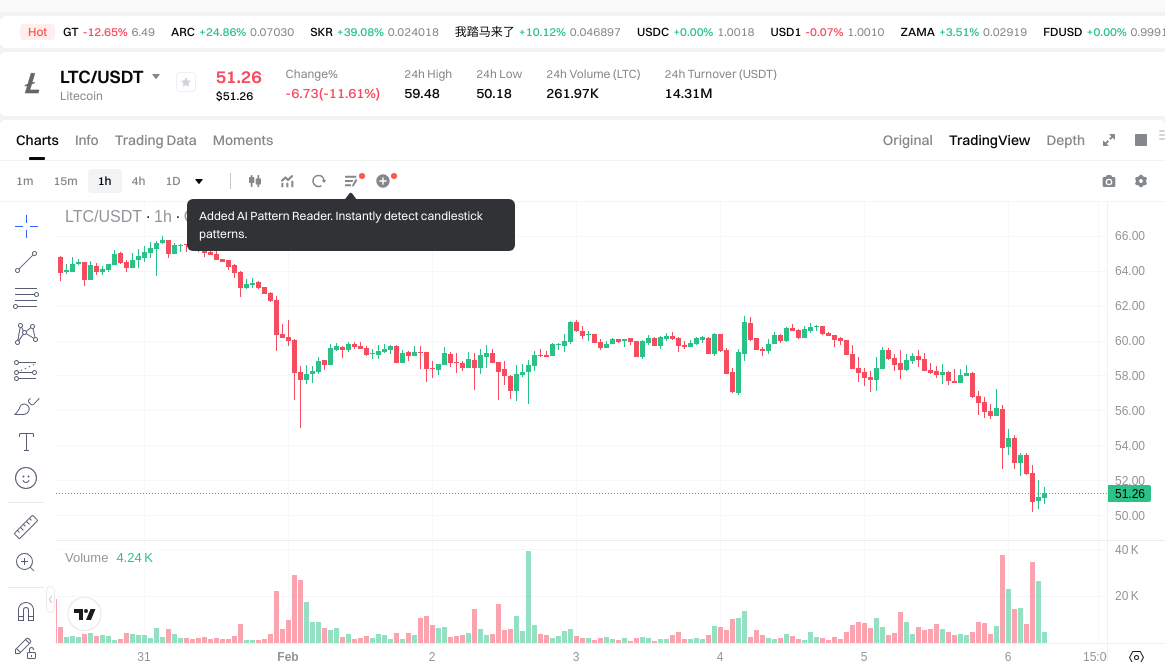
- LTC Current Price: $51.11
- 24-Hour Trading Volume: WING recorded $220,136.13 compared to LTC's $14,201,622.96
- Market Sentiment Index (Fear & Greed Index): 12 (Extreme Fear)
View real-time pricing:
- Check WING current price Market Price
- Check LTC current price Market Price
II. Core Factors Affecting WING vs LTC Investment Value
Supply Mechanism Comparison (Tokenomics)
-
WING: Wing Finance operates as a governance token within its DeFi ecosystem. The token functions primarily as a utility and governance instrument within decentralized lending and borrowing protocols, where supply dynamics are tied to platform usage and governance decisions rather than predetermined emission schedules.
-
LTC: Litecoin employs a deflationary supply model with a maximum cap of 84 million coins. The network implements a halving mechanism approximately every four years, reducing block rewards by 50%. The fourth halving is scheduled for July 2027, which theoretically reduces new coin supply and may create upward price pressure through scarcity.
-
📌 Historical Pattern: Supply mechanisms have historically driven price cycle variations. For LTC, previous halvings (2015, 2019) were followed by periods of price volatility, though correlation does not guarantee causation. The predictable supply reduction creates anticipation in markets, while WING's supply dynamics remain more closely tied to platform adoption and DeFi ecosystem growth.
Institutional Adoption and Market Application
-
Institutional Holdings: LTC has attracted more institutional attention, evidenced by the launch of the LTCC ETF by Canary Capital on October 28, 2025, though initial market response showed limited institutional demand. Additionally, Grayscale manages $127.4 million in LTC trust assets with plans to convert to ETF format. WING's institutional adoption remains primarily within the DeFi community rather than traditional financial institutions.
-
Enterprise Adoption: LTC has been positioned as a payment solution with faster block generation times compared to Bitcoin, targeting high-frequency small-value transfers and payment scenarios. However, implementation faces challenges including regulatory licensing requirements and partnerships with banking institutions. WING focuses on decentralized finance applications, providing lending and deposit services within the DeFi ecosystem, representing a different application paradigm.
-
National Policies: Regulatory attitudes vary significantly across jurisdictions. Cryptocurrency regulations continue to evolve globally, affecting both assets differently based on their classification—LTC as a payment-focused cryptocurrency and WING as a DeFi governance token.
Technology Development and Ecosystem Building
-
LTC Technology Upgrades: Litecoin's technical evolution includes several phases. In 2016, the development team released an ambitious roadmap introducing Segregated Witness (SegWit), Lightning Network, and smart contract functionality. SegWit activated on May 10, 2017, followed by Lightning Network launch on June 21, 2017. The most significant upgrade occurred in May 2022 with MimbleWimble Extension Blocks (MWEB), introducing privacy transaction capabilities and scalability improvements through compression technology. More recently, on May 31, 2025, LTC launched the LitVM Layer-2 network using Zero-Knowledge Rollup (ZK Rollup) technology, aiming to introduce smart contract functionality, cross-chain liquidity, and Real-World Asset (RWA) support—marking LTC's entry into smart contract platforms ten years after Ethereum.
-
WING Technology Development: Wing Finance operates as a decentralized platform providing lending and deposit services within the DeFi ecosystem. Its technology focuses on enabling secure and transparent financial services through blockchain infrastructure, though specific recent technological upgrades were not detailed in available materials.
-
Ecosystem Comparison: LTC's performance in DeFi and NFT sectors lagged significantly due to technical architecture limitations. The platform only introduced smart contract functionality through LitVM in May 2025, a decade after Ethereum, causing LTC to miss the explosive growth periods of DeFi and NFT. WING, as a DeFi-native project, has been positioned within decentralized finance applications from inception, focusing on lending and borrowing services that constitute core DeFi functionality.
Macroeconomic Factors and Market Cycles
-
Performance in Inflationary Environments: Cryptocurrencies with fixed supply models like LTC are often discussed as potential inflation hedges due to supply scarcity, though empirical evidence remains mixed. WING's value proposition relates more to DeFi ecosystem growth and utility rather than macroeconomic hedging characteristics.
-
Macroeconomic Monetary Policy: Interest rates, dollar index fluctuations, and broader monetary policy decisions influence cryptocurrency markets. Changes in risk appetite driven by interest rate adjustments may affect both assets, though LTC's longer market history and larger market capitalization may result in different sensitivity patterns compared to WING.
-
Geopolitical Factors: Cross-border transaction demand and international developments influence cryptocurrency adoption. LTC's positioning as a payment solution makes it potentially more sensitive to cross-border payment demand and banking system challenges. WING's value drivers remain more closely tied to DeFi ecosystem development and adoption within decentralized finance applications.
Note: Investment in cryptocurrencies involves substantial risk. Both LTC and WING face adoption challenges, regulatory uncertainties, and market volatility. The cryptocurrency market is characterized by high speculation, and past performance does not indicate future results.
III. 2026-2031 Price Prediction: WING vs LTC
Short-term Forecast (2026)
- WING: Conservative $0.053-$0.076 | Optimistic $0.076-$0.094
- LTC: Conservative $33.94-$51.42 | Optimistic $51.42-$63.25
Mid-term Forecast (2028-2029)
- WING may enter a consolidation phase with projected price range of $0.068-$0.148
- LTC may enter a growth phase with projected price range of $39.00-$74.23
- Key drivers: institutional capital inflows, ETF developments, ecosystem expansion
Long-term Forecast (2030-2031)
- WING: Baseline scenario $0.078-$0.130 | Optimistic scenario $0.134-$0.167
- LTC: Baseline scenario $40.45-$68.57 | Optimistic scenario $83.99-$110.87
Disclaimer
WING:
| Year | Predicted High Price | Predicted Average Price | Predicted Low Price | Price Change |
|---|---|---|---|---|
| 2026 | 0.0936276 | 0.07612 | 0.053284 | 0 |
| 2027 | 0.115428368 | 0.0848738 | 0.047529328 | 11 |
| 2028 | 0.14822360432 | 0.100151084 | 0.09314050812 | 31 |
| 2029 | 0.1353642051344 | 0.12418734416 | 0.068303039288 | 63 |
| 2030 | 0.138860078872504 | 0.1297757746472 | 0.11030940845012 | 70 |
| 2031 | 0.166554229182216 | 0.134317926759852 | 0.077904397520714 | 76 |
LTC:
| Year | Predicted High Price | Predicted Average Price | Predicted Low Price | Price Change |
|---|---|---|---|---|
| 2026 | 63.2466 | 51.42 | 33.9372 | 0 |
| 2027 | 63.639963 | 57.3333 | 53.893302 | 12 |
| 2028 | 65.32556202 | 60.4866315 | 50.203904145 | 18 |
| 2029 | 74.2291941768 | 62.90609676 | 39.0017799912 | 23 |
| 2030 | 99.42308592918 | 68.5676454684 | 40.454910826356 | 34 |
| 2031 | 110.8738827224028 | 83.99536569879 | 70.5561071869836 | 64 |
IV. Investment Strategy Comparison: WING vs LTC
Long-term vs Short-term Investment Strategies
-
WING: May suit investors focused on DeFi ecosystem growth and decentralized finance applications. The token's value proposition centers on governance functionality and platform utility within credit-based lending protocols. Short-term positioning faces challenges given lower trading volumes ($220,136.13 in 24-hour volume) and higher volatility characteristics. Long-term consideration depends on adoption of Wing Finance's lending services and broader DeFi sector expansion.
-
LTC: May appeal to investors seeking exposure to established cryptocurrency networks with payment-focused positioning. The asset demonstrates relatively higher liquidity with $14,201,622.96 in 24-hour trading volume. Long-term consideration involves upcoming supply events (halving scheduled for July 2027) and institutional developments including ETF conversions. Short-term strategies face market volatility and broader cryptocurrency cycle influences.
Risk Management and Asset Allocation
-
Conservative Investors: Portfolio construction might consider heavier allocation toward LTC (approximately 70-80%) given longer market history and institutional recognition, with limited exposure to WING (20-30%) as DeFi sector participation. This allocation reflects risk-adjusted positioning based on market capitalization differences and liquidity considerations.
-
Aggressive Investors: May explore higher WING allocation (40-50%) to capture potential DeFi ecosystem growth, balanced with LTC exposure (50-60%) for portfolio stability. This approach involves accepting elevated volatility in exchange for potential asymmetric returns from smaller market cap positioning.
-
Hedging Instruments: Risk management tools include stablecoin reserves for market downturn protection, options strategies for downside hedging, and cross-asset portfolio construction combining different cryptocurrency sectors (payment-focused and DeFi-oriented tokens) to reduce correlation risks.
V. Potential Risk Comparison
Market Risks
-
WING: Faces concentrated risks related to DeFi sector sentiment and adoption rates. Lower trading volumes create liquidity challenges during market stress periods. Price performance shows significant decline from 2020 peak of $140.81 to current levels near $0.07, indicating substantial volatility history. Market conditions during extreme fear (Fear & Greed Index: 12) may amplify price movements.
-
LTC: Exposed to broader cryptocurrency market cycles and correlation with Bitcoin price movements. Despite longer market history, price volatility remains substantial with historical range between $1.15 and $410.26. Institutional developments including ETF launches showed limited initial demand, creating uncertainty around institutional adoption trajectory. Market positioning faces competition from newer blockchain networks offering smart contract functionality.
Technical Risks
-
WING: Platform security depends on smart contract implementation and DeFi protocol architecture. Cross-chain functionality introduces additional complexity and potential vulnerability points. Network stability relates to underlying blockchain infrastructure and governance mechanism effectiveness.
-
LTC: Mining concentration presents considerations for network decentralization. The network introduced privacy features through MWEB in May 2022 and smart contract functionality via LitVM Layer-2 in May 2025, representing significant architecture changes that require ongoing testing and validation. Late entry into smart contract platforms (ten years after Ethereum) creates competitive disadvantages in DeFi and NFT sectors.
Regulatory Risks
- Global regulatory approaches differ significantly based on asset classification. LTC's payment-focused positioning faces scrutiny under payment system regulations, money transmission laws, and banking partnership requirements. WING as a DeFi governance token encounters evolving regulations around decentralized finance protocols, lending platforms, and token governance structures. Regulatory developments in major markets including the United States, European Union, and Asia-Pacific regions create ongoing uncertainty affecting both assets differently based on their functional characteristics and application scenarios.
VI. Conclusion: Which Is the Better Buy?
📌 Investment Value Summary:
-
WING Characteristics: Positioned within decentralized finance sector with focus on credit-based lending protocols. Offers exposure to DeFi ecosystem development and governance participation. Current market capitalization and trading volumes indicate smaller-scale positioning with corresponding volatility profiles. Price history shows significant decline from peak levels, presenting both recovery potential and downside risk considerations.
-
LTC Characteristics: Established cryptocurrency with thirteen-year market history and payment-focused positioning. Demonstrates higher liquidity and institutional recognition including ETF developments and trust fund management. Recent technological upgrades including privacy features and smart contract functionality through Layer-2 solutions represent efforts to expand use cases. Upcoming halving event in July 2027 creates supply-side dynamics that historically generated market attention.
✅ Investment Considerations:
-
Beginning Investors: May prioritize liquidity, market history, and institutional recognition when evaluating cryptocurrency exposure. Understanding fundamental differences between payment-focused tokens and DeFi governance tokens represents important knowledge development. Portfolio construction should emphasize risk management through position sizing appropriate to individual risk tolerance.
-
Experienced Investors: Can evaluate technical roadmaps, ecosystem developments, and tokenomics differences between payment-layer cryptocurrencies and DeFi protocols. Portfolio strategies might incorporate both asset types for sector diversification, while maintaining awareness of correlation patterns during market stress periods. Risk-adjusted position sizing based on volatility profiles and liquidity characteristics remains important.
-
Institutional Investors: Considerations include regulatory clarity, custodial solutions, liquidity depth, and compliance frameworks. LTC's longer operating history and developing institutional infrastructure (ETF products, trust funds) provide more established pathways for institutional participation. WING's DeFi positioning presents different regulatory considerations and operational requirements for institutional involvement.
⚠️ Risk Disclosure: Cryptocurrency markets demonstrate substantial volatility and speculation. This analysis does not constitute investment advice, financial guidance, or recommendations to purchase, sell, or hold any cryptocurrency. Investment decisions should involve comprehensive due diligence, risk assessment, and consultation with qualified financial professionals. Past performance does not indicate future results. Market conditions, regulatory developments, and technological changes create ongoing uncertainty affecting cryptocurrency valuations.
VII. FAQ
Q1: What is the fundamental difference between WING and LTC as cryptocurrency investments?
WING is a DeFi governance token focused on decentralized credit-based lending protocols, while LTC is an established payment-focused cryptocurrency with thirteen years of market history. WING's value derives from governance participation and platform utility within the Wing Finance ecosystem, targeting DeFi sector growth. LTC positions itself as a peer-to-peer payment solution with faster transaction speeds than Bitcoin, featuring a deflationary supply model capped at 84 million coins and upcoming halving events. The core distinction lies in application scenarios: WING serves decentralized finance applications, whereas LTC targets payment and value transfer use cases with recent expansions into smart contracts through Layer-2 solutions.
Q2: How do the supply mechanisms of WING and LTC affect their investment potential?
LTC employs a predictable deflationary model with a maximum supply of 84 million coins and halving events approximately every four years, with the next halving scheduled for July 2027. This mechanism reduces new coin issuance by 50%, theoretically creating scarcity-driven price pressure, though historical halving events showed mixed correlation with price performance. WING's supply dynamics connect more directly to platform usage, governance decisions, and DeFi ecosystem adoption rather than predetermined emission schedules. The supply difference means LTC follows predictable scarcity events that generate market anticipation, while WING's value proposition depends on platform adoption rates and DeFi sector expansion rather than supply reduction mechanisms.
Q3: What are the current liquidity differences between WING and LTC?
LTC demonstrates significantly higher liquidity with 24-hour trading volume of $14,201,622.96 compared to WING's $220,136.13 as of February 6, 2026. This 64x volume difference creates distinct trading characteristics: LTC offers easier entry and exit positions with tighter bid-ask spreads and lower slippage risk, making it more suitable for larger position sizes. WING's lower trading volumes present liquidity challenges during market stress periods, potentially causing wider price swings and execution difficulties for substantial transactions. For risk management purposes, LTC's higher liquidity provides more flexibility for portfolio rebalancing and position adjustments, while WING requires more careful consideration of order sizing and execution timing.
Q4: How have institutional developments affected WING and LTC differently?
LTC has attracted institutional attention through several developments: Canary Capital launched the LTCC ETF on October 28, 2025, though initial demand remained limited; Grayscale manages $127.4 million in LTC trust assets with planned ETF conversion. These institutional products provide regulated exposure pathways for traditional investors and signal growing recognition within financial infrastructure. WING's institutional adoption remains primarily within the DeFi community rather than traditional financial institutions, lacking comparable ETF products or trust fund structures. The institutional difference reflects LTC's longer market history and payment-focused positioning versus WING's DeFi-native application scenario, creating distinct regulatory considerations and adoption pathways for institutional capital participation.
Q5: What technological upgrades distinguish WING and LTC's development trajectories?
LTC implemented major technological phases including Segregated Witness (SegWit) activation in May 2017, Lightning Network launch in June 2017, MimbleWimble Extension Blocks (MWEB) privacy features in May 2022, and LitVM Layer-2 network using Zero-Knowledge Rollup technology in May 2025. The LitVM upgrade introduced smart contract functionality, cross-chain liquidity, and Real-World Asset support—marking LTC's entry into smart contract platforms ten years after Ethereum. WING focuses on decentralized lending and borrowing services within DeFi ecosystem infrastructure, providing secure and transparent financial services through blockchain technology. The technological distinction reflects different strategic priorities: LTC expanding from payment functionality toward broader smart contract capabilities, while WING maintains concentrated focus on DeFi lending protocol optimization.
Q6: What price performance patterns differentiate WING and LTC historically?
WING reached $140.81 following its September 2020 launch but declined to current levels near $0.07, representing substantial downward price movement and indicating either overvaluation at launch or significant market sentiment shifts. LTC demonstrated broader price retention with historical range between $1.15 and $410.26, reaching its peak of $410.26 in May 2021 during broader market momentum. The comparative pattern shows LTC's relative price stability despite volatility, while WING experienced more severe decline from peak levels. This historical difference reflects factors including market capitalization differences, liquidity characteristics, adoption rates, and sector-specific dynamics between established payment-focused cryptocurrencies and newer DeFi governance tokens.
Q7: How do regulatory risks differ between WING and LTC?
LTC faces regulatory scrutiny under payment system regulations, money transmission laws, and banking partnership requirements due to its payment-focused positioning. Implementation as a payment solution requires navigating complex licensing frameworks and compliance obligations across different jurisdictions. WING encounters evolving regulations around decentralized finance protocols, lending platforms, and token governance structures as regulatory frameworks for DeFi continue developing. The regulatory distinction means LTC operates within more established (though still evolving) payment regulatory frameworks, while WING faces uncertainty as regulators develop approaches to DeFi protocols. Both assets face jurisdiction-specific regulatory differences across the United States, European Union, and Asia-Pacific regions, though the specific regulatory challenges differ based on their functional characteristics and application scenarios.
Q8: What portfolio allocation approach suits different investor profiles for WING and LTC?
Conservative investors might consider heavier LTC allocation (70-80%) given longer market history, higher liquidity, and institutional recognition, with limited WING exposure (20-30%) for DeFi sector participation. This reflects risk-adjusted positioning based on market capitalization differences and liquidity considerations. Aggressive investors may explore higher WING allocation (40-50%) to capture potential DeFi ecosystem growth, balanced with LTC exposure (50-60%) for portfolio stability, accepting elevated volatility for potential asymmetric returns from smaller market cap positioning. Portfolio construction should incorporate risk management tools including stablecoin reserves, options strategies for downside hedging, and cross-asset diversification combining different cryptocurrency sectors. Position sizing should align with individual risk tolerance, understanding that both assets demonstrate substantial volatility and speculation characteristics inherent to cryptocurrency markets.
Share
Content
Introduction: Investment Comparison Between WING and LTC
I. Historical Price Comparison and Current Market Status
II. Core Factors Affecting WING vs LTC Investment Value
III. 2026-2031 Price Prediction: WING vs LTC
IV. Investment Strategy Comparison: WING vs LTC
V. Potential Risk Comparison
VI. Conclusion: Which Is the Better Buy?
VII. FAQ
How to Buy Cryptocurrency


Trending Cryptocurrencies



2025 SUI coin: price, buying guide, and Staking rewards

How to Buy Crypto: A Step-by-Step Guide with Gate.com

HNT Price in 2025: Helium Network Token Value and Market Analysis

What is SwissCheese (SWCH) and How Does It Democratize Investment?

Cardano (ADA) Price Analysis and Outlook for 2025

How to Invest in Metaverse Crypto

Understanding Demand and Supply Zones in Trading: Comprehensive Guide and Application Strategies

What Are Nodes?

What Is an IDO? Initial DEX Offering Explained

What is Bitcoin dominance and why does this metric matter

Cryptocurrency Training from Scratch: How to Choose the Right Path