An Alternative Approach to Leverage: How Gate Leveraged ETFs Simplify Amplified Trading

Last Updated 2026-03-24 13:55:18
Reading Time: 1m
In traditional leveraged trading, investors must manage margin ratios, leverage levels, and liquidation risks, making operations relatively complex. Gate Leveraged ETFs streamline this by turning leveraged exposure into directly tradable assets, allowing users to amplify market movements through spot trading. This article explains how leveraged ETFs work, details their rebalancing mechanisms, and compares them to traditional contract trading to help investors better understand the features and optimal use cases of these products.

Operational Challenges of Traditional Leveraged Trading
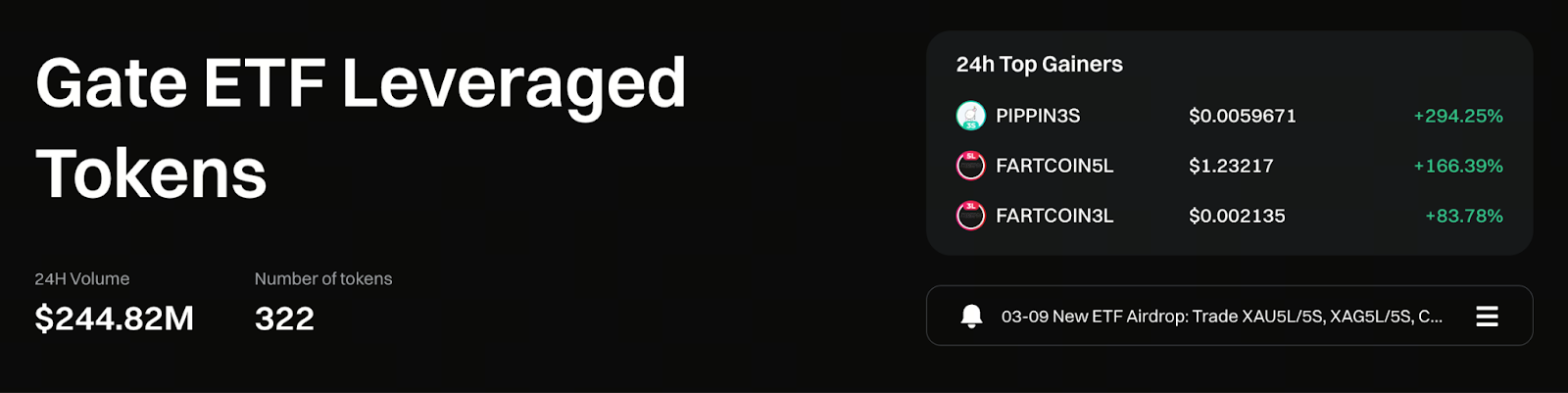
Operational Challenges of Traditional Leveraged Trading

In most trading markets, leverage is typically linked to contract trading. Investors must open positions, set leverage ratios, and continuously monitor their margin status. When volatility increases, they must quickly adjust positions or add funds to avoid forced liquidation.

While this trading model offers considerable flexibility, it also raises the operational threshold. For many investors, margin calculations and risk management often demand extra time and effort.

Start trading Gate Leveraged ETFs now: https://www.gate.com/leveraged-etf

Productizing the Leverage Effect

Gate Leveraged ETFs provide an alternative way to access leveraged returns. Unlike traditional contracts, users can buy and sell leveraged ETFs directly on the spot market, just like regular tokens.

Each product is designed with a fixed target leverage multiple—such as 3x or 5x. Investors are not required to set leverage ratios or establish independent contract positions.

This approach transforms the actively managed leverage mechanism into a built-in product feature, streamlining the entire trading process for greater simplicity and clarity.

Rebalancing Mechanism Maintains Leverage Ratio

To keep the intended leverage multiple, leveraged ETFs use a rebalancing mechanism to adjust their internal holdings. When market price fluctuations push the actual leverage ratio away from the target, the system reallocates positions. This mechanism aims to keep the product’s leverage effect within a reasonable range, preventing unlimited amplification from market volatility. Investors don’t have to track margin ratios or frequently adjust positions during sharp market swings.

Why There’s No Liquidation Mechanism

Unlike contract trading, leveraged ETFs do not have individual margin positions, so forced liquidation does not apply.

Key reasons include:

  • Investors do not directly borrow assets

  • Risk is reflected in the product’s net asset value, not individual accounts

  • The rebalancing mechanism proactively adjusts internal holdings

As a result, when markets move against investors, they typically see a decline in net asset value rather than forced account liquidation. This changes how leveraged risk is presented compared to traditional contracts.

Performance Across Different Market Conditions

Leveraged ETF performance depends on market structure. In clear trending markets, sustained price movement in one direction can deliver amplified returns.

In choppy or range-bound markets, frequent rebalancing may erode net asset value. These products are generally better suited to trending environments, while their results may differ from simple leverage calculations during prolonged sideways periods.

Greater Flexibility in Capital Usage

Leveraged ETFs use a spot trading model, so investors only need to pay the purchase amount to access leveraged returns—no extra collateral or borrowing required. Each product charges a fixed daily management fee to cover hedging and rebalancing costs. Compared to contract models that require margin maintenance, this design allows for more flexible capital allocation and reduces capital management complexity.

Leverage Still Means Amplified Risk

Even with a simpler trading process, leveraged ETFs fundamentally magnify market price movements. When investors correctly anticipate market direction, gains are accelerated; if not, losses also increase. It’s essential for investors to understand the mechanics of these products and allocate funds appropriately to avoid overconcentration in a single high-volatility instrument.

Summary

Leveraged ETFs offer a standardized way to access leveraged returns. With fixed leverage multiples and a rebalancing mechanism, Gate Leveraged ETFs convert actively managed leverage trading into a directly tradable product. This design doesn’t eliminate market risk—it changes how risk is managed and presented. When investors understand the product’s operation and allocate funds wisely, leveraged ETFs can serve as a valuable tool in investment strategies, providing more choices for market participation.

Author:  Allen
Disclaimer
* The information is not intended to be and does not constitute financial advice or any other recommendation of any sort offered or endorsed by Gate.
* This article may not be reproduced, transmitted or copied without referencing Gate. Contravention is an infringement of Copyright Act and may be subject to legal action.

Share

Crypto Calendar
Tokenların Kilidini Aç
Wormhole, 3 Nisan'da 1.280.000.000 W token açacak ve bu, mevcut dolaşımdaki arzın yaklaşık %28,39'unu oluşturacak.
W
-7.32%
2026-04-02
Tokenların Kilidini Aç
Pyth Network, 19 May'da 2.130.000.000 PYTH tokenini serbest bırakacak ve bu, mevcut dolaşım arzının yaklaşık %36,96'sını oluşturacak.
PYTH
2.25%
2026-05-18
Tokenların Kilidini Aç
Pump.fun, 12 Temmuz'da 82,500,000,000 PUMP token'ı kilidini açacak ve bu, mevcut dolaşımdaki arzın yaklaşık %23,31'ini oluşturacak.
PUMP
-3.37%
2026-07-11
Token Kilidi Açma
Succinct, 5 Ağustos'ta mevcut dolaşımdaki arzın yaklaşık %104,17'sini oluşturan 208,330,000 PROVE token'ını serbest bırakacak.
PROVE
2026-08-04
sign up guide logosign up guide logo
sign up guide content imgsign up guide content img
Sign Up

Related Articles

What is Fartcoin? All You Need to Know About FARTCOIN
Intermediate

What is Fartcoin? All You Need to Know About FARTCOIN

Fartcoin (FARTCOIN) is a representative meme coin within the Solana ecosystem based on an AI-driven narrative. Its core concept originated from an experiment aimed at exploring the "boundaries between AI Agents and humor." More than just a digital asset with social attributes, the project deeply couples absurd humor culture with on-chain financial logic by integrating autonomous AI interaction models.
2026-03-24 11:55:59
Gold Price Forecast for the Next Five Years: 2026–2030 Trend Outlook and Investment Implications, Could It Reach $6,000?
Beginner

Gold Price Forecast for the Next Five Years: 2026–2030 Trend Outlook and Investment Implications, Could It Reach $6,000?

Analyze current gold price trends alongside authoritative five-year forecasts, integrating an evaluation of market risks and opportunities. This gives investors insight into the potential trajectory of gold prices and the main drivers expected to shape the market over the next five years.
2026-01-26 03:33:33
What is MetFi? All You Need to Know About METFI (2025 Update)
Intermediate

What is MetFi? All You Need to Know About METFI (2025 Update)

MetFi is a decentralized metaverse and web3 incubator that utilizes NFTs to share investment returns with MetFi NFT holders and members of its community. As of 2025, MetFi trades at $0.225266 USD with a $47.7M market cap, offering AI-driven trading, blockchain learn-to-earn games, and ERC-404 airdrops through its Marine Moguls project for early claim rights to promising Web3 startups.
2026-03-24 11:52:36
What are Leveraged ETF Tokens?
Beginner

What are Leveraged ETF Tokens?

Leveraged ETF tokens are derivatives that can multiply profits through leverages without the risk of liquidation. Leveraged ETF tokens can be traded the same way as spot products and generate leveraged gains, just as in contract trading. Users will never be confronted with a liquidation even if the market is mispredicted, which significantly lowers the barrier for ordinary users.
2026-03-24 11:52:19
Every U.S. Crypto ETF You Need to Know About in 2025
Intermediate

Every U.S. Crypto ETF You Need to Know About in 2025

In 2025, crypto ETFs expanded to alternative assets such as Solana, XRP, and DOGE, with mainstream asset management firms rushing to submit applications. This article provides a detailed analysis of the current status of ETF applications, the likelihood of approval, and their potential impact, outlining the key path for crypto assets to integrate into the traditional financial system.
2026-03-24 11:57:05
Gate Research: BTC Hits New Highs, Bitwise Files Solana ETF, Stablecoin Exceeds $190B
Advanced

Gate Research: BTC Hits New Highs, Bitwise Files Solana ETF, Stablecoin Exceeds $190B

This week, BTC prices hit multiple new highs, reaching a 7-day peak of $94,643.6, with buying pressure continuing to strengthen. ETH showed relative weakness, with a weekly decline of 4.93%, remaining in a weak oscillating trend overall. Crypto asset management company Bitwise registered a Solana ETF in Delaware, USA, following its earlier application for an XRP ETF. USDT's market cap surpassed $130 billion, marking a historical high and reflecting increased capital inflow into the crypto market. Cryptocurrency lending platform Polter Finance suffered a hacker attack, resulting in a $12 million loss. Meanwhile, the crypto gambling platform Monkey Tilt completed a $30 million financing round, led by Pantera Capital.
2026-03-24 11:55:39