BlackRock’s Entry: The Strategic Significance of Staked Ethereum ETFs
BlackRock, one of the world’s largest asset managers, is steadily expanding its footprint in the digital asset space. After launching spot Bitcoin and spot Ethereum ETFs, the firm has now introduced a staked ETF (ETHB), further broadening its product landscape.
This new offering not only provides exposure to Ethereum (ETH) price movements but also generates additional yield for investors through on-chain staking. As a result, crypto ETFs are evolving from “passive price trackers” to “active yield generators.”
For the industry, this marks the beginning of traditional finance (TradFi) systematically integrating blockchain-native yield mechanisms.
Over $250 Million Raised in the First Week: Why Are Institutions Rushing In?
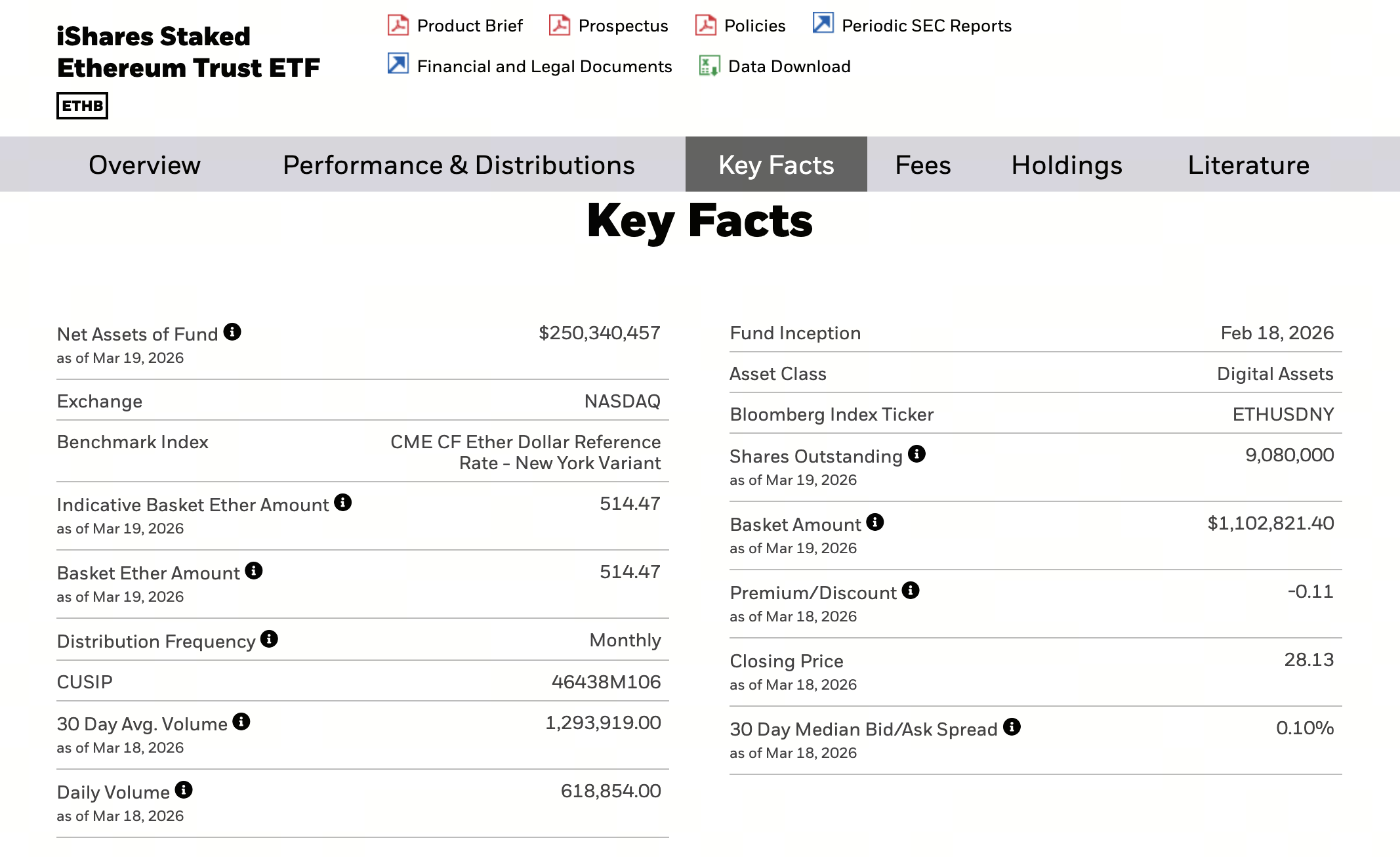 Source: iShares Official Website Data
Market data shows that BlackRock’s staked Ethereum ETF exceeded $250 million in assets under management shortly after its debut, reflecting robust investor demand. This surge is not accidental but the result of several combined factors:
-
The ETF saw active trading from the outset, with over $15 million in trading volume on the first day and clear net capital inflows.
-
Institutional demand for yield-generating crypto assets is surging. ETH, which can produce cash flow, better fits institutional allocation strategies compared to assets that rely solely on price appreciation.
-
BlackRock’s reputation and compliance strengths lower barriers for institutional investors, enabling traditional capital sources, such as pension funds and family offices, to participate more easily.
Together, these factors fueled rapid capital inflows in a short period.
Staking Mechanism Explained: How ETH Yield Is Embedded in the ETF
The key innovation of the staked ETF is its ability to “package” blockchain-native yield structures into a traditional financial product.
Here’s how it works:
-
The fund holds ETH as its underlying asset
-
The ETH is staked on-chain
-
The fund receives block rewards and transaction fee sharing
-
Yield is reflected in the fund’s net asset value or paid out as dividends
This ETF aims to track ETH’s price while also delivering an additional yield stream.
In essence, it standardizes and legitimizes DeFi yield mechanisms, allowing traditional investors to access similar returns without engaging directly with on-chain protocols.
Key Differences from Traditional Spot ETFs
Staked ETFs differ fundamentally from traditional spot ETFs in several ways:
- Yield Structure
- Asset Utilization Efficiency
- Investment Characteristics
This development brings ETH’s investment profile closer to that of bonds or dividend-paying assets.
The Shift in ETH Investment Logic: From Price Asset to Yield Asset
With Ethereum’s transition to Proof of Stake (PoS), ETH now offers a “hold-to-earn” yield feature.
This gives ETH a new position in asset classification:
BlackRock’s staked ETF amplifies this characteristic and integrates it into traditional finance. As a result, ETH’s market narrative is shifting from a “high-volatility risk asset” to a “yield-generating, allocable asset.”
Impact on DeFi and the On-Chain Staking Ecosystem
The introduction of staked ETFs will have profound effects on the crypto ecosystem:
Positive Impacts:
-
Increases the proportion of ETH staked, strengthening network security
-
Promotes standardization of on-chain yields
-
Attracts more traditional capital
Potential Challenges:
-
Centralized institutions may control a significant share of staked assets
-
Decentralized protocols (like Lido) face increased competition
-
Yields may decline as more capital enters the market
This points to a future staking market where institutional and decentralized models coexist.
Risks and Regulation: Uncertainties Behind the Yield
Despite strong performance, these products carry notable risks:
-
Regulatory Uncertainty: The legal status of staking yields varies by jurisdiction
-
Technical Risks: Including node operation and slashing
-
Yield Volatility: Staking returns are not fixed and fluctuate with network participation
-
Centralization Risk: Large institutions could influence network governance
These factors show that staked ETFs remain in the early stages of development.
Future Trends: Will Staked ETFs Become Mainstream?
Current trends suggest that staked ETFs are poised to become a major product type in the next phase of crypto finance:
-
For institutions: They offer a compliant path to yield
-
For the market: They enhance ETH price discovery
-
For the industry: They drive the standardization of yield-generating assets
Future developments may include:
-
Multi-strategy yield ETFs (restaking, DeFi yield integration)
-
Cross-chain staking products
-
Integration with traditional fixed-income markets