Why Are ETF Leveraged Tokens Attracting Increasing Market Attention?
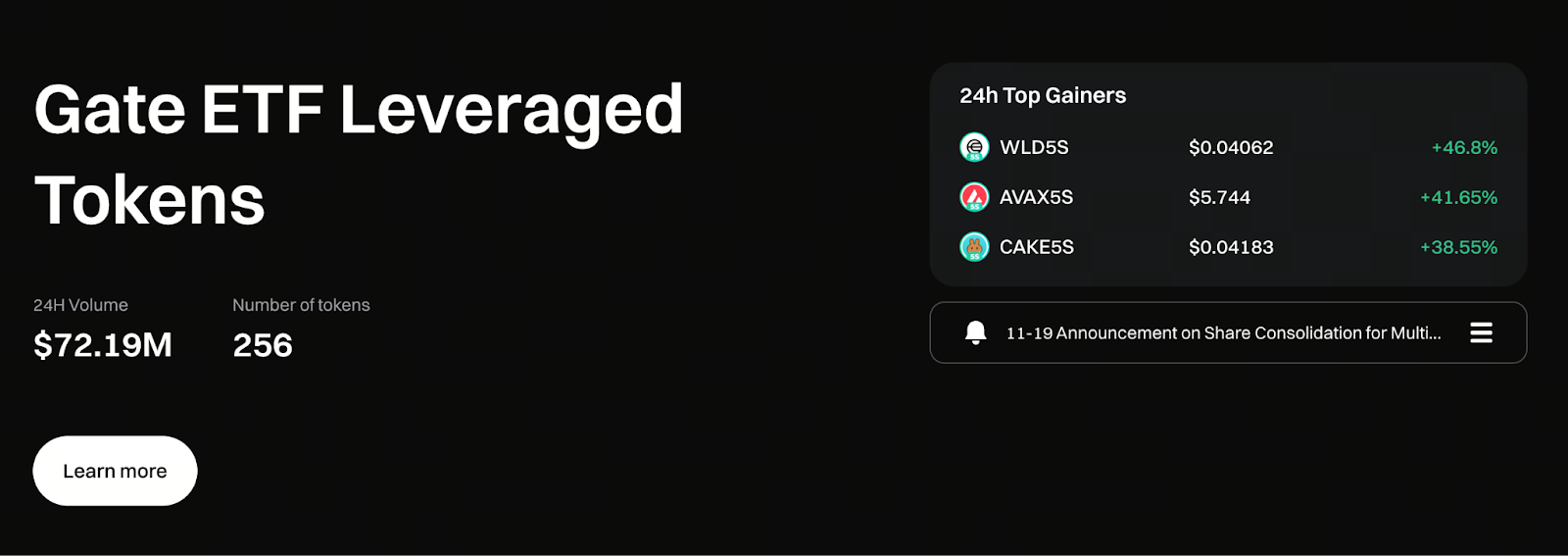
Image: https://www.gate.com/leveraged-etf
In the crypto market, many traders aim to maximize trend gains but prefer not to actively manage contract positions, margin requirements, or liquidation risks. This demand has led ETF leveraged tokens to become a widely adopted derivative product.
Gate's ETF leveraged tokens are essentially tokenized leveraged contract strategies. Users can capture amplified price movements simply by trading these tokens as they would any regular token—without directly participating in perpetual contract trading.
These products are especially popular among:
- Traders interested in trending markets who lack familiarity with contract mechanisms
- Users seeking short-term amplified returns without exposure to forced liquidation risks
- Investors employing swing trading, event-driven strategies, or short-term trend capture
Core Operating Mechanism of Gate ETF Leveraged Tokens
Gate ETF leveraged tokens deliver leverage through underlying contract positions managed behind the scenes. Each token is linked to a fixed target leverage—such as 3x or 5x.
When the underlying asset price shifts, the token's net asset value changes in proportion to the target leverage. For example:
- During uptrends, long ETF leveraged tokens typically outperform spot trading;
- During downtrends, short ETF leveraged tokens amplify returns from price declines.
To keep the leverage ratio stable, Gate automatically rebalances the underlying positions. Users do not need to manually adjust positions or monitor margin ratios.
No Forced Liquidation: Key Feature of ETF Leveraged Tokens
The main difference between Gate ETF leveraged tokens and traditional contract trading is the absence of forced liquidation (margin call) mechanisms.
In contract trading, sharp market swings and insufficient margin can trigger forced liquidation. ETF leveraged tokens employ net asset value management and automatic rebalancing to avoid the risk of instant value loss.
However, "no forced liquidation" does not mean "no risk." During periods of frequent volatility or reversals, ETF leveraged tokens may experience sustained net asset value erosion.
As a result, these products are not suitable for long-term holding and are best used to follow clear market trends.
Compounding Effect in Trending Markets
In one-way markets, Gate ETF leveraged tokens often demonstrate a pronounced compounding effect.
When the market rises or falls continuously, the automatic rebalancing mechanism keeps adjusting underlying positions, amplifying returns over consecutive price movements. This is why many traders consider ETF leveraged tokens as trend amplifiers.
This advantage stands out in environments such as:
- Clear directional breakouts in the crypto market
- Ongoing uptrends driven by macro or sector-positive factors
- Persistent pullbacks triggered by negative news
Conversely, in sideways or highly volatile markets, frequent rebalancing can erode net asset value.
Management Fees and Net Asset Value Erosion: Costs to Consider Rationally
Gate ETF leveraged tokens charge a fixed daily management fee, which is reflected in the token's net asset value rather than deducted separately.
For long-term holders, two points are critical:
- First, management fees continuously impact net asset value over time;
- Second, in markets lacking clear trends, volatility losses can magnify the effect of these costs.
Therefore, ETF leveraged tokens are better suited as trading instruments rather than long-term investment assets.
How to Use Gate ETF Leveraged Tokens More Effectively
Rational usage of ETF leveraged tokens is essential in practice.
Optimal strategies include:
- Entering at the start or confirmation of a trend
- Using take-profit and stop-loss orders for swing trading
- Employing them as supplementary tools alongside spot trading or other strategies
Frequent trading in uncertain or extremely volatile markets is not recommended, nor is concentrating all funds in a single leveraged token.
Positioning of Gate ETF Leveraged Tokens in Today's Market
As regulatory scrutiny of high-leverage crypto ETFs intensifies, platform-based ETF leveraged tokens have become a key alternative for traders seeking leveraged returns.
Gate's ETF leveraged tokens are designed to strike a balance between trading efficiency and risk control: they offer the benefits of leverage amplification while reducing operational complexity.
In today's fast-moving and highly volatile crypto market, these products will continue to serve as short-term trend tools.
Conclusion
Gate ETF leveraged tokens are not suitable for all investors, but in trending markets, they are an efficient tool for amplifying returns.
Understanding their operating mechanism, recognizing appropriate scenarios, and managing positions rationally are essential for using ETF leveraged tokens. Only with full awareness of the risks can leveraged tools deliver their true value.