Heightened Volatility at Metal Market Highs: Gate Metals Zone Expands New Opportunities for Multi-Asset Trading
Metals Market Moves into High-Volatility Range
Recently, the metals market has entered a phase characterized by elevated volatility. After a period of rising prices, there has been no clear downward trend; instead, prices have fluctuated within a higher range. This pattern typically indicates intensified competition between bulls and bears, creating more short-term trading opportunities.
Gold, silver, and similar assets have displayed pronounced range-bound activity, while some industrial metals have seen frequent swings driven by shifts in demand expectations and inventory adjustments. Overall, market activity has increased noticeably.
Structural Shifts Driving Higher Volatility
Rising volatility often signals underlying structural changes in the market.
Globally, uneven economic recovery makes it difficult to form a single view on metals demand. At the same time, greater capital participation—particularly from quantitative and short-term traders—has made prices react faster to news and data.
In this environment, markets are more prone to rapid breakouts and quick pullbacks, demanding sharper timing and execution from traders.
Trading Strategies Shift from “Holding” to “Timing”
As volatility rises, simple long-term holding strategies can face significant drawdowns. Increasingly, investors are focusing on timing-based trading—adjusting positions flexibly in response to changing market structure.
For example, swing strategies are used during sideways markets, trend-following approaches are adopted when clear momentum emerges, and positions are reduced as uncertainty grows. This approach requires a flexible trading environment and efficient execution.
Gate Metals Section: Functional Overview
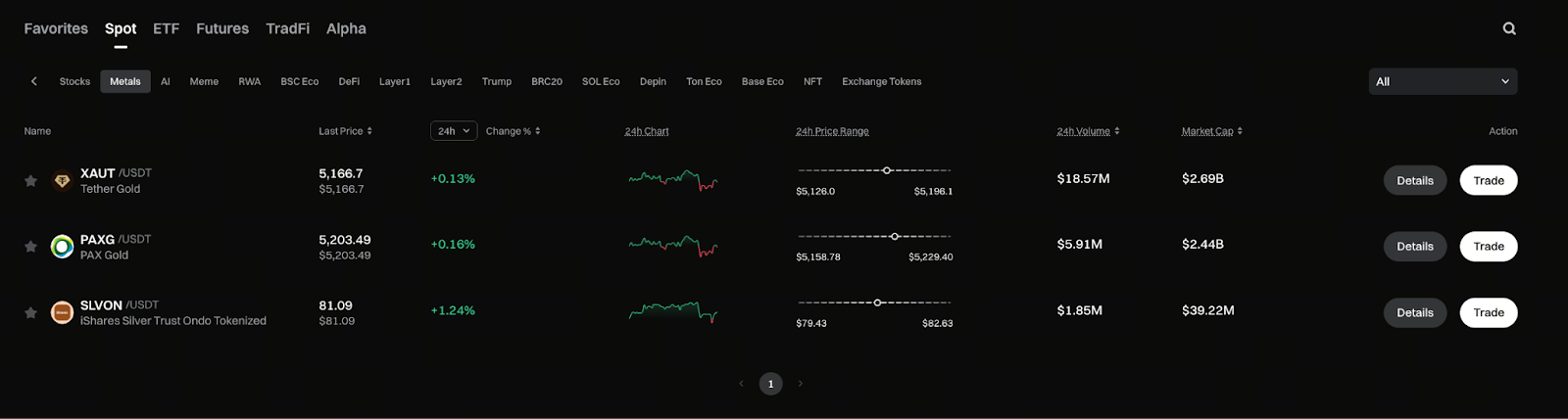
Image: https://www.gate.com/price/category-metals
The Gate Metals Section aims to provide users with a centralized, streamlined entry point for metals trading. With a unified interface and account system, users can quickly track market movements across multiple metals and execute trading strategies in a single environment.
The digital trading setup eliminates traditional time constraints, allowing investors to adjust positions flexibly in response to global market dynamics. In volatile conditions, this convenience helps boost operational efficiency.
Additionally, the platform’s stable trading system underpins frequent trading activity.
Integrating Metals and Digital Assets
In a multi-asset trading landscape, metals are becoming an increasingly important complement to investment portfolios. Because their price dynamics differ from those of many digital assets, thoughtful allocation helps diversify risk.
When risk appetite grows, capital may shift toward growth assets; during periods of uncertainty, metals often return to the spotlight. Managing multiple assets on a single platform enables more efficient capital allocation.
Participation Strategies in High-Volatility Markets
In today’s market, investors should pay close attention to position management and risk control. Proper allocation of capital and adjusting strategies as market conditions evolve are key to successful metals trading.
Staying attuned to shifts in market rhythm and avoiding emotional trading during periods of heightened sentiment can help maintain stable performance amid volatility.
Overall, the metals market remains highly active in the current high-volatility environment. The Gate Metals Section offers investors a flexible entry point, making multi-asset trading and strategy execution more convenient.
Share
Content


Related Articles

What is Fartcoin? All You Need to Know About FARTCOIN

Gold Price Forecast for the Next Five Years: 2026–2030 Trend Outlook and Investment Implications, Could It Reach $6,000?
2026 Silver Price Forecast: Bull Market Continuation or High-Level Pullback? In-Depth Analysis of Silver Candlestick Chart

Crypto Future Profit Calculator: How to Calculate Your Potential Gains
Crypto Futures Calculator: Easily Estimate Your Profits & Risks