Korean Stocks Trigger Circuit Breaker: Oil Shock and Capital Repricing Behind the KOSPI Plunge
Risk Aversion Surges: Korea at the Center of Pressure
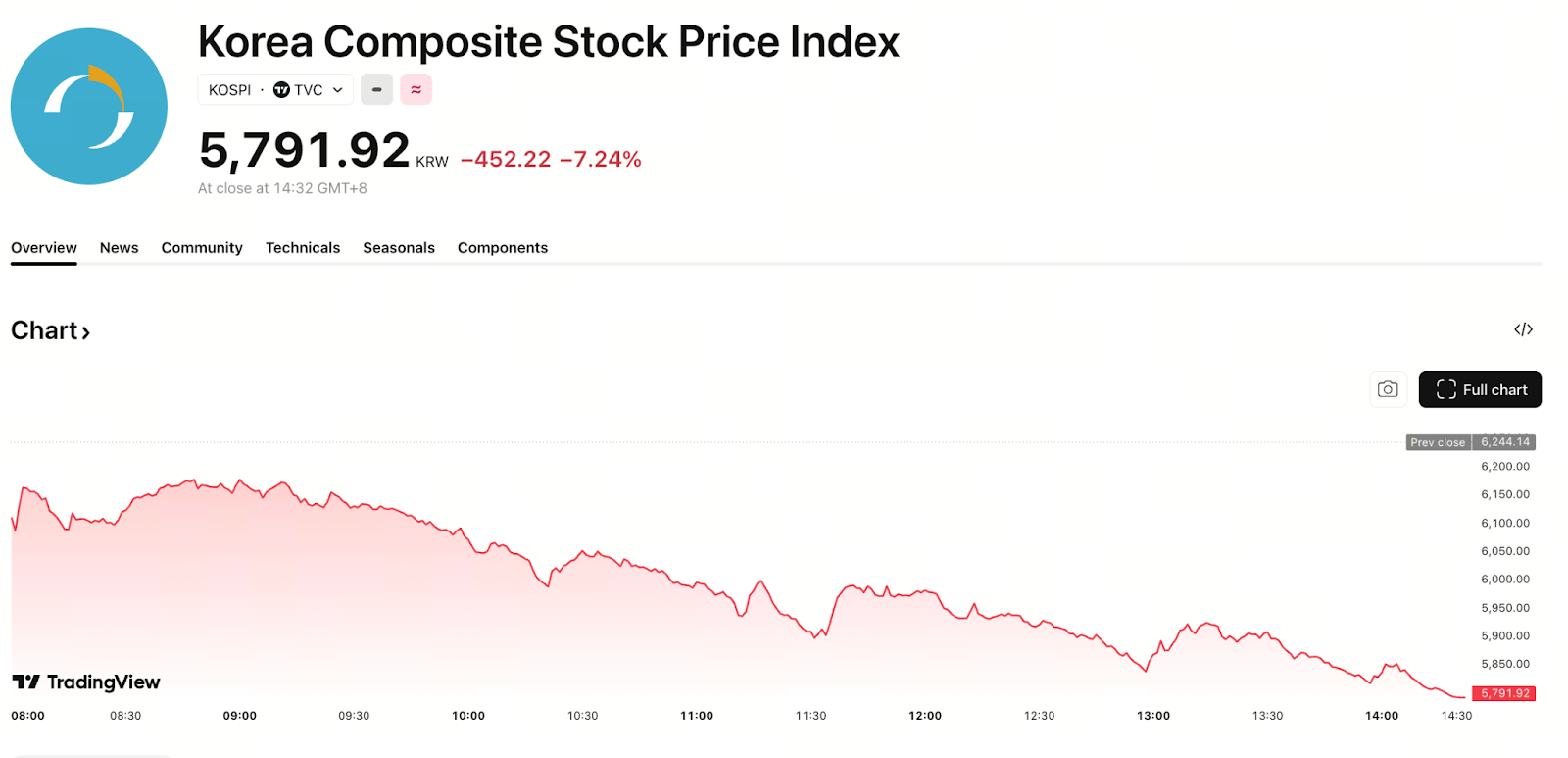
Chart: https://www.tradingview.com/symbols/TVC-KOSPI/
On March 3, Korea’s benchmark KOSPI index dropped as much as 5.6% during trading, triggering algorithmic trading circuit breakers—the largest single-day decline since November 2023. The Korean won fell 1.9% against the dollar, marking its biggest single-day drop since May 2023.
This move is not simply a technical correction. It signals a rapid contraction in global risk appetite. With escalating tensions in the Middle East, markets quickly raised expectations for oil supply risk. Korea’s heavy reliance on energy imports makes it especially sensitive to oil price shocks, positioning it as the focal point for regional market stress.
Asia-Pacific markets also came under pressure. Japan’s Nikkei 225 fell about 2.5% intraday, and the MSCI Asia Pacific Index saw its largest two-day drop since April 2023. US and European stock index futures declined as well, confirming that risk aversion is a global repricing process, not a localized phenomenon.
Structural Drivers of the Index Plunge: Concentrated Weight and High Volatility
KOSPI’s pronounced volatility stems from its index structure. The Korean stock market is highly concentrated in a handful of leading tech and semiconductor firms. Samsung Electronics and SK Hynix hold dominant weights in the index, so when both fall more than 6% at the same time, the impact on the index is significant.
Markets with high concentration show greater upside elasticity during rallies but magnify volatility during risk-off periods. Especially after a rapid run-up, substantial unrealized gains accumulate, and when macro variables shift, profit-taking and risk control actions trigger simultaneously.
Semiconductor Pullback and Reassessment of the AI Narrative
KOSPI remains up more than 40% year-to-date, mainly driven by expectations for increased semiconductor demand amid the AI investment boom. Global data center construction, cloud expansion, and computing power upgrades have sharply boosted demand for memory and logic chips.
Samsung Electronics and SK Hynix, as key global memory chip suppliers, became the core allocation targets for capital. Yet high-growth narratives often come with elevated valuations. When markets expect a loose interest rate environment, high valuations are tolerated; but if rising oil prices threaten to push up inflation and interest rates, the discount rate assumption changes, leading to valuation compression before earnings revisions.
This recent decline does not necessarily indicate a deterioration in semiconductor fundamentals. Rather, it reflects a recalibration of discount rates and risk premiums.
What the Countertrend Performance in Defense and Energy Signals
In sharp contrast to tech sector weakness, defense stocks surged. Hanwha Aerospace and LIG Nex1 gained more than 25%.
This pattern reflects a shift in capital logic—from growth-driven to risk-hedging. Geopolitical conflict escalation often brings expectations of expanded defense budgets, with anticipated order growth priced into shares ahead of time.
The energy sector also saw support. If oil prices stay high, related companies’ profitability will improve. During periods of heightened volatility, capital tends to favor sectors with “price transmission capability” to hedge macro uncertainty.
How Oil Price Shocks Affect Inflation and Interest Rate Trajectories
The true variable shaping the market’s medium-term outlook remains oil prices. If conflict persists, global energy supply chains may be disrupted and crude prices could reach new highs.
For Korea, rising energy costs will directly increase production expenses and push inflation higher through imports. If inflation rebounds, global central banks’ policy space will be affected. Previously, markets were betting on gradually easing inflation and falling rates; if that assumption falters, asset pricing systems will need to adjust.
Even small changes in rate expectations have a pronounced effect on high-valuation growth stocks. Higher discount rates compress the present value of future cash flows and alter investor risk preferences.
Foreign Capital Flows, Won Volatility, and Asset Rebalancing
Capital flow data shows net foreign selling has exceeded KRW 4 trillion, driving the market downturn. Meanwhile, local retail investors have chosen to buy on dips.
Foreign capital behavior is shaped by global asset allocation logic. When uncertainty rises, international investors typically reduce exposure to emerging markets and shift toward more liquid dollar assets. The won’s depreciation reflects the linkage between capital flows and exchange rates.
This “double whammy” of equities and currency often occurs in the early stages of risk events. If oil prices stabilize or conflict cools, capital outflows may slow; if risks persist, pressure on both the exchange rate and stock market could intensify.
Market Rhythm Outlook
Based on current information, the market is pricing a “moderate risk scenario”—conflict remains at a certain intensity but has not fully spilled over.
- If conflict quickly eases and oil prices fall, risk premiums will contract, and tech-weighted stocks may see a short-term rebound.
- If conflict persists but remains controllable, the market may enter a consolidation phase, with energy and defense sectors outperforming while high-valuation growth stocks face valuation compression.
- If conflict escalates and disrupts the global energy supply chain, inflation rebound and capital expenditure contraction risks will rise, and market volatility will expand sharply.
Overall, the current plunge in Korean stocks appears to be a risk repricing triggered by geopolitics, not a fundamental collapse. The long-term demand logic for semiconductors remains unchanged, but during adjustments to rate and liquidity expectations, valuation swings may far exceed changes in earnings. The market is reassessing the price of uncertainty, not ending the growth trend. Going forward, the true drivers will be oil price trends, the pace of conflict developments, and shifts in global capital flows.
Share
Content
Risk Aversion Surges: Korea at the Center of Pressure
Structural Drivers of the Index Plunge: Concentrated Weight and High Volatility
Semiconductor Pullback and Reassessment of the AI Narrative
What the Countertrend Performance in Defense and Energy Signals
How Oil Price Shocks Affect Inflation and Interest Rate Trajectories
Foreign Capital Flows, Won Volatility, and Asset Rebalancing
Market Rhythm Outlook


Related Articles

What is Fartcoin? All You Need to Know About FARTCOIN

Gold Price Forecast for the Next Five Years: 2026–2030 Trend Outlook and Investment Implications, Could It Reach $6,000?

XRP Surge, A Review of 9 Projects with Related Ecosystems

Pump.fun Launches Its Own AMM Pool? The Intent to Take Raydium’s Profits is Obvious
Every U.S. Crypto ETF You Need to Know About in 2025