Pokémon Card Tokenization? The Impact, Logic, and Risks of Financializing Cultural Assets
I. Collectibles Enter Structured Capital Systems
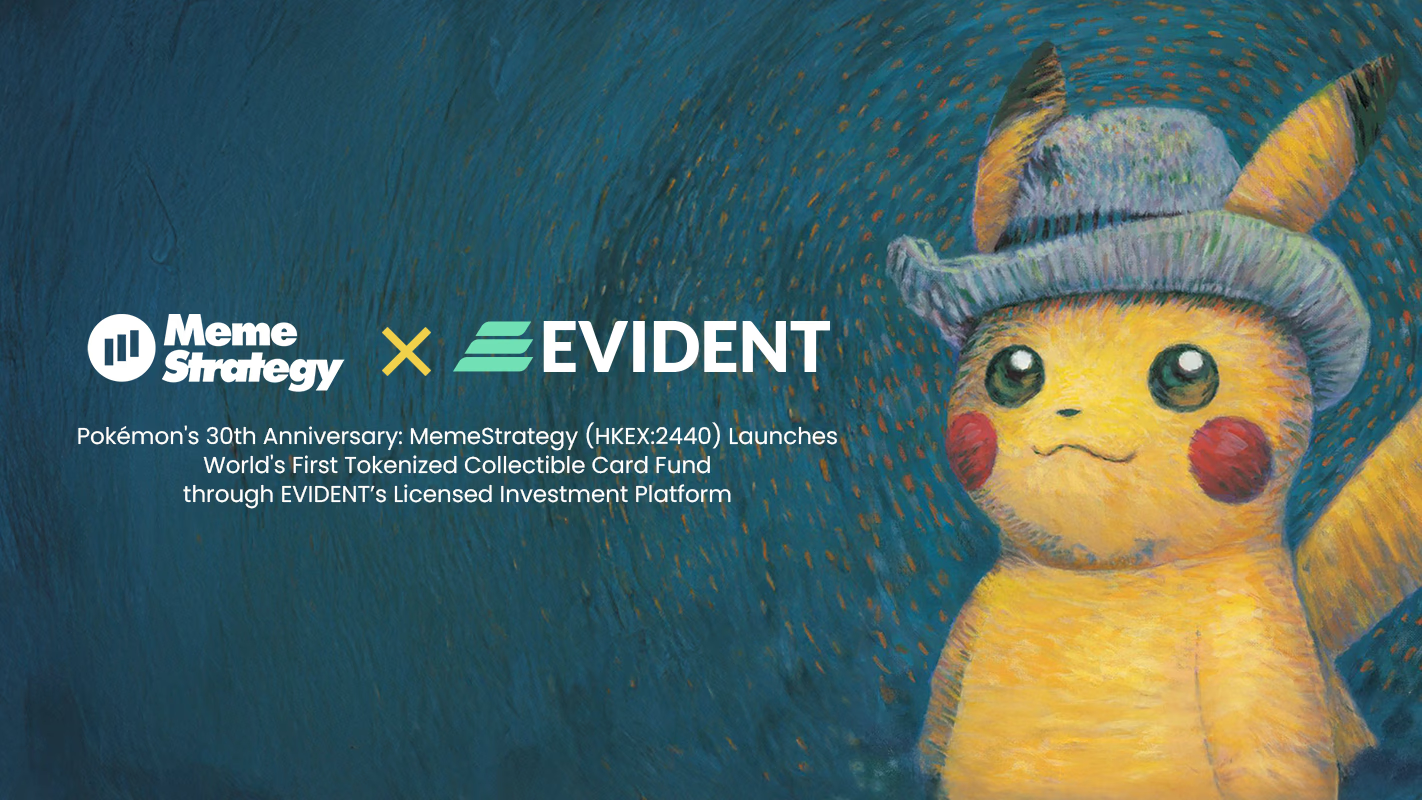
On March 3, 2026, MemeStrategy, a publicly listed Asian digital asset company, announced the launch of the world’s first Pokémon card tokenization fund, focusing on PSA 10 grade “Van Gogh Pikachu” (Pikachu with Grey Felt Hat). Jointly released by The Pokémon Company and the Van Gogh Museum, this card combines IP co-branding and limited edition status.
EVIDENT Platform Services Limited, a licensed fintech firm headquartered in Hong Kong, specializes in digital issuance and management infrastructure for private funds and real-world assets (RWA). Leveraging compliance frameworks, custody and audit mechanisms, and blockchain technology, EVIDENT supports asset managers in structuring assets, tokenizing equity, and managing investors, positioning itself as a bridge between traditional private markets and digital asset markets. For this Pokémon card fund, EVIDENT provides the structural layer, serving as the compliance and asset digitization infrastructure provider—not an IP participant.
At first glance, this is an innovative approach to alternative assets. Structurally, it signals a broader trend: cultural assets are being integrated into the structured logic of capital markets.
This is not just tokenization—it is financialization.
II. From Collectibles to Assets: Changing Market Structure
The traditional collectibles market forms prices based on four core variables:
- Scarcity
- IP popularity
- Collector consensus
- Auction transaction records
Together, these factors anchor price. Auction records confirm pricing, while community consensus determines the valuation ceiling.
Pokémon card appreciation over the past two decades is fundamentally driven by global IP expansion and generational user accumulation. As the Pokémon IP grows worldwide, new players enter the market, previous generations accumulate wealth, and demand structure strengthens. Extreme cases, such as the multimillion-dollar card once owned by Logan Paul, reinforce the belief that “rare cards = high-value assets.”
However, the collectibles market has three inherent structural traits:
- Niche market
- Emotion-driven
- Limited liquidity
Prices rely more on event-driven momentum and consensus reinforcement than deep, continuous trading. When fund structures enter, market logic shifts from an “interest market” to a “capital market.”
III. Tokenization: A Capital Structure Challenge, Not Just a Technical One
Many compare these products to NFT fractionalization, but their logical frameworks differ.
NFT fractionalization follows this path:
- Lock high-value NFT
- Issue divisible tokens
- Market trading determines price
This addresses liquidity splitting and is essentially a technical innovation.
The Pokémon card fund, however, aligns more with traditional private fund logic. Its core structure includes:
- Partnership framework
- Third-party custody
- Audit and disclosure mechanisms
- Tokenized equity representation
The critical change is not the token itself, but the restructuring of asset ownership. Scarce assets once scattered among collectors are now centralized, structured, and capitalized.
This leads to three developments:
- Pricing power concentrates
- Circulation structure changes
- Collectible and asset attributes begin to diverge
The real transformation happens at the capital structure level—not on the blockchain technical layer.
IV. Chip Concentration Effect: Short-Term Price Reshaping
If the fund targets acquiring 25% of PSA 10 cards, circulating supply will shrink dramatically. In a market with limited depth, concentrated holdings may trigger structural shocks.
Short-term changes may include:
1. Marked increase in price elasticity
- Reduced circulation
- Stronger marginal buying force
- Small trades can drive exponential volatility
2. Distorted price signals
- Fund activity becomes a key price variable
- Market quotes no longer fully reflect genuine collector demand
- Expectations of “position-controlled pricing” may emerge
3. Changing demand structure
- Interest-driven demand declines
- Asset allocation-driven demand increases
- Some investors enter based on portfolio logic, not sentiment
This step marks a critical transition from collectibles to financial markets.
V. Medium-Term Changes: Structural Shift in Price Mechanisms
As cultural assets enter financial structures, their price formation mechanisms shift.
From “Auction Pricing” to “Net Asset Value Pricing”
If the fund regularly discloses:
- Holdings
- Valuation models
- Audit reports
The market may see:
- NAV premiums/discounts
- Divergence between secondary market and physical prices
- Closed-end fund-like structures
At this stage, cards become part of an “asset pool” rather than standalone items.
From “Community Trading” to “Cross-Market Linkage”
Previously, card prices were shaped by:
- Collector community popularity
- IP activity
- Community expansion speed
Future variables may include:
- Macro liquidity
- Crypto market risk appetite
- Digital asset volatility cycles
If tokens trade on digital asset markets, card prices could move in sync with BTC. Asset characteristics are shifting toward “risk assets.”
VI. Long-Term Impact: Financialization’s Double-Edged Sword
History shows financialization brings two opposing outcomes: increased liquidity and amplified volatility.
Compare with tokenized gold products like Pax Gold. Gold, as a standardized commodity, features:
- Unified global pricing
- Large supply
- Deep liquidity
Tokenization does not alter its market structure.
Pokémon cards, however, are fundamentally different:
- Non-standardized
- Highly limited supply
- Consensus-driven valuation
Thus, financialization results are more uncertain and prone to structural volatility.
VII. Potential Risks: Liquidity Illusion and Stampede Mechanism
Token liquidity does not equal physical liquidity.
Under stress, scenarios may include:
- Mass investor redemptions
- Funds forced to sell physical cards
- Insufficient buyer depth in high-end card markets
This can trigger:
- Rapid price markdowns
- Discounted auction sales
- Valuation models breaking down
Collectibles market history repeatedly shows that during macro liquidity contractions, high-end asset prices often experience sharp corrections. Financialization does not eliminate cycles—it accelerates them.
VIII. Will Cultural Attributes Be Diluted?
Pokémon cards originated as:
- Game derivatives
- Emotional carriers
- Community symbols for players
As financial product assets, they may undergo these changes:
- Higher collecting thresholds
- Ordinary players pushed to the margins
- Prices detached from real usage
- Capital dictates market rhythm
The art market has seen similar phases. Institutional entry raised prices but changed participant structure. Once cultural assets are financialized, ecosystems rarely fully revert to their original state.
IX. Where Does the Market Go When Capital Enters?
It’s less about “successful institutionalization” or “bubble” and more about structural redistribution. When capital enters collectibles, single-path progress is rare—internal hierarchy restructuring is common.
One scenario: high-end rare cards become institutionalized. Institutional demand persists, valuation models stabilize, and volatility is absorbed by asset allocation logic. Pokémon cards shift from cultural goods to alternative asset portfolio components. Prices move with allocation needs, not pure sentiment.
Another force: the capital cycle itself. In liquidity expansion, funds concentrate, prices rise; in risk contraction, liquidity recedes, and the market seeks real buyer depth. If exit demand falls short, prices revert to collector-driven ranges. This isn’t market failure—it’s the capital cycle’s natural course.
More important than these extremes is structural layering.
Capital tends to target the rarest, most standardized, and easiest-to-price segment—high-end PSA 10 cards. This segment may become financialized, forming the “capital layer.” Meanwhile, mid- and low-end cards remain under player and collector control, retaining cultural and emotional traits.
Two parallel tracks may emerge:
- Asset layer led by institutional capital
- Collectible layer led by community interest
Price mechanisms, participant groups, and volatility rhythms will differ.
So, instead of asking whether the market will succeed or bubble, ask how it will layer. Capital entry rarely destroys the original ecosystem—it changes the structural ratio. This is not linear evolution, but layered restructuring.
XI. Price Impact Forecast
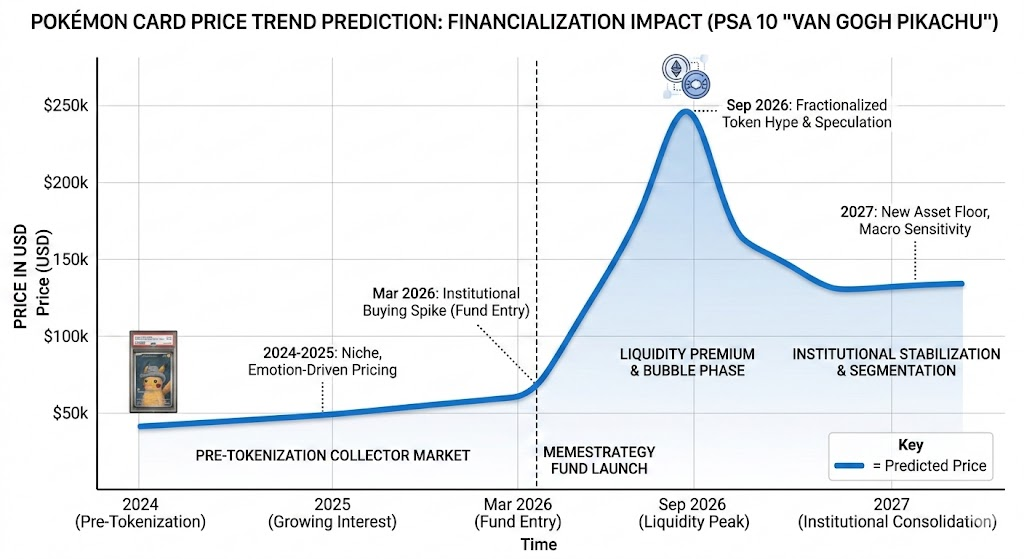
Four-Stage In-Depth Analysis
1. 2024–2025: Traditional Collectibles Driven Phase (Pre-Tokenization)
- Price trend: Gradual rise, low volatility.
- Core logic: Price is determined by sentiment and true scarcity. Buyers are primarily hardcore collectors and IP fans. Transactions occur on high-friction platforms like eBay and auction houses, with low turnover; prices reflect internal community consensus.
- Chart meaning: This is the asset’s “value base,” free of financial leverage.
- March 2026: Institutional Entry Pulse (Fund Entry)
- Price trend: Curve slope jumps sharply, clear “gap up” effect.
- Core logic: Funds such as MemeStrategy enter. To lock in 25% of circulating supply, institutions conduct bulk buying.
- Market behavior: All low-priced listings are quickly absorbed, remaining card holders become reluctant to sell, pushing marginal prices higher with minimal trades. Pricing power shifts from dispersed collectors to centralized funds.
3. September 2026: Tokenization Speculation Peak (Liquidity Peak)
- Price trend: Forms a “spike,” detached from fundamentals.
- Core logic: Fractionalized tokens launch for trading.
- Lowered threshold: Cards once priced at $50,000 can now be accessed by retail investors for $10 per share.
- Liquidity premium: Assets trade 24/7 on digital exchanges, exponentially increasing transaction frequency.
- Result: Prices reflect both card value and speculative option value.
4. 2027: Valuation Reshaping and Layering (Institutional Consolidation)
- Price trend: Sharp correction followed by a high plateau.
- Core logic: Bubble bursts, “value return” begins.
- New normal: Prices won’t fall back to 2024 levels, as institutional holdings lock in chips, creating a new asset floor.
- Macro sensitivity: Prices now hinge on macro factors like Fed policy and crypto market systemic risk, not just new Pokémon games. Cards complete their transformation from “toy” to “alternative asset (Alt-Asset).”
Conclusion: Fundamental Shift in Investment Logic
For holders, this brings:
- Higher holding costs: Ordinary players can no longer afford top cards and must buy tokens instead.
- Changed volatility logic: Previously, risk meant card damage; now, it means fund liquidation.
- Differentiated exit mechanisms: Institutions can liquidate anytime via secondary markets (tokens), while physical cards may become harder to sell quickly at high prices as liquidity is absorbed by tokens.
XI. Macro Perspective: RWA Expands to Emotional Assets
Previously, RWA focused mainly on:
- Government bonds
- Real estate
- Private debt
These assets have clear cash flow or income structures.
Pokémon cards represent:
- Non-cash flow assets
- Scarcity assets
- Emotion-driven assets
When RWA expands to this level, capital markets are attempting to incorporate consensus value into structured systems. This is fundamentally an institutional experiment.
XII. Final Assessment
Short term:
- High likelihood of price appreciation
- Increased volatility
- Chip concentration amplifies elasticity
Medium term:
- Valuation logic shifts
- Pricing power partially concentrates
- Greater correlation with macro markets
Long term:
- Success depends on stable institutional demand
- And on avoiding liquidity stampedes
Regardless of outcome, one trend is clear: cultural assets are becoming the new frontier for capital markets.
Future may bring:
- Sports card index funds
- Art tokenization funds
- Structured IP collectible products
Once collectibles are included on the balance sheet, they become capital allocation tools—not just objects of sentiment. The real question isn’t whether card prices will rise, but: When culture is reshaped by financial structures, can it retain its original meaning?
Share
Content
I. Collectibles Enter Structured Capital Systems
II. From Collectibles to Assets: Changing Market Structure
III. Tokenization: A Capital Structure Challenge, Not Just a Technical One
IV. Chip Concentration Effect: Short-Term Price Reshaping
V. Medium-Term Changes: Structural Shift in Price Mechanisms
VI. Long-Term Impact: Financialization’s Double-Edged Sword
VII. Potential Risks: Liquidity Illusion and Stampede Mechanism
VIII. Will Cultural Attributes Be Diluted?
IX. Where Does the Market Go When Capital Enters?
XI. Price Impact Forecast
XI. Macro Perspective: RWA Expands to Emotional Assets
XII. Final Assessment


Related Articles

What is Fartcoin? All You Need to Know About FARTCOIN

Gold Price Forecast for the Next Five Years: 2026–2030 Trend Outlook and Investment Implications, Could It Reach $6,000?

XRP Surge, A Review of 9 Projects with Related Ecosystems

Pump.fun Launches Its Own AMM Pool? The Intent to Take Raydium’s Profits is Obvious
Every U.S. Crypto ETF You Need to Know About in 2025