Key Gaps for AI Agents Entering the Executable Economy
 (Source: worldlibertyfi)
AI systems have made great strides in reasoning and decision-making, but they still fall short when it comes to managing funds. For agents to truly execute tasks, they need more than just the ability to understand requirements—they must be able to:
This means that, for AI to be deployed in real-world applications, it must be paired with a robust payment infrastructure.
USD1: A Stable Asset Designed for AI Systems
USD1 is not a stablecoin in the traditional sense. Instead, it serves as a capital layer specifically designed for AI and automated systems.
Its core features include:
-
Dollar-denominated to minimize volatility risk
-
Enables transactions by non-human participants (AI agents)
-
Functions as a settlement medium for AI task execution
USD1 acts as the operating currency of the AI economy—it’s not just a store of value, but an asset embedded directly in agent operations.
AgentPay SDK: Empowering AI with Payment Capabilities
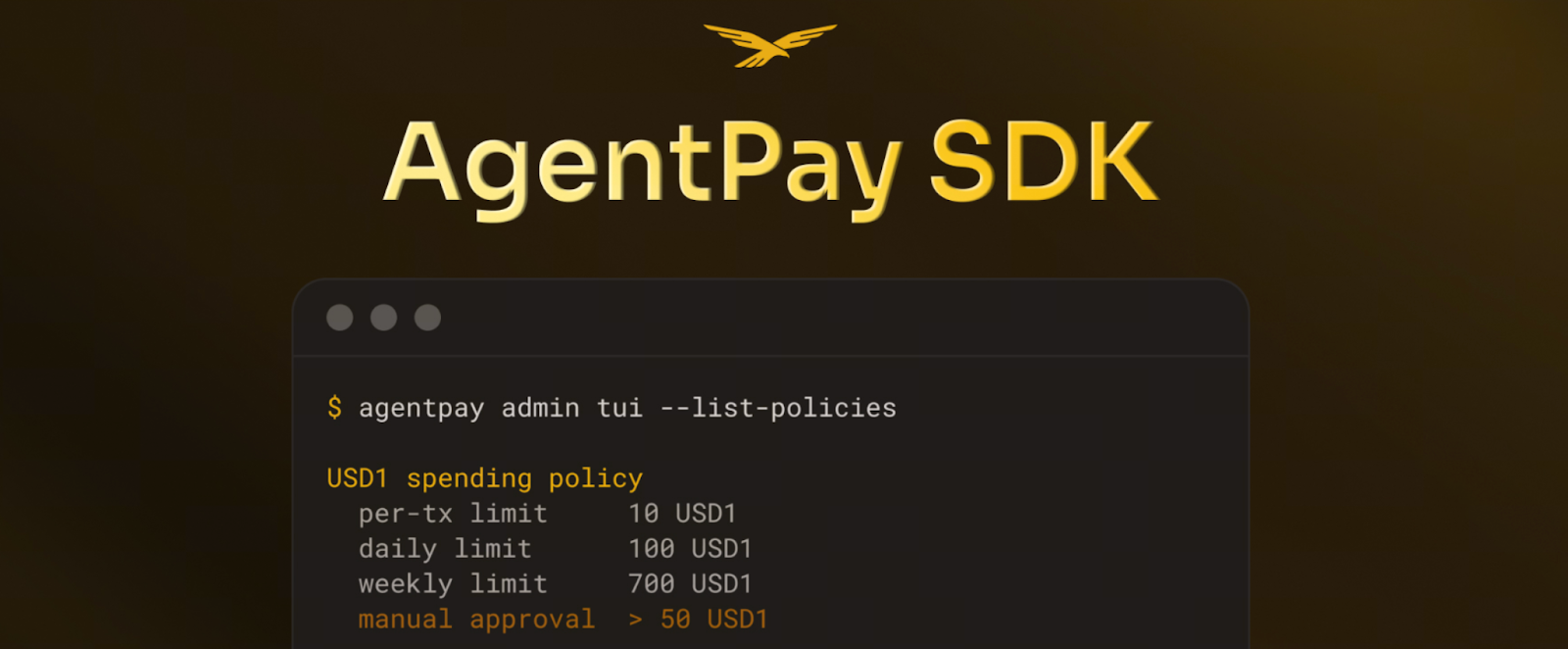
To enable agents to actually operate with USD1, the system introduces AgentPay SDK—an open-source, self-custody-focused developer toolkit.
Key features include:
-
Local private key management (never transmitted externally)
-
Transaction policy enforcement mechanisms
-
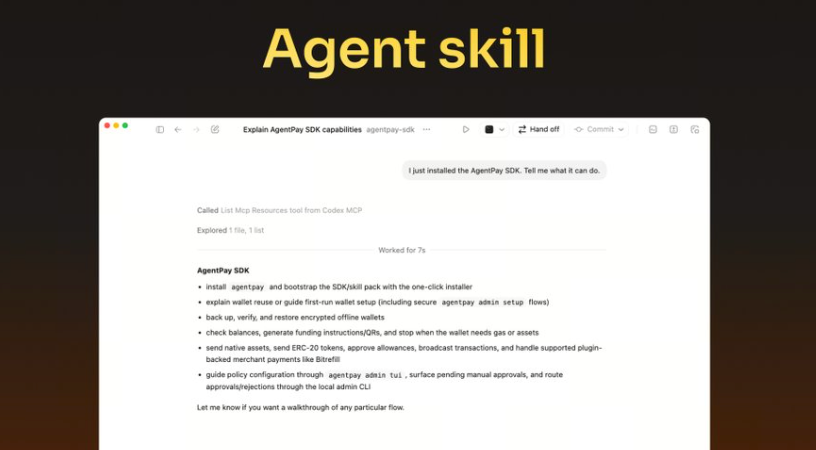
Integration with a variety of AI development tools
-
Operates on local devices without reliance on centralized services
The SDK integrates directly with common development environments, allowing AI to perform payments within existing workflows.
How Does a Transaction Work?
When a user instructs an AI agent to make a payment, the process involves several layers of checks and execution:
The basic steps are:
-
Parse instruction: Identify the payment asset and target address
-
Balance check: Verify the wallet has sufficient funds and gas
-
Policy verification: Ensure compliance with per-transaction or daily spending limits
-
Local signing: Sign the transaction via the local daemon
-
On-chain broadcast: Submit the transaction and finalize settlement
The entire workflow completes in seconds, and all sensitive data (such as private keys) remains on the local device.
Handling Exceptions: Mitigating Fund Risks
AgentPay SDK not only handles successful transactions but also provides solutions for common failure scenarios.
- Insufficient balance
The system does not force transactions. Instead, it:
-
Reports the missing asset type
-
Displays wallet information and top-up options
-
Provides a QR code to assist with deposits
- Exceeding authorized limits
If the transaction amount exceeds a preset threshold:
-
The system automatically pauses
-
Sends a manual approval request
-
Only executes the transaction after authorization
This design ensures both automation and human oversight can coexist.
SDK Architecture and Functional Modules
 (Source: worldlibertyfi)
AgentPay SDK is composed of four main components:
Currently, the system also supports:
-
Multiple EVM chains (including Ethereum and BSC)
-
More than 40 CLI commands
-
Integration with a range of AI tools
-
Built-in product purchasing features (such as gift cards and eSIMs)
Why Do AI Systems Need Dedicated Payment Infrastructure?
As AI agents become increasingly active in the digital economy, the limitations of traditional payment systems are becoming clear. Historically, stablecoins have been designed around compliance, liquidity, and capital efficiency, with human users as the primary audience.
In the AI era, payment needs have fundamentally changed—the challenge is no longer just whether payments can be made, but how to ensure payments are executed safely and controllably within automated decision-making.
In this context, payment systems must offer advanced capabilities: automatic execution within preset policy limits, the ability to instantly pause in high-risk or abnormal scenarios, and seamless integration with task workflows as part of AI execution logic. AgentPay SDK was created to meet these needs, delivering a payment solution purpose-built for AI agents and the automated economy.
Future Directions
The SDK is only the beginning. Planned enhancements include:
-
Support for EIP-3009 (gasless transactions)
-
Establishment of agent payment standards (EIP proposals)
-
Expansion of plugins and third-party integrations
-
Support for cross-border payments and financial applications
-
Deep integration with DeFi and institutional-grade settlements
The ultimate goal is to transform AI from an advisor into an economic actor.
Conclusion
As AI technology evolves from content generation to task execution, payment capabilities are becoming the key hurdle to real-world adoption. USD1 and AgentPay SDK are not merely new stablecoins or tools—they are building a comprehensive capital operations framework that enables AI to autonomously execute transactions and decisions within defined rules. As capital flows and task execution become integrated, AI will move beyond being just a supporting tool, becoming an independent participant in economic activity—signaling the agentic economy’s transition from concept to reality.