Common Barriers to Leveraged Trading
In most financial markets, leverage is typically implemented through contracts or margin trading. Traders must open positions, set leverage multiples, and actively monitor their margin ratios and risk levels.
During periods of sharp market volatility, investors may need to quickly add margin or adjust their positions to avoid triggering forced liquidation. Although this approach offers greater trading flexibility, it also increases operational complexity. For some investors, ongoing margin and risk management demands significant time and effort, raising the barrier to entry.
Start trading Gate Leveraged ETFs: https://www.gate.com/leveraged-etf
Converting Leverage into Tradable Products
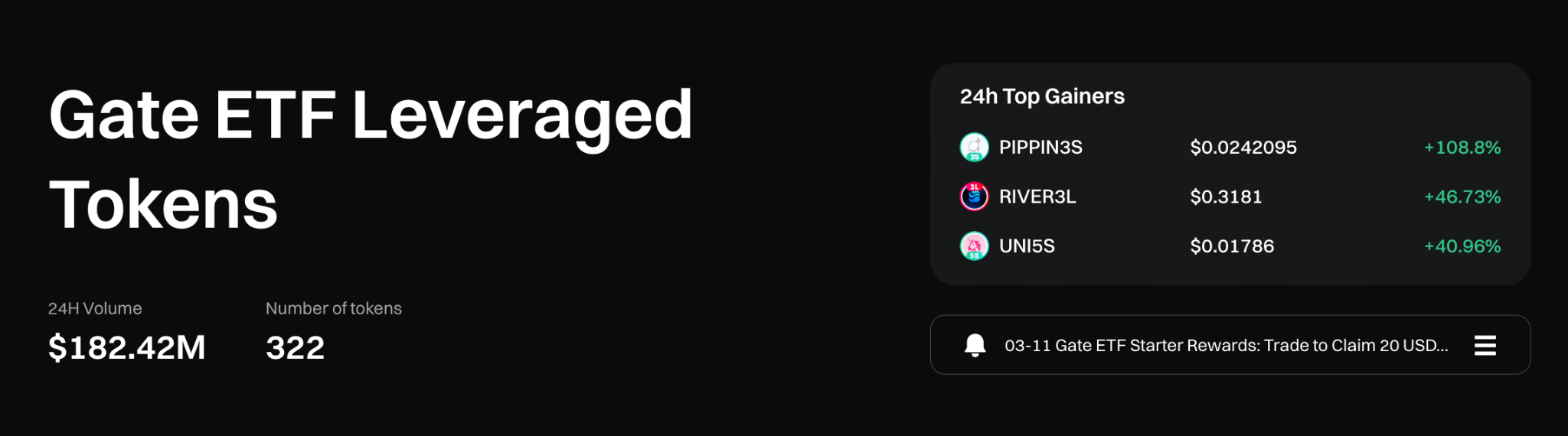
Gate Leveraged ETFs introduce a new trading approach. Unlike traditional contracts, these products embed leverage directly into their structure, so investors can simply buy or sell them in the spot market.
Each leveraged ETF is issued with a fixed target leverage, such as:
-
3x Long ETF
-
3x Short ETF
-
5x Leveraged ETF
Because the leverage multiple is built into the product, investors do not need to manually set leverage ratios or open separate contract positions. The trading process closely resembles spot token trading, making it more straightforward.
How Rebalancing Maintains Leverage
To keep the product aligned with its preset leverage multiple, leveraged ETFs use a rebalancing mechanism to adjust internal holdings. When market price changes cause the actual leverage ratio to deviate from the target, the system automatically reallocates positions to bring leverage back within the expected range.
This structure offers several advantages:
-
System automatically adjusts holdings
-
No manual margin tracking required
-
Reduced need for frequent position changes
As a result, even in volatile markets, investors don’t need to constantly monitor margin status as with contract trading.
Why Leveraged ETFs Don’t Experience Liquidation
A key difference between leveraged ETFs and traditional contracts is the lack of individual margin accounts, which eliminates forced liquidation.
This is mainly because:
-
Investors aren’t directly borrowing funds
-
Leverage risk is reflected in product price movements
-
The system manages internal risk through rebalancing
When markets move against investors, the typical outcome is a decrease in product net value—not forced account liquidation. The risk profile differs from contract trading.
Leveraged ETF performance depends on market structure. In clear trending markets, sustained price movements can amplify returns. In sideways or consolidating markets, frequent price swings may cause the rebalancing mechanism to erode net value. Over extended periods of range-bound trading, actual performance may diverge from simple multiple calculations. This is why leveraged ETFs are often seen as better suited for trending markets.
Capital Flexibility with Spot Trading
Gate Leveraged ETFs use spot trading, so investors only pay the purchase amount to participate in leveraged trading—no extra collateral or borrowing required. The product also charges a fixed daily management fee to cover hedging and rebalancing costs.
Compared to models requiring margin maintenance, this approach offers several benefits:
-
Simpler capital management
-
No need for additional margin
-
More flexible asset allocation
For investors looking to participate in leveraged trading without managing complex positions, this model provides an alternative.
Use Leveraged Products Cautiously
While trading is simplified, leveraged ETFs still amplify price volatility. When market direction is correctly anticipated, returns can be quickly magnified; if the market moves against expectations, losses will increase accordingly.
When using leveraged ETFs, investors should:
-
Understand how the product works
-
Manage capital allocation carefully
-
Avoid concentrating too heavily in high-volatility instruments
Prudent leverage use remains essential for risk management.
Conclusion
Leveraged ETFs offer a new way to participate in leveraged trading, distinct from traditional contracts. With fixed leverage design and automatic rebalancing, Gate Leveraged ETFs turn active leverage management into a tradable product. This structure doesn’t eliminate market risk, but changes how leverage risk is presented and managed. When investors understand the mechanics and allocate capital wisely, leveraged ETFs can be a valuable addition to investment strategies, expanding market participation opportunities.