As blockchain technology expanded beyond simple peer-to-peer transactions, it introduced new forms of collective coordination that required structured governance systems. Traditional governance models rely on centralized authorities, which are incompatible with decentralized environments.
DeXe addresses this gap by offering programmable governance frameworks, enabling transparent decision-making, automated execution, and collective treasury management. These systems allow distributed participants to coordinate effectively while maintaining decentralization principles.
What is DeXe?
Within blockchain ecosystems, DeXe functions as a governance infrastructure that supports how decentralized communities organize decision-making, manage shared treasuries, and enforce rules through smart contracts. It provides a structured environment where participants can collectively define rules, submit proposals, and coordinate actions without relying on centralized oversight.

As part of a broader class of blockchain governance frameworks, DeXe addresses the challenge of coordinating distributed participants who may have differing incentives, levels of participation, and access to information. Instead of informal or fragmented governance approaches, it introduces a consistent system where processes are predefined and executed transparently on-chain.
Its design emphasizes standardization in governance workflows, including how proposals are created, how voting power is distributed, and how outcomes are implemented. This reduces ambiguity in decision-making and helps participants understand how influence and responsibility are allocated within a DAO.
By embedding governance logic into programmable smart contracts, DeXe enables decentralized organizations to operate with predictable rules, verifiable outcomes, and reduced reliance on trust between participants. This approach supports the transition from loosely organized communities to more structured and scalable decentralized systems.
Why does DeXe exist?
The expansion of decentralized finance (DeFi) and broader Web3 ecosystems introduced new forms of coordination that traditional governance systems were not designed to support. As decentralized networks grew in scale and complexity, informal governance approaches became increasingly difficult to manage effectively.
Several structural gaps contributed to the need for more formalized governance infrastructure:
-
Inconsistent governance models: Early DAOs often relied on loosely defined voting mechanisms, where rules varied widely and lacked standardization. This made decision-making unpredictable and difficult to scale.
-
Limited transparency in fund management: Managing shared treasuries across distributed participants required systems that could provide clear visibility into how funds were allocated and used. Without such mechanisms, accountability remained limited.
-
Coordination inefficiencies: Participants in decentralized systems are often geographically dispersed and operate with different incentives. Aligning these participants and reaching consensus without centralized control presented ongoing challenges.
-
Lack of automation in execution: Even when decisions were made, executing them often required manual intervention or off-chain coordination, introducing delays and potential inconsistencies.
DeXe introduces a structured governance framework that embeds rules, processes, and execution logic into smart contracts, enabling decentralized systems to operate with consistent, scalable, and automated coordination.
How does DeXe work?
DeXe operates through a system of smart contracts that define governance rules, coordinate voting mechanisms, and manage treasury operations within a DAO environment.
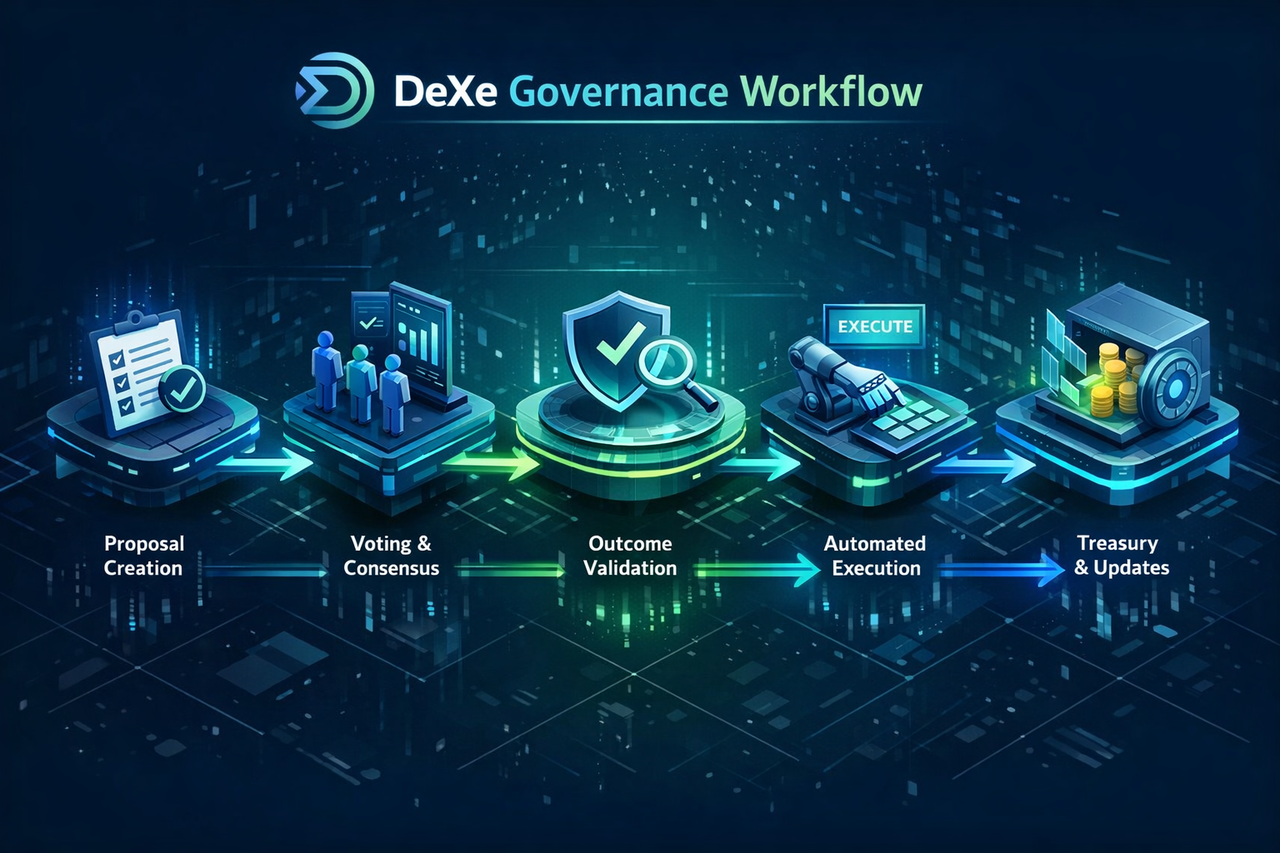
The governance process can be understood as a sequence of structured steps:
Step 1: Proposal creation Participants initiate governance by submitting proposals that outline specific actions, such as allocating funds, modifying parameters, or introducing new initiatives. Each proposal follows predefined rules that determine eligibility and format.
Step 2: Voting and consensus formation Once a proposal is submitted, eligible participants vote based on governance parameters such as quorum requirements, voting duration, and approval thresholds. Voting power is typically linked to token holdings or delegated authority.
Step 3: Validation of outcomes After the voting period ends, the system verifies whether the proposal meets the required conditions for approval. This ensures that only proposals with sufficient consensus move forward.
Step 4: Automated execution Approved proposals are executed automatically through smart contracts. Actions such as transferring funds, updating parameters, or triggering protocol changes occur without manual intervention.
Step 5: Treasury and system updates Execution outcomes directly affect the DAO’s treasury or operational state, ensuring that decisions translate into measurable changes within the system.
DeXe works by using smart contracts to manage a step-based governance process, where proposals are submitted, voted on, validated, and automatically executed, enabling decentralized and automated decision-making within DAOs
Core components and key features of DeXe
DeXe integrates multiple components that work together to form a cohesive governance infrastructure for decentralized organizations. Rather than operating as isolated modules, these components interact to support decision-making, resource management, and participant coordination within a unified system.
| Component |
Description |
Function |
| Governance module |
Defines voting rules and proposal structures |
Enables decision-making processes |
| Treasury system |
Manages pooled assets on-chain |
Ensures transparent fund allocation |
| Incentive mechanisms |
Rewards participation and contributions |
Aligns user behavior with DAO goals |
| Delegation system |
Allows voting power delegation |
Improves governance flexibility |
These components form the operational foundation of DeXe, where governance logic, financial coordination, and participation incentives are interconnected. Together, they create a system in which decisions are not only made collectively but are also executed and reflected across the DAO’s resources.
Building on this foundation, several key features emerge that define how DeXe functions in practice:
-
Modular governance design: Governance parameters such as quorum thresholds, voting duration, and proposal requirements can be customized. This flexibility allows DAOs to adapt governance structures to their specific needs and stages of development.
-
Transparent treasury management: All treasury activities are recorded on-chain, providing visibility into how funds are allocated and used. This transparency supports accountability and reduces information asymmetry among participants.
-
Incentive alignment mechanisms: Structured reward systems encourage active participation in governance. By linking incentives to contributions, the system helps align individual behavior with collective goals.
-
Automation and programmability: Governance decisions are executed automatically through smart contracts once conditions are met. This reduces delays, minimizes reliance on intermediaries, and ensures consistency in execution.
DeXe combines governance modules, treasury systems, incentive mechanisms, and delegation features into a unified framework that enables decentralized organizations to coordinate decisions, manage resources, and automate execution through programmable rules.
DeXe tokenomics: governance, incentives, and treasury management
The DeXe ecosystem centers around the DEXE token, which functions as the core mechanism for governance coordination, incentive distribution, and treasury control within DAO structures. Its design reflects a governance-first approach, where token utility is closely tied to participation, responsibility, and long-term ecosystem alignment.
| Token Function |
Description |
Impact on Ecosystem |
| Governance voting |
Token holders participate in proposal voting, often with configurable voting models |
Shapes protocol direction and DAO policies |
| Staking and participation |
Tokens can be staked to access governance roles or increase participation weight |
Encourages long-term commitment and active involvement |
| Incentive distribution |
Rewards are allocated for contributions such as voting, proposing, or ecosystem support |
Sustains engagement and aligns incentives |
| Treasury governance |
Tokens are used to approve and manage treasury allocations |
Enables collective control over shared resources |
| Delegation |
Voting power can be delegated to other participants or representatives |
Supports flexible and scalable governance structures |
DeXe’s tokenomics integrates governance staking and participation models, linking influence to active engagement rather than passive holding. Treasury management is governed through token-based decisions, ensuring resource allocation follows transparent, rule-based processes.
The model also aims to balance influence distribution by combining token ownership with delegation and participation incentives, reducing purely passive control.
DeXe tokenomics centers on the DEXE token, which enables governance voting, staking-based participation, incentive distribution, and treasury control, creating a system where decision-making and resource management are coordinated through active on-chain engagement.
Main uses and applications of DeXe
DeXe is used in a range of scenarios where decentralized governance, coordination, and resource management are required. Its infrastructure supports both the creation of new DAOs and the operation of existing decentralized systems.
-
DAO creation and lifecycle management DeXe provides a structured environment for launching, configuring, and maintaining decentralized organizations, including governance rules, voting systems, and treasury logic.
-
DeFi protocol governance Within decentralized finance ecosystems, DeXe supports on-chain decision-making processes such as parameter updates, funding allocation, and protocol upgrades without centralized oversight.
-
Community coordination systems Distributed communities use DeXe to organize initiatives, vote on priorities, and allocate shared resources, enabling collective direction-setting across geographically dispersed participants.
-
Collaborative asset management Groups can manage digital assets through shared governance frameworks, where decisions about allocation, investment, or usage are made collectively and executed transparently.
DeXe is used to create and manage DAOs, support DeFi governance, coordinate community decisions, and enable collective asset management through transparent, rule-based decentralized systems.
What are the risks and limitations of DeXe?
While DeXe introduces structured governance mechanisms, it still reflects several limitations commonly associated with DAO-based systems. These risks arise from both technical design and participant behavior within decentralized environments.
-
Governance concentration Voting power may become concentrated among large token holders or delegated representatives, which can reduce the level of decentralization and influence decision outcomes disproportionately.
-
Smart contract risk Since governance logic and treasury operations are executed through smart contracts, vulnerabilities or coding errors can lead to unintended outcomes, including financial loss or governance disruption.
-
Participation imbalance Effective governance depends on active participation. Low voter turnout or reliance on a small group of contributors can weaken decision legitimacy and reduce system resilience.
-
Complex governance configuration Designing governance parameters such as quorum thresholds, voting duration, and proposal rules—requires careful calibration. Poorly configured systems may result in inefficiencies, governance deadlock, or unintended incentives.
DeXe faces risks including governance concentration, smart contract vulnerabilities, low participation, and complex configuration, which can affect decentralization, security, and the effectiveness of DAO decision-making.
Summary
DeXe functions as an infrastructure layer for decentralized governance, enabling communities to organize, make decisions, and manage shared resources without centralized control.
Through the integration of programmable governance rules, token-based participation, and transparent treasury systems, it supports the transition of DAOs into more structured and scalable coordination frameworks. This reflects a broader shift toward formalized, system-driven governance in decentralized digital environments.
DeXe provides governance infrastructure for DAOs by combining programmable rules, token-based participation, and transparent treasury management to enable structured and scalable decentralized coordination.
FAQs
What is DeXe used for?
DeXe is used to build and manage decentralized autonomous organizations, enabling governance, voting, and treasury coordination.
Is DeXe a DAO or a protocol?
DeXe is a protocol that provides infrastructure for multiple DAOs rather than being a single DAO itself.
How does DeXe automate governance?
It uses smart contracts to execute decisions automatically once voting conditions are met.
What role does the DeXe token play?
The token enables governance participation, incentivizes engagement, and supports treasury management.
What are the main limitations of DeXe?
Key limitations include governance centralization risks, smart contract vulnerabilities, and challenges in maintaining active participation.