

Trade
Basic
Futures
Futures
Hundreds of contracts settled in USDT or BTC
TradFi
Gold
Trade global traditional assets with USDT in one place
Options
Hot
Trade European-style vanilla options
Unified Account
Maximize your capital efficiency
Demo Trading
Futures Kickoff
Get prepared for your futures trading
Futures Events
Participate in events to win generous rewards
Demo Trading
Use virtual funds to experience risk-free trading
Earn
Launch
CandyDrop
Collect candies to earn airdrops
Launchpool
Quick staking, earn potential new tokens
HODLer Airdrop
Hold GT and get massive airdrops for free
Launchpad
Be early to the next big token project
Alpha Points
Trade on-chain assets and enjoy airdrop rewards!
Futures Points
Earn futures points and claim airdrop rewards
Investment
Simple Earn
Earn interests with idle tokens
Auto-Invest
Auto-invest on a regular basis
Dual Investment
Buy low and sell high to take profits from price fluctuations
Soft Staking
Earn rewards with flexible staking
Crypto Loan
0 Fees
Pledge one crypto to borrow another
Lending Center
One-stop lending hub
VIP Wealth Hub
Customized wealth management empowers your assets growth
Private Wealth Management
Customized asset management to grow your digital assets
Quant Fund
Top asset management team helps you profit without hassle
Staking
Stake cryptos to earn in PoS products
Smart Leverage
New
No forced liquidation before maturity, worry-free leveraged gains
GUSD Minting
Use USDT/USDC to mint GUSD for treasury-level yields

More


Singapore-based cryptocurrency company Penguin Securities completes approximately $18 million in funding, with participation from multiple Japanese investment institutions including Tokyo University of Science Investment Management Company.
Just Now
"Big Short" Michael Burry: Current Bitcoin Trend May Repeat 2022 Bear Market Rhythm
5m ago
Trending Topics
View More75.49K Popularity
4.18K Popularity
1.58K Popularity
1.96K Popularity
6.02K Popularity



Pin
Today's Cryptocurrency News (February 5) | Bitcoin briefly drops below $70,000; Bessent says the government has no authority to "rescue Bitcoin"
This article summarizes cryptocurrency news as of February 5, 2026, focusing on the latest Bitcoin updates, Ethereum upgrades, Dogecoin trends, real-time crypto prices, and price forecasts. Major Web3 events today include:
DWF Labs founder Andrei Grachev posted, "I believe the crypto market is now approaching the bottom, with Bitcoin prices possibly fluctuating around 15% more. This doesn’t mean prices can only go up afterward, but it will drive more capital into the market.
While professional investors are still deploying funds, especially into RWA (Real World Assets) and projects with ‘large-scale and bold visions,’ direct market buy-ins are almost lacking in capital inflow. In my view, making a new project popular and attracting attention is much easier than reviving and pushing old projects. That’s also why I believe most altcoins will rise after this bear market, except for those with real business operations and business expansion—they will be naturally driven up by the overall market growth in the future.
Retail-driven trading volume, or foolhardy trading, is currently mainly flowing into PumpFun, with some going to Polymarket, but the world won’t change because of this. When the market begins to recover and prices start rising, these traders will follow suit, buying what whales are currently purchasing, as well as the new tokens I mentioned earlier.
Behind the scenes, M&A activity is very active, with many projects and companies being acquired, some of which are at least generating certain revenues and planning to go public. Because the long-term growth of the crypto industry is not an issue, only a matter of time; the problem lies in survival rates."
A U.S. congressional hearing unexpectedly ignited market sentiment. U.S. Treasury Secretary Scott Bessent was asked by California Democrat Brad Sherman in the House Financial Services Committee: “When Bitcoin prices plummet significantly, does the federal government have the authority to step in and ‘rescue Bitcoin’?” This question spread rapidly on social platforms, making “Does Bitcoin enjoy government backing?” a hot topic.
In response, Bessent clearly stated that, whether as Treasury Secretary or as Chair of the Financial Stability Oversight Council, he has no authority to use public resources to support Bitcoin prices, nor can he instruct banks to buy the asset. This statement effectively reaffirmed to the market: Bitcoin is not protected by the U.S. government, and investment risks are entirely borne by individuals.
Currently, Bitcoin has fallen over 40% from its all-time high and is below the high range set earlier in 2026. Bessent’s response was interpreted as a “de-risking signal,” and Bitcoin briefly weakened again during the trading day. Unlike traditional financial institutions that can receive policy support during crises, crypto assets remain in a “self-reliant” state.
It is also noteworthy that Bessent mentioned another reality: some Bitcoin seized and held by U.S. law enforcement has already yielded substantial paper gains as prices rose. This is not an investment activity but passive holding, which also indirectly reflects Bitcoin’s high volatility.
In the second half of the hearing, political friction arose. New York State Congressman Gregory Meeks engaged in a heated debate with Bessent over investigations into crypto companies linked to Trump, with scenes nearly out of control. These episodes highlight that, under the current regulatory framework, legislators still find it difficult to effectively address the boundaries between crypto assets and traditional finance.
For investors, this congressional dialogue sends a clear signal: Bitcoin will not receive a federal “safety net.” Without policy intervention, price volatility may continue, and the market can only rely on supply, demand, and sentiment regulation. This again underscores the fundamental difference between decentralized assets and traditional financial systems.
Silver experienced a sharp plunge early Thursday, with spot prices dropping over 17% at one point, then rebounding to around $80 per ounce, still down about 9% for the day. This rapid decline not only erased gains from the previous two days but also continued the high volatility after last Friday’s 36% plunge. Just days ago, silver surged above $121 per ounce to a historic high, but now it faces a swift reversal, indicating a clear shift in market sentiment.
Meanwhile, gold also suffered, falling back to around $4,934 per ounce, breaking below the $5,000 mark again. The U.S. dollar index rose to a two-week high, considered a key factor suppressing precious metals. ING commodities strategist Ewa Manthey pointed out that the inverse relationship between the dollar and precious metals has re-emerged, making gold and silver particularly sensitive to exchange rate changes, with short-term prices likely to fluctuate with the dollar.
Analysts warn that the silver market is much smaller than gold, making it more prone to sharp swings. Before this decline, hedge funds and managed funds had already begun reducing long positions in silver and other metals, shifting some funds into energy and other commodities, which exacerbated the price pullback.
Market tension is not limited to precious metals. Risk assets are broadly under pressure, with tech stocks and cryptocurrencies declining in tandem. Due to rapid AI technological iteration, some software companies faced sell-offs, with the decline spreading across the entire tech sector. Louis Navellier of Navellier & Associates stated that the competitive pressure and job displacement risks brought by AI are changing investors’ valuation logic for the software industry.
In Asian markets, Samsung Electronics and SoftBank Group stocks fell about 6% and 7%, respectively. In crypto, Bitcoin dropped to about $71,200, down roughly 7% in 24 hours, with nearly 19% decline over the past week. The simultaneous weakness across multiple assets indicates capital reallocation, and the global markets may be entering a new phase of structural rotation.
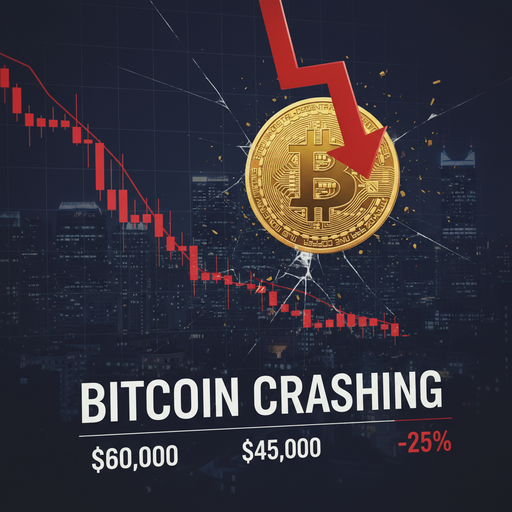
Bitcoin’s price plunged sharply, briefly falling below $70,000, hitting a new low since November 2024, and slightly rebounding to around $71,000 at press time. Over the past week, Bitcoin has declined approximately 20%, reigniting fierce debate about the crypto cycle’s direction. As risk sentiment heats up, capital is withdrawing from high-volatility assets, and the correlation between crypto markets and tech stocks has re-emerged.
This correction not only impacts digital assets but also quickly propagates to crypto-related companies listed on U.S. stock markets. Strategy, known for Bitcoin treasury strategies, saw its stock drop over 5% in a single day, with nearly a 23% decline over the past month. Coinbase (COIN) fell more than 7%, while Circle and Robinhood also experienced varying degrees of correction, indicating a reassessment of valuations for crypto-related businesses.
Nansen analyst Aurelie Barthere pointed out that crypto assets and U.S. stocks are re-establishing a positive correlation, with both likely to come under pressure when macro risks rise. This linkage makes Bitcoin less of an “independent asset” and more part of the risk market.
The mining sector is also under significant pressure. Several Bitcoin mining companies’ stocks fell into double digits in a single day. With rising mining costs and increased hash rate competition, many miners have shifted some resources to AI services, but in the short term, they still find it difficult to fully hedge the downward impact on prices.
Market experts believe this correction is more like a confluence of multiple factors: tightening macro liquidity, amplified tech stock volatility, and profit-taking by some funds. The future trend depends on whether Bitcoin can stabilize at key support levels and whether overall risk sentiment improves. Under increased uncertainty, investors’ patience and risk management are facing a new test.
The U.S. Commodity Futures Trading Commission (CFTC) recently withdrew a controversial regulatory proposal that aimed to impose strict restrictions on prediction markets and ban contracts related to sports and political events. The cancellation of this rule marks a significant easing of regulatory tone and is seen as an important turning point in the U.S. prediction market regulation direction. The market believes this decision alleviates longstanding legal uncertainties and opens up greater space for innovative financial products.
Prediction markets have seen rapid growth in recent years. On-chain platforms like Polymarket show that trading volume of related contracts has exceeded $3 billion, with some hot event discussions comparable to the 2024 U.S. presidential election. Users increasingly prefer to obtain information through “price as probability,” which offers more real-time and crowd-sourced insights than traditional polls. This has led prediction markets to be viewed as a new information discovery mechanism.
Looking back, the U.S. regulatory environment has historically maintained a high-pressure stance, restricting political contracts and frequently enforcing laws, causing some businesses to relocate. However, demand has not disappeared but shifted into more covert channels. Now, the CFTC demonstrates a more pragmatic approach, beginning to reassess the value of transparency and compliance pathways, creating conditions for industry to explore legitimate frameworks.
This shift is especially important for native crypto platforms. Prediction markets naturally align with blockchain technology, with smart contracts enabling automatic settlement, and on-chain data ensuring transparency and traceability, reducing trust costs. For Web3 builders, the new policy signals mean a more controllable risk environment and easier attraction of long-term capital and institutional interest.
Although there are still disagreements within the community—some worry that future policies may tighten again—the current trend shows positive signals. Regulatory stance shifts often guide capital and developers to reorient. If subsequent rules become clearer, prediction markets could become a key infrastructure connecting finance, data, and the real world within the crypto ecosystem.
On-chain monitoring platform Lookonchain found that vitalik.eth recently made multiple Ethereum transfers. Data shows that over three days, he sold 2,961.5 ETH in batches, roughly valued at $6.6 million at the time. These transactions were executed via the CoW protocol, using small amounts repeatedly, and on-chain settlement was verified by Arkham, with no signs of hidden routing or mixer operations.
Historically, this is not a temporary action. Vitalik has previously stated he will gradually transfer out some ETH for long-term plans. Recently, he also moved 16,384 ETH, worth over $43 million, some of which was used for his Kanro organization supporting biotech research, open-source security, and public welfare projects. His past operations have always been slow and planned, with no sudden liquidations.
Nevertheless, this news caused brief market sentiment swings on social platforms. The “sell-off” label spread quickly, and some traders overreacted. In reality, Ethereum’s price had already experienced a significant correction due to macro factors, and these transfers are more about following the trend rather than being a direct cause of the decline. Compared to Ethereum’s daily liquidity of tens of billions of dollars, this scale of sale has limited market impact.
More importantly, Ethereum’s fundamentals remain unchanged. Network activity, development progress, and Layer 2 adoption continue to improve. Vitalik also continues to invest resources into ecosystem development and cutting-edge research. For long-term participants, these on-chain actions are more about fund allocation than network pessimism. Short-term volatility will pass, and the accumulation of technology and applications is what ultimately determines value.
The U.S. is accelerating the development of a crypto regulatory framework, aiming to establish a new balance between traditional banking and digital asset innovation. U.S. Senate Banking Committee Chair Tim Scott recently stated that, as long as consumer protection and financial stability are maintained, allowing reasonable space for crypto firms and banks to cooperate will help keep innovation within the U.S., rather than forcing it overseas. He emphasized that competition and technological progress can reduce costs and expand financial service coverage.
Currently, stablecoin regulation is a core policy discussion. Legislators seek to set clear boundaries for how “digital dollar” operates within the U.S. financial system, while crypto companies want to avoid over-restriction. Multiple sources indicate that some industry groups have agreed to strengthen custody standards, allowing banks to securely hold digital assets within a compliant framework, thus pushing previously stalled legislation back onto the negotiation table. As mid-term elections approach, policymakers also face the practical need to show progress.
For years, banks and the crypto industry have had tense relations, with regulators often viewing them as risk sources. Now, attitudes are beginning to shift. Supporters believe that cooperation can enhance U.S. financial competitiveness and accelerate real-world asset tokenization, cross-border settlement, and cost reduction scenarios. A clear regulatory environment also provides predictability for long-term planning.
However, market reactions remain mixed. Some practitioners worry that expanding bank influence could squeeze out startups; others believe stricter regulation might favor large institutions. In any case, this negotiation is seen as a key turning point in U.S. crypto policy.
If a compromise is reached, the U.S. could maintain its leadership in global digital asset competition; otherwise, innovation may continue to flow out. The regulatory direction will profoundly influence the crypto financial landscape over the next decade.
As of January 2026, the active lending volume in Ethereum’s on-chain lending ecosystem has surpassed $28 billion, setting a new record. Token Terminal data shows this has increased more than tenfold since early 2023. Among them, Aave accounts for about 70% of the market share, serving as the core engine supporting the entire Ethereum DeFi lending system, giving the network a significant advantage over competitors like Solana and Base in scale.
The continuous expansion of lending activity reflects increasing adoption of DeFi by institutions and long-term users. By Q3 2025, the total crypto lending scale reached $73.6 billion, a 38.5% quarter-over-quarter increase. Kobeissi analyst noted that the approval of Bitcoin ETFs and industry recovery have driven a rapid rebound in on-chain financial demand. However, rising lending concentration also means that in extreme market conditions, automated liquidations could be amplified.
This risk was tested in late January 2026. During that weekend, Bitcoin rapidly fell from about $84,000 to below $76,000, influenced by weekend liquidity shortages, tensions in the Middle East, and U.S. government funding uncertainties. Over 2.2 billion USD of global leverage positions were liquidated within 24 hours. Aave executed over $140 million in automated liquidations across multiple networks, with Ethereum Gas soaring above 400 gwei at times, yet no system outages or bad debts occurred.
If this core protocol fails, undercollateralized loans could quickly accumulate, triggering a chain reaction. Fortunately, Aave’s stable operation prevented risk spread. Platforms like Compound, Morpho, and Spark also participated in absorbing liquidations but still face limitations in scale and automation. Major holders like Trend Research also sold some ETH to repay loans, reducing leverage via Aave mechanisms.
This event demonstrates that Ethereum’s lending system is maturing amid growth. Despite a more than 6% drop in AAVE tokens over 24 hours, Aave’s performance in extreme conditions reinforces its role as a “DeFi stabilizer” during turbulence.
Tether (USDT) hit a new high in Q4 2025, with an average of 24.8 million active on-chain users per month, up 15% month-over-month, setting a record. Chainalysis and Artemis statistics show that USDT’s market share has risen to 68.4%, maintaining an absolute lead in the global stablecoin sector and widening the gap with other projects.
Supported by multiple blockchain networks, USDT has formed a broad liquidity ecosystem capable of meeting fast settlement and cross-chain needs across regions. Especially in emerging markets, inflation pressures drive users to prefer stable assets for value storage and daily transfers, fueling Tether’s continued expansion. In contrast, some competing stablecoins have seen their market share shrink due to regulatory uncertainties and sluggish growth.
On the application layer, the role of stablecoins is also evolving. Beyond crypto trading, USDT is used for cross-border remittances, corporate treasury management, and P2P payments. Traditional banking systems’ speed and cost shortcomings make stablecoins an attractive alternative. Data shows that USDT has over 534.5 million wallet addresses globally, with Tron and Ethereum remaining the main platforms, and Layer 2 adoption rising rapidly.
This expansion is not short-term. Network effects and deep liquidity are creating positive feedback: more users lead to higher usage frequency, attracting merchants and institutions. Although regulators worldwide are closely monitoring stablecoin development, market demand remains strong in scenarios like cross-border payments, anti-inflation tools, and digital financial infrastructure.
Current data indicates that Tether’s leading position is becoming structurally entrenched. As stablecoins gradually integrate into global capital flows, USDT is becoming a crucial bridge connecting traditional finance and the digital economy, with influence continuing to grow.
Pi Network officially launched the Pi Advertising Network, providing a new monetization method for ecosystem applications. This feature allows advertisers to use Pi tokens to run ads, and app developers built on Pi Browser can earn Pi directly by displaying ads. This mechanism is seen as the first truly value-circulating platform-level tool in the Pi ecosystem, marking a key step from “user growth” to “application monetization.”
The core logic of the Pi Advertising Network is straightforward: advertisers must acquire Pi before running ads, with tokens then distributed to developers, forming an internal economy based on application traffic. Previously, many Pi apps had users but lacked sustainable revenue sources; now, this problem may be alleviated. For the still-developing Pi ecosystem, this provides clear incentives for developers and enhances long-term retention potential.
This model was not built overnight. In March 2024, the Pi core team tested the ad feature in a small scope; by April 2025, it was open to all qualifying applications. In 2026, Pi Network officially positioned it as a core feature, aiming to convert user attention into real network value rather than relying on market sentiment.
Meanwhile, Pi’s infrastructure continues to improve. Recently, about 2.5 million users completed mainnet migration, bringing the verified and migrated account count close to 17 million; in February, approximately 189 million Pi tokens will be unlocked. Community members emphasize that, at this stage, system operation capability is more important than short-term price performance.
Long-term, the success of the Pi Advertising Network still depends on application quality, user activity, and mainnet stability, but it has already outlined a clear direction: building an internal economy where tokens circulate among users, advertisers, and developers. If this model continues to advance, Pi Network may gradually evolve into a truly operational digital application network.
Ethereum’s price continues to decline, approaching the $2,000 level, causing BitMine’s holdings of 4.2 million ETH to lose significant value, with unrealized losses surpassing $7 billion. BitMine’s total ETH holdings are valued at about $8.93 billion, purchased at a cost of roughly $15 billion, with unrealized losses over $4 billion, reflecting severe market pressure.
Despite the heavy losses, BitMine continues to acquire ETH, recently purchasing 41,788 ETH, demonstrating confidence in Ethereum’s long-term potential. BitMine founder Tom Lee stated on social media that unrealized losses in the treasury are inherent to the strategy, not mistakes, emphasizing that Ethereum is the future of finance.
The global crypto market recently experienced a massive sell-off, with total market cap dropping to about $2.4 trillion, evaporating nearly $700 billion in one day. Ethereum’s price has seen significant declines in weekly and monthly cycles, raising concerns about holding below $2,000. Although Vitalik Buterin’s recent warnings about Polygon, Base, and Arbitrum Layer 2 networks have brought some bullish expectations, overall market sentiment remains cautious.
Meanwhile, BitMine-related stock BMNR fell nearly 10% to $20.30 by Wednesday close; BitMine’s stock closed at $19.40, down about 5% in a day. Analysts warn that if Ethereum continues to fall and breaks key support levels, it could trigger broader market liquidations and capital outflows.
Overall, Ethereum breaking below $2,000 not only impacts BitMine’s treasury strategy but also intensifies panic across the crypto market. Investors should monitor Bitcoin and major altcoins’ movements, as well as institutional accumulation and capital flows, to prepare for potential short-term crashes.
Digital asset custody platform Fireblocks announced a partnership with Bitcoin Layer 2 network Stacks, enabling institutional clients to access native Bitcoin DeFi services. The integration is expected to go live in Q1 2026.
This integration will allow over 2,400 Fireblocks institutional clients to participate in the Stacks-based DeFi ecosystem without selling their BTC holdings, including STX token custody, sBTC minting and cross-chain, BTC collateralized lending via Zest and Granite, and participation in Hermetica’s BTC yield vaults, Bitflow’s native trading, and liquidity services.
Blockchain infrastructure project Espresso released its ESP tokenomics:
The initial total supply of ESP tokens is 3.59 billion, with dynamic adjustments due to staking reward mechanisms; there is no fixed maximum supply. Of these, 27.36% will be allocated to contributors (with a 1-year cliff and 4-year linear unlock), 14.32% to investors (1-year cliff, 4-year linear), 10% for airdrops (with eligibility and distribution based on a comprehensive assessment including over 40 qualification methods, fully unlocked at TGE), 1% for community sale (1-year cliff, 2-year linear), 3.01% for staking rewards and network decentralization (2-year linear), 24.81% reserved for future incentives (supporting diversified plans, 6-year linear), 15% for foundation operations (6-year linear), and 4.5% for liquidity provision and additional activation (fully unlocked at TGE).
Despite Bitcoin once approaching $70,000 and Ethereum dropping to about $2,099, latest data from Santiment shows that overall market sentiment continues to deteriorate, but XRP traders remain relatively optimistic. Social media sentiment analysis indicates XRP’s positive/negative score is 2.19, significantly higher than Ethereum’s 1.08 and Bitcoin’s 0.80, up 103% and 173% respectively, suggesting investors are more positive about XRP.
According to CoinMarketCap, over the past seven days, Bitcoin and Ethereum declined about 4.97% and 4.92%, respectively, while XRP fell 6.82%. Swyftx chief analyst Pav Hundal noted that XRP holders have a higher tolerance for market volatility and maintain confidence in the fundamentals, so even with price drops, they are not rushing to sell.
Santiment believes that current market panic could present short-term rebound opportunities. Analysis indicates that as long as retail investors remain cautious, short-term upside potential exists. The Fear & Greed Index from Alternative.me shows market sentiment is extremely cautious, scoring only 12, the lowest since mid-December last year.
Meanwhile, CoinMarketCap’s altcoin season index shows investors still favor Bitcoin, with a score of 32 out of 100, indicating risk appetite has not fully recovered. Bitwise CIO Matt Hougan stated that since January 2025, the crypto market has entered a deep winter, and the current phase may be closer to the end of winter.
Overall, despite downward pressure on Bitcoin and Ethereum, XRP still shows resilience in the short term. Market focus on sentiment shifts and short-term rebound opportunities could be key signals for portfolio adjustments and strategic planning.
The U.S. House of Representatives has officially launched an investigation into crypto firm World Liberty Financial (WLFI). The company, due to its close ties with Trump and alleged connections with foreign sovereign capital, has attracted high attention from Congress regarding national security, funding sources, and technology policy impacts.
According to The Wall Street Journal, a U.S.-related entity linked to Abu Dhabi, UAE, agreed secretly to acquire 49% of WLFI for about $500 million shortly before Trump took office in early 2025. This news quickly sparked controversy in Washington.
Senator Ro Khanna, a senior member of the House China Committee from Pennsylvania, has issued a formal letter to WLFI requesting full disclosure of ownership structure, payment pathways, and internal communications. The investigation focuses on potential conflicts of interest, whether it involves national security risks related to U.S. export controls on AI chips, and the role of WLFI’s USD1 stablecoin in a $2 billion cross-border investment.
The letter also seeks confirmation on whether approximately $187 million flowed to entities related to the Trump family, and whether additional payments were made to the co-founders’ affiliated companies. Meanwhile, Congress demands WLFI submit details on its capital structure, profit sharing, board appointments, and due diligence related to Aryam Investment 1.
Another key focus is the USD1 stablecoin, used to settle a $2 billion investment involving major crypto platforms. Lawmakers are investigating why USD1 was chosen, how the transaction profits were distributed, and whether company personnel participated in discussions involving the pardon of the platform’s founder.
The committee also instructs WLFI to preserve all electronic communications and internal compliance documents related to conflicts of interest, export controls, and dealings with entities connected to the UAE or China. All materials are required to be submitted by March 1.
As the investigation deepens, this event could have profound implications for U.S. crypto regulation, stablecoin compliance, and the intersection of politics and digital assets.