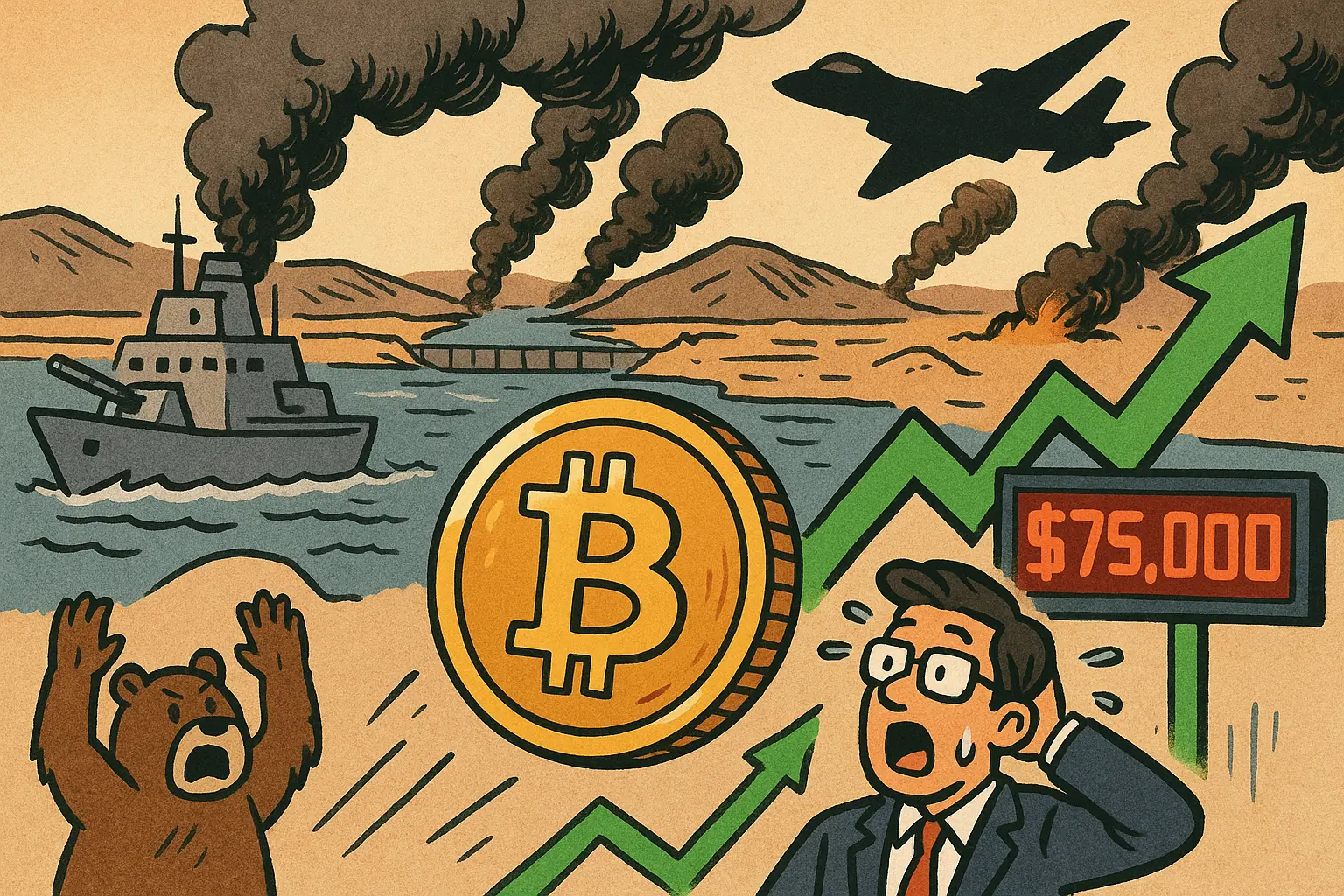
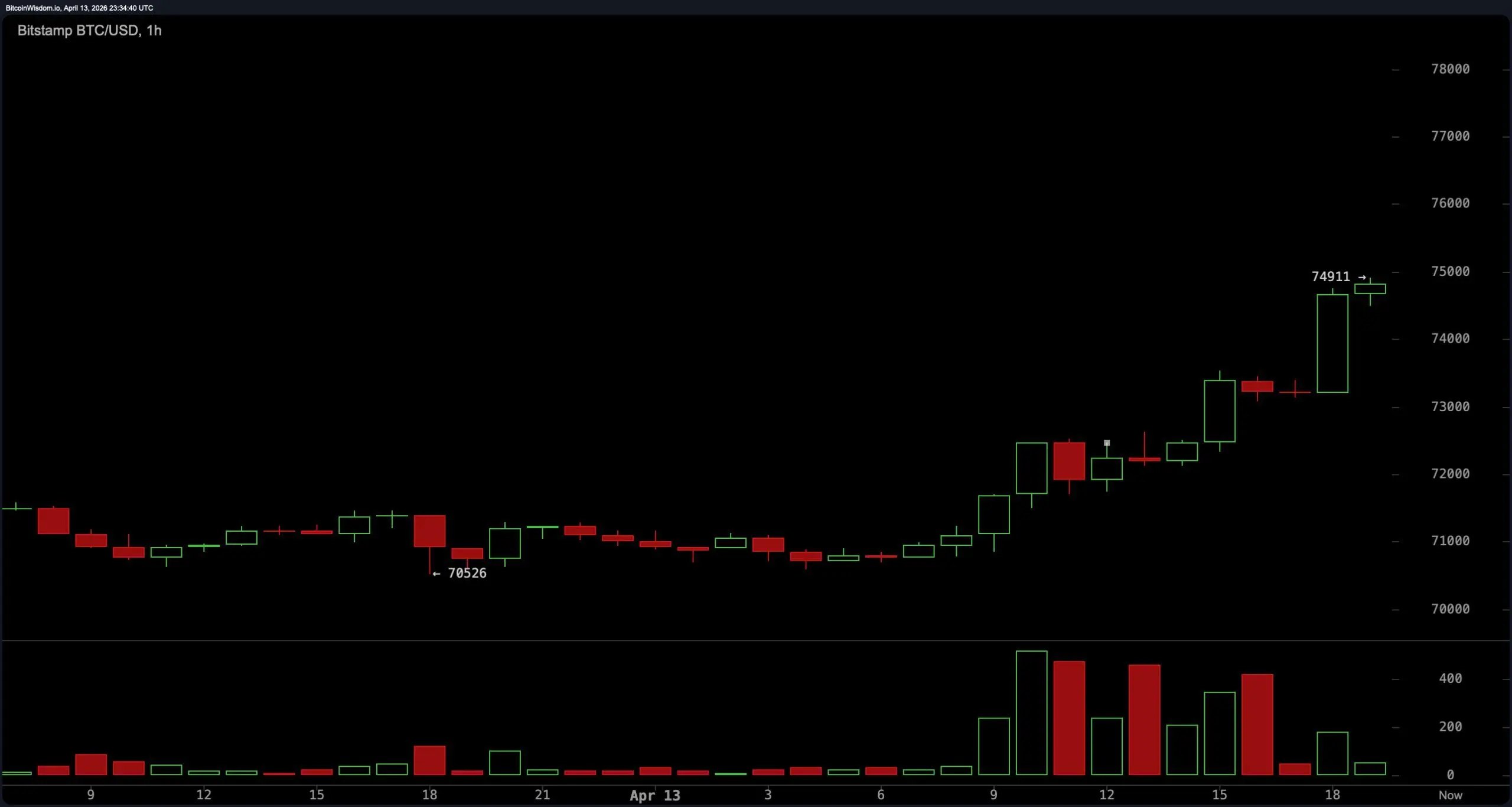
On April 13, Bitcoin rose from its early-session low of $70,741, reaching a high of $74,900 during the session and edging toward the $75,000 level. The main driving forces came from two directions: after Trump ordered a blockade of the Strait of Hormuz, traders began viewing Bitcoin as a geopolitical hedge asset; a massive net short position accumulated as the funding rate continued to turn negative ran into liquidations, triggering a chain reaction of liquidations totaling millions of dollars around the $70,000 support level.
The Trigger Mechanism for Short Covering: The Reverse Effect of the Blockade News
 (Source: Trading View)
Trump announced the blockade of the Strait of Hormuz on Monday, initially putting selling pressure on global risk assets; but within a few hours, market perspectives began to diverge. Some traders started to position Bitcoin as a non-sovereign safe-haven asset. Capital flowed from traditional risk assets such as the stock market into the crypto market, forming buy-side support.
The key to triggering this round of sharp gains was the short-position structure that had been built up earlier. Before the weekend, Bitcoin’s funding rate had been turning negative for a sustained period, indicating that short positions were severely overcrowded. When buy orders entered near the $70,000 key support level, the overly concentrated short positions began to face a chain of forced liquidations, accelerating a rapid rally from the lows to $74,900.
This upswing also tested the upper edge of the consolidation range that Bitcoin has maintained since February—roughly a choppy range between $65,000 and $75,000—which has been a multi-month correction period after Bitcoin hit an all-time high above $126,000 in October 2025.
Structural Support: Institutional ETF Inflows and Corporate Net Accumulation
In addition to short covering, this Bitcoin rally also had structural buy-side support behind it. In March and April, spot Bitcoin ETFs once again saw net inflows. Institutional capital continued to enter through the ETF channel, which is an important reason the $68,000 to $70,000 support level was able to hold after multiple retests. Strategy continued to add 13,927 BTC this week; it currently holds 780,897 BTC, further strengthening the market’s expectation of ongoing institutional accumulation. The simultaneous growth in ETF inflows and the scale of corporate Bitcoin holdings forms the structural support cited by long-term holders.
Key Technical Levels and Near-Term Risks: $75,000 Is the Line Between Bulls and Bears
A large number of short positions have piled up around the $75,000 range. If Bitcoin can effectively break out and hold above it with strong trading volume, it could theoretically trigger further short-squeeze momentum and open the upside path toward $80,000.
However, near-term downside risk should not be ignored:
Tax-season selling pressure: Before the U.S. tax filing deadline on April 15, holders in the U.S. may sell, weakening spot demand
Inflation risk: The Hormuz situation has pushed up oil prices, intensifying inflation expectations and potentially delaying the Fed’s rate-cut schedule
Geopolitical reversal: If U.S.-Iran talks achieve a breakthrough and the blockade eases, safe-haven buying may fade, bringing near-term selling pressure
Test of key support levels: If the $72,000 to $73,000 range cannot be defended, the price may fall back toward around $68,000
From a seasonal perspective, April has historically been more favorable for Bitcoin—since 2013, about 69% of April closing prices have been higher than the prior month; but in April 2026, performance has been below the historical average due to persistent macro headwinds. As of now, the cumulative gain in the second quarter is about 8.64%.
U.S.-Iran Negotiation Progress: The Possibility of Extended Ceasefire May Dominate the Outlook
According to CNN, the Trump administration is discussing arranging a second round of face-to-face U.S.-Iran talks before the ceasefire expires this week, with Islamabad and Geneva listed as potential locations. Turkey is actively bridging differences between the two sides, and the ceasefire deadline may also be extended.
Market watchers note that each development in U.S.-Iran negotiations sends a direct price signal to Bitcoin: breakthroughs in talks often bring short-term selling pressure as safe-haven sentiment cools, while escalation of conflict has the opposite effect, boosting Bitcoin’s safe-haven buying. Traders are currently closely watching the $70,000 support level and the $75,000 resistance band as core signposts for judging the next move.
Frequently Asked Questions
Why is Bitcoin up today? What are the core driving factors?
This rally is driven by two forces: first, after Trump announced a blockade of the Strait of Hormuz, some traders started treating Bitcoin as a geopolitical hedge asset, which boosted capital inflows; second, overcrowded short positions accumulated over the long term with the funding rate turning negative encountered forced liquidations around the $70,000 support level—short covering accelerated and propelled this rally.
Can Bitcoin keep rising and break above $75,000?
$75,000 is currently the most critical technical resistance level, and a successful breakout requires strong trading volume to accompany it. If it manages to hold above it, it could trigger further short-squeeze action and open the channel toward $80,000. However, April 15 tax-season selling, concerns about inflation, and geopolitical uncertainty all pose downside risks to upside momentum.
How does U.S.-Iran negotiation progress affect Bitcoin’s price action?
The evolution of the U.S.-Iran situation has a two-way impact on Bitcoin: if talks yield a breakthrough and tensions ease, safe-haven funds may leave Bitcoin, bringing near-term pressure; if talks collapse or the blockade escalates, Bitcoin’s safe-haven appeal could rise further. The second round of talks is currently expected to be held around April 16, and the outcome will be an important indicator to watch for near-term price action.
Disclaimer: The information on this page may come from third parties and does not represent the views or opinions of Gate. The content displayed on this page is for reference only and does not constitute any financial, investment, or legal advice. Gate does not guarantee the accuracy or completeness of the information and shall not be liable for any losses arising from the use of this information. Virtual asset investments carry high risks and are subject to significant price volatility. You may lose all of your invested principal. Please fully understand the relevant risks and make prudent decisions based on your own financial situation and risk tolerance. For details, please refer to
Disclaimer.
Related Articles
BTC drops 0.52% in 15 minutes: Whale inflows to exchanges combined with insufficient liquidity amplify sell pressure
From 2026-04-17 10:15 to 2026-04-17 10:30 (UTC), the BTC price rapidly fell within the 75214.3 – 75725.9 USDT range. The cumulative return over 15 minutes was -0.52%, and the amplitude reached 0.68%. During this period, market sentiment shifted from cautious to bearish, volatility on the board increased, mainstream trading pairs saw an increase in主动 sell-side volume, buy-side acceptance became constrained, and overall trading activity declined significantly.
The primary driver behind this unusual move is that large holders (whales) concentrated their short-term inflows into exchanges. On-chain data shows that net inflows to addresses holding more than 1000 BTC per address changed from a steady state to a positive value, directly boosting exchange balances over the short term. Historical data indicates that whale inflows to exchanges are highly correlated with sell pressure in the medium to short term. In the same period, order book snapshots reflected a significant increase in the volume of主动 sell orders, and the成交价梯度 shifted downward, highlighting that weak market absorption capacity caused a short-term drop in price.
In addition, in the derivatives market, the long/short positioning structure tilted toward shorts. The number of主动 sell contracts exceeded that of buys in a short time, and rising pressure to close long positions further intensified the downtrend. Market liquidity overall was relatively weak; the number of active addresses over the past 10 minutes was only about 42k, and both fees and the mempool were near their lowest levels of the recent month. Against a backdrop of insufficient capital absorption, the marginal impact of large sell orders was amplified. On the macro front, the Federal Reserve’s monetary policy tightening and industry media repeatedly downgraded BTC’s near-term expectations led investors’ risk appetite to generally decline, creating a resonance at the level of market sentiment.
In the short term, it is still necessary to stay alert to liquidity risk and the price impact of one-way large transactions in specific trading pairs. Going forward, focus on key developments such as changes in whales’ on-chain holdings, exchange balances, and rebounds in activity metrics, as well as the potential impact of macro policy direction on risk assets. Relevant users should primarily guard against the risk of sharply amplified short-term price volatility and promptly track more market information.
GateNews26m ago
Bitcoin Developers Propose Freezing Coins That Skip Quantum-Safe Migration Under BIP-361
A draft proposal circulating among Bitcoin developers would give holders roughly five years to move their coins to quantum-resistant addresses or watch them become permanently unspendable on the network.
Key Takeaways:
BIP-361, co-authored by Casa CTO Jameson Lopp, proposes freezing Bitcoin in le
Coinpedia51m ago
BTC slides 0.70% in the short term: On-chain fund outflows and derivatives deleveraging align to weigh on the market
Between 09:30 and 09:45 (UTC) on 2026-04-17, the BTC price’s return within 15 minutes was -0.70%. During the day, it fluctuated in the 75511.9 to 76307.6 USDT range, with an amplitude of 1.04%. Short-term market sentiment became more cautious; although capital activity increased, volatility noticeably accelerated.
The main driving force behind this move is the large-scale outflow of funds on-chain and active deleveraging in the derivatives market. On-chain data shows that, within this time window, the net outflow from BTC exchanges increased, with a 24-hour net outflow of -2,844.68 BTC. Investors transferred a large amount of BTC to cold wallets, significantly weakening market liquidity and pressuring buy-side demand, which dragged prices lower. In the derivatives space, open interest in perpetual contracts fell in tandem; some leveraged funds actively reduced exposure, indicating the market’s more conservative stance on short-term price action, thereby further weakening support.
In addition, multiple large transfers and whale address activity occurred frequently during the anomaly period, amplifying pressure on capital flows and causing sentiment in the derivatives market to turn even colder. The funding rate dropped briefly within the window, indirectly reflecting that some position holders moved into cold wallets for safer risk management. At the same time, the number of active addresses remained persistently high at over 120k, suggesting network participation was not hit and the fundamentals remained stable; however, the combined effect of frequent outflows amplified market volatility in the short term.
What needs to be watched is that continuous net outflows of funds on-chain and a decline in holdings pose a threat to the stability of support levels. Large address behavior could lead to further capital escaping. In the short term, focus on changes in exchange BTC balances, on-chain transfer volumes, whale address flow, and the dynamics of derivatives open interest. If capital does not return later, volatility risk may further expand; it is recommended to closely monitor real-time market conditions and key on-chain indicators.
GateNews1h ago
The U.S. vetoes the Iran-war powers resolution, while the BTC price trades in a range near $75,000
On April 17, Bitcoin traded in a tight range near $75,500. The U.S. vetoed a war-powers resolution against Iran, while Israel and Lebanon reached a 10-day ceasefire—geopolitical signals moved in opposite directions. Institutional fund inflows coexisted with outflows on-chain; Bitcoin’s correlation with the Nasdaq briefly turned negative—leaving the market waiting for a breakout in either direction.
GateInstantTrends1h ago
BTC breaks through 76000 USDT
Gate News bot message, Gate market data shows that BTC has broken through 76000 USDT, with the current price at 76188.7 USDT.
CryptoRadar1h ago
CleanSpark (CLSK) Highest Shorted BTC Mining Stock at 34.89%
CleanSpark (Nasdaq: CLSK) has the largest share of short open interest among Bitcoin mining and treasury companies, with short positions representing 34.89% of the free float and 4.71 days to cover, according to the source analysis. The stock traded at $11.42, up from $8.18 at the end of March,
CryptoFrontier1h ago


