Oil prices rose sharply on Friday, with both crude benchmarks jumping over 5% as investors expect the conflict in the Middle East to drag on. West Texas Intermediate futures reached $88, and Brent futures surpassed $91 as President Trump demanded an unconditional surrender from Iran’s regime.
Oil Prices Skyrocket As Iran’s Conflict Is Expected To Drag On, Disrupting Crude Supply Chains
The U.S. and Israel’s operations against the Iranian regime are creating price disruptions across the oil industry.
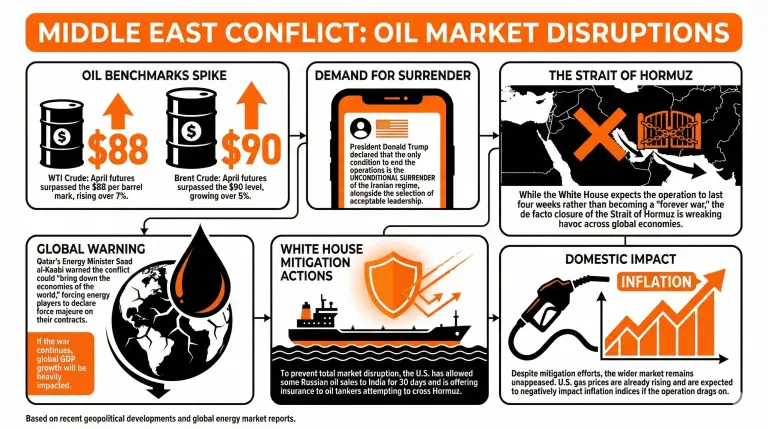
The prices of the Brent and West Texas Intermediate (WTI) benchmarks shot up as investors considered the possibility of the conflict growing larger, involving more countries in the Middle East. WTI April futures surpassed the $88 per barrel mark, rising over 7% during the session, while Brent April futures also grew over 5%, surpassing the $90 level.
The spike occurred after President Donald Trump declared that the only condition to end the conflict would be an unconditional surrender from the Iranian regime.
On Truth Social, Trump stated:
“There will be no deal with Iran except UNCONDITIONAL SURRENDER! After that, and the selection of a GREAT & ACCEPTABLE Leader(s), we, and many of our wonderful and very brave allies and partners, will work tirelessly to bring Iran back from the brink of destruction, making it economically bigger, better, and stronger than ever before.”
While the White House expected the operation to last four weeks, with President Trump stressing that it would not be a “forever war,” the de facto closure of the Strait of Hormuz is wreaking havoc across world economies.
Saad al-Kaabi, Qatar’s energy minister, issued a stark warning, stressing that the Iran conflict could “bring down the economies of the world” and claiming that all relevant players in the energy business would be about to declare force majeure on their contracts.
“If this war continues for a few weeks, GDP growth around the world will be impacted. Everybody’s energy price is going to go higher,” he assessed.
Even after the White House has taken action to avoid disruptions in the oil market, including allowing some Russian oil sales to India for 30 days and offering insurance to oil tankers crossing Hormuz, it has failed to appease market concerns. As a result, gas prices have also risen in the U.S. and are expected to impact inflation indices if the operation lasts longer than expected.
FAQ
- What effect are U.S. and Israel’s operations against Iran having on oil prices?
Prices for Brent and West Texas Intermediate (WTI) crude oil have surged, with WTI futures surpassing $88 per barrel and Brent exceeding $90 amid escalating tensions.
- What sparked the recent increase in oil prices?
The spike in prices followed President Trump’s statement that an unconditional surrender from Iran was necessary to end the conflict.
- What warnings have been issued regarding the economic impact of the Iran conflict?
Qatar’s energy minister cautioned that the conflict could “bring down the economies of the world,” significantly impacting global GDP growth and energy prices.
- What measures has the White House taken to mitigate disruptions in the oil market?
The administration has allowed some Russian oil sales to India for 30 days and offered insurance for tankers crossing the Strait of Hormuz, but these actions have not quelled market concerns.
Disclaimer: The information on this page may come from third parties and does not represent the views or opinions of Gate. The content displayed on this page is for reference only and does not constitute any financial, investment, or legal advice. Gate does not guarantee the accuracy or completeness of the information and shall not be liable for any losses arising from the use of this information. Virtual asset investments carry high risks and are subject to significant price volatility. You may lose all of your invested principal. Please fully understand the relevant risks and make prudent decisions based on your own financial situation and risk tolerance. For details, please refer to
Disclaimer.


