Bitcoin traded near $69,000 on March 11, 2026, hovering inside a tight consolidation band after failing to hold a push toward the $71,600 area. Across the one-hour, four-hour and daily charts, price action remained largely range-bound as oscillators and moving averages collectively pointed to a neutral technical outlook.
Bitcoin Chart Outlook
On the daily chart, bitcoin showed a clear consolidation structure centered around the $69,000–$70,000 region after retreating from the recent $71,612.49 high. Price activity hovered near $69,034 while maintaining support close to $69,000 and encountering resistance near $70,000.
The broader market capitalization stood near $1.38 trillion with roughly $49.0 billion in 24-hour trading volume, suggesting steady participation but not the sort of aggressive inflows typically associated with directional breakouts. In short, the market appeared comfortable drifting sideways, a classic pause after volatility rather than a decisive shift in trend.
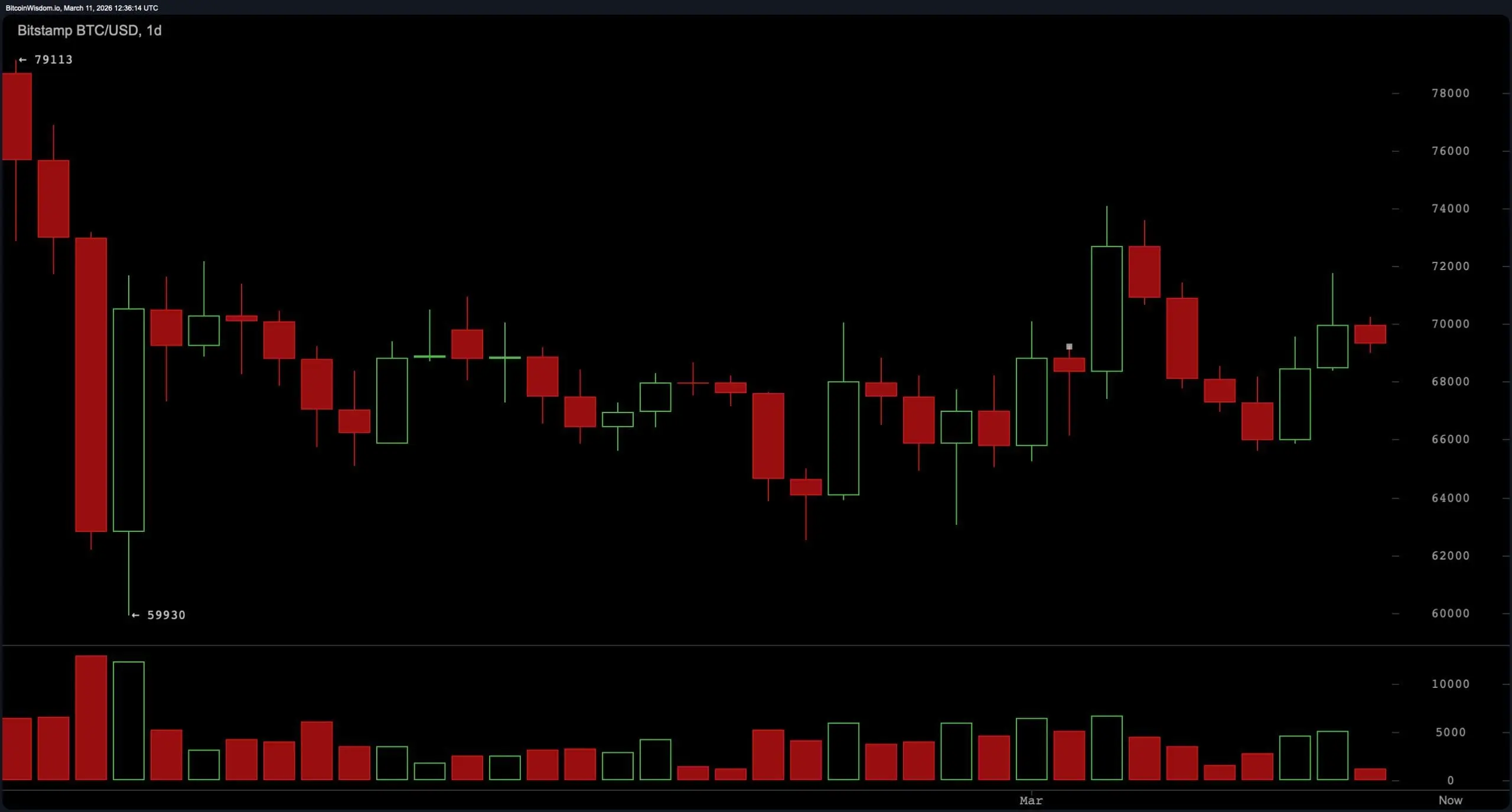 BTC/USD 1-day chart via Bitstamp on March 11, 2026.
The four-hour chart echoed that lack of urgency. Price fluctuated around roughly $69,100 with support clustering just under $69,000 and resistance forming near $69,200. These narrow ranges reflected a market digesting the earlier rally toward $71,600 rather than extending it. The absence of strong directional candles reinforced the consolidation narrative. For traders expecting dramatic moves every hour, the chart instead delivered something closer to a financial shrug.
BTC/USD 1-day chart via Bitstamp on March 11, 2026.
The four-hour chart echoed that lack of urgency. Price fluctuated around roughly $69,100 with support clustering just under $69,000 and resistance forming near $69,200. These narrow ranges reflected a market digesting the earlier rally toward $71,600 rather than extending it. The absence of strong directional candles reinforced the consolidation narrative. For traders expecting dramatic moves every hour, the chart instead delivered something closer to a financial shrug.
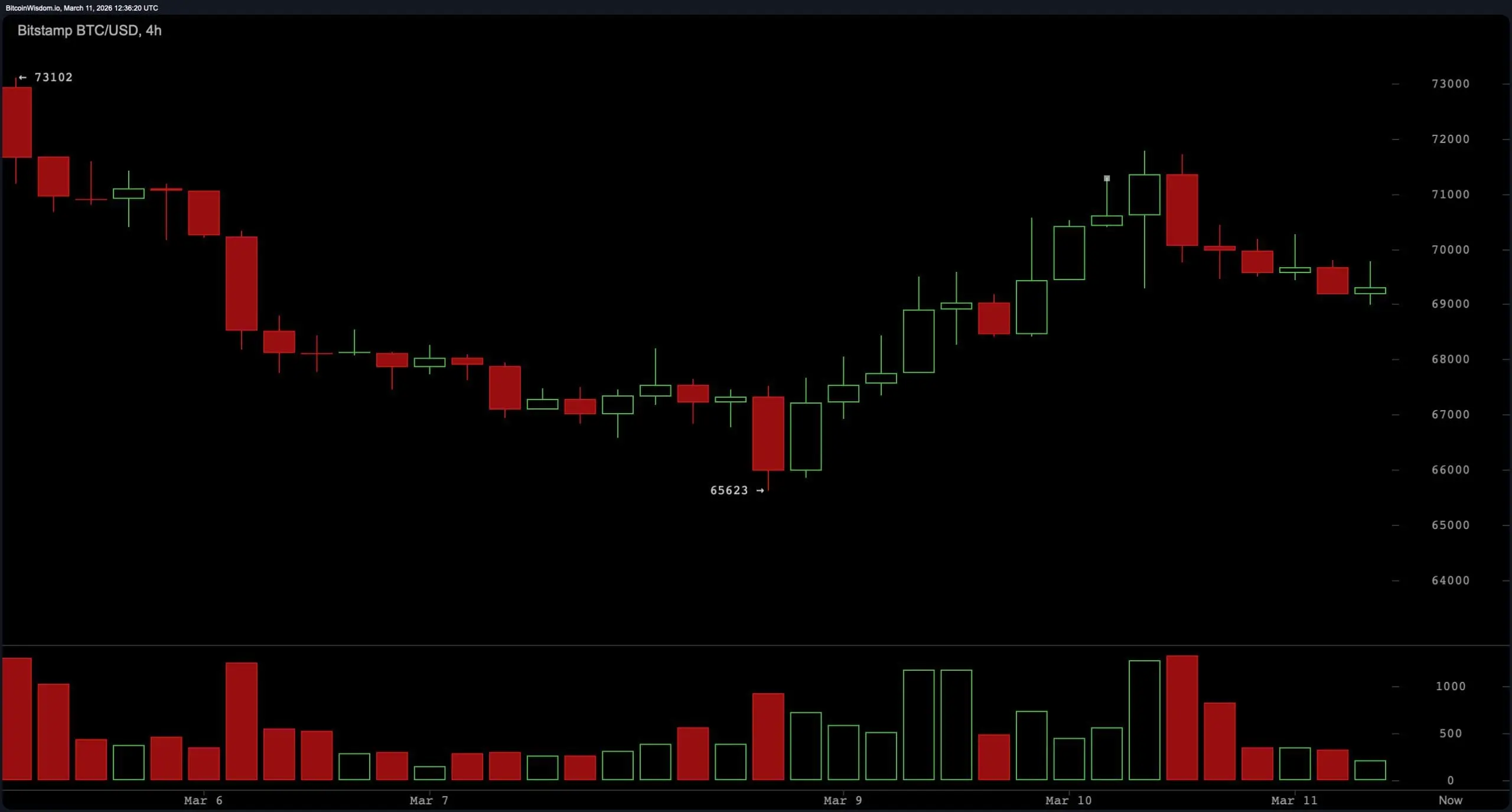 BTC/USD 4-hour chart via Bitstamp on March 11, 2026.
The one-hour chart tightened the range even further, with bitcoin oscillating between approximately $69,100 and $69,150 during the observed window. Short-term candles displayed minimal expansion, and volatility compressed noticeably compared with earlier sessions. This intraday behavior is consistent with the broader multi-timeframe structure: a market pausing while participants wait for confirmation of either a push above the $70,000–$70,500 region or a breakdown beneath $69,000.
BTC/USD 4-hour chart via Bitstamp on March 11, 2026.
The one-hour chart tightened the range even further, with bitcoin oscillating between approximately $69,100 and $69,150 during the observed window. Short-term candles displayed minimal expansion, and volatility compressed noticeably compared with earlier sessions. This intraday behavior is consistent with the broader multi-timeframe structure: a market pausing while participants wait for confirmation of either a push above the $70,000–$70,500 region or a breakdown beneath $69,000.
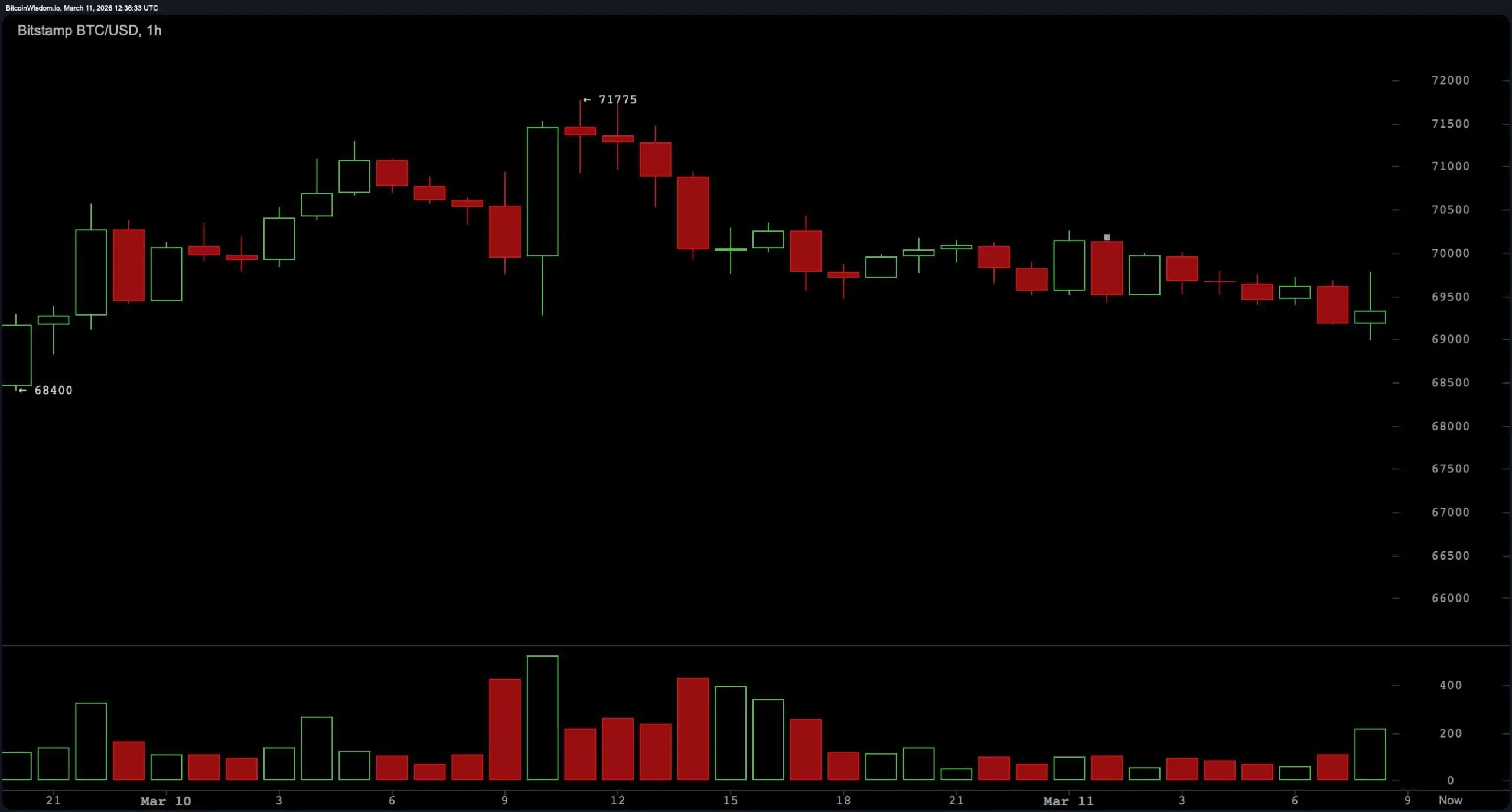 BTC/USD 1-hour chart via Bitstamp on March 11, 2026.
Oscillator readings reinforced that middle-of-the-road stance. The relative strength index ( RSI) registered 49, squarely in neutral territory. Stochastic measured 56, also neutral, while the commodity channel index (CCI) printed 81 without signaling overbought conditions.
BTC/USD 1-hour chart via Bitstamp on March 11, 2026.
Oscillator readings reinforced that middle-of-the-road stance. The relative strength index ( RSI) registered 49, squarely in neutral territory. Stochastic measured 56, also neutral, while the commodity channel index (CCI) printed 81 without signaling overbought conditions.
The average directional index (ADX) came in at 29, indicating moderate but not dominant trend strength. The Awesome oscillator remained neutral at 425. Two indicators leaned constructively: momentum (10) posted 3,311, and the moving average convergence divergence ( MACD) level registered −830, both classified as positive signals. Even so, the overall oscillator summary—two positive signals, eight neutral, and one negative—hardly suggests a market brimming with conviction.
Moving averages (MAs) offered an equally divided verdict. Short-term levels leaned supportive, with the $68,521 10-period exponential moving average (EMA), $68,959 10-period simple moving average (SMA), $68,689 20-period EMA and $67,797 20-period SMA all positioned below the current price and signaling positive momentum.
The $67,838 30-period SMA also sat beneath the market, reinforcing near-term support. However, longer-term averages told a different story. The $69,825 30-period EMA, $72,977 50-period EMA and $72,803 50-period SMA stood above the price, alongside the $80,194 100-period EMA, $81,570 100-period SMA, $88,491 200-period EMA and $94,735 200-period SMA. In practical terms, bitcoin sits above short-term trend gauges but well below longer-term ones—a textbook example of technical indicators politely disagreeing with each other.
Taken together, the multi-timeframe picture points to consolidation rather than a directional breakout. The daily chart anchors the range near $69,000–$70,000, the four-hour chart reflects steady, but muted trading around $69,100, and the one-hour chart compresses that action into an even tighter band. Oscillators remain largely neutral, while moving averages split between supportive short-term levels and heavier resistance overhead. Until price convincingly leaves the $69,000–$70,000 zone, bitcoin appears content doing what markets often do best: absolutely nothing dramatic.
Bull Verdict:
If bitcoin sustains support above the $69,000 region and reclaims the $70,000–$70,500 resistance band with consistent trade above those levels, the technical structure would shift from consolidation toward upward continuation. Shorter-term moving averages—including the 10-period and 20-period EMA and SMA—are already positioned beneath price, signaling underlying support during pullbacks. With momentum (10) and moving average convergence divergence ( MACD) showing positive signals and oscillators largely neutral rather than overheated, the market retains room for expansion. A confirmed break above the $70,000 range ceiling would place prior resistance near $71,612.49 back into focus as the next technical test.
Bear Verdict:
If bitcoin loses the $69,000 support zone on a decisive close and sustained trade below that level, the current consolidation structure would weaken and shift risk toward a deeper retracement. Despite short-term averages offering nearby support, the broader moving average stack—including the 50-period, 100-period and 200-period EMA and SMA—remains positioned above price, reflecting lingering longer-term downward pressure. With oscillators mostly neutral rather than strongly positive, momentum could easily tilt lower if support fails. Under that scenario, downside continuation would likely target lower support levels beneath the current range as the market exits the $69,000–$70,000 consolidation band.
FAQ 🔎
- What was bitcoin’s price on March 11, 2026?
Bitcoin traded around $69,000 on March 11, 2026, consolidating near support after failing to hold gains above $71,600.
- What do bitcoin’s technical indicators show right now?
Most oscillators and moving averages show a neutral outlook, signaling consolidation rather than a strong trend.
- What are the key support and resistance levels for bitcoin?
Technical charts show support near $69,000 and resistance around the $70,000–$71,600 range.
- Is bitcoin trending up or down?
Across the one-hour, four-hour and daily charts, bitcoin is trading sideways within a tight range near $69,000.


