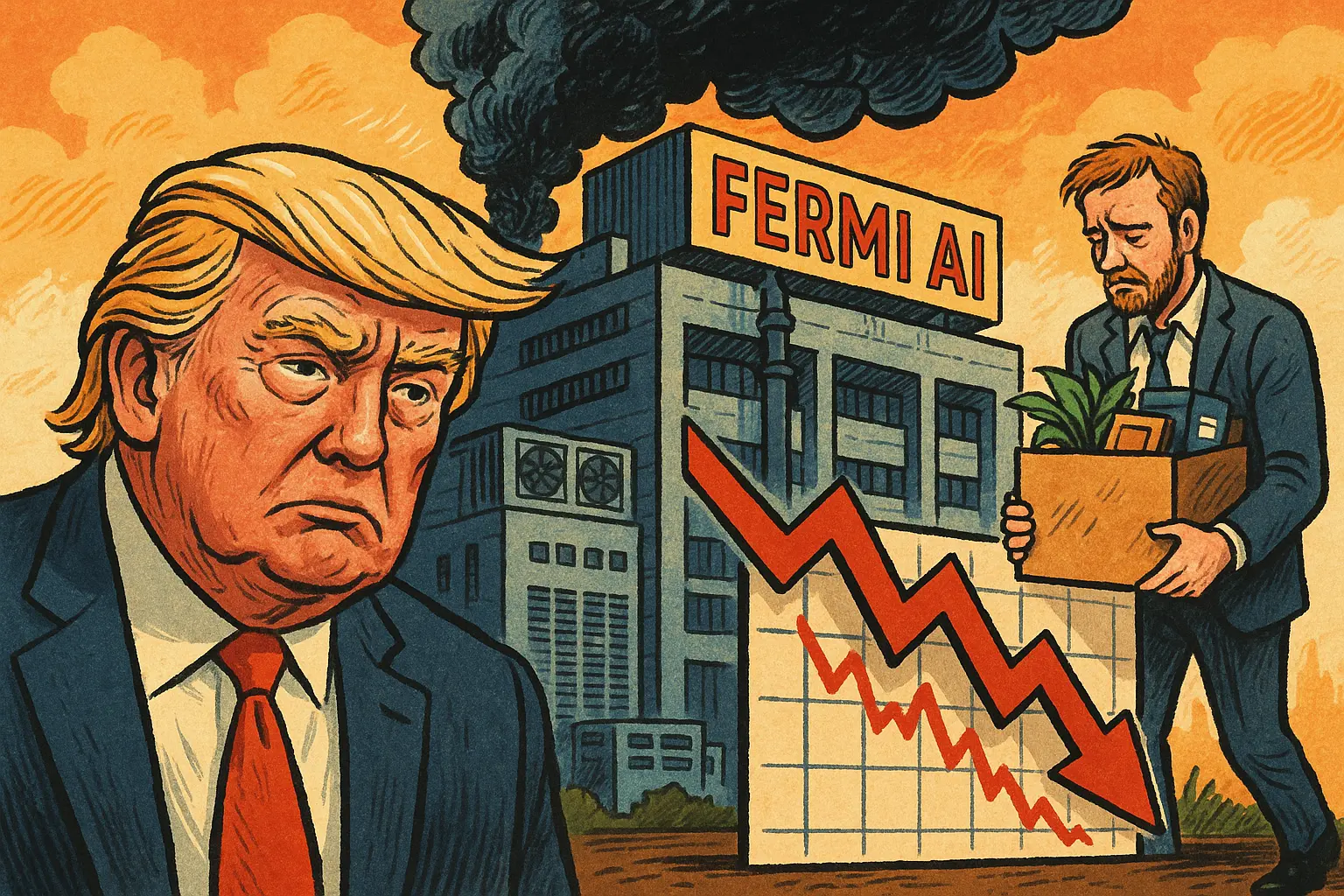
American AI data center developer Fermi America’s CEO Toby Neugebauer abruptly resigned on April 17, sending the stock price down by roughly 20% after hours. Since listing last October, Fermi’s share price has fallen by about 75% in total—from the first-day high of over $30, set at its $21 IPO price, to its current level of $6.55.
Dual Predicament: No Anchoring Tenants and Supply-Chain Runaway
Fermi’s project troubles center on two interdependent problems. First, to date it has been unable to publicly confirm any hyperscaler as an anchoring tenant, even though long-term leases like these are a necessary prerequisite for large data center projects to obtain institutional financing. Second, data center cooling system designs typically need to be led by the lead tenant; with the tenant not yet determined, the cooling方案 cannot be finalized either, creating a double bottleneck.
In an Axios interview the day before he resigned, Neugebauer admitted, “I may have misunderstood the supply chain—that counts as failure.” An estimate from independent market intelligence firm Cleanview suggests that even if an anchoring tenant is signed this month, the first batch of construction would not go live until May 2027—about one year later than originally planned. In its latest SEC filing, Fermi has confirmed it cannot meet its original targets.
CEO Resignation and Internal Loosening: Triple Pressure of Lawsuit, Share Sales, and Executive Conflict
Neugebauer’s resignation caught the market off guard. The board immediately set up a temporary “executive office” composed of Chief Operating Officer Jacob Ortiz and board observer Anna Boffa, and began the search process for a permanent successor, with more details expected to be announced on April 20.
Multiple internal pressures had already surfaced in advance: after a tenant exited in December last year, investors filed a class action lawsuit over it; co-founder Griffin Perry (the son of former Energy Secretary Rick Perry) disclosed on April 15 that he sold about 11 million shares (about 15% of his holdings); a March report from Politico said that Neugebauer previously had a clash in a meeting with U.S. Commerce Secretary Howard Lutnick.
A Barometer for AI Data Center Investments
Fermi was jointly founded by the former U.S. Energy Secretary and Texas governor Rick Perry. With no revenue yet, the company completed an IPO at a valuation of $15 billion in less than a year, which was once seen as a representative case of the AI infrastructure boom. Its current predicament is now prompting the industry to reexamine the core execution risks of ultra-large AI data center projects: supply-chain constraints, power infrastructure, cooling system design, and customer concentration have become unavoidable systemic challenges for this kind of project.
Frequently Asked Questions
What is Fermi America, and why is this crisis drawing so much attention?
Fermi America is an AI data center developer based in Amarillo, Texas, founded by former Energy Secretary Rick Perry along with a co-founder. It is developing plans for an ultra-large data center campus with planned power capacity of 17 gigawatts (three times the electricity usage of New York City), with a power mix primarily centered on natural gas, nuclear power, and solar power. Its public-market valuation, the founders’ backgrounds, and the scale of the project make it an important barometer for the market’s assessment of the sustainability of the AI infrastructure investment boom.
What is an “anchoring tenant,” and why is it so critical for Fermi?
An anchoring tenant is typically a hyperscale cloud provider such as Google, Microsoft, or Amazon. Its long-term lease is the standard prerequisite for large data center projects to obtain commercial bank or institutional financing. Without confirmation of an anchoring tenant, major uncertainties arise around the project’s cash-flow forecasts, construction loans, and equity financing, and key infrastructure design such as cooling systems also cannot be moved forward.
What does Fermi’s predicament imply for the broader AI infrastructure investment sector?
The Fermi case reveals the structural risks of AI infrastructure investments: ultra-large projects need to build a sustainable business model only after securing anchoring tenants and resolving supply-chain and power infrastructure issues. When high valuations driven by macro narratives are pursued in a listing without revenue, they often face a harsh test at the execution level and subsequently encounter sharp valuation repricing.
Disclaimer: The information on this page may come from third parties and does not represent the views or opinions of Gate. The content displayed on this page is for reference only and does not constitute any financial, investment, or legal advice. Gate does not guarantee the accuracy or completeness of the information and shall not be liable for any losses arising from the use of this information. Virtual asset investments carry high risks and are subject to significant price volatility. You may lose all of your invested principal. Please fully understand the relevant risks and make prudent decisions based on your own financial situation and risk tolerance. For details, please refer to
Disclaimer.
Related Articles
Nvidia CEO Jensen Huang Criticizes US Chip Export Controls as "Loser's Mentality"
Nvidia CEO Jensen Huang criticized U.S. chip export restrictions, arguing they won't hinder China's AI advancements. He stressed the need for a unified global tech ecosystem and emphasized Nvidia's growing market share despite competition, highlighting the challenges in disrupting computing ecosystems.
GateNews12m ago
Villar Family Denies SEC Charges of Insider Trading and Market Manipulation
Billionaire Manny Villar and family denied insider trading and securities violation charges from the SEC, claiming no wrongdoing. They submitted counter-affidavits to the DOJ, asserting actions were made in good faith amid allegations of significant financial discrepancies.
GateNews22m ago
Global Semiconductor Equipment Makers' Top 10 Combined Revenue Exceeds $130 Billion in 2025
In 2025, the top 10 global semiconductor equipment manufacturers achieved over $130 billion in revenue, with ASML leading at $37.2 billion. The rankings remained unchanged from 2024, with combined revenue from the top five making up 85% of the total.
GateNews32m ago
Public Bitcoin Miners Sold Over 32,000 BTC in Q1 2026, Hitting Record High
In Q1 2026, Bitcoin miners sold over 32,000 BTC, the highest on record, to reinvest in AI infrastructure amid rising mining costs.
GateNews37m ago
Hong Kong SFC prepares the world’s first tokenized assets trading framework for VATP: money market funds to lead the way, gradually expanding to all authorized products
The Hong Kong Securities and Futures Commission will publish a framework in April 2026 that will allow licensed virtual asset trading platforms to conduct secondary-market transactions of tokenized assets, with the first batch including money market funds and future expansion to stocks, bonds, and more. This will make Hong Kong the first market to use Web3 infrastructure, and it will advance in step with the regulatory technology “CrypTech” to establish a regulatory template for tokenized finance. The move is intended to secure Hong Kong’s position as an Asia-Pacific digital-asset hub and to create competitive pressure on Taiwan-based industry players.
ChainNewsAbmedia39m ago
Singapore's STI Index Rises 0.1% Amid US-Iran Tensions
On April 20, Singapore stocks rose modestly, with the Straits Times Index up 0.1%. UOL was the top gainer, while Seatrium fell. Market activity saw slight declines outpacing gains, amid ongoing US-Iran tensions and rising oil prices.
GateNews42m ago


