GateUser-da94ddbc

vip
Age 1.5 Yıl
Peak Tier 0
No content yet
#TopCopyTradingScout
Deep-Dive Analysis — Strategy, Psychology, and the Real Game Behind Copy Trading Success
The hashtag #TopCopyTradingScout is not just about finding profitable traders to follow—it represents a growing shift in how retail participants approach the market. Copy trading has evolved from a beginner shortcut into a sophisticated strategy layer within crypto and traditional finance. But here’s the reality most people ignore: success in copy trading is not about blindly following top performers—it’s about selecting, managing, and adapting strategies intelligently over time.
---
Vortex_King
#TopCopyTradingScout
Deep-Dive Analysis — Strategy, Psychology, and the Real Game Behind Copy Trading Success
The hashtag #TopCopyTradingScout is not just about finding profitable traders to follow—it represents a growing shift in how retail participants approach the market. Copy trading has evolved from a beginner shortcut into a sophisticated strategy layer within crypto and traditional finance. But here’s the reality most people ignore: success in copy trading is not about blindly following top performers—it’s about selecting, managing, and adapting strategies intelligently over time.
---
1. Understanding Copy Trading: The Illusion vs Reality
At first glance, copy trading appears simple. You find a profitable trader, allocate funds, and mirror their trades. But this simplicity is deceptive. Behind every “top trader” is a complex mix of strategy, timing, risk tolerance, and sometimes pure luck.
Most beginners assume high ROI equals skill. In reality, high returns often come with high risk exposure. A trader showing 300% gains may be using extreme leverage, meaning one wrong move could wipe out the account. This is why professional scouts focus less on returns and more on consistency and risk control.
---
2. What Makes a True “Top Scout”
A Top Copy Trading Scout is not someone who just finds profitable traders—they identify sustainable performers. This requires analyzing multiple dimensions:
Risk-to-reward ratio
Maximum drawdown
Trade consistency
Market adaptability
Emotional discipline
A true scout understands that the goal is not to chase profits but to build a stable portfolio of traders that can perform across different market conditions.
---
3. The Core Metrics That Actually Matter
To separate real professionals from gamblers, scouts rely on key metrics. ROI alone is misleading. Instead, focus on:
Drawdown: How much the trader loses during bad periods
Win rate vs risk ratio: A high win rate means nothing if losses are large
Trade frequency: Overtrading often signals emotional decisions
Holding time: Reveals whether the strategy is scalping, swing, or position-based
For example, a trader with 40% ROI and low drawdown is often more valuable than one with 150% ROI but extreme volatility.
---
4. Strategy Types in Copy Trading
Not all traders use the same approach. Understanding strategy types is critical for proper allocation.
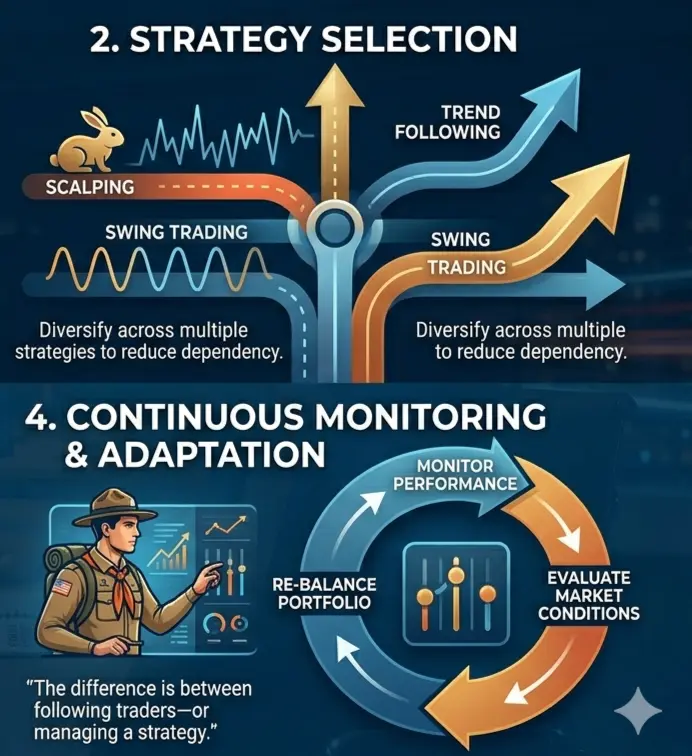
Scalpers: High-frequency trades, small profits, high stress
Swing traders: Medium-term positions, balanced risk
Trend followers: Ride large market moves, fewer trades
Grid traders: Automated strategies, work best in ranging markets
A smart scout diversifies across these strategies instead of relying on a single trader.
---
5. The Biggest Mistake: Blind Following
The most common mistake in copy trading is blind trust. Many users allocate funds based purely on leaderboard rankings without understanding the underlying strategy.
This leads to a dangerous cycle:
Trader performs well → users pile in
Market conditions change → strategy fails
Users panic and exit at a loss
Successful copy trading requires active management, not passive following.
---
6. Risk Management: The Real Edge
Risk management is where most copy traders fail. Even the best trader can experience losses, so capital allocation becomes critical.
Professional scouts follow rules like:
Never allocate more than 10–20% to a single trader
Diversify across multiple strategies
Set stop-loss thresholds for each copied account
This transforms copy trading from gambling into a structured investment approach.
---
7. Market Conditions: Adapting to Change
Different strategies perform differently depending on market conditions.
Bull markets favor trend followers
Sideways markets favor grid strategies
Volatile markets benefit scalpers
A top scout constantly adjusts allocations based on macro trends instead of sticking to a fixed setup.
---
8. Psychology: The Hidden Factor
Even though you are copying others, psychology still plays a huge role. Users often:
Exit during drawdowns
Increase allocation after gains
Panic during volatility
This behavior leads to buying high and selling low—the exact opposite of profitable trading.
A disciplined approach requires trusting the strategy while managing risk objectively.
---
9. Platform Dynamics: Why Infrastructure Matters
Copy trading platforms are not all equal. Execution speed, slippage, and liquidity can significantly impact results.
For example:
Delayed execution can reduce profits
High slippage can turn winning trades into losses
Low liquidity can prevent proper scaling
A top scout evaluates not just traders, but also the platform environment in which they operate.
---
10. Scenario Analysis: Different Outcomes
Scenario 1: Strong Market Alignment
If you select traders whose strategies align with current market trends, returns can compound quickly with controlled risk.
Scenario 2: Market Shift
If conditions change and you fail to adapt, even top traders can underperform, leading to drawdowns.
Scenario 3: Overexposure
Allocating too much capital to a single trader can result in significant losses during unexpected market moves.
These scenarios highlight the importance of flexibility and continuous evaluation.
---
11. Building a Winning Copy Trading Portfolio
A professional approach involves constructing a balanced portfolio of traders.
Example structure:
40% in low-risk, consistent traders
30% in medium-risk swing traders
20% in high-risk, high-reward strategies
10% reserved for experimental allocations
This layered approach balances stability with growth potential.
---
12. Final Insight: Copy Trading Is a Skill, Not a Shortcut
The narrative around #TopCopyTradingScout often portrays copy trading as easy money. In reality, it is a skill that requires analysis, discipline, and adaptability.
The difference between failure and success comes down to one principle:
Are you following traders—or are you managing a strategy?
Those who treat copy trading as a passive shortcut often lose. Those who approach it as an active, strategic process can build consistent, long-term returns.
In the evolving landscape of crypto and financial markets, the role of a Top Copy Trading Scout is becoming increasingly important—not just as a participant, but as a strategist who understands that true success lies not in chasing profits, but in controlling risk while capturing opportunity.
repost-content-media
  • Reward
  • Comment
  • Repost
  • Share
#JustinSunSuesWorldLibertyFinancial
Deep-Dive Analysis — Power Clash, Token Control, and the Dark Side of Crypto Governance
The hashtag #JustinSunSuesWorldLibertyFinancial represents one of the most explosive legal battles in crypto right now, where Justin Sun has taken legal action against World Liberty Financial. This is not just a lawsuit—it’s a direct confrontation between capital, control, and governance in a rapidly evolving financial system. At its core, this case exposes a harsh truth: in crypto, ownership does not always equal control, and even the largest investors can face restrict
WLFI-2,97%
SUN-0,21%
Vortex_King
#JustinSunSuesWorldLibertyFinancial
Deep-Dive Analysis — Power Clash, Token Control, and the Dark Side of Crypto Governance
The hashtag #JustinSunSuesWorldLibertyFinancial represents one of the most explosive legal battles in crypto right now, where Justin Sun has taken legal action against World Liberty Financial. This is not just a lawsuit—it’s a direct confrontation between capital, control, and governance in a rapidly evolving financial system. At its core, this case exposes a harsh truth: in crypto, ownership does not always equal control, and even the largest investors can face restrictions if the system allows it.
---
1. The Core Conflict: What Triggered the Lawsuit
The dispute began when Justin Sun accused World Liberty Financial of freezing his WLFI token holdings without clear justification. As one of the largest investors in the project, Sun had committed significant capital, expecting liquidity and control over his assets. However, after reportedly refusing to provide additional funding, his tokens were allegedly restricted, preventing transfers or sales. This situation triggered the legal battle, raising serious concerns about investor rights and platform authority in crypto ecosystems.
---
2. The Financial Stakes: Hundreds of Millions at Risk
This case involves massive financial exposure, with Sun’s holdings estimated to be worth hundreds of millions of dollars. The inability to access or liquidate these tokens creates not only unrealized losses but also opportunity costs, especially in a volatile market. This highlights a critical issue in crypto markets: large capital does not guarantee liquidity if the underlying system imposes restrictions. It also raises broader concerns about how wealth concentration interacts with governance power.
---
3. The Allegations: Fraud, Pressure, and Hidden Controls
The lawsuit includes serious allegations such as wrongful freezing of tokens, hidden contract mechanisms that allow restrictions, and pressure tactics aimed at forcing additional investment. According to the claims, the platform may have embedded control features within its token contracts, enabling it to limit user activity without transparent approval. If true, this would challenge the fundamental idea that blockchain assets are fully controlled by their holders, revealing a deeper layer of centralized influence beneath decentralized branding.
---
4. The Defense: Platform Justification and Counterclaims
On the other side, World Liberty Financial has denied wrongdoing and maintains that its actions were necessary to protect the integrity of the platform. From this perspective, restrictions may be framed as risk management measures rather than abuse of power. This creates a complex legal and ethical debate, where the definition of “protection” versus “control” becomes blurred, and the final judgment will depend on how digital ownership is interpreted in a legal context.
---
5. Governance Breakdown: The Real Issue Beneath the Surface
Beyond the legal dispute, this case exposes a deeper issue within crypto systems—governance concentration. When decision-making power is held by a small group or influenced by insiders, the system can function in ways that contradict its decentralized narrative. This raises important questions about whether token holders truly participate in governance or whether control remains effectively centralized behind the scenes. The situation highlights the gap between theoretical decentralization and practical implementation.
---
6. Token Ownership vs Control: A Dangerous Illusion
One of the most important lessons from this case is the difference between owning a token and controlling it. While blockchain technology promises self-custody and autonomy, the reality can be very different when smart contracts include restrictive functions. Ownership may exist on paper, but operational control can still be limited by code or governance decisions. This creates a new paradigm where technological structure and platform rules can override individual asset freedom.
---
7. Political and Institutional Layer: Expanding the Impact
The involvement of a high-profile platform like World Liberty Financial adds another dimension to the case, extending its implications beyond crypto into broader financial and institutional discussions. When large platforms intersect with influence and capital, the stakes become much higher, and outcomes can shape regulatory approaches and global perception of digital assets. This transforms the dispute into a case study for the future of financial systems.
---
8. Market Reaction: Confidence vs Fear
Events like this directly impact market psychology. Investors begin to question not only price movements but also structural risks within platforms. Confidence can weaken quickly when users realize that access to assets may not be guaranteed. This shifts focus from short-term gains to long-term security, forcing traders and investors to rethink how they evaluate projects and allocate capital. The narrative moves from profit potential to trust and reliability.
---
9. Scenario Analysis: What Happens Next
Several outcomes are possible. If Justin Sun wins the case, it could strengthen investor rights and force platforms to adopt more transparent systems. A settlement could resolve the dispute quietly while leaving broader questions unanswered. If World Liberty Financial prevails, it may reinforce platform-level control and increase concerns about centralization. Each scenario will influence how future crypto projects design governance and manage user assets.
---
10. Industry Impact: A Turning Point for Crypto Governance
This case has the potential to reshape industry standards by increasing demand for transparency in smart contracts and governance structures. Projects may face greater scrutiny from both investors and regulators, leading to stronger compliance requirements and clearer rules around asset control. It also highlights a broader shift in the industry toward more structured and regulated systems, moving away from purely experimental models.
---
11. Strategic Insight for Investors and Traders
For investors, the key takeaway is the importance of understanding not just the asset but the system behind it. Evaluating smart contract permissions, governance mechanisms, and platform authority becomes essential. Diversification, risk management, and awareness of structural risks are now critical components of any investment strategy. In this environment, informed decision-making provides a significant advantage over blind participation.
---
12. Final Insight: Power Is the Real Currency
The story behind #JustinSunSuesWorldLibertyFinancial is ultimately about power—who holds it, how it is used, and how it shapes the future of finance. Justin Sun versus World Liberty Financial is more than a legal dispute; it is a reflection of the evolving dynamics within crypto ecosystems. The outcome will influence not only this case but also the broader understanding of ownership, control, and trust in digital finance.
repost-content-media
  • Reward
  • Comment
  • Repost
  • Share
#USIranTalksProgress
Deep-Dive Analysis — Fragile Diplomacy, Military Pressure, and the Future of Global Markets
The hashtag #USIranTalksProgress reflects a highly complex and fragile geopolitical situation where diplomacy and military escalation are unfolding at the same time. On the surface, there are signs of progress, including ceasefire extensions and renewed dialogue signals. But beneath that surface, tensions remain elevated, creating an environment where progress is real yet highly unstable and easily reversible.
---
1. Current Situation: Progress or Illusion?
Recent developments sugg
Vortex_King
#USIranTalksProgress
Deep-Dive Analysis — Fragile Diplomacy, Military Pressure, and the Future of Global Markets
The hashtag #USIranTalksProgress reflects a highly complex and fragile geopolitical situation where diplomacy and military escalation are unfolding at the same time. On the surface, there are signs of progress, including ceasefire extensions and renewed dialogue signals. But beneath that surface, tensions remain elevated, creating an environment where progress is real yet highly unstable and easily reversible.
---
1. Current Situation: Progress or Illusion?
Recent developments suggest that both sides are still exploring diplomatic pathways. The United States has shown willingness to extend negotiation windows, while Iran appears cautious, balancing internal political dynamics with external pressure. This creates a mixed-signal environment where forward movement exists, but commitment remains uncertain and conditional.
---
2. Ceasefire Dynamics: A Strategic Pause, Not Peace
The current ceasefire should not be mistaken for a long-term resolution. It functions more as a tactical pause than a permanent solution. Both the United States and Iran are using this period to reassess strategies, maintain leverage, and prepare for different outcomes. This means that stability is temporary, and any breakdown in talks could quickly reverse current progress.
---
3. Military Pressure: The Silent Driver Behind Talks
One of the most important forces shaping negotiations is military positioning. The United States continues to maintain a strong regional presence, while Iran demonstrates its ability to influence strategic routes and regional dynamics. This creates a high-pressure environment where diplomacy is not purely voluntary but influenced by the risk of escalation. The presence of force acts as both a deterrent and a negotiation tool.
---
4. Economic Impact: Markets React to Every Signal
Global markets are highly sensitive to developments between the United States and Iran. Even minor positive signals can improve sentiment, while negative developments can trigger sharp reactions. The reason is simple: this situation directly impacts oil supply, inflation expectations, and global risk appetite. As a result, investors closely monitor every headline, knowing that geopolitical shifts can rapidly change market direction.
---
5. Key Obstacles: Why Progress Is Slow
Despite ongoing discussions, several major obstacles remain. A deep trust deficit exists between the United States and Iran, shaped by years of conflict and failed agreements. Internal political complexities on both sides further complicate decision-making. Additionally, the balance between pressure and diplomacy remains fragile, as actions perceived as coercive can slow or even derail negotiations.
---
6. Strategic Pressure Point: Regional Influence
One of the most critical elements in this situation is control over strategic regions and trade routes. Iran holds influence over key transit points that are vital for global energy supply, giving it leverage in negotiations. This creates a scenario where economic and military considerations are deeply interconnected, and any disruption can have global consequences.
---
7. Negotiation Framework: What Each Side Wants
To understand the direction of talks, it is important to examine the objectives of both parties. The United States is focused on limiting security risks and maintaining regional stability, while Iran seeks economic relief and recognition of its strategic position. These goals are not easily aligned, making negotiations complex and time-consuming.
---
8. Scenario Analysis: What Happens Next
If a breakthrough occurs, markets could respond positively with increased stability and reduced risk perception. If talks continue without resolution, uncertainty will persist, leading to fluctuating market conditions. In a worst-case scenario, escalation could result in renewed conflict, driving volatility across global markets. Each possible outcome highlights the importance of closely monitoring developments and adapting strategies accordingly.
---
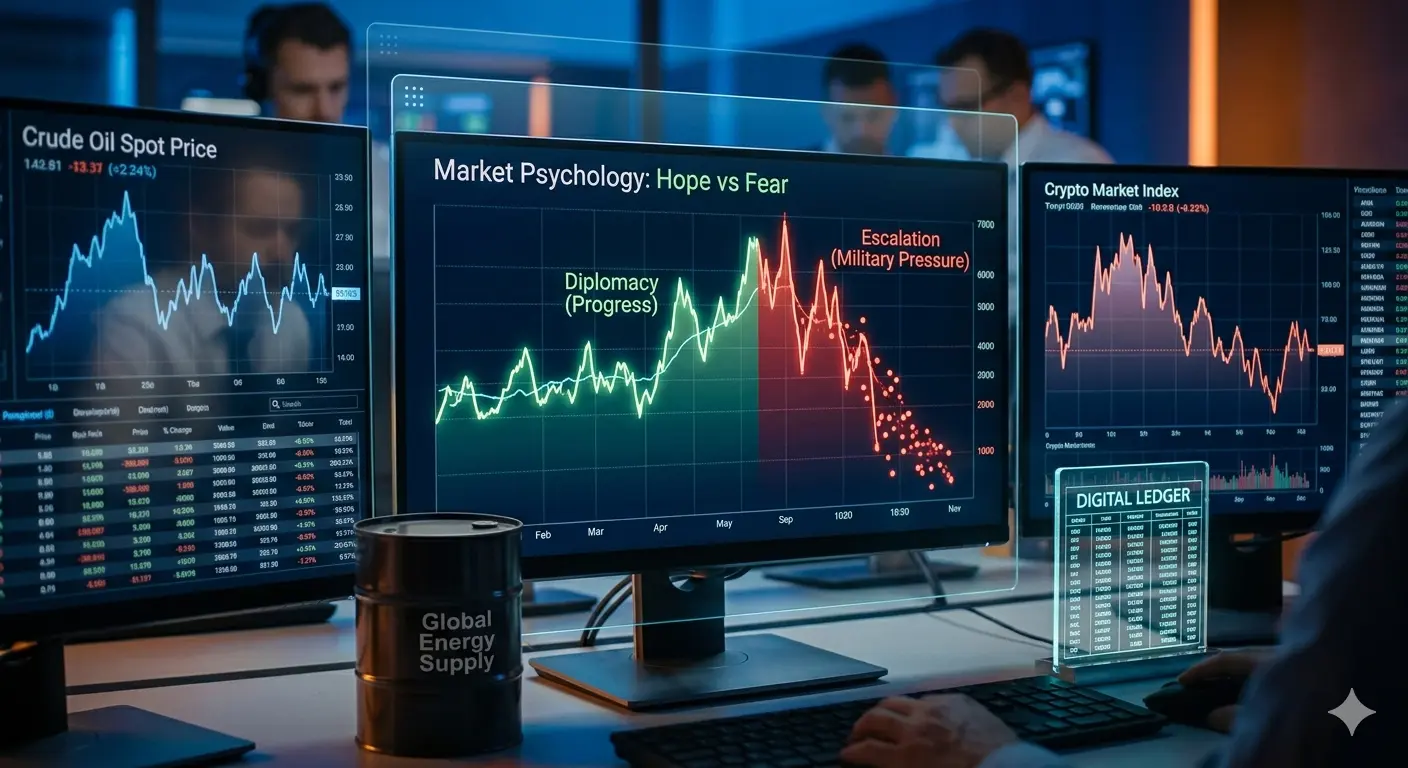
9. Market Psychology: Hope vs Fear
At present, market sentiment is divided between optimism and caution. Hope is driven by the possibility of diplomatic success, while fear stems from the risk of sudden escalation. This dual sentiment creates a reactive environment where investor behavior can shift quickly based on new information. Understanding this psychological dynamic is essential for navigating current market conditions.
---
10. Crypto Market Impact: A Secondary Shockwave
Cryptocurrency markets are indirectly influenced by geopolitical tensions involving the United States and Iran. During periods of uncertainty, liquidity often decreases and volatility increases. However, over the long term, geopolitical instability can strengthen the narrative for decentralized assets as alternatives to traditional financial systems.
---
11. Strategic Insight: How to Navigate This Environment
In such a complex environment, strategy becomes more important than prediction. Investors and traders should prioritize risk management, maintain flexibility, and stay informed about macro developments. Rapid changes in geopolitical conditions require adaptive thinking and disciplined decision-making to manage uncertainty effectively.
---
12. Final Insight: Progress Exists—But It’s Fragile
The story behind #USIranTalksProgress is not a simple narrative of peace or conflict—it is a balance between both. While there are genuine signs of progress, they exist within a framework of pressure, mistrust, and strategic positioning. The situation remains fluid, and future developments will determine whether current progress leads to lasting stability or renewed tension.
repost-content-media
  • Reward
  • Comment
  • Repost
  • Share
#EthereumMemeSeasonReturns
Deep-Dive Analysis — Liquidity Cycles, Retail Frenzy, and the Return of High-Risk Alpha
The hashtag #EthereumMemeSeasonReturns signals a familiar but powerful shift in crypto market behavior, where capital begins rotating from major assets into high-risk, high-reward meme tokens on the Ethereum ecosystem. This is not just hype—it’s a cyclical pattern driven by liquidity, psychology, and speculative momentum. When meme season returns, it reflects a deeper transformation in market structure, where risk appetite expands and retail participation accelerates.
1. Market C
ETH-0,81%
MEME1,31%
Vortex_King
#EthereumMemeSeasonReturns
Deep-Dive Analysis — Liquidity Cycles, Retail Frenzy, and the Return of High-Risk Alpha
The hashtag #EthereumMemeSeasonReturns signals a familiar but powerful shift in crypto market behavior, where capital begins rotating from major assets into high-risk, high-reward meme tokens on the Ethereum ecosystem. This is not just hype—it’s a cyclical pattern driven by liquidity, psychology, and speculative momentum. When meme season returns, it reflects a deeper transformation in market structure, where risk appetite expands and retail participation accelerates.
1. Market Context: Why Meme Season Is Back
Every meme season begins with a foundation of liquidity. When major assets like Ethereum stabilize or trend upward, confidence increases across the market. As volatility decreases at the top, traders start looking for higher returns elsewhere, pushing capital into smaller and more speculative assets.
This rotation is not random—it follows a predictable flow. First, large-cap assets move, then mid-cap projects gain attention, and finally, meme tokens explode as the last phase of risk expansion. This is where exponential gains—and losses—are most common.
2. Liquidity Rotation: The Core Driver
Liquidity is the lifeblood of meme season. When capital flows into the Ethereum ecosystem, it doesn’t stay concentrated—it spreads outward. Traders who profit from major assets often redeploy gains into smaller tokens, creating a chain reaction of speculative activity.
This process amplifies price movements. A relatively small amount of capital can create massive percentage gains in low-cap tokens, attracting more participants and reinforcing the cycle. The result is a feedback loop driven by profit, attention, and momentum.
3. Retail Psychology: Fear of Missing Out
Meme seasons are fueled by one dominant psychological force: fear of missing out. As early participants post large gains, new traders rush into the market, often without understanding the underlying risks.
This creates a surge in demand that is not based on fundamentals but on narrative and social momentum. Prices rise rapidly, not because of intrinsic value, but because of collective belief and speculative enthusiasm.
However, this same psychology can reverse just as quickly, turning rapid gains into equally rapid losses.
4. Social Media Amplification: Narrative Over Fundamentals
Unlike traditional assets, meme tokens thrive on attention. Platforms like X and Telegram act as catalysts, spreading narratives at extreme speed.
Viral posts, influencer mentions, and community hype can drive massive inflows of capital within hours. In this environment, narrative becomes more important than technology, and visibility becomes a key driver of price action.
This is why meme seasons often feel chaotic—they are driven by information velocity rather than structured analysis.
5. The Role of Smart Money
While meme seasons appear retail-driven, experienced traders and early participants often play a significant role. These participants accumulate positions before narratives go mainstream and distribute them as liquidity increases.
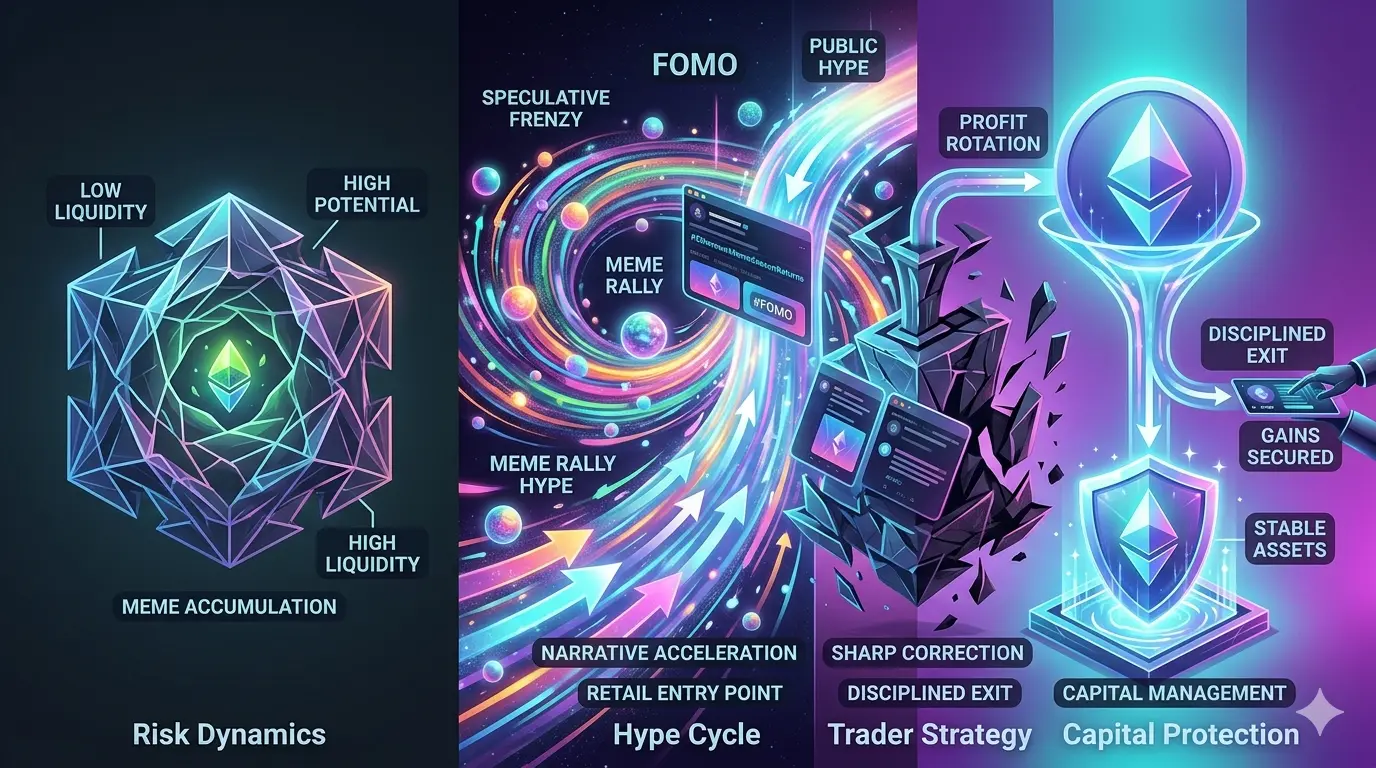
This creates a typical cycle:
Early accumulation
Public hype phase
Distribution phase
Sharp correction
Understanding this cycle is critical, because most retail participants enter during the hype phase and exit during the correction.
6. Risk Dynamics: High Reward, Higher Risk
Meme tokens offer the potential for extreme returns, but they also carry significant risks.
Common risks include:
Low liquidity leading to price manipulation
Lack of fundamental value
Smart contract vulnerabilities
Sudden loss of interest
These factors make meme trading fundamentally different from investing. It is closer to speculation, where timing and risk management determine success more than long-term holding.
7. Market Structure: The Late-Cycle Indicator
Historically, meme seasons tend to occur in the later stages of bullish cycles. When capital has already flowed through major sectors, it eventually reaches the most speculative layer of the market.
This makes meme season both an opportunity and a warning signal. While profits can be significant, it often indicates that the market is approaching a phase of increased volatility and potential correction.
8. Scenario Analysis: What Happens Next
If the current momentum continues, meme tokens on Ethereum could see exponential growth, attracting more retail participants and expanding the cycle.
If liquidity slows or macro conditions tighten, the rally could stall, leading to sharp corrections across meme assets.
In a more extreme scenario, excessive speculation could trigger a broader market pullback, affecting not only meme tokens but also larger assets.
Each scenario highlights the importance of timing and adaptability.
9. Trader Strategy: How to Navigate Meme Season
Successful participation in meme season requires a different approach compared to traditional trading.
Key principles include:
Enter early, before hype peaks
Take profits progressively rather than waiting for maximum gains
Avoid emotional decision-making
Limit exposure to high-risk assets
This approach transforms meme trading from gambling into a calculated strategy, although risk can never be eliminated entirely.
10. Capital Management: Protecting Gains
One of the biggest mistakes traders make during meme season is failing to secure profits. Rapid gains can create overconfidence, leading to increased exposure and eventual losses.
A disciplined strategy involves rotating profits back into more stable assets, ensuring that gains are preserved even if the market reverses. This creates a balance between growth and protection.
11. The Bigger Picture: Evolution of Crypto Culture
Meme seasons are not just financial events—they are cultural phenomena. They reflect how communities, humor, and collective belief can create real economic value in decentralized systems.
On Ethereum, this dynamic is amplified by strong developer ecosystems and active communities, making it a central hub for meme token innovation.
This blending of culture and finance is one of the most unique aspects of the crypto industry.
12. Final Insight: Opportunity with Caution
The return of #EthereumMemeSeasonReturns signals a high-energy phase in the market where opportunities are abundant but risks are elevated.
Meme seasons reward speed, discipline, and awareness—but punish greed and emotional decision-making.
The key takeaway is simple:
Meme season is not just about catching the next big token—it’s about knowing when to enter, when to exit, and how to protect your capital in a fast-moving and unpredictable environment.
repost-content-media
  • Reward
  • Comment
  • Repost
  • Share
#BitcoinBouncesBack
Deep-Dive Analysis — Market Recovery, Structure Shift, and What Comes Next
The hashtag #BitcoinBouncesBack reflects a critical turning point in the crypto market where Bitcoin is showing strong signs of recovery after a period of uncertainty and volatility. This rebound is not just a simple price move—it represents a shift in sentiment, liquidity flow, and market structure. Understanding this bounce requires analyzing macro conditions, trader psychology, technical levels, and forward projections step by step.
---
1. Current Situation: Recovery with Caution
At present, Bitc
BTC-0,08%
Vortex_King
#BitcoinBouncesBack
Deep-Dive Analysis — Market Recovery, Structure Shift, and What Comes Next
The hashtag #BitcoinBouncesBack reflects a critical turning point in the crypto market where Bitcoin is showing strong signs of recovery after a period of uncertainty and volatility. This rebound is not just a simple price move—it represents a shift in sentiment, liquidity flow, and market structure. Understanding this bounce requires analyzing macro conditions, trader psychology, technical levels, and forward projections step by step.
---
1. Current Situation: Recovery with Caution
At present, Bitcoin is trading in a recovery phase after defending key lower levels and regaining upward momentum. The bounce indicates that buyers have stepped back into the market, absorbing selling pressure and stabilizing price action. However, this recovery is not yet a confirmed full bull trend—it is a transition phase where the market is testing strength.
The key characteristic of the current situation is uncertainty mixed with optimism. Price is rising, but conviction is still developing. This is typical of early recovery stages where smart money begins accumulating while retail remains cautious.
---
2. Market Trends: From Fear to Gradual Confidence
The broader market trend shows a shift from fear-driven selling to cautious accumulation. Previously, macro uncertainty and liquidity tightening pushed markets into defensive behavior. Now, with stabilization in global conditions, risk appetite is slowly returning.
In trend terms, Bitcoin is transitioning from a corrective phase to a potential accumulation phase. This is important because accumulation phases often precede stronger bullish expansions.
Volume patterns also support this view, as buying activity increases near support zones, indicating that long-term participants are positioning themselves for future upside.
---
3. Trader Psychology: Smart Money vs Retail Behavior
One of the most important aspects of this rebound is trader psychology.
Smart money typically enters during uncertainty, accumulating positions before the trend becomes obvious. Retail traders, on the other hand, tend to wait for confirmation, often entering after significant price movement has already occurred.
Currently, the market reflects this dynamic:
Institutional and experienced traders are gradually building positions
Retail traders remain hesitant, waiting for stronger confirmation
This creates a controlled upward movement rather than a parabolic rally, which is actually healthier for long-term sustainability.
---
4. Technical Structure: Higher Lows Formation
From a technical perspective, Bitcoin is beginning to form higher lows, a key indicator of trend reversal.
Higher lows suggest that buyers are stepping in earlier on each dip, showing increasing confidence. This structure is essential for building a sustained uptrend.
If this pattern continues, it will confirm that the market is transitioning from distribution to accumulation, setting the stage for a potential breakout.
---
5. Support Levels: Where Buyers Are Strong
Support levels represent areas where demand consistently outweighs supply.
Currently, key support zones include:
Immediate support near recent consolidation areas
Strong psychological support around previous breakout levels
Major structural support at lower accumulation zones
These levels are critical because if price holds above them, it confirms buyer strength. A breakdown below major support would signal weakness and potentially invalidate the bullish setup.
---
6. Resistance Levels: The Real Test Ahead
While support defines downside protection, resistance defines upside potential.
Key resistance zones include:
Short-term resistance near recent highs
Major resistance at previous rejection levels
Psychological resistance zones where selling pressure increases
For Bitcoin to continue its rebound, it must break and hold above these resistance levels. This is where most rallies fail, making resistance the true test of strength.
---
7. Volume and Liquidity: Fuel Behind the Move
A rebound without volume is weak, but current price action shows improving liquidity conditions.
Rising volume during upward movement indicates genuine buying interest rather than temporary spikes. This suggests that the current bounce is supported by real capital inflows rather than short-term speculation.
Liquidity returning to the market is one of the strongest signals that a recovery may evolve into a sustained trend.
---
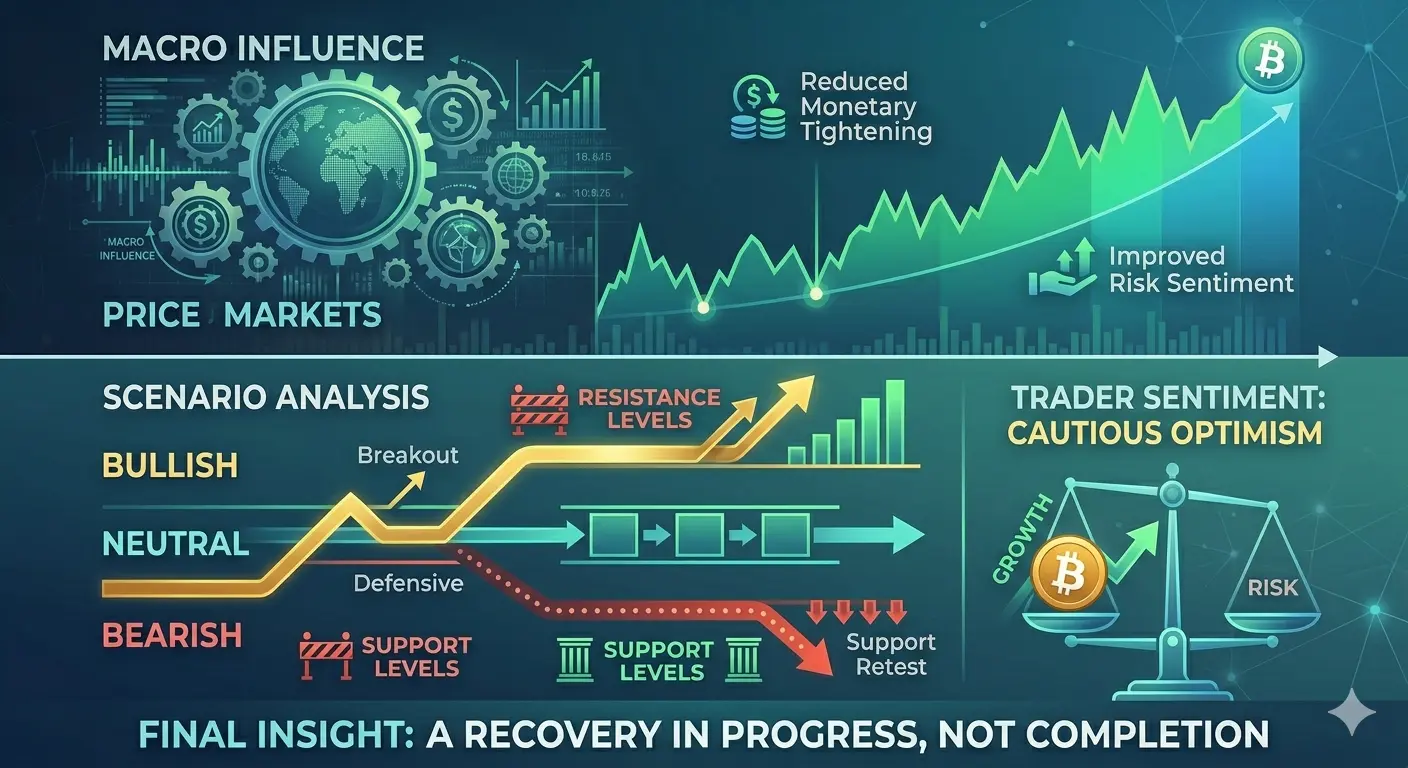
8. Macro Influence: The Bigger Picture
Bitcoin does not move in isolation—it is heavily influenced by macroeconomic conditions.
Factors contributing to the rebound include:
Stabilization in global financial markets
Improved risk sentiment
Reduced fear of aggressive monetary tightening
These macro shifts create an environment where risk assets can recover, supporting Bitcoin’s upward movement.
---
9. Scenario Analysis: Possible Market Paths
Bullish Scenario
If momentum continues and resistance levels break, Bitcoin could enter a strong uptrend, attracting more capital and accelerating gains.
Neutral Scenario
Price consolidates within a range, building strength before the next major move. This is often a healthy phase that allows the market to reset.
Bearish Scenario
Failure to hold support could lead to a pullback, retesting lower levels and delaying the recovery.
Each scenario depends on how price reacts at key levels and how external factors evolve.
---
10. Trader Sentiment: Cautious Optimism
Current sentiment can be described as cautiously optimistic. Traders recognize the strength of the bounce but remain aware of risks.
This balanced sentiment is important because extreme optimism often leads to market tops, while cautious optimism supports gradual and sustainable growth.
---
11. Forecast Price: Where Is Bitcoin Heading?
Based on current structure and momentum, Bitcoin has potential to test higher resistance zones if the trend continues.
Short-term forecast: gradual upward movement with possible pullbacks
Mid-term forecast: breakout attempt above major resistance
Long-term outlook: continuation of bullish cycle if macro conditions remain supportive
However, forecasts are conditional—they depend on maintaining support levels and breaking resistance zones with strong volume.
---
12. Final Insight: A Recovery in Progress, Not Completion
The story behind #BitcoinBouncesBack is not about a completed rally—it is about a recovery in progress.
The market is shifting from fear to confidence, from selling pressure to accumulation, and from uncertainty to opportunity.
The key takeaway is clear:
Bitcoin is showing strength, but confirmation comes only with sustained structure, strong volume, and successful resistance breakouts.
For traders and investors, this is a phase where discipline matters most—because the biggest opportunities often come not at the peak of excitement, but during the early stages of recovery.
repost-content-media
  • Reward
  • Comment
  • Repost
  • Share
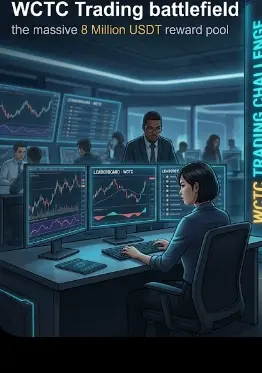
#WCTCTradingChallengeShare8MUSDT
Deep-Dive Analysis — Competition Strategy, Capital Dynamics, and the Psychology of High-Stakes Trading
The hashtag #WCTCTradingChallengeShare8MUSDT highlights one of the most aggressive and high-reward trading competitions in the crypto space, where millions in rewards are designed to attract both professional traders and ambitious newcomers. But beyond the prize pool, this event represents something deeper: a real-time battlefield of strategy, psychology, and risk management under pressure.
---
1. Current Situation: Opportunit
Vortex_King
#WCTCTradingChallengeShare8MUSDT
Deep-Dive Analysis — Competition Strategy, Capital Dynamics, and the Psychology of High-Stakes Trading
The hashtag #WCTCTradingChallengeShare8MUSDT highlights one of the most aggressive and high-reward trading competitions in the crypto space, where millions in rewards are designed to attract both professional traders and ambitious newcomers. But beyond the prize pool, this event represents something deeper: a real-time battlefield of strategy, psychology, and risk management under pressure.
---
1. Current Situation: Opportunity Wrapped in Risk
The competition environment is fundamentally different from normal trading conditions. With a large prize pool driving participation, traders are incentivized to maximize returns within a limited time frame. This creates a high-intensity environment where decision-making accelerates and risk tolerance increases.
Participants are not just trading the market—they are competing against each other. This shifts the objective from consistent profitability to relative performance, meaning traders often take more aggressive positions to outperform rivals.
---
2. Competition Structure: How the Game Is Played
In competitions like this, rankings are usually based on return on investment rather than absolute profit. This changes behavior significantly. A trader with a smaller account can outperform larger participants by taking higher risks and achieving higher percentage gains.
This structure creates a dynamic where:
High leverage becomes attractive
Short-term trades dominate
Risk management is often compromised
Understanding this structure is essential because it explains why competition trading often looks very different from professional portfolio management.
---
3. Market Behavior During Competitions
Large trading competitions can influence market behavior. Increased activity leads to higher volume, sharper price movements, and more volatility.
This happens because:
Many traders enter similar positions simultaneously
Liquidations increase due to leverage
Momentum builds quickly in both directions
As a result, the market becomes more reactive and less predictable, creating both opportunities and dangers for participants.
---
4. Trader Psychology: Pressure Changes Everything
Psychology plays a massive role in competition trading. The presence of a leaderboard creates constant pressure to perform.
Common psychological effects include:
Overtrading to climb rankings
Revenge trading after losses
Increased emotional decision-making
Even experienced traders can struggle in this environment because the competitive element amplifies stress and reduces patience.
---
5. Strategy Types: Conservative vs Aggressive Approaches
There are generally two types of strategies in such competitions.
Conservative traders focus on steady gains, aiming to avoid large losses and maintain consistent growth. While this approach reduces risk, it may not be enough to reach top rankings.
Aggressive traders take high-risk positions, often using leverage to maximize returns. This approach can lead to rapid gains but also rapid losses.
Most top performers use a hybrid strategy, starting aggressively and then shifting to risk control once they achieve a strong position on the leaderboard.
---
6. Risk Management: The Deciding Factor
Despite the competitive nature, risk management remains the most important factor.
Key principles include:
Limiting exposure per trade
Avoiding excessive leverage
Protecting profits once achieved
The biggest mistake participants make is focusing only on gains while ignoring downside risk. In reality, surviving the competition is just as important as winning it.
---
7. Timing and Market Conditions
Timing plays a crucial role in success. Entering the competition during favorable market conditions can significantly improve performance.
Trending markets provide clearer opportunities, while ranging markets require more precise execution. Understanding the current market environment allows traders to adjust strategies accordingly.
---
8. Capital Allocation: Smart Distribution
Effective capital allocation can make a major difference. Instead of committing all funds to a single strategy, successful traders diversify their approach within the competition.
For example:
A portion allocated to high-risk trades
A portion reserved for stable strategies
A reserve kept for opportunistic entries
This layered approach helps balance risk and reward, increasing the chances of staying competitive throughout the event.
---
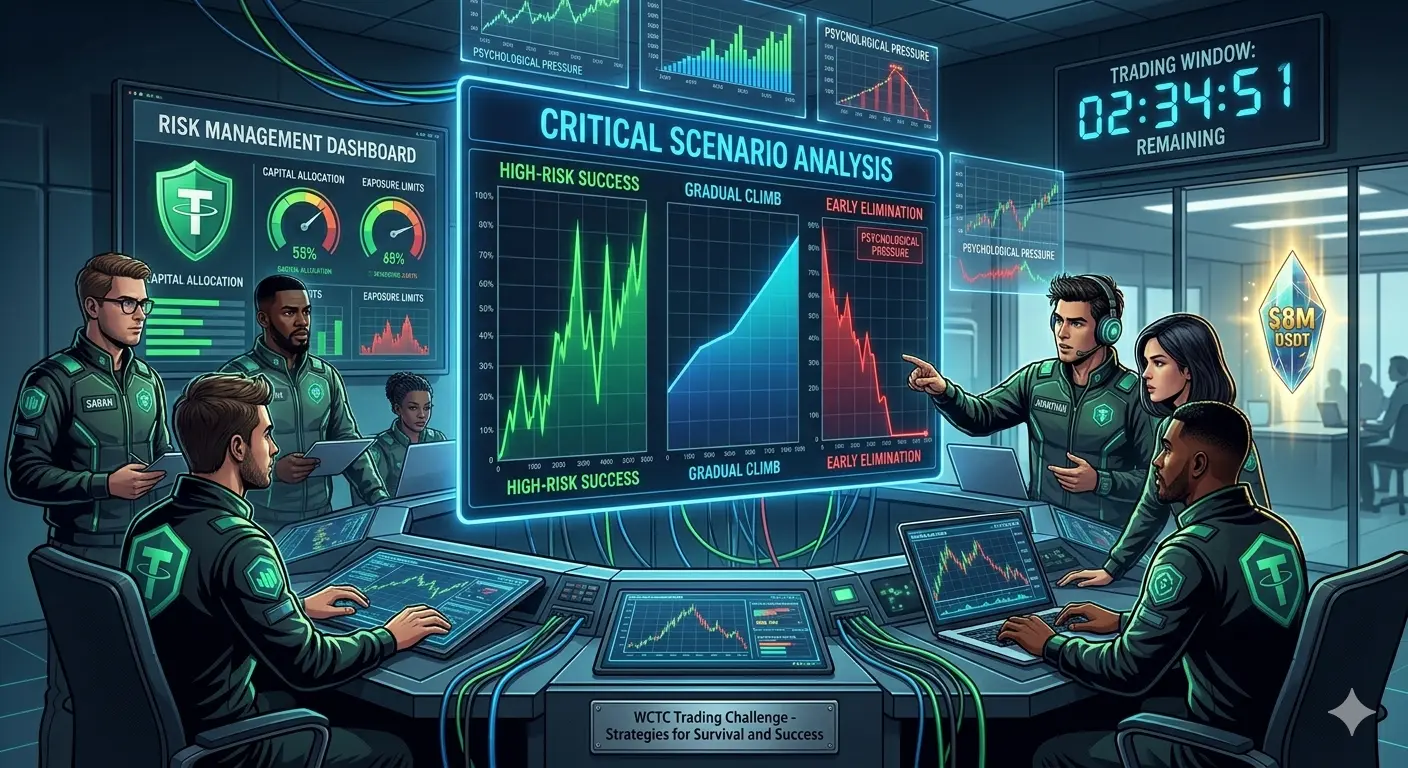
9. Scenario Analysis: Possible Outcomes
Scenario 1: High-Risk Success
Traders who take aggressive positions early may achieve rapid gains and secure top rankings, but this requires precise timing and favorable conditions.
Scenario 2: Gradual Climb
Steady performers may slowly rise through the rankings, relying on consistency rather than explosive gains.
Scenario 3: Early Elimination
Overexposure and poor risk management can lead to quick losses, removing traders from contention early in the competition.
Each scenario highlights the importance of balancing ambition with discipline.
---
10. Market Impact Beyond the Competition
Events like this extend beyond individual participants. They increase overall market engagement, attract new users, and generate significant trading volume.
This can lead to:
Increased liquidity
Higher volatility
Greater attention on specific assets
Such competitions often act as catalysts for short-term market activity.
---
11. Strategic Insight: How to Approach the Challenge
To navigate a high-stakes trading competition effectively, traders should focus on:
Clear strategy planning before entering
Discipline in execution
Emotional control under pressure
Continuous adaptation based on performance
Success is not just about making profits—it’s about making the right decisions consistently under competitive conditions.
---
12. Final Insight: A Test of Skill and Discipline
The story behind #WCTCTradingChallengeShare8MUSDT is not just about winning a prize—it’s about proving trading ability in one of the most demanding environments possible.
The competition rewards not only boldness but also control, not only strategy but also psychology.
The key takeaway is simple:
In high-stakes trading competitions, the winners are not just the most aggressive traders—they are the ones who can balance risk, strategy, and discipline under pressure.
repost-content-media
  • Reward
  • Comment
  • Repost
  • Share
#Gate13thAnniversaryLive
Deep-Dive Analysis — Growth, Global Expansion, and the Evolution of Crypto Exchanges
The hashtag represents more than just a celebration—it marks a milestone in the evolution of one of the most recognized crypto platforms, Gate.io. Over 13 years, the exchange industry has transformed from a niche experiment into a global financial infrastructure, and this anniversary highlights how far the ecosystem has come while also signaling where it is heading next.
---
1. Current Situation: A Milestone in a Rapidly Changing Industry
Reaching a 13-year milestone in crypto is not
Vortex_King
#Gate13thAnniversaryLive
Deep-Dive Analysis — Growth, Global Expansion, and the Evolution of Crypto Exchanges
The hashtag represents more than just a celebration—it marks a milestone in the evolution of one of the most recognized crypto platforms, Gate.io. Over 13 years, the exchange industry has transformed from a niche experiment into a global financial infrastructure, and this anniversary highlights how far the ecosystem has come while also signaling where it is heading next.
---
1. Current Situation: A Milestone in a Rapidly Changing Industry
Reaching a 13-year milestone in crypto is not a small achievement. The industry itself has gone through multiple cycles—booms, crashes, regulatory challenges, and technological breakthroughs. Gate.io’s longevity reflects its ability to adapt to these changes while maintaining relevance in an increasingly competitive environment.
At present, the platform operates in a market that is more mature but also more demanding. Users now expect security, liquidity, innovation, and transparency—all at the same time. This creates pressure for continuous evolution.
---
2. Historical Growth: From Early Adoption to Global Presence
The journey of Gate.io mirrors the broader development of the crypto industry. In its early days, the focus was on basic trading functionality. Over time, the platform expanded into derivatives, staking, copy trading, and Web3 integrations.
This growth reflects a shift from simple exchanges to full financial ecosystems, where users can access multiple services within a single platform. It also shows how exchanges have become central hubs in the crypto economy.
---
3. Market Position: Competing in a Crowded Landscape
Today, the exchange sector is highly competitive, with major players constantly innovating to capture market share. Gate.io maintains its position by focusing on a wide range of assets, global accessibility, and diverse trading products.
However, competition is no longer just about features—it is about trust, compliance, and user experience. Platforms that fail to meet these expectations risk losing relevance quickly.
---
4. Product Evolution: Beyond Spot Trading
One of the key factors behind long-term survival in crypto is product diversification. Gate.io has expanded far beyond spot trading to include derivatives, structured products, and passive income solutions.
This evolution reflects a broader trend where exchanges are becoming financial service providers, offering tools for both active traders and long-term investors. It also increases user retention by creating multiple engagement points within the platform.
---
5. Community and Ecosystem: The Power of Users
A major strength of any exchange lies in its community. Over the years, Gate.io has built a global user base that contributes to liquidity, adoption, and brand recognition.
Community-driven growth is especially important in crypto, where trust and network effects play a critical role. A strong user base not only supports trading activity but also drives innovation through feedback and participation.
---
6. Security and Trust: The Foundation of Longevity
Security remains one of the most critical aspects of any exchange. Surviving for over a decade requires consistent focus on protecting user assets and maintaining operational integrity.
Gate.io’s longevity suggests a commitment to these principles, which is essential in an industry where trust can be lost instantly. Users today prioritize platforms that demonstrate reliability and transparency.
---
7. Innovation and Future Direction
As the industry evolves, innovation becomes a key differentiator. Exchanges are now exploring areas such as decentralized finance, AI-driven trading tools, and cross-chain integration.
For Gate.io, the challenge is to continue innovating while maintaining stability. Balancing these two factors will determine its ability to stay competitive in the next phase of crypto development.
---
8. Market Trends: Where the Industry Is Heading
The broader crypto market is moving toward greater integration with traditional finance, increased regulation, and more sophisticated financial products.
This creates both opportunities and challenges for exchanges. Platforms must adapt to regulatory requirements while continuing to provide innovative services. The ability to navigate this balance will define long-term success.
---
9. Scenario Analysis: The Next Phase
Scenario 1: Continued Expansion
If innovation and user growth continue, Gate.io could strengthen its global presence and expand into new markets and technologies.
Scenario 2: Industry Consolidation
Increased competition and regulation may lead to consolidation, where only the strongest platforms maintain dominance.
Scenario 3: Technological Disruption
Emerging technologies could reshape how exchanges operate, requiring rapid adaptation to remain relevant.
Each scenario highlights the importance of flexibility and forward-thinking strategy.
---
10. Trader Perspective: What This Means for Users
For traders and investors, the evolution of exchanges directly impacts trading experience, liquidity, and opportunities. A platform that continues to innovate provides more tools and options, enabling users to adapt to different market conditions.
At the same time, users must remain aware of platform risks and ensure proper risk management when engaging with any exchange.
---
11. Strategic Insight: Lessons from 13 Years
The journey of Gate.io offers valuable lessons for the entire industry. Adaptability, user focus, and continuous innovation are essential for long-term survival.
In a market defined by rapid change, the ability to evolve is more important than any single feature or product.
---
12. Final Insight: More Than an Anniversary
The story behind #Gate13thAnniversaryLive is not just about celebrating the past—it is about preparing for the future.
Thirteen years represent resilience, growth, and transformation in one of the most volatile industries in the world.
The key takeaway is clear:
Success in crypto is not just about surviving—it’s about evolving with the market, anticipating change, and continuously delivering value to users.
repost-content-media
  • Reward
  • Comment
  • Repost
  • Share
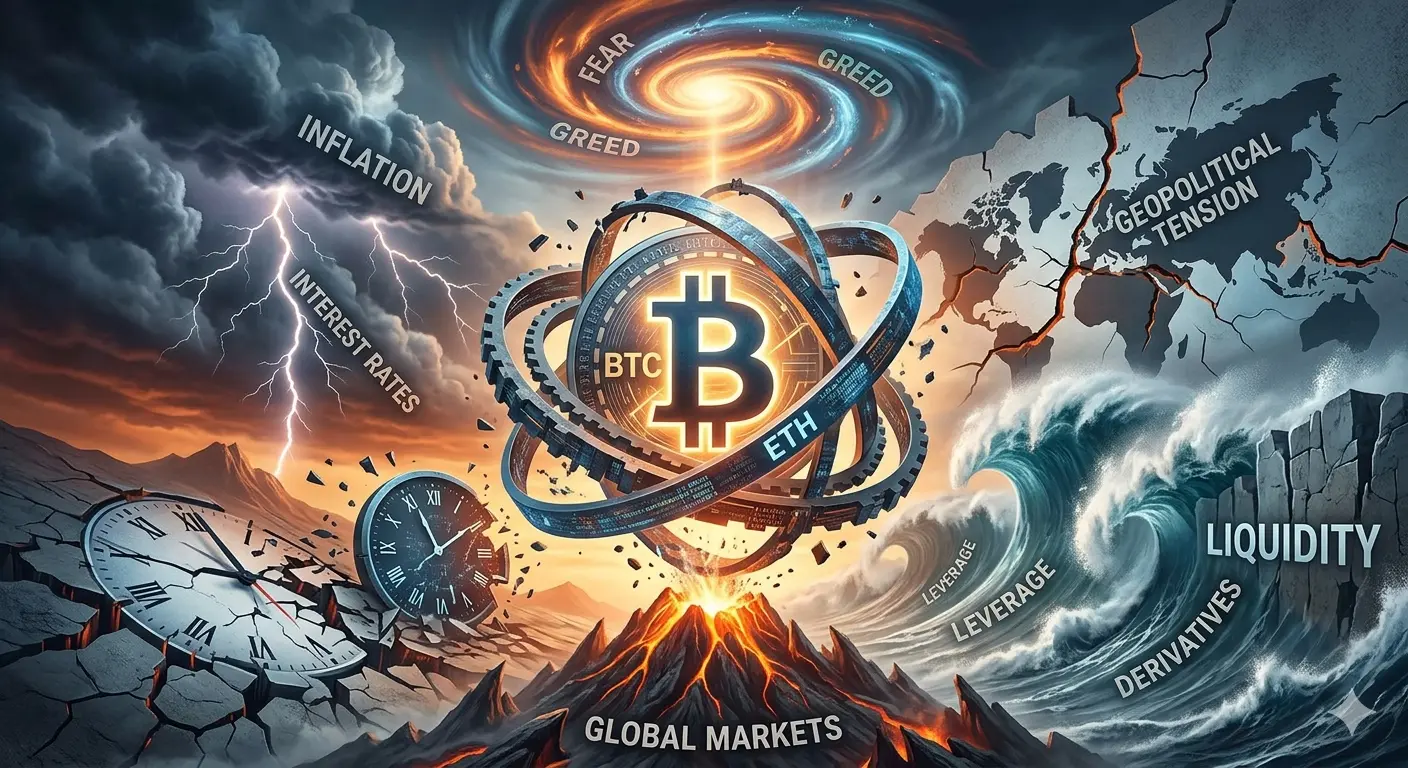
#CryptoMarketSeesVolatility
The cryptocurrency market has once again entered a phase of heightened volatility, reflecting a complex interplay of macroeconomic pressures, geopolitical uncertainty, evolving market structure, and shifting trader psychology. Volatility in crypto is not a new phenomenon, but the current environment stands out due to the convergence of multiple high-impact factors happening simultaneously. To understand what’s truly going on, it’s important to break the situation down step by step—starting from the broader macro landscape, then narrowing
Vortex_King
#CryptoMarketSeesVolatility
The cryptocurrency market has once again entered a phase of heightened volatility, reflecting a complex interplay of macroeconomic pressures, geopolitical uncertainty, evolving market structure, and shifting trader psychology. Volatility in crypto is not a new phenomenon, but the current environment stands out due to the convergence of multiple high-impact factors happening simultaneously. To understand what’s truly going on, it’s important to break the situation down step by step—starting from the broader macro landscape, then narrowing into on-chain behavior, technical structures, and finally trader sentiment and forward expectations.
At the macro level, global financial conditions remain a dominant driver of crypto price action. Interest rate uncertainty, inflation persistence, and central bank policy indecision are creating an unstable foundation for all risk assets. When liquidity tightens, speculative markets like crypto tend to react sharply. Even minor economic data surprises can trigger outsized moves in Bitcoin and altcoins. In this context, crypto is behaving less like an isolated ecosystem and more like a high-beta extension of global financial markets. This explains why sudden spikes in volatility often align with macro headlines rather than purely crypto-native developments.
Another key driver is geopolitical tension. Any uncertainty—whether related to conflicts, trade disputes, or political instability—creates a ripple effect across financial markets. Crypto, being globally accessible and highly liquid, often becomes a fast-moving instrument for traders repositioning risk. During uncertain times, some investors view Bitcoin as a hedge, while others treat it as a risk asset to offload. This dual narrative contributes to rapid price swings, as capital flows in and out with little warning.
Moving deeper into the crypto-native layer, market structure plays a crucial role in amplifying volatility. The rise of derivatives trading—especially perpetual futures—has significantly increased leverage in the system. High leverage creates fragile conditions where even small price movements can trigger cascading liquidations. When a key level is breached, forced liquidations accelerate the move, creating sharp spikes or crashes within minutes. This is why we often see sudden wicks in both directions, with billions in positions wiped out in a short time frame.
Liquidity conditions also deserve attention. Unlike traditional markets, crypto liquidity can thin out quickly, especially during off-peak hours or in uncertain environments. When order books are shallow, large trades can move prices disproportionately. This lack of depth magnifies volatility, making the market more reactive and less stable. Additionally, the concentration of liquidity around key levels—such as psychological price zones or major support/resistance—creates magnets for price action, leading to frequent tests and fakeouts.
From an on-chain perspective, there are mixed signals. Long-term holders generally remain resilient, showing little inclination to sell during dips. This suggests underlying confidence in the long-term trajectory of the market. However, short-term holders and leveraged traders are far more reactive, contributing to increased churn and volatility. Exchange inflows and outflows also indicate periods of uncertainty, as investors move assets either to sell or to secure in cold storage depending on sentiment shifts.
Stablecoin flows provide another layer of insight. When stablecoin reserves on exchanges increase, it often signals potential buying power waiting on the sidelines. Conversely, declining stablecoin balances may indicate reduced immediate demand. In the current volatile environment, these flows tend to fluctuate rapidly, reinforcing the idea that market participants are hesitant and reactive rather than committed to a clear directional bias.
Technically, the market is exhibiting classic signs of a consolidation phase with high volatility. Price action is often trapped between well-defined support and resistance levels, but with frequent breakouts and breakdowns that fail to sustain. This type of structure is typically referred to as a “choppy” market, where trend-following strategies struggle and mean-reversion tactics dominate. Traders attempting to catch breakouts often get trapped, leading to frustration and increased caution.
Support levels in such environments become less reliable, as repeated tests weaken their strength. Each time a support level is revisited, the probability of it eventually breaking increases. Similarly, resistance levels become zones of heavy selling pressure, as trapped buyers look to exit at breakeven. This creates a tightening range where volatility compresses temporarily before expanding again in a more aggressive move.
Momentum indicators often reflect this indecision. Oscillators swing rapidly between overbought and oversold conditions, while trend indicators flatten out. This lack of clear direction further contributes to erratic price behavior, as traders struggle to find conviction. Volume patterns also show inconsistency, with bursts of activity during major moves followed by periods of relative quiet.
Trader psychology is perhaps the most critical factor in understanding current volatility. The market is in a state of uncertainty, where confidence is fragile and sentiment shifts quickly. Fear and greed cycles are accelerating, with traders reacting emotionally to short-term price movements rather than sticking to long-term strategies. Social media and news amplification further intensify these reactions, creating feedback loops that drive volatility.
Retail traders often enter during upward momentum and exit during downturns, exacerbating price swings. Meanwhile, institutional players tend to exploit these emotional patterns, taking positions against the crowd. This dynamic creates a push-and-pull effect, where price movements are less about fundamental value and more about positioning and liquidity.
Another important psychological element is the presence of “liquidation clusters.” Traders using leverage often place stop losses or liquidation levels around similar price points. These clusters become targets for larger players, who can push price into these zones to trigger cascades of forced selling or buying. This behavior is a key reason why volatility appears sudden and extreme rather than gradual.
Looking at market trends, there is a noticeable rotation between sectors within crypto. Capital flows in and out of major narratives—such as AI tokens, meme coins, layer-2 solutions, and DeFi projects—create localized volatility even when the broader market appears stable. This rotation reflects a search for opportunity in a market that lacks a clear overarching trend.
Bitcoin dominance also plays a role. When dominance rises, it often indicates a flight to relative safety within the crypto space. When it falls, it suggests increased risk appetite and capital flowing into altcoins. These shifts can happen بسرعة in volatile conditions, adding another layer of complexity for traders trying to navigate the market.
In terms of support and resistance on a broader scale, the market is currently respecting key psychological levels but with frequent deviations. For Bitcoin, round numbers act as strong magnets for price action. Breaks above or below these levels often trigger momentum, but sustainability depends on volume and follow-through. Without strong conviction, breakouts tend to fail, leading to sharp reversals.
Forecasting price in such an environment requires caution. Volatility implies uncertainty, and while short-term moves can be anticipated based on technical and liquidity factors, long-term direction depends on macro clarity and sustained capital inflows. If macro conditions stabilize and liquidity improves, the market could transition into a more structured trend, either bullish or bearish. Until then, volatility is likely to remain elevated.
From a strategic perspective, traders need to adapt to the environment rather than fight it. Risk management becomes paramount. Position sizing, stop-loss discipline, and avoiding excessive leverage are essential practices. In volatile markets, survival is more important than maximizing gains. Preserving capital allows traders to take advantage of clearer opportunities when they arise.
Patience is another key factor. Not every move needs to be traded. Waiting for high-probability setups, confirmed by multiple indicators, can significantly improve outcomes. Overtrading in a volatile environment often leads to losses, as false signals are common.
For long-term investors, volatility can be viewed differently. Instead of a threat, it can be an opportunity to accumulate assets at discounted prices. However, this approach requires conviction in the underlying value of the assets and the ability to withstand short-term fluctuations without emotional decision-making.
In conclusion, the current state of the crypto market is defined by uncertainty, rapid shifts in sentiment, and structural factors that amplify price movements. Volatility is being driven by a combination of macroeconomic conditions, geopolitical events, leveraged trading, liquidity dynamics, and psychological behavior. While this creates challenges, it also presents opportunities for those who understand the underlying mechanics and approach the market with discipline.
The path forward is unlikely to be smooth. Expect continued sharp moves in both directions, frequent fakeouts, and evolving narratives. Traders and investors who remain adaptable, informed, and risk-aware will be best positioned to navigate this environment successfully.
repost-content-media
  • Reward
  • Comment
  • Repost
  • Share
#WCTCTradingChallengeShare8MUSDT
1. Understanding the Core Objective
The primary goal is simple: outperform other traders using smart strategies while managing risk effectively. But beneath that simplicity lies complexity—market psychology, timing, and execution all matter. Winning is not about luck; it’s about calculated moves.
2. The Power of the 8M USDT Prize Pool
A reward of this scale changes everything. It increases competition intensity and motivates traders to push their limits. It also creates opportunities for both beginners and professionals to earn significant rewards if they perf
ShainingMoon
#WCTCTradingChallengeShare8MUSDT
1. Understanding the Core Objective
The primary goal is simple: outperform other traders using smart strategies while managing risk effectively. But beneath that simplicity lies complexity—market psychology, timing, and execution all matter. Winning is not about luck; it’s about calculated moves.
2. The Power of the 8M USDT Prize Pool
A reward of this scale changes everything. It increases competition intensity and motivates traders to push their limits. It also creates opportunities for both beginners and professionals to earn significant rewards if they perform well.
3. Strategy Over Emotion
Emotional trading is the biggest enemy. Successful participants rely on technical analysis, trend identification, and data-backed decisions rather than fear or greed. Discipline separates winners from the crowd.
4. Risk Management is Key
Even the best strategies fail without proper risk control. Setting stop-loss levels, managing leverage, and avoiding overexposure are essential. Smart traders focus on protecting capital before chasing profits.
5. Market Volatility as an Opportunity
Volatility during the challenge is not a threat—it’s an advantage. Rapid price movements create chances for high returns if approached with the right strategy. Timing entries and exits becomes crucial.
6. Consistency Beats Aggression
Many traders lose by going all-in too quickly. Consistent, small gains over time often outperform risky, aggressive trades. The leaderboard rewards sustained performance, not just one lucky trade.
7. Leveraging Advanced Tools
Using indicators like RSI, MACD, and volume analysis can significantly improve decision-making. Combining multiple tools helps confirm trends and reduces the chances of false signals.
8. Competition Psychology
Seeing others climb the leaderboard can create pressure. Strong traders stay focused on their own strategy instead of reacting to others. Confidence and patience are essential traits.
9. Learning Through Participation
Even if someone doesn’t win, the experience gained is invaluable. Real-time exposure to competitive trading sharpens skills, improves decision-making, and builds long-term expertise.
10. Final Mindset for Success
Approach the challenge with a clear plan, strong discipline, and a learning mindset. The goal is not just to win rewards but to evolve as a trader and refine your strategy for future opportunities.
This trading challenge represents more than just profit—it’s about growth, strategy, and mastery of the market. Those who combine knowledge with discipline will stand out and capture the biggest rewards.
Stay focused. Trade smart. Win big.
SHAININGMOON
repost-content-media
  • Reward
  • Comment
  • Repost
  • Share
#US-IranTalksStall #1. Diplomatic Breakdown Between Global Rivals
Negotiations between the United States and Iran have slowed to a near halt, reflecting deeper mistrust rather than a temporary pause. Multiple rounds of indirect talks failed to deliver a breakthrough, showing that both sides are prioritizing long-term strategic interests over short-term agreements. This diplomatic freeze highlights how complex and fragile international negotiations can become when national security and economic survival are involved.
2. Core Conflict: The Nuclear Deal Dispute
At the center of the crisis lies th
ShainingMoon
#US-IranTalksStall #1. Diplomatic Breakdown Between Global Rivals
Negotiations between the United States and Iran have slowed to a near halt, reflecting deeper mistrust rather than a temporary pause. Multiple rounds of indirect talks failed to deliver a breakthrough, showing that both sides are prioritizing long-term strategic interests over short-term agreements. This diplomatic freeze highlights how complex and fragile international negotiations can become when national security and economic survival are involved.
2. Core Conflict: The Nuclear Deal Dispute
At the center of the crisis lies the Iran Nuclear Deal (JCPOA). The U.S. wants Iran to scale back its nuclear program and allow strict inspections, ensuring that nuclear development remains peaceful. On the other hand, Iran demands full removal of economic sanctions before taking any major steps. This “who moves first” dilemma has become the biggest obstacle, locking both sides in a strategic standoff.
3. Economic Pressure vs National Resistance
Sanctions imposed by the U.S. have severely impacted Iran’s economy—reducing oil exports, weakening its currency, and increasing inflation. However, Iran has responded with resistance, strengthening internal production and building alternative trade partnerships. This situation has created a cycle where pressure leads to resistance, and resistance leads to more pressure.
4. Middle East Power Balance at Risk
The stalled talks are not just about two countries—they directly affect the regional balance of power. Nations like Israel see Iran’s nuclear potential as a direct threat, while Saudi Arabia is concerned about Iran’s growing regional influence. Any agreement—or failure—can shift alliances and tensions across the Middle East.
5. Oil Markets React to Uncertainty
Iran holds one of the largest oil reserves in the world. If sanctions are lifted, global oil supply could increase significantly. However, with talks stalled, uncertainty dominates the energy market. Prices remain sensitive to headlines, and traders are closely watching every development for signals of either a deal or further escalation.
6. Rising Risk of Military Tensions
Diplomatic failure often increases the risk of military confrontation. While direct war is unlikely, indirect conflicts—such as proxy wars or naval tensions in key regions like the Persian Gulf—could intensify. This raises global concerns about security and stability.
7. Domestic Political Pressures on Both Sides
Leadership in both countries faces internal challenges. In the U.S., policymakers must balance diplomacy with political criticism. In Iran, economic hardship has increased public pressure on the government to secure sanctions relief. These internal dynamics make compromise more difficult, as leaders must also protect their domestic image.
8. Global Economic Ripple Effects
The stalled negotiations impact more than just politics—they affect global markets. Currency fluctuations, investor confidence, and commodity prices are all influenced by geopolitical uncertainty. A breakthrough could boost markets, while continued deadlock may increase volatility.
9. Alternative Diplomatic Channels
With direct talks struggling, indirect negotiations and third-party mediation—especially from European nations—are being explored. These backchannel efforts aim to rebuild trust and create a pathway forward, but progress remains slow and uncertain.
10. Future Outlook: Prolonged Stalemate or Sudden Breakthrough?
The current situation suggests a prolonged negotiation phase rather than an immediate resolution. However, geopolitical history shows that breakthroughs can happen suddenly when conditions align. Until then, patience, pressure, and strategic positioning will define the path forward.
Final Insight
The #USIranTalksStall represents more than a diplomatic delay—it is a critical geopolitical moment influencing global energy markets, regional stability, and economic confidence. The outcome of these talks will shape not only the future of United States and Iran relations but also the broader direction of international politics.
repost-content-media
  • Reward
  • Comment
  • Repost
  • Share
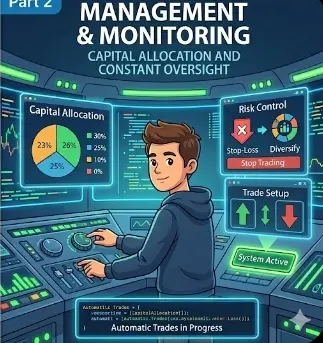
#TopCopyTradingScout Step 1: Understand Copy Trading Concept
Copy trading means automatically copying trades of professional traders. Before starting, understand how profits and losses are generated.
Step 2: Select a Trusted Platform
Choose a reliable exchange or platform that offers verified copy trading features and transparent trader statistics.
Step 3: Create and Secure Your Account
Register your account and enable security features like 2FA to protect your funds from unauthorized access.
Step 4: Explore Top Traders (Scout Phase)
Analyze available traders carefully:
Profit consistency
Risk
ShainingMoon
#TopCopyTradingScout Step 1: Understand Copy Trading Concept
Copy trading means automatically copying trades of professional traders. Before starting, understand how profits and losses are generated.
Step 2: Select a Trusted Platform
Choose a reliable exchange or platform that offers verified copy trading features and transparent trader statistics.
Step 3: Create and Secure Your Account
Register your account and enable security features like 2FA to protect your funds from unauthorized access.
Step 4: Explore Top Traders (Scout Phase)
Analyze available traders carefully:
Profit consistency
Risk level
Trading history
Drawdown percentage
Step 5: Compare Trader Performance
Do not select randomly. Compare multiple traders based on:
Monthly returns
Stability in different market conditions
Trading strategy type
Step 6: Select the Best Traders to Copy
Choose 1–3 strong traders instead of many. Focus on quality, not quantity.
Step 7: Allocate Your Capital Wisely
Divide your investment carefully:
Don’t invest all funds in one trader
Start with small capital
Increase gradually if performance is stable
Step 8: Set Risk Management Rules
Protect your account:
Set stop-loss limits
Define maximum copy amount per trader
Avoid high-risk exposure
Step 9: Activate Copy Trading System
Once everything is set:
Enable copy trading
Confirm allocation settings
System will start copying trades automatically
Step 10: Monitor and Adjust Regularly
Even automated systems need review:
Track performance weekly
Remove weak traders
Rebalance portfolio when needed
Adapt to market changes
Final Insight
TopCopyTradingScout is not a shortcut to guaranteed profit, but a structured way to follow expert traders. Success depends on smart selection, proper risk control, and continuous monitoring.
repost-content-media
  • Reward
  • 3
  • Repost
  • Share
ShainingMoon:
To The Moon 🌕
View More
#USMilitaryMaduroBettingScandal STEP 1: Incident Overvirefers to an alleged case where a U.S. military personnel is accused of using sensitive operational intelligence related to Venezuela and President Nicolás Maduro for personal financial gain through prediction markets.
STEP 2: Core Allegation
The central claim is that classified or restricted military information about a potential operation or strategic planning was accessed by an individual who was not authorized to use it for any external activity, especially financial trading or betting.
STEP 3: Prediction Market Activity
The individual
ShainingMoon
#USMilitaryMaduroBettingScandal STEP 1: Incident Overvirefers to an alleged case where a U.S. military personnel is accused of using sensitive operational intelligence related to Venezuela and President Nicolás Maduro for personal financial gain through prediction markets.
STEP 2: Core Allegation
The central claim is that classified or restricted military information about a potential operation or strategic planning was accessed by an individual who was not authorized to use it for any external activity, especially financial trading or betting.
STEP 3: Prediction Market Activity
The individual allegedly engaged in prediction markets, platforms where users speculate on real-world events such as political outcomes, military actions, or elections. These platforms reward correct forecasting with monetary profits.
STEP 4: Use of Insider Information
The key controversy is the use of non-public military knowledge to influence betting decisions. This creates an “insider advantage,” similar in concept to insider trading in financial markets.
STEP 5: Financial Gains
Reports suggest that significant profits were made—possibly in the range of hundreds of thousands of dollars—after placing strategic bets aligned with confidential expectations or operational insights.
STEP 6: Legal Violations
If proven, the actions may involve multiple legal violations including:
Misuse of classified information
Fraudulent financial activity
Breach of military conduct regulations
Possible violations of federal security laws
STEP 7: Military Security Concerns
This case raises serious concerns about internal security protocols within military systems. It highlights the risk of sensitive data being exploited by insiders for non-operational purposes.
STEP 8: Ethical Issues
Beyond legality, the situation raises ethical questions about:
Trust and discipline in the armed forces
Responsibility of personnel with access to classified intelligence
Misuse of national security information for personal profit
STEP 9: Impact on Prediction Markets
The scandal has also drawn attention to prediction betting platforms, raising concerns that:
Sensitive geopolitical information may distort market fairness
Regulatory oversight may be insufficient
Insider exploitation could become a systemic risk
STEP 10: Broader Global Implications
If confirmed, this case could lead to:
Stricter military monitoring systems
New regulations for political prediction markets
Stronger enforcement of insider trading-style rules in digital platforms
Increased global debate on the intersection of war intelligence and financial speculation
Final Insight
The #USMilitaryMaduroBettingScandal is not just a single incident—it represents a growing challenge in the modern world where military intelligence, digital finance, and global politics intersect, creating new risks that traditional laws are still adapting to handle.
repost-content-media
  • Reward
  • Comment
  • Repost
  • Share
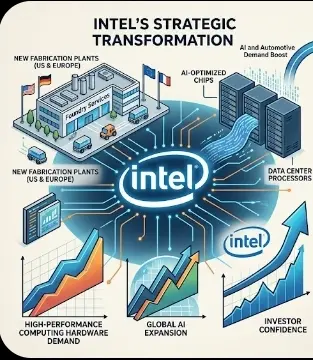
#IntelandTexasInstrumentsSurge Step 1: Market Recovery Signals
The semiconductor sector had previously faced pressure due to supply chain disruptions, inventory corrections, and reduced demand from consumer electronics. However, recent data suggests stabilization. Demand from automotive, artificial intelligence, and industrial sectors is gradually increasing again, creating a healthier balance between supply and demand.
Intel is benefiting from its aggressive restructuring strategy, focusing on foundry services and advanced chip production. Texas Instruments, on the other hand, continues to do
ShainingMoon
#IntelandTexasInstrumentsSurge Step 1: Market Recovery Signals
The semiconductor sector had previously faced pressure due to supply chain disruptions, inventory corrections, and reduced demand from consumer electronics. However, recent data suggests stabilization. Demand from automotive, artificial intelligence, and industrial sectors is gradually increasing again, creating a healthier balance between supply and demand.
Intel is benefiting from its aggressive restructuring strategy, focusing on foundry services and advanced chip production. Texas Instruments, on the other hand, continues to dominate in analog and embedded processing chips, which are essential in industrial systems, automotive electronics, and power management.
Step 2: Intel’s Strategic Transformation
Intel’s recent surge is closely tied to its long-term roadmap of becoming a global semiconductor manufacturing leader. The company is heavily investing in new fabrication plants, particularly in the United States and Europe. This strategy aims to reduce dependency on external foundries and strengthen supply chain independence.
Additionally, Intel’s push into AI-optimized chips and data center processors is gaining traction. As artificial intelligence workloads expand globally, demand for high-performance computing hardware is increasing, directly supporting Intel’s growth narrative.
Step 3: Texas Instruments’ Steady Strength
Unlike highly volatile tech firms, Texas Instruments maintains a stable growth model based on essential semiconductor components. Its products are widely used in automotive systems, industrial automation, medical devices, and consumer electronics.
The company’s advantage lies in its manufacturing efficiency and long product lifecycle strategy. Even during market downturns, demand for analog chips remains relatively stable, providing consistent revenue streams. This stability has helped Texas Instruments attract long-term institutional investors.
Step 4: AI and Automotive Demand Boost
One of the biggest drivers behind the surge is the global expansion of AI infrastructure and electric vehicles. Both Intel and Texas Instruments are positioned to benefit from these trends. AI data centers require advanced processing units, while electric vehicles rely heavily on power management and embedded chips.
This dual demand from emerging industries is creating a structural growth opportunity for semiconductor companies, rather than a short-term speculative spike.
Step 5: Investor Confidence and Future Outlook
Market sentiment around semiconductors has improved significantly. Investors are now viewing the sector as a foundational pillar of the digital economy rather than a cyclical industry alone. Government support for domestic chip manufacturing, especially in the U.S. and Europe, further strengthens this outlook.
However, risks remain, including geopolitical tensions, high capital expenditure requirements, and competition from Asian manufacturers. Despite these challenges, the long-term trajectory for both Intel and Texas Instruments remains positive.
Conclusion
The surge in Intel and Texas Instruments highlights a broader semiconductor revival driven by AI, automotive innovation, and global digital transformation. While short-term volatility may continue, the structural demand for advanced chips suggests sustained growth potential in the coming years.
#IntelandTexasInstrumentsSurge
SHAININGMOON
repost-content-media
  • Reward
  • Comment
  • Repost
  • Share
#TopCopyTradingScout 🏆 From Follower to Smart Scout 🚀
This isn’t just copy trading anymore — it’s about finding the traders who actually win consistently.
The #TopCopyTradingScout campaign by Gate.io is turning users into analysts, scouts, and decision-makers.
---
🎯 What Makes This Different
Most people copy blindly.
Smart users analyze before they follow.
👉 This initiative rewards: • 🧠 Research-driven decisions
• 📊 Data-backed trader selection
• 💬 Sharing real insights with the community
---
📊 How Real Scouts Identify Winning Traders
If you want to stand out (and win), focus on qualit
ShainingMoon
#TopCopyTradingScout 🏆 From Follower to Smart Scout 🚀
This isn’t just copy trading anymore — it’s about finding the traders who actually win consistently.
The #TopCopyTradingScout campaign by Gate.io is turning users into analysts, scouts, and decision-makers.
---
🎯 What Makes This Different
Most people copy blindly.
Smart users analyze before they follow.
👉 This initiative rewards: • 🧠 Research-driven decisions
• 📊 Data-backed trader selection
• 💬 Sharing real insights with the community
---
📊 How Real Scouts Identify Winning Traders
If you want to stand out (and win), focus on quality over hype:
✔️ Consistency > Big Gains
A steady 5–10% monthly performer beats a one-time 200% pump trader
✔️ Low Drawdown = Real Skill
If a trader loses 50% to gain 60% → that’s gambling, not strategy
✔️ Clear Strategy Style
Scalper? Swing trader? Trend follower?
👉 Random trading = red flag
✔️ Market Behavior Understanding
Top traders adapt in volatility — not panic
---
🔥 What Most People Do Wrong
Let’s be honest:
• ❌ Chasing top leaderboard without checking risk
• ❌ Copying traders with short history
• ❌ Ignoring drawdown completely
👉 This is why most copy traders lose money
---
🧠 Pro-Level Scout Metrics
When you share your scout report, include:
• 📉 Max Drawdown (MOST IMPORTANT)
• 📈 Win Rate vs Risk Ratio
• ⏳ Track Record (6–12 months minimum)
• 🌍 Performance in volatile markets
👉 Data = credibility = higher chances to win rewards
---
⚠️ Reality Check
Even the best traders lose sometimes:
• Copy trading ≠ guaranteed profit
• Over-leverage kills accounts
• Blind trust = biggest risk
---
💬 Final Insight
In 2026, the edge isn’t just trading…
👉 It’s knowing WHO to follow — and WHY
Don’t just copy trades.
Scout intelligence. Follow discipline. Win smart.
Are you scouting for rewards… or building a smarter portfolio? 👇
#CryptoStrategy #TradingMindset #Crypto2026 🚀
  • Reward
  • Comment
  • Repost
  • Share
#Gate13thAnniversaryLive
1. Anniversary Milestone Significance
Gate.io completing 13 years shows long-term survival in a highly volatile crypto industry. Many exchanges disappear in early cycles, but Gate’s consistency highlights trust, security systems, and global adoption.
2. Global User Base Expansion
Over the years, Gate has built a multi-million global user community, supporting traders from Asia, Europe, and emerging markets. This anniversary emphasizes its global reach strategy.
3. Live Event Engagement Strategy
The “Live” aspect focuses on real-time interaction, including AMA sessions
TOKEN37,63%
ShainingMoon
#Gate13thAnniversaryLive
1. Anniversary Milestone Significance
Gate.io completing 13 years shows long-term survival in a highly volatile crypto industry. Many exchanges disappear in early cycles, but Gate’s consistency highlights trust, security systems, and global adoption.
2. Global User Base Expansion
Over the years, Gate has built a multi-million global user community, supporting traders from Asia, Europe, and emerging markets. This anniversary emphasizes its global reach strategy.
3. Live Event Engagement Strategy
The “Live” aspect focuses on real-time interaction, including AMA sessions, giveaways, trading competitions, and ecosystem announcements that boost community participation.
4. Product Ecosystem Growth
Gate has expanded beyond spot trading into:
Futures trading
Copy trading tools
Launchpad projects
DeFi integration
This shows a shift toward a complete crypto financial ecosystem.
5. Security & Trust Framework
A key highlight is Gate’s continued focus on asset security, cold wallet storage, and risk control systems, which are essential for long-term investor trust.
6. Innovation in Trading Tools
The platform continuously improves:
AI-based trading insights
Copy trading systems
Advanced charting tools
These upgrades aim to improve user trading efficiency and decision-making.
7. Community Reward Programs
Anniversary events often include:
Airdrops
Trading competitions
Bonus campaigns
This strengthens user loyalty and engagement retention.
8. Market Position Strength
Gate remains competitive among top exchanges due to:
High liquidity
Wide token listings
Early access to new projects
This positions it as a strong player in global crypto markets.
9. Future Roadmap Vision
The 13th anniversary live event also signals upcoming focus areas:
Web3 integration
DeFi expansion
Global regulatory alignment
Institutional trading services
This indicates long-term strategic growth planning.
10. Investor Sentiment Impact
Anniversary events typically improve market sentiment, increasing user confidence and potentially boosting trading activity and platform volume.
Final Insight
The #Gate13thAnniversaryLive is not just a celebration—it is a strategic branding, ecosystem strengthening, and community expansion event that reinforces Gate’s position in the crypto industry.
SHAININGMOON
repost-content-media
  • Reward
  • Comment
  • Repost
  • Share
#XRPMarketAnalysis
XRP Market Analysis — Deep Dive (April 2026)
Current Price: $1.438 (-2.64% in 24h)
Step 1 — Market Overview: Consolidation with Underlying Strength
The current structure of XRP reflects a classic consolidation phase following recent volatility across the broader crypto market. While the token has experienced a short-term decline of 2.64% over the last 24 hours, this movement should not be viewed in isolation. On a broader timeframe, XRP remains relatively strong, maintaining a +4.51% gain over the past 7 days. This divergence between short-term weakness and medium-term stre
XRP0,49%
BTC-0,08%
SOL-0,12%
Vortex_King
#XRPMarketAnalysis
XRP Market Analysis — Deep Dive (April 2026)
Current Price: $1.438 (-2.64% in 24h)
Step 1 — Market Overview: Consolidation with Underlying Strength
The current structure of XRP reflects a classic consolidation phase following recent volatility across the broader crypto market. While the token has experienced a short-term decline of 2.64% over the last 24 hours, this movement should not be viewed in isolation. On a broader timeframe, XRP remains relatively strong, maintaining a +4.51% gain over the past 7 days. This divergence between short-term weakness and medium-term strength is a key characteristic of markets that are preparing for their next directional move. At a current market capitalization of approximately $88.1 billion, XRP continues to hold its position among the top-tier digital assets. This ranking reflects sustained investor confidence, liquidity depth, and institutional relevance. The recent decline is mainly due to profit-taking after a rally and overall market hesitation led by Bitcoin’s sideways movement, but importantly, XRP has not broken any critical support levels, showing buyers are still active.
Step 2 — Price Structure: Understanding the Current Range
XRP is currently trading within a defined range between approximately $1.30 and $1.48. This range represents a balance between buyers and sellers. At the lower boundary, buyers consistently defend the price, while at the upper boundary, sellers cap the upside. This repeated interaction forms a compression pattern where volatility decreases but pressure builds. Such conditions often lead to a strong breakout once the range is resolved.
Step 3 — Support Zones: Where Demand Dominates
The primary support at $1.30–$1.32 is the most critical level and acts as the foundation of the current structure. Multiple retests have confirmed strong demand here, making it a key line in the sand for bulls. If this level holds, the bullish structure remains intact and increases the probability of upward movement. However, if it breaks, selling pressure could increase rapidly. The secondary support at $1.20–$1.23 serves as a deeper accumulation zone where institutional buyers are likely to step in. This level would act as a safety net in case of a deeper correction and could provide a stronger base for recovery.
Step 4 — Resistance Zones: Barriers to Bullish Expansion
Immediate resistance at $1.45–$1.48 is currently limiting price movement and aligns with recent highs. A breakout above this level would signal renewed bullish momentum and attract more buyers. The next key resistance is $1.60, a psychological level where selling pressure historically increases. Breaking this would confirm a stronger bullish trend. On a larger scale, $2.00+ remains a major resistance and long-term target, supported by institutional projections, though reaching this level requires broader market support.
Step 5 — Technical Indicators: Mixed but Promising
Technical indicators show mixed signals across timeframes. In the short term, the market shows slight bearish pressure but also early signs of recovery through MACD signals. On the 4-hour chart, the trend remains strong with bullish momentum and signs of potential continuation. On the daily timeframe, overbought conditions suggest caution, meaning the market may need to cool off before the next major move.
Step 6 — Volume Analysis: The Confirmation Factor
Volume remains relatively low compared to what is needed for a strong breakout. This indicates that traders are waiting for confirmation before entering large positions. For XRP to break above $1.48 convincingly, a noticeable increase in volume is required. Without this, any breakout attempt may fail and result in a false move.
Step 7 — Fundamental Strength: The Real Driver
XRP’s strength is not only technical but also fundamental. Over $1.5 billion in ETF inflows highlights strong institutional interest. The integration of XRP into the Solana ecosystem as wXRP expands its use case in DeFi. Additionally, the introduction of zero-knowledge proof technology enhances privacy and makes XRP more attractive for institutional use. Ongoing regulatory developments further improve market confidence and reduce long-term uncertainty.
Step 8 — Market Sentiment and Positioning
Market sentiment remains highly positive, with around 96% bullish sentiment across social platforms. This reflects strong confidence among investors. However, extreme optimism can sometimes lead to short-term corrections, as markets tend to move against overly crowded positions.
Step 9 — Relative Performance
XRP is slightly underperforming Bitcoin, indicating that capital is still concentrated in BTC. This is typical before an altcoin rally. Once capital rotates into altcoins, XRP could see stronger upward movement and outperform the broader market.
Step 10 — What Comes Next
If XRP successfully breaks above $1.48 with strong volume, the next target will be $1.60, followed by higher levels such as $1.80 and $2.00. If the price fails to hold above $1.30, a drop toward $1.20 becomes likely. The most probable scenario for now is continued consolidation within the range until a breakout occurs.
Final Conclusion
XRP is currently at a critical decision point. The market is not weak but preparing for its next major move. Strong fundamentals, institutional support, and growing adoption provide a solid foundation for future growth. However, short-term technical signals suggest caution. The key levels to watch are $1.30 for support and $1.48 for resistance. The breakout from this range will determine the next major trend. 🚀
repost-content-media
  • Reward
  • Comment
  • Repost
  • Share
#GatePreIPOsLaunchesWithSpaceX
The launch of pre-IPO opportunities tied to companies like SpaceX represents a powerful shift in how retail and global investors engage with innovation-driven markets. Traditionally, access to pre-IPO equity has been restricted to venture capital firms, institutional investors, and ultra-high-net-worth individuals. Now, with platforms exploring structured exposure to such assets, the boundaries between private and public market participation are beginning to blur. This evolution is not just about accessibility—it reflects a deeper transformation in capital flow
BTC-0,08%
ETH-0,81%
Vortex_King
#GatePreIPOsLaunchesWithSpaceX
The launch of pre-IPO opportunities tied to companies like SpaceX represents a powerful shift in how retail and global investors engage with innovation-driven markets. Traditionally, access to pre-IPO equity has been restricted to venture capital firms, institutional investors, and ultra-high-net-worth individuals. Now, with platforms exploring structured exposure to such assets, the boundaries between private and public market participation are beginning to blur. This evolution is not just about accessibility—it reflects a deeper transformation in capital flow dynamics, where early-stage valuation growth is no longer exclusively captured behind closed doors.
At its core, the appeal of pre-IPO exposure lies in asymmetry. Companies like SpaceX operate at the frontier of technological disruption, spanning aerospace, satellite communications, and global connectivity infrastructure. Their growth trajectory is not linear—it is exponential, driven by innovation cycles, government partnerships, and commercial scalability. Entering at a pre-IPO stage allows participants to position themselves before broader market pricing mechanisms take over. However, this also introduces complexity, as valuations in private markets are often less transparent and influenced by negotiated funding rounds rather than continuous price discovery.
The integration of such opportunities into crypto-native ecosystems like Gate signals a convergence between traditional finance and digital asset infrastructure. This convergence is significant because it introduces new liquidity pathways. While private equity is historically illiquid, tokenized or structured representations can potentially enable more flexible participation models. This does not eliminate risk—in fact, it redefines it. Investors must now evaluate not only the underlying company fundamentals but also the structure, custody, and market mechanics of the platform offering exposure.
From a macro perspective, this move aligns with a broader trend of capital seeking high-growth sectors amid global economic uncertainty. Aerospace and space technology, once considered speculative, are now viewed as strategic industries. Governments and corporations alike are investing heavily in satellite networks, defense capabilities, and space exploration. SpaceX stands at the center of this transformation, with projects like Starlink reshaping global internet infrastructure and Falcon launches redefining cost efficiency in space travel. This positions the company not just as a technological leader, but as a critical node in future global systems.
However, the narrative is not purely bullish. Pre-IPO exposure carries inherent risks that require disciplined analysis. Valuation inflation, limited liquidity, regulatory uncertainty, and information asymmetry all play significant roles. Unlike publicly traded assets, where price reacts instantly to news and data, private market valuations can remain static for extended periods, creating a disconnect between perceived and real value. For participants entering through platforms, understanding these nuances is essential to avoid mispricing risk.
Another critical dimension is timing. Entering a pre-IPO opportunity too early can result in long holding periods with limited exit options, while entering too late reduces the upside potential that makes such investments attractive in the first place. This creates a strategic balancing act—investors must assess not only the company’s growth trajectory but also its proximity to public listing or liquidity events. In the case of SpaceX, speculation around future IPO possibilities has persisted for years, yet the company continues to leverage private funding to maintain strategic flexibility.
The psychological aspect of such opportunities cannot be overlooked. The association with a high-profile innovator like Elon Musk amplifies interest and often fuels hype-driven participation. While this can accelerate demand, it can also distort rational decision-making. Successful positioning in pre-IPO markets requires detachment from narrative-driven excitement and a focus on fundamentals, structure, and long-term viability.
From a trading and portfolio perspective, exposure to pre-IPO assets should be approached as a high-risk, high-reward allocation rather than a core holding. Diversification remains critical, especially in volatile macro environments where liquidity conditions can shift rapidly. Integrating such opportunities alongside more liquid assets like Bitcoin or Ethereum can create a balanced strategy that captures both stability and growth potential.
Ultimately, the introduction of pre-IPO access within crypto ecosystems represents more than just a new product—it signals a structural evolution in global finance. It challenges traditional gatekeeping mechanisms and opens the door to a more inclusive, albeit complex, investment landscape. For those who understand the risks and mechanics, it offers a unique opportunity to participate in the early stages of transformative companies. For those driven purely by hype, it presents a landscape where missteps can be costly.
As the market continues to evolve, the key to navigating opportunities like this lies in informed positioning, disciplined risk management, and a clear understanding of both the upside potential and the structural limitations. The intersection of private equity and digital assets is still in its early stages, but its trajectory suggests that it will play an increasingly important role in shaping how capital flows into the industries defining the future.
repost-content-media
  • Reward
  • Comment
  • Repost
  • Share
#Gate13thAnniversaryLive
The 13th anniversary celebration of Gate is more than just a milestone event—it represents a defining moment in the evolution of crypto exchanges from simple trading platforms into full-scale financial ecosystems. Over the years, the digital asset industry has transitioned through cycles of speculation, innovation, regulation, and institutional adoption. Events like this are not only symbolic of longevity but also reflective of resilience in a market that constantly tests the strength of its participants. Reaching a 13-year mark in crypto is not ordinary—it signals ad
Vortex_King
#Gate13thAnniversaryLive
The 13th anniversary celebration of Gate is more than just a milestone event—it represents a defining moment in the evolution of crypto exchanges from simple trading platforms into full-scale financial ecosystems. Over the years, the digital asset industry has transitioned through cycles of speculation, innovation, regulation, and institutional adoption. Events like this are not only symbolic of longevity but also reflective of resilience in a market that constantly tests the strength of its participants. Reaching a 13-year mark in crypto is not ordinary—it signals adaptability, strategic foresight, and the ability to navigate both bull euphoria and bear market pressure.
At the core of this anniversary lies the concept of community. Unlike traditional financial systems, crypto thrives on participation, engagement, and shared growth. The live celebration is not just about announcements or rewards—it is about reinforcing the relationship between the platform and its global user base. Traders, builders, investors, and enthusiasts all play a role in shaping the ecosystem. This interaction creates a feedback loop where innovation is driven not only by internal development but also by external demand and user behavior patterns.
From a market perspective, anniversary events often align with increased activity. Promotions, trading competitions, and reward campaigns introduce short-term liquidity boosts, attracting both new and existing participants. However, beyond the surface-level excitement, these events also provide insight into the platform’s strategic direction. Product launches, feature upgrades, and ecosystem expansions announced during such milestones often indicate where the next phase of growth will occur. This is particularly important in a competitive landscape where exchanges are no longer differentiated solely by fees, but by the depth of their offerings and the strength of their infrastructure.
Another critical layer to consider is timing. The anniversary arrives at a period where the broader crypto market is in a transitional phase—balancing between caution and opportunity. Sentiment remains mixed, with fear still influencing retail behavior, while institutional interest continues to build in the background. In such an environment, a large-scale event acts as a catalyst. It can reignite engagement, shift short-term sentiment, and even influence trading volume patterns across key assets. This does not necessarily change macro trends, but it can accelerate momentum within existing structures.
The psychological dimension of events like #Gate13thAnniversaryLive is equally significant. Markets are not driven purely by data—they are driven by perception. A well-executed global event creates a sense of momentum and confidence. It reminds participants that the ecosystem is active, evolving, and far from stagnant. This perception can translate into increased participation, which in turn feeds into liquidity and price action. In many cases, the emotional impact of such events can temporarily outweigh fundamental factors, especially in shorter timeframes.
From a strategic standpoint, experienced traders approach these events with a dual mindset. On one hand, they recognize the potential for volatility spikes driven by increased activity and promotional incentives. On the other hand, they remain cautious of overextension, understanding that hype-driven moves can reverse quickly once the event concludes. This balance between participation and discipline is what separates reactive trading from calculated positioning.
The anniversary also highlights the broader narrative of exchange evolution. Modern platforms are no longer limited to spot and futures trading—they encompass staking, structured products, AI-driven tools, and even access to emerging sectors like pre-IPO opportunities. This diversification is not accidental; it reflects a shift toward creating all-in-one financial hubs that can retain users within a single ecosystem. The more integrated the platform becomes, the stronger its network effect grows.
Looking forward, the significance of this milestone extends beyond the event itself. It sets the stage for the next phase of competition within the industry. As more platforms innovate and expand, the focus will increasingly shift toward user experience, security, transparency, and ecosystem depth. Anniversary events serve as checkpoints—moments where platforms showcase their progress and outline their vision for the future.
In conclusion, #Gate13thAnniversaryLive is not just a celebration—it is a signal. A signal of endurance in a volatile industry, a signal of growth in an evolving market, and a signal of opportunity for those who understand how to navigate both the excitement and the underlying structure. For participants, the key lies in observing beyond the surface—analyzing not just what is presented, but what it implies for the future of trading, liquidity, and digital asset innovation.
repost-content-media
  • Reward
  • Comment
  • Repost
  • Share
#WCTCTradingChallengeShare8MUSDT
The WCTC Trading Challenge is not just another competition—it is a high-stakes environment where strategy, discipline, and psychological control determine success far more than luck or short-term intuition. With an $8M USDT prize pool on the line, the structure of this challenge transforms trading from a routine activity into a performance battlefield where every decision carries amplified consequences. Understanding how to navigate this environment requires more than technical knowledge; it demands a complete framework that integrates market analysis, risk ma
BTC-0,08%
Vortex_King
#WCTCTradingChallengeShare8MUSDT
The WCTC Trading Challenge is not just another competition—it is a high-stakes environment where strategy, discipline, and psychological control determine success far more than luck or short-term intuition. With an $8M USDT prize pool on the line, the structure of this challenge transforms trading from a routine activity into a performance battlefield where every decision carries amplified consequences. Understanding how to navigate this environment requires more than technical knowledge; it demands a complete framework that integrates market analysis, risk management, and behavioral control.
At the foundation of any successful approach in this challenge is clarity of market structure. Crypto markets operate in cycles—accumulation, expansion, distribution, and correction. Identifying which phase the market is currently in is critical because each phase requires a different strategy. During accumulation, patience and positioning matter more than aggressive trading. During expansion, momentum strategies dominate. In distribution, risk management becomes the priority, and in correction phases, capital preservation is the ultimate goal. Traders who fail to adapt their approach to these phases often find themselves consistently on the wrong side of the market.
Equally important is the ability to read liquidity. Markets move toward liquidity, not away from it. This means understanding where stop-loss clusters, leverage positions, and large orders are likely placed. Price often makes sharp moves not because of new information, but because it is seeking liquidity pockets. In a competition setting, this becomes even more critical, as many participants place predictable trades, creating exploitable patterns. Recognizing these patterns allows experienced traders to position themselves ahead of the crowd rather than reacting after the move has already begun.
Risk management is the defining factor between survival and elimination. In a high-reward competition, the temptation to over-leverage is strong, but this is also the fastest path to failure. Sustainable performance comes from controlled exposure—risking a small percentage of capital per trade, maintaining consistent position sizing, and avoiding emotional decision-making after wins or losses. The objective is not to win every trade, but to ensure that losses remain small while gains are allowed to grow. This asymmetry is what compounds performance over time.
Another key element is timing. Not every moment in the market offers opportunity. High-probability setups occur when multiple factors align—technical levels, volume confirmation, and broader market context. Entering trades without this confluence reduces the probability of success. In a competitive environment, patience becomes a strategic advantage. Waiting for the right setup often outperforms constant activity, especially when the majority of participants are driven by the urge to trade frequently.
Psychology plays an even larger role than strategy. The presence of a leaderboard, rewards, and competition creates emotional pressure that can distort decision-making. Fear of missing out leads to chasing trades, while the desire to recover losses can result in impulsive risk-taking. Successful traders maintain emotional neutrality—they treat each trade as an independent event, unaffected by previous outcomes. This level of control is what allows them to execute their strategy consistently, regardless of external pressure.
Market correlation is another dimension that cannot be ignored. Even when trading altcoins or derivatives, the influence of major assets like Bitcoin remains significant. Sudden movements in Bitcoin can override individual setups, leading to unexpected volatility across the market. Monitoring these correlations helps traders anticipate broader shifts and adjust their positions accordingly, rather than being caught off guard by systemic moves.
Leverage, when used correctly, can enhance performance—but it must be applied with precision. Instead of maximizing leverage on every trade, experienced traders use it selectively, increasing exposure only when confidence in a setup is high and risk is clearly defined. This controlled use of leverage allows for capital efficiency without exposing the account to unnecessary liquidation risk.
Another often overlooked aspect is adaptability. Markets are dynamic, and strategies that work in one condition may fail in another. The ability to recognize when a strategy is no longer effective and adjust accordingly is crucial. This requires continuous observation, self-assessment, and a willingness to evolve. In a competition setting, where conditions can shift rapidly, adaptability becomes a key differentiator.
From a strategic perspective, there are generally two approaches to such competitions. The first is a conservative approach, focusing on steady growth, low risk, and consistent performance. This approach increases the probability of finishing in a respectable position but may limit the ability to reach the very top of the leaderboard. The second is an aggressive approach, involving higher risk and aiming for exponential gains. While this can lead to top rankings, it also significantly increases the probability of early elimination. The optimal strategy often lies somewhere in between—balancing calculated risk with disciplined execution.
The final and perhaps most important element is consistency. One successful trade does not define a winning trader, just as one loss does not define a failure. What matters is the ability to execute a strategy repeatedly over time. Consistency in analysis, execution, and risk management is what ultimately determines performance in a competition of this scale.
In conclusion, #WCTCTradingChallengeShare8MUSDT is not just a test of trading skill—it is a comprehensive evaluation of a trader’s ability to think, adapt, and perform under pressure. The combination of market complexity and competitive intensity creates an environment where only those with a structured, disciplined approach can succeed. For participants, the goal should not simply be to chase rewards, but to refine their trading framework, strengthen their psychological resilience, and develop the habits that lead to long-term success in the ever-evolving world of crypto trading.
repost-content-media
  • Reward
  • Comment
  • Repost
  • Share
#CryptoMarketsDipSlightly
The recent dip across the crypto market is not a breakdown—it is a controlled cooling phase within a broader structural cycle. After periods of upward momentum or localized rallies, markets naturally retrace to rebalance liquidity, reset leverage, and establish stronger foundations for the next move. The slight decline seen in major assets like Bitcoin and Ethereum reflects this process rather than signaling a definitive trend reversal.
At the core of this dip lies profit-taking behavior. When prices move up, early participants begin to secure gains, creating tempora
BTC-0,08%
ETH-0,81%
Vortex_King
#CryptoMarketsDipSlightly
The recent dip across the crypto market is not a breakdown—it is a controlled cooling phase within a broader structural cycle. After periods of upward momentum or localized rallies, markets naturally retrace to rebalance liquidity, reset leverage, and establish stronger foundations for the next move. The slight decline seen in major assets like Bitcoin and Ethereum reflects this process rather than signaling a definitive trend reversal.
At the core of this dip lies profit-taking behavior. When prices move up, early participants begin to secure gains, creating temporary selling pressure. This is especially common in short-term rallies where leveraged positions amplify both upside and downside moves. As these positions unwind, the market experiences a pullback—not because the underlying narrative has changed, but because liquidity is being redistributed. This redistribution is essential for sustaining longer-term trends, as it prevents overextension and reduces the risk of sharper corrections later.
Another key factor is liquidity dynamics. Markets tend to move toward areas where orders are concentrated, including stop-loss levels and liquidation zones. A slight dip often serves to sweep these areas, triggering forced selling and clearing excess leverage from the system. This process, while uncomfortable for traders caught on the wrong side, ultimately strengthens the market by removing weak positions and allowing stronger hands to accumulate.
Sentiment also plays a crucial role. Even a minor decline can shift short-term perception from optimism to caution. Traders who entered late in the previous move may interpret the dip as the بداية of a larger سقوط, leading to reactive selling. However, experienced participants recognize this pattern as a typical “shakeout” phase—where the market tests conviction before deciding its next direction. The key distinction lies in whether the dip is accompanied by structural breakdowns or simply occurs within an intact range.
From a technical perspective, the market remains within a decision zone. Support levels are being tested, but not decisively broken, while resistance levels continue to cap upward movement. This creates a range-bound environment where price oscillates as it searches for direction. Such conditions often precede larger moves, as compression builds energy that eventually releases through a breakout or breakdown.
Macro factors cannot be ignored in this context. Broader financial conditions, including movements in equity markets and expectations around monetary policy, influence crypto behavior. For instance, strength in traditional markets or shifts in interest rate expectations tied to institutions like the Federal Reserve can impact liquidity flows into risk assets. A slight dip in crypto may therefore reflect not only internal dynamics but also external pressures adjusting capital allocation across markets.
The role of institutional activity is another important dimension. Large players often use periods of weakness to accumulate positions without significantly moving the market. This accumulation typically occurs quietly, during low-volatility pullbacks, rather than during aggressive rallies. As a result, what appears to be weakness on the surface may actually be a phase of strategic positioning by entities with longer time horizons.
Altcoins tend to amplify these movements. During a dip, they often experience larger percentage declines compared to Bitcoin, due to lower liquidity and higher volatility. This can create the illusion of widespread weakness, even when the overall market structure remains stable. However, it also sets the stage for stronger rebounds once stability returns, as oversold conditions attract opportunistic buyers.
Trader psychology during this phase is critical. The market is effectively testing patience and discipline. Those who react impulsively to minor dips often exit positions prematurely, while those who maintain a structured approach can use these moments to refine entries or strengthen existing positions. The difference between success and failure in such environments often comes down to emotional control rather than analytical ability.
Looking ahead, the key question is whether this dip evolves into a deeper correction or resolves as a continuation pattern. If support levels hold and buying interest returns, the market is likely to resume its upward trajectory. If, however, support breaks with strong volume and follow-through, it could signal a transition into a more extended consolidation or correction phase. At present, the evidence leans toward a temporary pullback rather than a structural shift.
In conclusion, #CryptoMarketsDipSlightly should be viewed in context. Markets do not move in straight lines, and minor declines are a natural and necessary part of any healthy trend. This phase represents a recalibration of liquidity, sentiment, and positioning. For informed participants, it is less a cause for concern and more an opportunity to observe, adapt, and prepare for the next decisive move.
repost-content-media
  • Reward
  • Comment
  • Repost
  • Share
  • Pin