BlackRiderCryptoLord

vip
Age 0.4 Yıl
Peak Tier 0
No content yet
post-image
dragon_fly2vip
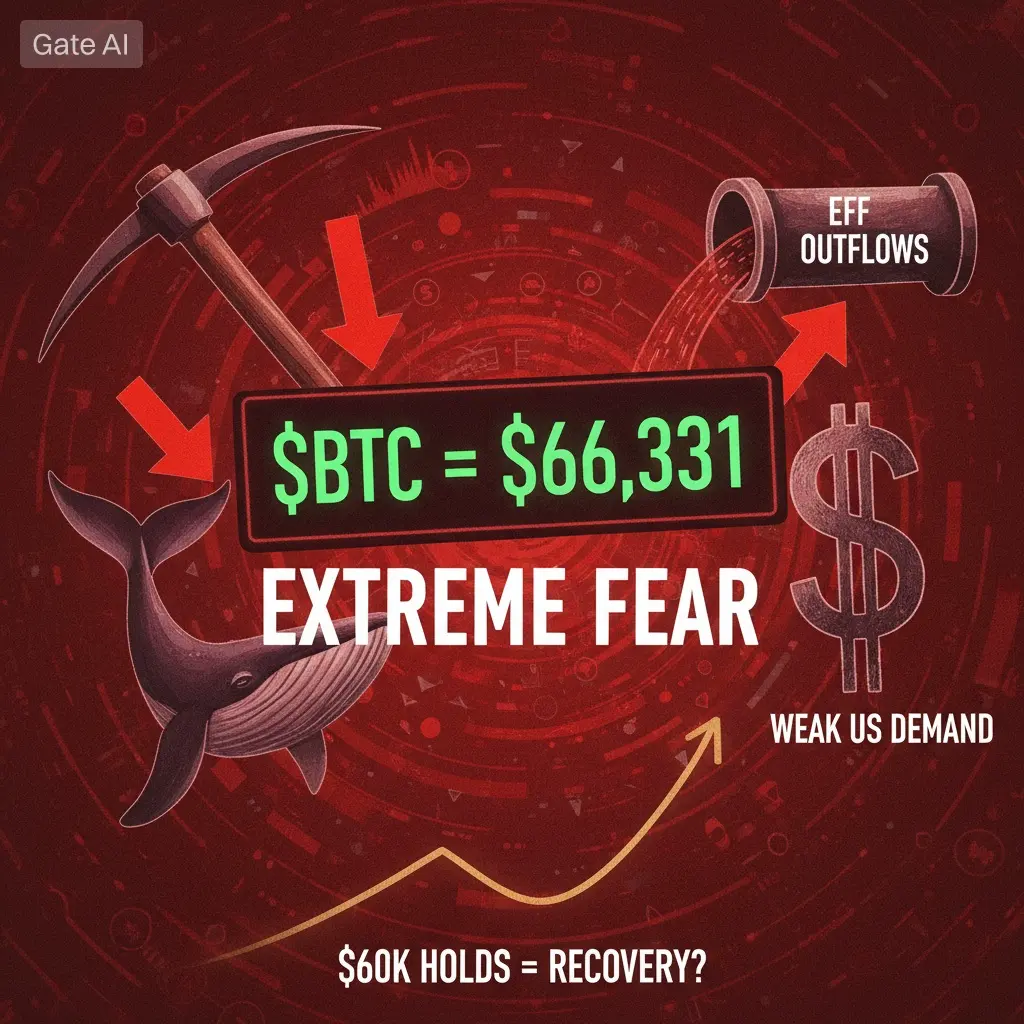
#BitcoinDropsBelow$65K Bitcoin slips below $65,000, a level many assumed would hold. This isn’t just a price dip—it’s a stress test for the entire crypto ecosystem. Traders and investors must now separate noise from real signals.
Market dynamics at play:
Institutional positioning: Large BTC wallets are moving funds toward exchanges, signaling potential sell-side pressure. This isn’t retail panic—it’s calculated repositioning by whales and institutions.
Technical structure: Short-term support around $64,500 is under threat. If breached, rapid liquidations could accelerate, dragging ETH and top altcoins along. Key levels on ETH ($3,100) and SOL must be watched closely.
Volatility reality: A drop below $65K reminds us that crypto remains a high-risk, high-reward environment. Market swings of 5–10% in days are normal, not anomalies.
Trader considerations:
Avoid emotional decisions; let data and charts guide your moves.
Monitor on-chain flows and whale activity for early warnings.
Use dips to build risk-adjusted positions, not to chase FOMO gains.
Why this matters long-term:
BTC under $65K tests conviction and market resilience. Strong hands may see this as an accumulation opportunity, while weak hands face the cost of panic decisions. Historical cycles show that price stress often precedes major moves—both up and down.
Bottom line: The current dip isn’t a headline story—it’s a signal. Those who read the charts, analyze market behavior, and stay disciplined will find opportunity in volatility. Crypto rewards preparation, patience, and informed action.
🔥 Keep strategy sharp, watch the charts, and treat this as a moment to observe, learn, and act wisely.
repost-content-media
  • Reward
  • Comment
  • Repost
  • Share
#GlobalTechSell-OffHitsRiskAssets The tech sector trembles, and risk assets bleed. Today, global markets are reeling as tech giants face unprecedented sell-offs—investors are fleeing high-multiple stocks, crypto is feeling the shockwaves, and market sentiment is tipping toward caution. Bitcoin and Ethereum dipped sharply as risk-on appetite faltered, while Nasdaq futures signal ongoing volatility.
Macro signals are screaming: inflation concerns persist, interest rates remain stubborn, and liquidity is tightening. Hedge funds and whales are repositioning aggressively, and retail investors are c
BTC-2,2%
ETH-4,94%
dragon_fly2vip
#GlobalTechSell-OffHitsRiskAssets The tech sector trembles, and risk assets bleed. Today, global markets are reeling as tech giants face unprecedented sell-offs—investors are fleeing high-multiple stocks, crypto is feeling the shockwaves, and market sentiment is tipping toward caution. Bitcoin and Ethereum dipped sharply as risk-on appetite faltered, while Nasdaq futures signal ongoing volatility.
Macro signals are screaming: inflation concerns persist, interest rates remain stubborn, and liquidity is tightening. Hedge funds and whales are repositioning aggressively, and retail investors are caught between fear and opportunity. This isn’t just a tech correction—it’s a market-wide stress test for risk assets.
Eyes on crypto: BTC testing critical support zones near $58,000, ETH under pressure around $3,100. Altcoins mirror the panic—some bleeding double digits—but smart capital is scouting for accumulation points. The key takeaway: volatility isn’t the enemy—it’s the battlefield where winners separate from losers.
If you thought risk assets were untouchable, this sell-off is a brutal reminder: markets punish overconfidence and reward vigilance. Stay informed, monitor liquidity flows, and respect macro signals—this is not a drill; this is structural rotation in real time.
repost-content-media
  • Reward
  • Comment
  • Repost
  • Share
#GlobalTechSell-OffHitsRiskAssets The tech sector trembles, and risk assets bleed. Today, global markets are reeling as tech giants face unprecedented sell-offs—investors are fleeing high-multiple stocks, crypto is feeling the shockwaves, and market sentiment is tipping toward caution. Bitcoin and Ethereum dipped sharply as risk-on appetite faltered, while Nasdaq futures signal ongoing volatility.
Macro signals are screaming: inflation concerns persist, interest rates remain stubborn, and liquidity is tightening. Hedge funds and whales are repositioning aggressively, and retail investors are c
BTC-2,2%
ETH-4,94%
dragon_fly2vip
#GlobalTechSell-OffHitsRiskAssets The tech sector trembles, and risk assets bleed. Today, global markets are reeling as tech giants face unprecedented sell-offs—investors are fleeing high-multiple stocks, crypto is feeling the shockwaves, and market sentiment is tipping toward caution. Bitcoin and Ethereum dipped sharply as risk-on appetite faltered, while Nasdaq futures signal ongoing volatility.
Macro signals are screaming: inflation concerns persist, interest rates remain stubborn, and liquidity is tightening. Hedge funds and whales are repositioning aggressively, and retail investors are caught between fear and opportunity. This isn’t just a tech correction—it’s a market-wide stress test for risk assets.
Eyes on crypto: BTC testing critical support zones near $58,000, ETH under pressure around $3,100. Altcoins mirror the panic—some bleeding double digits—but smart capital is scouting for accumulation points. The key takeaway: volatility isn’t the enemy—it’s the battlefield where winners separate from losers.
If you thought risk assets were untouchable, this sell-off is a brutal reminder: markets punish overconfidence and reward vigilance. Stay informed, monitor liquidity flows, and respect macro signals—this is not a drill; this is structural rotation in real time.
repost-content-media
  • Reward
  • Comment
  • Repost
  • Share
#BuyTheDipOrWaitNow?
#BuyTheDipOrWaitNow? |BTC trading below $60,000 is not a “cheap entry” narrative — it’s a global liquidity stress signal.
When crypto, US equities, gold, and silver all sell off together, this is not sentiment-driven panic; this is forced deleveraging across markets.
1️⃣ Bottom-fishing reality (no sugarcoating)
Trying to call a bottom during high volatility is not strategy — it’s gambling.
Historically, real bottoms form after volatility compresses, funding rates normalize, and sellers are exhausted.
Fear alone doesn’t mark bottoms — liquidity returning does.
2️⃣ Why every
BTC-2,2%
dragon_fly2vip
#BuyTheDipOrWaitNow?
#BuyTheDipOrWaitNow? |BTC trading below $60,000 is not a “cheap entry” narrative — it’s a global liquidity stress signal.
When crypto, US equities, gold, and silver all sell off together, this is not sentiment-driven panic; this is forced deleveraging across markets.
1️⃣ Bottom-fishing reality (no sugarcoating)
Trying to call a bottom during high volatility is not strategy — it’s gambling.
Historically, real bottoms form after volatility compresses, funding rates normalize, and sellers are exhausted.
Fear alone doesn’t mark bottoms — liquidity returning does.
2️⃣ Why everything is falling together
• Higher-for-longer interest rate expectations
• Margin calls triggering asset-agnostic selling
• Funds reducing risk exposure simultaneously
When liquidity tightens, correlation goes to 1 — everything becomes a source of cash.
3️⃣ Trading review (discipline check)
This is not an environment for aggressive longs.
Capital preservation > prediction.
Selective hedging or staying flat beats emotional dip-buying.
My stance:
I’m waiting, not chasing.
The market will offer entries again — but only after sellers lose control, not while they’re still pressing.
Markets don’t reward urgency.
They reward patience, structure, and survival.
repost-content-media
  • Reward
  • 1
  • Repost
  • Share
CryptoLensvip:
btc price will be droping today and it will be at least5%+
#CelebratingNewYearOnGateSquare #我在Gate广场过新年
The New Year didn’t make me profitable.
Discipline did — after the market punished me for ignoring it.
Most people celebrate a date change.
The market only respects behavior change.
Last year made one thing painfully clear:
Hope traders became liquidity
Risk managers stayed alive
Patience outperformed intelligence
That order doesn’t reset in January.
While timelines are full of wishes, fireworks, and screenshots, serious capital is quiet:
Defining invalidation
Cutting exposure early
Waiting for confirmation instead of chasing movement
If you’re ente
dragon_fly2vip
#CelebratingNewYearOnGateSquare #我在Gate广场过新年
The New Year didn’t make me profitable.
Discipline did — after the market punished me for ignoring it.
Most people celebrate a date change.
The market only respects behavior change.
Last year made one thing painfully clear:
Hope traders became liquidity
Risk managers stayed alive
Patience outperformed intelligence
That order doesn’t reset in January.
While timelines are full of wishes, fireworks, and screenshots, serious capital is quiet:
Defining invalidation
Cutting exposure early
Waiting for confirmation instead of chasing movement
If you’re entering this year without rules you actually follow, you’re not early — you’re exposed.
Gate Square isn’t a place for motivational quotes.
It’s where habits get priced in real time.
New Year doesn’t mean new luck.
It means the market will test you again —
and this time, it won’t be gentle.
Adapt, or repeat.
The chart already knows your choice.
repost-content-media
  • Reward
  • Comment
  • Repost
  • Share
#WhiteHouseTalksStablecoinYields
Stablecoins (USDT, USDC, etc.) currently sit at a market cap of roughly $260–320 billion (fluctuating around $267–310B in early 2026 data, with peaks near $318B). This is the total supply/outstanding circulation — think of it as the "size" of the stablecoin economy.
Market Breakdown & Percentages (as of early-mid 2026)
Total stablecoin market cap/supply: ~$260–320 billion (e.g., $266B in Jan, up to $318B peaks, ~$267–270B in Feb reports).
USDT (Tether) dominance: 60–68% of the market (~$185–187B market cap), often 61–64%. It controls the lion's share.
USDC (Ci
DAI-0,01%
USDE-0,01%
HighAmbitionvip
#WhiteHouseTalksStablecoinYields
Stablecoins (USDT, USDC, etc.) currently sit at a market cap of roughly $260–320 billion (fluctuating around $267–310B in early 2026 data, with peaks near $318B). This is the total supply/outstanding circulation — think of it as the "size" of the stablecoin economy.
Market Breakdown & Percentages (as of early-mid 2026)
Total stablecoin market cap/supply: ~$260–320 billion (e.g., $266B in Jan, up to $318B peaks, ~$267–270B in Feb reports).
USDT (Tether) dominance: 60–68% of the market (~$185–187B market cap), often 61–64%. It controls the lion's share.
USDC (Circle): 23–25% (~$64–78B), more institutional-focused and regulated.
Others (DAI, USDe, PYUSD, etc.): Remaining 7–15%, with growing but smaller shares.
Concentration: Top 2 (USDT + USDC) often hold 85–93% of total supply, showing extreme dominance.
Trading Volume
Stablecoins power the vast majority of crypto trading and transfers:
Annual transaction volume: $27–46 trillion (some estimates hit $33–35T in 2025–2026, often exceeding Visa/PayPal combined).
Daily/24h volume: Often $30–100B+ across major pairs, with USDT alone driving $50–100B+ daily in many snapshots.
Percentage role: Stablecoins facilitate ~70–82% of all centralized exchange (CEX) spot trading volume and a huge chunk of DeFi/on-chain activity. They are the "quoting currency" — most trades happen in USDT or USDC pairs.
Liquidity
Liquidity refers to how easily you can buy/sell large amounts without moving the price much (tight spreads, deep order books).
Stablecoins provide the deepest liquidity in crypto markets — USDT especially dominates on CEXs (75%+ of stablecoin trading volume flows through it).
On-chain: Ethereum holds ~50–70% of supply in some breakdowns, Tron ~40–45% (low-fee transfers), Solana/Base/Arbitrum growing fast.
Depth: Major pairs (BTC/USDT, ETH/USDT) have massive liquidity pools, enabling high-frequency trading, derivatives, and institutional flows.
Stablecoins reduce slippage and impermanent loss in DeFi liquidity pools, boosting overall market efficiency.
Price Stability
Stablecoins are designed to hold ~$1 peg (price stability = minimal deviation from $1).
Mechanisms: Reserves (Treasuries, cash equivalents) + arbitrage/redemption keep the peg tight.
Yields impact: Issuers earn interest on reserves (Treasuries yield 3–5%+ in recent environments), but if yields are passed to holders:
Attracts more users → higher supply/adoption → deeper liquidity and tighter pegs (more arbitrageurs stabilize price).
But creates risks: Higher yields could pull money from bank deposits → potential runs/redemptions during stress → temporary peg breaks or forced Treasury sales → short-term liquidity squeezes in Treasuries.
Without yields (banks' push): Less attractive for holding → potentially slower growth, but more "payment-only" focus → stable but lower volume/liquidity growth.
Real-world: Peg holds very well for USDT/USDC (deviations rare, <0.5% usually), but past events (e.g., 2022–2023 stress) showed minor wobbles when liquidity dries up.
How Yields Tie Into Price, Volume, Liquidity & Percentages
Pro-yield (crypto side): Rewards (passive or activity-based) boost adoption → more supply minted → higher market cap percentages for compliant issuers → deeper liquidity pools → higher trading volume (people hold more for yields) → better price stability via more arbitrage capital.
Anti-yield (banks side): Yields = unfair competition → deposit flight (estimates: $500B–$6T+ potential outflows from banks) → reduced bank lending → systemic risks. If banned/limited, stablecoins become pure payments tools → slower growth in supply/volume, but potentially more stable pegs (less run risk from yield-chasing).
Compromise floating: Ban passive yields on holdings, allow activity-based rewards (staking, liquidity provision, transactions) → balances innovation with bank concerns → moderate impact on volume/liquidity growth.
Overall impact if yields restricted: Could cap stablecoin market growth (projections $500B–$2T by 2028–2030 slower), reduce volume/liquidity in DeFi, shift dominance to non-US issuers (offshore), but protect bank deposits and systemic stability.
Bottom Line
Stablecoins are already the backbone of crypto liquidity (80%+ trading, trillions in volume) and price stability ($1 peg). The White House talks could reshape everything:
Full yields → explosive growth in supply/volume/liquidity, but higher risks.
Strict limits → controlled growth, better bank protection, potentially lower dominance percentages for US-based issuers long-term.
The Feb 2026 meetings (Feb 2 deadlock, Feb 10 follow-up) are crunch time — no deal yet, but pressure is on for a compromise by month-end to unlock CLARITY Act/GENIUS Act progress. This directly affects how much stablecoins grow, how liquid markets stay, how stable the $1 peg remains, and who captures the biggest percentage slice of the digital dollar pie.
repost-content-media
  • Reward
  • Comment
  • Repost
  • Share
#BitMineBuys40KETH
BitMine (also referred to as Bitmine Immersion Technologies, ticker BMNR, and chaired by Tom Lee) has indeed made a significant purchase of 40,000 ETH (Ethereum) in a single day recently. This was part of their ongoing aggressive accumulation strategy, with on-chain data showing buys like 20,000 ETH from FalconX and another 20,000 ETH from BitGo, totaling around $83.4 million at the time (based on prices around $2,000–$2,100 per ETH during the transaction period).
This move came amid a sharp market pullback, where ETH has dropped over 60% from its recent all-time highs (aro
ETH-4,94%
HighAmbitionvip
#BitMineBuys40KETH
BitMine (also referred to as Bitmine Immersion Technologies, ticker BMNR, and chaired by Tom Lee) has indeed made a significant purchase of 40,000 ETH (Ethereum) in a single day recently. This was part of their ongoing aggressive accumulation strategy, with on-chain data showing buys like 20,000 ETH from FalconX and another 20,000 ETH from BitGo, totaling around $83.4 million at the time (based on prices around $2,000–$2,100 per ETH during the transaction period).
This move came amid a sharp market pullback, where ETH has dropped over 60% from its recent all-time highs (around $4,900+). Despite massive unrealized losses (reportedly $7–8 billion+ on their overall holdings), BitMine views this dip as a strong buying opportunity tied to Ethereum's fundamentals, staking yields, and long-term role in finance.
Key Details on BitMine's Ethereum Position
Total holdings: Approximately 4.326 million ETH (as of early February 2026), representing about 3.6% of Ethereum's circulating supply — making them one of the largest corporate holders.
Staking: Nearly 2.9 million ETH are staked, generating passive daily rewards (estimated around $1 million+ per day in some reports).
Overall treasury: Their crypto + cash + other investments exceed $10 billion, with ETH as the primary reserve asset.
Strategy: Led by Tom Lee (famous for bullish crypto calls), BitMine is treating the current weakness as an entry point, expecting a V-shaped recovery based on historical patterns. They continue buying even as prices hover near $2,000.
This signals strong institutional confidence in ETH despite the bearish market phase. Large buys like this often act as bullish catalysts, reducing available supply and potentially supporting price floors.
Current Ethereum Price (as of February 10, 2026)
Ethereum (ETH) is currently trading around $2,000–$2,012 USD, down about 1–2% in the last 24 hours amid broader crypto weakness. It's well below its 2025 peaks but holding key support levels near $2,000.
Ethereum Price Forecast and Potential Impact from This News
The crypto market is highly volatile, and predictions vary widely. Here's a balanced discussion based on recent analyst views and market sentiment:
Short-term (next few months in 2026): ETH could face more downside pressure if the broader bear market continues (some technical targets mention $1,760, $1,400, or even $1,000 in worst-case scenarios). However, heavy institutional buying like BitMine's could provide support and limit deeper drops. A rebound to $2,500–$3,000 is possible if sentiment improves.
Medium-term (end of 2026): More optimistic forecasts include:
Standard Chartered: Targets $7,500 by end-2026 (with extensions to $15,000+ in later years).
Other analysts: Ranges from $5,000–$8,000+ if recovery plays out, driven by staking rewards, network upgrades, and institutional adoption.
Tom Lee's view (via BitMine): Expects a swift V-shaped recovery, implying strong upside from current levels.
Longer-term (2027–2030): Bullish scenarios see ETH reaching $10,000–$40,000 in multi-year cycles, fueled by Ethereum's utility in DeFi, NFTs, layer-2 scaling, and real-world finance. Bearish views cap it lower if adoption slows.
Impact of BitMine's buy on ETH price:
This kind of whale/institutional accumulation (especially at scale, with 3.6%+ of supply held) is bullish. It reduces circulating supply, signals "smart money" confidence, and could spark FOMO among other investors. Combined with staking (locking up supply), it might accelerate recovery once market conditions turn (e.g., better liquidity or macro improvements). However, in the short term, overall market sentiment dominates — so while this is a positive signal, ETH won't moon overnight.
Overall, BitMine's move reinforces the narrative that big players see ETH as undervalued right now and are positioning for the next bull run.
repost-content-media
  • Reward
  • Comment
  • Repost
  • Share
#MegaETHMainnetLaunches
🚀 MegaETH Mainnet Is Live: Ethereum Enters the Real-Time Era
MegaETH, the high-performance Ethereum Layer-2 blockchain, has officially launched its mainnet, marking a major milestone for Ethereum scaling. The network is no longer in test mode — it is now fully live and open for real-world use by developers, users, and applications worldwide.
The mainnet launch took place on February 9, 2026, and alongside it, MegaETH introduced its ecosystem frontend called “The Rabbithole.” This serves as the main gateway for users to explore live applications, bridge assets, deploy
ETH-4,94%
LINK-3,91%
DEFI-8,63%
TOKEN-1,53%
HighAmbitionvip
#MegaETHMainnetLaunches
🚀 MegaETH Mainnet Is Live: Ethereum Enters the Real-Time Era
MegaETH, the high-performance Ethereum Layer-2 blockchain, has officially launched its mainnet, marking a major milestone for Ethereum scaling. The network is no longer in test mode — it is now fully live and open for real-world use by developers, users, and applications worldwide.
The mainnet launch took place on February 9, 2026, and alongside it, MegaETH introduced its ecosystem frontend called “The Rabbithole.” This serves as the main gateway for users to explore live applications, bridge assets, deploy contracts, and interact with the network easily.
🔍 What Does the Mainnet Launch Mean?
In simple terms, MegaETH has transitioned from testnet (experimental environment) to mainnet (real blockchain with real value).
Users can now:
Send real transactions
Deploy smart contracts
Interact with live decentralized apps (dApps)
Bridge assets from Ethereum
Swap tokens
Use real DeFi protocols, games, and on-chain tools
All transactions ultimately settle on Ethereum, meaning MegaETH benefits from Ethereum’s security while delivering massive performance improvements.
⚡ Why MegaETH Is Different: The “Real-Time” Blockchain
MegaETH is designed to feel less like a traditional blockchain and more like a real-time web application. The goal is near-instant execution with minimal delay — removing the friction users usually experience on Ethereum.
Key Technical Highlights:
100,000+ transactions per second (TPS) claimed
(50,000+ TPS targets reported at launch)
Sub-10 millisecond block times
(transactions confirm in under 0.01 seconds)
10+ Ggas per second processing capability
Built as an Ethereum Layer-2, inheriting Ethereum’s security while scaling performance massively
During pre-launch stress testing, MegaETH reportedly:
Handled 55,000 TPS peaks
Processed billions of transactions
Demonstrated strong stability under heavy load
This level of performance opens the door for high-frequency trading, real-time gaming, social platforms, instant payments, and advanced DeFi, all running on Ethereum infrastructure.
📊 Early Network Activity & On-Chain Stats
Since the mainnet launched very recently, the ecosystem is still in its early growth phase — but momentum is building quickly.
Current Early Indicators:
Total Value Locked (TVL): ~$40 million
(initial launch figures were as low as $3M, showing rapid growth)
Stablecoin Market Cap: ~$35 million
(primarily USDT)
DEX Volume (24h): Very low (~$40–$50)
Bridged TVL: Over $90 million on some trackers
Daily transactions: Still ramping up, but expected to grow as adoption increases
More than 50+ applications were live or integrating at launch, including:
DeFi and lending tools
Derivatives platforms
Oracle integrations via Chainlink
Infrastructure and developer tooling
The Blockscout explorer already shows millions of transactions processed, indicating active network usage despite the early stage.
🪙 $MEGA Token: Price, Supply & Liquidity Status
The native token $MEGA has a total supply of 10 billion, but it is not yet fully tradable on major centralized exchanges.
Current Token Situation:
Price: ~$0.13–$0.132 (pre-market / perpetual indicators)
24h Volume: Extremely low or near zero on most trackers
Market Cap: Not fully established due to minimal circulating supply
FDV: ~$1.3 billion (based on pre-market pricing)
Liquidity: Very limited — no deep DEX or CEX pools yet
Token releases appear tied to future milestones and ecosystem growth, not an immediate full TGE or airdrop. For now, MegaETH’s focus is clearly on network adoption, infrastructure, and application growth, rather than short-term token speculation.
🔮 Overall Outlook: Big Vision, Early Stage
MegaETH represents a major step forward for Ethereum scalability, aiming to close the speed gap with ultra-fast chains while maintaining Ethereum’s security and decentralization.
Strengths:
Extremely low latency
Massive throughput potential
Strong technical vision
Ethereum security + Chainlink integrations
Challenges Ahead:
User adoption will be the true test
Liquidity and volume must grow
Strong competition from other L2s (Base, Arbitrum, Optimism, etc.)
Token economics and exchange listings will be major catalysts
For developers and users interested in ultra-fast Ethereum applications, now is the perfect time to explore MegaETH via The Rabbithole and official documentation.
🚀 Final Thought
Ethereum’s future isn’t just about scaling — it’s about speed without compromise. MegaETH is betting that real-time blockchain experiences are the next evolution.
repost-content-media
  • Reward
  • Comment
  • Repost
  • Share
#MrBeastAcquiresStep
🚀 BIG NEWS: MrBeast Just Acquired Step – Entering the Fintech World!
YouTube's biggest star, Jimmy "MrBeast" Donaldson, has officially taken his empire into financial services. Through his company Beast Industries, he has acquired Step, the popular teen-focused banking and money management app.
This move marks a major expansion beyond content creation, Feastables chocolate, and philanthropy — straight into helping millions of young people build better financial habits.
Here’s the full breakdown, point by point:
What is Step?
Step is a mobile-first fintech app designed sp
ETH-4,94%
DEFI-8,63%
HighAmbitionvip
#MrBeastAcquiresStep
🚀 BIG NEWS: MrBeast Just Acquired Step – Entering the Fintech World!
YouTube's biggest star, Jimmy "MrBeast" Donaldson, has officially taken his empire into financial services. Through his company Beast Industries, he has acquired Step, the popular teen-focused banking and money management app.
This move marks a major expansion beyond content creation, Feastables chocolate, and philanthropy — straight into helping millions of young people build better financial habits.
Here’s the full breakdown, point by point:
What is Step?
Step is a mobile-first fintech app designed specifically for teens, Gen Z, and young adults. It acts as an all-in-one money platform (not a full bank, but partnered with Evolve Bank & Trust for FDIC-insured services). Key features include:
No-fee debit accounts
Secured Visa credit-building card (helps build credit early without debt risk)
Savings tools with interest
Early pay / cash advance options
Spending controls for parents
Focus on financial literacy and money management
The Acquisition Details
Announced on February 9, 2026
Beast Industries bought Step (terms not publicly disclosed; estimated under $200M based on market observers)
Step already has over 7 million users and previously raised significant funding (including from Stripe, General Catalyst, Coatue, plus celebrities like Stephen Curry, Will Smith, Charli D’Amelio, and The Chainsmokers)
This follows Beast Industries’ $200M investment from BitMine Immersion Technologies (a major Ethereum treasury firm chaired by Tom Lee) in January 2026
Why MrBeast Did This
In his own words (from his X post):
“Nobody taught me about investing, building credit, or managing money when I was growing up. That’s exactly why we’re joining forces with Step! I want to give millions of young people the financial foundation I never had.”
It aligns perfectly with his audience — mostly Gen Z and Gen Alpha — who are just starting to handle money.
What Impact Will This Have on the Crypto Market?
While Step currently focuses on traditional fintech (banking, credit, savings), the crypto angle is heating up speculation:
Beast Industries received $200M from BitMine, an Ethereum-focused treasury company. BitMine’s chair Tom Lee has hinted at exploring DeFi integration into Beast’s upcoming financial platform.
In late 2025, MrBeast-linked entities filed a trademark for “MrBeast Financial”, explicitly covering cryptocurrency trading, crypto payment processing, DEX transactions, and digital asset services.
If crypto features roll out (e.g., easy on-ramps for ETH, stablecoins, or DeFi tools inside the app), it could onboard millions of Gen Z users — many crypto-curious but new to wallets/exchanges — into the ecosystem.
Short-term: Minimal direct pump (no token yet, no immediate crypto launch announced).
Long-term potential: Massive adoption catalyst. MrBeast’s 466M+ YouTube reach + trust factor could normalize crypto for teens, drive on-chain activity, and boost Ethereum/DeFi narratives (especially with BitMine’s ETH treasury backing).
Watch for: Future announcements on “MrBeast Financial” products — crypto could be the killer feature that differentiates this from traditional neobanks.
What This Means for Users & the Future
Step users get access to Beast Industries’ massive reach (466M+ YouTube subscribers + global brand power)
Expect new groundbreaking products, better financial education tools, and possibly integrations with MrBeast-style rewards or giveaways
Step’s team (including founder/CEO CJ MacDonald) stays on to scale the platform
Hints at bigger ambitions: This could be the foundation for a full “MrBeast Financial” suite
Why It’s a Game-Changer
MrBeast is one of the most trusted names with young people — combining that trust with real financial tools could disrupt teen banking
It’s a smart pivot: from viral videos and giveaways to long-term value creation through fintech (and potentially crypto)
Competitors like traditional banks, other neobanks (Chime, Current), and apps like Greenlight should take note
MrBeast is no longer just entertaining — he’s building tools to change lives through money smarts. This could be the start of “MrBeast Financial” becoming a real thing — and maybe even a bridge to mainstream crypto adoption.
repost-content-media
  • Reward
  • 1
  • Repost
  • Share
Thynkvip:
Watching Closely 🔍️
#YiLihuaExitsPositions
The phrase “Yi Lihua exits positions” is used in crypto discussions to suggest that Yi Lihua (a known trader, fund manager, or market participant) has closed or reduced active trading positions in certain crypto assets.
At present, there is no fully verified public disclosure confirming the exact assets, position sizes, or timing of these exits. Because of this, the topic should be understood more as a market narrative or sentiment signal, rather than a confirmed on-chain or official announcement.
To properly understand its impact, it’s important to first understand wha
HighAmbitionvip
#YiLihuaExitsPositions
The phrase “Yi Lihua exits positions” is used in crypto discussions to suggest that Yi Lihua (a known trader, fund manager, or market participant) has closed or reduced active trading positions in certain crypto assets.
At present, there is no fully verified public disclosure confirming the exact assets, position sizes, or timing of these exits. Because of this, the topic should be understood more as a market narrative or sentiment signal, rather than a confirmed on-chain or official announcement.
To properly understand its impact, it’s important to first understand what exiting positions means in crypto trading and why such actions attract attention.
What Does “Exiting Positions” Mean in Crypto?
In crypto trading, exiting a position means closing an open trade:
Selling an asset if the trader was long
Buying back an asset if the trader was short
This is the point where profits or losses are realized, making exit decisions one of the most critical parts of trading.
Why Would a Trader Exit Positions?
Traders and institutions exit positions for several strategic reasons:
Profit targets reached
Gains are locked in to avoid reversals.
Risk management
Stop-loss levels are triggered to prevent larger losses.
Market or news events
Regulatory changes, macro shocks, or sudden volatility can force exits.
Portfolio rebalancing
Capital is shifted to other assets or reduced exposure.
Market structure changes
Trend breakdowns or weakening momentum signal caution.
Why This Topic Gets Attention
When a well-known trader or fund is believed to be exiting positions, markets often react emotionally. Traders may interpret it as:
A possible local market top
Increased downside risk
A shift toward a risk-off environment
However, this does not automatically mean the market will fall—context matters.
Common Exit Strategies Used by Professionals
Manual exits based on technicals, volume, or news
Automated exits using stop-loss and take-profit orders
Trailing stops that protect gains while allowing trends to continue
Large players often exit gradually to minimize market impact.
Mistakes Retail Traders Often Make
Exiting too early due to fear
Holding losing positions hoping for recovery
Ignoring liquidity, fees, and slippage
Blindly copying large traders without confirmation
Headlines alone should never dictate trading decisions.
How Traders Should Interpret This Situation
Instead of reacting emotionally, traders should:
Treat it as a sentiment signal, not a trade command
Recheck technical levels and volume
Adjust risk exposure if needed
Focus on personal strategy and time horizon
Smart trading is about confirmation, not imitation.
Risk Reminder
Crypto markets are highly volatile. Even when large participants reduce exposure, price action can move in either direction. Always trade with:
Clear entry and exit plans
Proper position sizing
Defined risk limits
No single trader controls the market.
Final Note
Until confirmed data or official statements are available, this topic should be viewed as contextual market discussion, not verified fact. Patience, discipline, and independent analysis remain essential.
repost-content-media
  • Reward
  • Comment
  • Repost
  • Share
#GateLunarNewYearOn-ChainGala
The Gate Lunar New Year On-Chain Gala is Gate.io’s flagship event celebrating the Lunar New Year in 2026. The event combines on-chain innovation, community engagement, trading incentives, and exclusive rewards, blending blockchain technology with cultural festivities. Here’s everything you need to know.
1️⃣ Purpose of the Gala
The primary goal is to celebrate the Lunar New Year with the global crypto community, emphasizing Gate.io’s role as a leader in decentralized and centralized trading.
It aims to increase user engagement, encourage active trading, and showca
BTC-2,2%
ETH-4,94%
GALA-3,36%
DEFI-8,63%
HighAmbitionvip
#GateLunarNewYearOn-ChainGala
The Gate Lunar New Year On-Chain Gala is Gate.io’s flagship event celebrating the Lunar New Year in 2026. The event combines on-chain innovation, community engagement, trading incentives, and exclusive rewards, blending blockchain technology with cultural festivities. Here’s everything you need to know.
1️⃣ Purpose of the Gala
The primary goal is to celebrate the Lunar New Year with the global crypto community, emphasizing Gate.io’s role as a leader in decentralized and centralized trading.
It aims to increase user engagement, encourage active trading, and showcase the platform’s advanced on-chain capabilities.
The Gala also serves as a community-building exercise, strengthening ties between Gate.io and retail/institutional traders worldwide.
2️⃣ Event Structure & Key Highlights
Trading Competitions
Users can participate in special Lunar New Year trading contests.
Top traders are rewarded with bonuses in BTC, ETH, or selected altcoins.
Metrics tracked include trade volume, transaction count, and profit percentage, rewarding both high-volume and skilled traders.
NFT Drops & Collectibles
Exclusive Lunar New Year-themed NFTs were released for the event.
Some NFTs are tradable or redeemable on-chain, offering utility beyond simple collectibles.
NFTs include limited edition art, digital zodiac icons, and event badges.
Staking & Yield Rewards
Gate.io offered special staking campaigns tied to the Gala.
Users staking certain tokens during the Gala period earned higher-than-usual APY, along with potential NFT bonuses.
Lucky Draws & Red Packet Giveaways
Inspired by traditional Lunar New Year customs, Gate.io conducted digital “red packet” giveaways on-chain.
Participants could receive random token rewards, adding an element of gamification and excitement.
Cultural & Educational Engagement
The Gala featured mini-events explaining Lunar New Year traditions, connecting global users to the cultural significance.
Educational content also highlighted on-chain trading tips, DeFi strategies, and NFT utility.
3️⃣ On-Chain Integration
Unlike purely marketing-focused celebrations, this Gala leveraged Gate.io’s on-chain capabilities:
Direct on-chain reward distribution ensures transparency and traceability of all prizes.
Smart contract automation handled contests, staking, and NFT allocations efficiently.
Users could verify all rewards directly on-chain, enhancing trust and reducing disputes.
4️⃣ Participation & Community Impact
Participation was global, including Asia, Europe, and North America.
Community feedback emphasized fun, reward variety, and transparency.
Events like NFT drops and trading competitions increased user retention and platform activity, aligning with Gate.io’s growth strategy.
5️⃣ Market & Platform Implications
Trading Volume Boost: On-chain events often generate short-term spikes in trading volume and liquidity.
New User Acquisition: Festivals with gamified rewards attract new users and introduce them to crypto trading and staking.
Brand Visibility: The Gala positions Gate.io as innovative and culturally conscious, bridging blockchain technology with global traditions.
6️⃣ Key Takeaways
The Gate Lunar New Year On-Chain Gala is more than a celebration—it’s a strategic engagement campaign leveraging on-chain transparency, gamification, and community incentives.
It strengthens user loyalty, promotes active trading, and enhances Gate.io’s reputation in both crypto and cultural spheres.
The event showcases how blockchain technology can make traditional celebrations interactive, rewarding, and globally accessible.
✅ Summary
The Gala successfully merged cultural celebration with blockchain innovation, offering users an engaging, transparent, and rewarding experience. From trading competitions and NFT drops to staking incentives and red packet giveaways, every aspect was designed to enhance participation, trust, and platform growth.
repost-content-media
  • Reward
  • 1
  • Repost
  • Share
ybaservip:
2026 Go Go Go 👊
#BuyTheDipOrWaitNow?
Gate Plaza|2/6 Market Update: Bitcoin < $60k, Gold/Silver Plunge, Stocks Under Pressure
🎁 Fan Appreciation Benefits · Rewards Keep Increasing
🌍 1. Market Overview: Global Risk-Off Takes Hold
This morning, global risk markets experienced a sharp, multi-asset selloff:
Bitcoin dipped below $60,000, erasing post-election gains and currently trading volatile around mid-$60k levels. Over the past month, BTC is down roughly 30%, highlighting the high volatility in crypto markets.
U.S. stock index futures extended losses. Nasdaq and S&P have declined sharply over multiple sessi
BTC-2,2%
HighAmbitionvip
#BuyTheDipOrWaitNow?
Gate Plaza|2/6 Market Update: Bitcoin < $60k, Gold/Silver Plunge, Stocks Under Pressure
🎁 Fan Appreciation Benefits · Rewards Keep Increasing
🌍 1. Market Overview: Global Risk-Off Takes Hold
This morning, global risk markets experienced a sharp, multi-asset selloff:
Bitcoin dipped below $60,000, erasing post-election gains and currently trading volatile around mid-$60k levels. Over the past month, BTC is down roughly 30%, highlighting the high volatility in crypto markets.
U.S. stock index futures extended losses. Nasdaq and S&P have declined sharply over multiple sessions, while the Dow shed hundreds of points, reflecting broad risk aversion.
Precious metals faced a severe correction. Spot gold retreated to $4,660 per ounce, and silver plummeted 9% intraday, pressured by forced deleveraging and margin calls.
Market question: When will the bottom arrive? No clear bottom is visible yet, as deleveraging cascades and high volatility continue to push prices lower. Potential stabilization signals to monitor include:
Reduced selling from long-term holders in Bitcoin.
A cooling in the VIX (volatility index) indicating risk appetite returning.
Dip-buying rebounds in gold and silver.
Historically, crypto drawdowns of ~40% often test lower support zones—in BTC’s case, roughly $56k–$58k. Extreme fear sentiment can indicate that a capitulation phase may be near, but timing is uncertain.
💹 2. Bottom-Fishing Signals: Timing and Strategy
Traders are asking: Will the market continue to decline, and when is the right time to bottom-fish?
Near-Term Risks: The leveraged unwind from gold/silver margin hikes is spilling over to equities and crypto. Macroeconomic uncertainty and tech/AI disruption fears add further downward pressure.
Oversold Conditions: BTC is nearing major technical supports like the 200-week moving average, and gold is pulling back after a parabolic run—potential early signals that the downside is being absorbed.
Best Bottom-Fishing Approach:
Wait for confirmation signals, e.g., volatility decreasing, ETF inflows resuming, or BTC holding support in the $56k–$60k range.
Scale into positions during capitulation spikes, when high-volume selling aligns with extreme fear indicators.
Long-term holders often profit in these phases, but short-term traders face heightened risks if deleveraging continues.
Key takeaway: Bottom-fishing requires patience and discipline—avoid trying to catch a falling knife.
🔍 3. Cause Analysis: Why Are Multiple Markets Falling Together?
Seeing gold, silver, U.S. stocks, and crypto all declining simultaneously can be confusing, but several factors explain the correlation:
Forced Deleveraging & Margin Calls
Precious metals saw sharp corrections after CME margin hikes (up 30–40%).
Leveraged traders were forced to sell gold and silver, which spilled over into BTC and equities to cover losses.
Risk-Off Contagion
Broader investor flight from risk assets affected tech stocks (AI disruption concerns, weak labor data) and crypto.
Geopolitical tensions and Fed policy uncertainty further amplified selling pressure.
Not Fundamentals Alone
Gold and silver were overextended due to speculative, leveraged buying; BTC’s short-term movements correlate more with credit availability and risk appetite than its long-term “digital gold” thesis.
When leverage unwinds, assets that are usually uncorrelated sell together, even if their fundamental drivers differ.
True Driving Factors
High leverage built up across multiple markets.
Macro shocks, including tariff fears, Fed policy ambiguity, and AI capex concerns, created cascading sell pressure.
Insight: Understanding these causes helps traders avoid panic reactions and make calculated decisions, rather than just following the herd.
📊 4. Trading Review: How Are Traders Reacting?
Market participants are responding with a mix of strategies:
Shorting: Traders capitalize on downward momentum in BTC, stocks, or silver.
Dip Buying: Cautious entries at perceived lows aim for medium- to long-term gains.
Hedging & Risk Management: Using stablecoins, options, or diversified portfolios to limit losses.
Portfolio Diversification: Spreading exposure across assets reduces single-market risk.
Key takeaway: Discipline, patience, and a clear plan are essential. Emotional trading in volatile markets can quickly lead to losses.
✅ Final Thoughts
Markets remain volatile, and bottoms are hard to time precisely. Observing technical signals, macro drivers, and trading strategies can help navigate this turbulence. Whether your approach is buying the dip, shorting, or waiting, preparation and risk management are crucial.
repost-content-media
  • Reward
  • 1
  • Repost
  • Share
ybaservip:
2026 GOGOGO 👊
#TopCoinsRisingAgainsttheTrend
Bitcoin and most altcoins are dropping 5–15%.
But 4–5 specific coins (maybe SOL, TON, some new layer-1, or a meme coin with hype) are green and up 10–30%.
Overall Market Trend – How Much Has It Dropped?
The global cryptocurrency market cap is around $2.3 Trillion (estimates range from $2.24T to $2.33T).
24-hour change: Down approximately 6.5% to 8% (major value wipeout).
Bitcoin (BTC) is leading the decline.
Bitcoin (BTC) current status:
Current price: Around $65,000 – $65,700 USD (varies slightly across exchanges).
24-hour change: Down 6.9% to 7.5%.
24-hour tra
BTC-2,2%
ETH-4,94%
SOL-5,37%
TON-2,62%
HighAmbitionvip
#TopCoinsRisingAgainsttheTrend
Bitcoin and most altcoins are dropping 5–15%.
But 4–5 specific coins (maybe SOL, TON, some new layer-1, or a meme coin with hype) are green and up 10–30%.
Overall Market Trend – How Much Has It Dropped?
The global cryptocurrency market cap is around $2.3 Trillion (estimates range from $2.24T to $2.33T).
24-hour change: Down approximately 6.5% to 8% (major value wipeout).
Bitcoin (BTC) is leading the decline.
Bitcoin (BTC) current status:
Current price: Around $65,000 – $65,700 USD (varies slightly across exchanges).
24-hour change: Down 6.9% to 7.5%.
24-hour trading volume: Extremely high at $140B+.
This sharp drop signals heavy selling pressure and bearish sentiment affecting most altcoins (Ethereum down ~8–9%, Solana down ~12–15% in many reports).
The market is clearly weak — most major coins are in the red.
What Does "Rising Against the Trend" Mean Here?
Even in this red market, a few top coins are bucking the trend:
They are gaining positive percentage (green) or showing much smaller losses.
This indicates outperformance, possible whale accumulation, strong fundamentals, or hype.
Two Key Coins Rising Against the Trend – Detailed Discussion
Hyperliquid (HYPE)
Current price: Around $34 – $36 USD.
24-hour change: Up +3.19% to +6.08% (positive while BTC drops 7%+).
24-hour trading volume: Extremely high at $1.28B+ (top volume today).
Market cap: Around $9B+ (solid mid-cap rank).
Liquidity & discussion: Very strong liquidity on DEXs and perps. High interest due to its utility in derivatives trading. Traders see it as a resilient DeFi/perps play — even in a crash, people are using and accumulating it. Clear relative strength.
Decred (DCR)
Current price: Around $20.50 – $21 USD.
24-hour change: Up +9.10% to +9.51% (strong green pump).
24-hour trading volume: Solid at $12M–$13M+.
Market cap: Around $350M–$364M (established coin).
Liquidity & discussion: Decent liquidity on major exchanges. Known for hybrid PoW/PoS and strong governance community. The rise suggests accumulation or momentum in privacy/governance coins during uncertainty. Seen as a hidden gem with low correlation to BTC dumps lately.
Other quick mentions of strength today include MYX Finance (up ~10%), MemeCore (up ~4%), and some Solana-related tokens showing double-digit gains in spots.
Bottom Line
In this bearish market (BTC -7%, overall cap -7%), coins like Hyperliquid and Decred are classic examples of rising against the trend — showing resilience, high volume interest, and positive price action. This could mean smart money rotating or early bullish divergence. Always do your own research and watch BTC closely — if it stabilizes, these could pump hard.
repost-content-media
  • Reward
  • 1
  • Repost
  • Share
ybaservip:
2026 GOGOGO 👊
#GlobalTechSell-OffHitsRiskAssets
Big Picture: What’s Really Happening?
The current global sell-off (early February 2026) is not a single-event panic — it’s a multi-layered repricing of risk after years of aggressive upside, particularly in AI-driven tech stocks.
Markets are reacting to a convergence of pressures:
Excessive AI capital expenditure (capex) expectations
Structural fears that AI is cannibalizing traditional software revenues
Valuation fatigue after a historic multi-year rally
Weak U.S. labor market signals, reigniting slowdown/recession fears
When all of this hits at once, marke
BTC-2,2%
HighAmbitionvip
#GlobalTechSell-OffHitsRiskAssets
Big Picture: What’s Really Happening?
The current global sell-off (early February 2026) is not a single-event panic — it’s a multi-layered repricing of risk after years of aggressive upside, particularly in AI-driven tech stocks.
Markets are reacting to a convergence of pressures:
Excessive AI capital expenditure (capex) expectations
Structural fears that AI is cannibalizing traditional software revenues
Valuation fatigue after a historic multi-year rally
Weak U.S. labor market signals, reigniting slowdown/recession fears
When all of this hits at once, markets don’t rotate politely — they de-risk aggressively.
This is a classic global risk-off phase, where correlations rise and diversification temporarily fails.
The Core Trigger: AI Capex Shock & Software Disruption Fears
🔹 AI Spending Anxiety
Major tech leaders have guided massive AI infrastructure spending into 2026–27, raising uncomfortable questions:
How long before these investments pay off?
Will margins compress before revenues catch up?
Are shareholders funding a multi-year profit gap?
Alphabet’s $175–185B 2026 capex guidance became a psychological tipping point.
🔹 AI vs Traditional Software
New-generation AI tools (including models from players like Anthropic) are triggering a deeper fear:
AI doesn’t just enhance software — it replaces parts of it
Subscription-based SaaS models face pricing pressure
Enterprise software moats look weaker than assumed
This explains why software stocks are being sold harder than semiconductors.
Index-Level Damage: How Deep Is the Sell-Off?
📉 Nasdaq Composite (Tech Heavy)
Down ~1.5–1.6% in recent sessions
Worst multi-day drop in months
Nasdaq 100 erased >$1 trillion in market value
Leadership unwind is the key story here
📉 S&P 500
Down ~1.2–1.3%
Tech’s heavy weighting drags the entire index lower
Even “safe” mega-caps failed to cushion declines
📉 Dow Jones
Down ~1.1–1.2% (≈500–600 points)
Outperformed relatively due to limited tech exposure
Confirms this is a growth-led sell-off
Global Spillover
Asia hit hard: Kospi fell >5% intraday, later narrowing losses
Europe followed with broad declines
MSCI global equities index down >1%
This is not a U.S.-only issue — capital flows are moving defensively worldwide.
Sector Breakdown: Where the Damage Is Concentrated
💻 Software: Ground Zero
iShares Expanded Tech-Software ETF:
Six consecutive losing sessions
~$830B to nearly $1 trillion wiped out
This sector absorbed the AI disruption narrative most directly
📉 Major Tech Stock Moves
AMD: −17% (single session collapse)
Qualcomm: −8.5% (weak forward outlook)
Palantir: −12%
Micron: −10%
Nvidia: −3–3.4% (relative strength, but still red)
Alphabet: −2–4% (capex shock)
Microsoft, Amazon, Tesla: −3–5%+
“Magnificent Seven”: Mostly red, driving index losses
Even the strongest balance sheets weren’t spared — that’s textbook risk liquidation.
Liquidity, Volume & Volatility: What the Tape Is Saying
🔹 Volume
Elevated across tech and software
Indicates institutional de-risking, not retail panic
Heavy selling into rallies — a bearish short-term signal
🔹 Liquidity
Core U.S. equity markets remain functional
But:
Bid-ask spreads widened in volatile names
Software and growth stocks saw liquidity thinning
🔹 Volatility
Volatility spiked rapidly
Options markets show rising demand for downside protection
Short-term uncertainty is being aggressively priced in
Broader Risk Assets: Why Everything Is Falling Together
This is where many people get confused — but the logic is simple.
🔗 Correlation Effect
When tech (the dominant performance driver) breaks:
Funds reduce overall exposure
Risk-on baskets are sold together
Asset correlations jump toward 1
📉 Impacted Assets
Cryptocurrencies: Sharp drawdowns, thin liquidity amplified moves
Bitcoin fell below $70,000
Nearly 50% down from Oct 2025 highs
Silver: Down 18–20%
Emerging Markets: Broad pressure
Alternative assets: Sold to raise cash
🛡️ Safe Havens
U.S. Treasuries rallied
Yields fell as capital rotated defensively
Cash and short-duration assets gained favor
The Macro Accelerator: Weak U.S. Jobs Data
Recent labor market data added fuel:
Rising jobless claims
Signs of cooling employment momentum
Markets fear:
Earnings pressure
Reduced consumer demand
Policy missteps if growth slows too fast
This turned a sector correction into a macro-driven risk-off move.
Is This Panic or a Structural Reset?
📌 What This Is:
A valuation reset
A sentiment shock
A leadership unwind
❌ What This Is NOT:
A financial system crisis
A liquidity collapse
A confirmed long-term bear market (yet)
Some areas — especially software — appear oversold short-term, and:
Tactical bounces are possible
Relief rallies can occur if data stabilizes
Volatility will remain elevated
But leadership will likely change.
Forward Outlook: What Matters Next
Markets will focus on:
AI monetization clarity (not just spending)
Upcoming macro data (jobs, inflation, growth)
Earnings revisions
Bond market signals
Volatility compression or expansion
Until confidence returns, expect:
Choppy price action
Fast rotations
Reduced tolerance for high-beta trades
🔚 Final Takeaway
This global sell-off is a textbook risk-off phase triggered by tech dominance breaking down.
AI enthusiasm didn’t disappear — but expectations were pulled forward too aggressively, and markets are now repricing reality.
In such environments:
Capital preservation matters
Position sizing matters
Diversification matters — even if it temporarily fails
Volatility is not a signal to panic — it’s a signal to think clearly and act selectively.
repost-content-media
  • Reward
  • Comment
  • Repost
  • Share
#CryptoMarketStructureUpdate
The cryptocurrency market is deep in a severe bearish correction and capitulation phase. Extreme fear dominates (Fear & Greed Index sitting in the 11–23 range, firmly in "Extreme Fear"). Total market cap has plunged to approximately $2.35–$2.45 trillion (down 4–5%+ in the last 24 hours, with roughly $450–500 billion wiped out since late January peaks). This move is driven by macro risk-off sentiment: spillover from the AI/tech stock rout, hawkish Fed expectations (no rapid rate cuts anticipated), ongoing geopolitical tensions, selective ETF outflows, heavy long li
BTC-2,2%
ETH-4,94%
SOL-5,37%
LINK-3,91%
HighAmbitionvip
#CryptoMarketStructureUpdate
The cryptocurrency market is deep in a severe bearish correction and capitulation phase. Extreme fear dominates (Fear & Greed Index sitting in the 11–23 range, firmly in "Extreme Fear"). Total market cap has plunged to approximately $2.35–$2.45 trillion (down 4–5%+ in the last 24 hours, with roughly $450–500 billion wiped out since late January peaks). This move is driven by macro risk-off sentiment: spillover from the AI/tech stock rout, hawkish Fed expectations (no rapid rate cuts anticipated), ongoing geopolitical tensions, selective ETF outflows, heavy long liquidations (recent single-day figures around $500M–$650M, cumulative billions), and noticeably weak on-chain demand. Bitcoin dominance remains elevated (around 55–59%), but the entire market is bleeding — altcoins are suffering even more severely.
1. Overall Market Structure & Trend
Total Crypto Market Cap: ~$2.35T–$2.45T (sharp decline; multiple reports highlight over $467 billion erased in roughly one week).
Dominance & Rotation: Bitcoin is holding relatively better (dominance rising), while altcoins face deeper pain — classic risk-off behavior where speculative assets bleed heavily and utility-focused sectors show slight relative resilience.
Trend & Patterns: Broad downtrend characterized by lower highs and lower lows since late 2025 / early 2026 peaks. Descending channel clearly visible on daily and weekly charts. Volatility spiked during the liquidation cascade and is now turning choppy near key support zones. RSI readings are oversold across most assets (average ~30–40, dipping below 30 in several spots), suggesting a potential short-term relief bounce — but no convincing reversal signal has appeared yet. Momentum remains firmly bearish; analysts are debating whether this is a mid-cycle correction or the early stages of a broader bear market (some forecasting a bottom around Q3 2026).
Sentiment: Extreme Fear levels — retail panic selling and forced liquidations are widespread, though historically such readings frequently mark local bottoms. Institutions appear to be quietly accumulating dips in fundamentally strong projects.
2. Bitcoin (BTC) – Market Leader Breakdown
Current Price: ~$70,500–$72,000 range (down 5–7.5%+ over the last 24 hours; Asian session lows touched near $70,100–$70,700, with brief dips below $71,000; live quotes showing ~$70,900–$71,350 in recent prints).
Trend: Brutal correction underway — down more than 40% from the 2025 peak (~$126k), approximately 18–20% wiped out year-to-date in 2026, fully erasing post-election gains. Consecutive red candles continue, now testing significant cycle lows.
Technical Structure:
Support: Psychological $70,000 level is critical (holding here keeps bounce potential alive; a clean break opens the door to the $68,000–$65,000 zone, with the 200-week EMA sitting near $68,400 as the next major structural level). In a worst-case macro deterioration, extension toward $60,000–$58,000 cannot be ruled out.
Resistance: $73,000–$75,000 (former support now acting as resistance), followed by $76,000–$78,000 (prior consolidation areas).
Patterns: Downtrend channel remains intact with heavy downside volume. RSI is oversold, and on-chain data shows a high percentage of supply now underwater, increasing stress among holders.
Outlook: Short-term bearish pressure is dominant — the $70,000 level is the immediate make-or-break zone. Macro factors (tech rout, Fed policy) continue to override crypto-specific drivers.
3. Ethereum (ETH) & Altcoins
ETH Price: ~$2,090–$2,150 (down 7–8%+ in recent sessions; lows near $2,078–$2,100, with weekly declines in the 25–28% range).
Trend: Underperforming Bitcoin significantly (higher beta in risk-off environments) — on-chain activity is slowing, gas fees remain low, and downside pressure is more intense.
Technical: Key supports broken; structure shows lower highs and lower lows with oversold conditions, but recovery requires Bitcoin to stabilize first.
Altcoins: Most of the top 100 are deep red (examples: SOL around $90–$91 down over 26% weekly; many others in the -20–30% range). Utility-focused sectors (RWA projects like Chainlink and ONDO, infrastructure plays, stablecoin-related assets) are showing relative strength and less severe bleeding — clear decoupling: speculative altcoins are being crushed while real-use-case projects demonstrate more resilience. Layer-1 chains (SOL, ADA, AVAX) remain heavily in the red.
4. Short-Term vs Long-Term Outlook & Trader Plans
Short-Term (Next Days–Weeks – Feb/March 2026): Bearish bias remains strong — further downside risk exists if Bitcoin breaks $70,000 cleanly (potential extension targets $65,000–$60,000). Expect choppy ranges near support levels with elevated volatility. Extreme fear readings have historically preceded local bottoms, but confirmation is essential (volume spike, higher lows, clear reversal candles). Fakeouts are frequent — avoid FOMO entries.
Long-Term (Rest of 2026 and Beyond): Structurally bullish outlook persists for patient participants. Institutional adoption continues to build (ETF products maturing), US regulatory clarity is progressing (Senate bill advancements), real-world asset tokenization is accelerating, stablecoin usage is expanding, and DeAI narratives are gaining traction. The market cycle appears to be evolving — more adoption-driven than strictly tied to halving timelines. Many view the current drawdown as a healthy reset and accumulation opportunity after the 2025 highs; longer-term forecasts still point toward recovery and potential new all-time highs later in the year (some targets $138,000–$200,000+ for BTC end-of-year if macro conditions stabilize).
Trader Hazrat – Practical Next Plans (Realistic Discussion)
The market is currently in a high-risk, low-conviction environment — survival and capital preservation take priority over aggressive prediction. Discipline is everything.
Short-Term Traders (Scalp/Swing):
Avoid aggressive long entries — fake bounces are common and punishing.
Wait for Bitcoin to hold $70,000 decisively with strong reversal evidence (volume increase, higher low formation) → possible bounce target toward $73,000–$75,000.
Bearish setups: If $70,000 breaks cleanly, consider shorts targeting $68,000–$65,000 (keep stops tight above recent swing highs).
Core rules: Reduce position size to 50% of normal, use wider stops, place limit orders only at precise levels. Holding cash or stablecoins is the safest stance if conviction is low. Range trading in chop is viable but requires precision.
Medium-Term (1–3 Months – Position Building):
View this dip as a legitimate accumulation window — dollar-cost average into Bitcoin and Ethereum on weakness below $70,000 and $2,000 respectively.
Prioritize utility and resilient altcoins (RWA, infrastructure plays) that have bled less. Avoid pure speculative/memecoin exposure at this stage.
Consider hedging with stablecoins if macro fears intensify further.
Long-Term Holders / Allocate:
The bigger-picture setup remains bullish — continue allocating gradually on dips rather than going all-in at once.
Primary risks: Extended hawkish Fed policy or major geopolitical escalation could push prices deeper.
Primary opportunities: Extreme fear environments have historically been strong buying zones for fundamentally sound assets.
Bottom Line
Bitcoin is testing $70,000 as the immediate make-or-break level — holding opens the door to a relief rally toward $75,000+, while a clean break signals more pain ahead (potentially $65,000–$60,000 zone). Ethereum sits around $2,100 and is bleeding harder, with total market cap near $2.4 trillion after massive recent losses. Macro risk-off and liquidation cascades are in control right now.
repost-content-media
  • Reward
  • Comment
  • Repost
  • Share
#USIranNuclearTalksTurmoil
US-IRAN NUCLEAR TALKS TURMOIL: TALKS SAVED FOR FRIDAY IN OMAN
Indirect US-Iran nuclear talks confirmed for TOMORROW Friday Feb 6 in Muscat, Oman (10am local). Venue switched from Istanbul after Iran demanded Oman-only, nuclear-focus format. Talks nearly canceled Feb 4 over location/agenda drama, but Arab lobbying (Qatar, Egypt, others) saved it.
Trump warns Khamenei: "Be very worried." Rubio pushes to include ballistic missiles, regional proxies (Houthis/Hezbollah), human rights—not just uranium. Iran insists: Nuclear ONLY + sanctions relief. High stakes ahead.
OIL
BTC-2,2%
ETH-4,94%
HighAmbitionvip
#USIranNuclearTalksTurmoil
US-IRAN NUCLEAR TALKS TURMOIL: TALKS SAVED FOR FRIDAY IN OMAN
Indirect US-Iran nuclear talks confirmed for TOMORROW Friday Feb 6 in Muscat, Oman (10am local). Venue switched from Istanbul after Iran demanded Oman-only, nuclear-focus format. Talks nearly canceled Feb 4 over location/agenda drama, but Arab lobbying (Qatar, Egypt, others) saved it.
Trump warns Khamenei: "Be very worried." Rubio pushes to include ballistic missiles, regional proxies (Houthis/Hezbollah), human rights—not just uranium. Iran insists: Nuclear ONLY + sanctions relief. High stakes ahead.
OIL VOLATILITY & CRYPTO RISK-OFF MODE TRIGGERED
Oil prices slid in volatile trading today on de-escalation hopes from talks revival, but any threats could spike it. Geopolitics = massive crypto fuel.
Risk-off dominates: Oil uncertainty → investors dump risky assets like BTC/ETH. Recent impact: BTC plunged hard (below $71k-$74k levels amid US-Iran flare-ups, Treasury no-bailout signals). Billions liquidated; market bleed continues.
IRAN'S CRYPTO ECOSYSTEM EXPLODING AMID SANCTIONS & UNREST
Chainalysis: Iranian wallets received record $7.8B+ in 2025 (up from $7.4B in 2024, $3.17B in 2023). Estimates up to $10B (TRM Labs).
Drivers: Rial collapse, hyperinflation, sanctions evasion, hedge tool. ~15M Iranians use exchanges (Nobitex etc.). IRGC-linked activity huge (~50% of volumes, $3B+ to affiliated addresses). Crypto used for oil smuggling, proxy funding, bypassing freezes. US probes intensifying on evasion platforms.
HISTORICAL US-IRAN PARALLELS: CRYPTO REACTIONS OVER TIME
Jan 2020 Soleimani assassination: BTC surged 5-15% quickly (~$7.2k to $8.5k+); Iranian premiums spiked as hedge demand exploded. Gold/oil rallied too.
June 2025 Israel-Iran 12-day war + protests: Massive exchange outflows to personal wallets during blackouts/hacks. BTC dipped short-term on global fear, but Iranian inflows surged as flight-to-safety.
Late 2025/early 2026 escalations (strikes, proxy clashes): BTC bled initially (6-10% drops, e.g., to $88k lows Jan '26; recent plunge below $71k). ETH hit harder. Quick rebounds if no full war—back to higher zones post-panic. Gold often outperformed as pure safe haven.
MORE PATTERNS & WILDCARDS FROM RECENT EVENTS
2025 protests/unrest waves: BTC withdrawals from Iranian exchanges spiked 150%+ → personal wallets (capital flight amid crackdowns/currency weakness).
If talks fail tomorrow: Tighter sanctions → rial tanks → more fiat-to-BTC/stablecoin shifts → long-term Iranian hedge inflows (potential upside wildcard, IRGC ramps evasion ops).
Short-term reality: Global fear wins → risk-off sell pressure → BTC/ETH further dips (watch $70k support from parallels). Volatility spike incoming.
SCENARIO BREAKDOWN: FRIDAY TALKS CATALYST
Positive signals/deal progress → Oil calms, risk-on returns → Crypto relief rally (BTC bounce from current lows).
Turmoil/breakdown/stalemate → Oil spikes + fear spreads → Short-term crypto plunge (more bleed like recent $71k lows).
Contained outcome → History pattern: Quick stabilization/recovery + strengthened Iran hedge narrative long-term (adoption upside amid uncertainty).
Oman Feb 6 = huge market trigger. Position wisely.
FINAL TAKE: MONITOR MUSCAT LEAKS CLOSELY
Any Friday leaks from Oman could swing markets wildly—positive or negative.
repost-content-media
  • Reward
  • Comment
  • Repost
  • Share
#BuyTheDipOrWaitNow?
Current Market Snapshot: Stocks and Crypto
US Stock Market (Major Indexes):
S&P 500: ~6,882 (down ~0.5% recently)
Nasdaq (tech-heavy): ~22,900 (down ~1.5% in recent sessions)
Dow Jones (older, more stable companies): ~49,500 (holding better, even slightly up)
Why the dip?
Most of the recent weakness is concentrated in tech, software, and AI-related stocks. Investors worry that AI could disrupt some large software companies like Adobe or Salesforce, leading to significant sell-offs. Meanwhile, money is rotating from tech-heavy growth stocks into value-oriented sectors, ba
BTC-2,2%
HighAmbitionvip
#BuyTheDipOrWaitNow?
Current Market Snapshot: Stocks and Crypto
US Stock Market (Major Indexes):
S&P 500: ~6,882 (down ~0.5% recently)
Nasdaq (tech-heavy): ~22,900 (down ~1.5% in recent sessions)
Dow Jones (older, more stable companies): ~49,500 (holding better, even slightly up)
Why the dip?
Most of the recent weakness is concentrated in tech, software, and AI-related stocks. Investors worry that AI could disrupt some large software companies like Adobe or Salesforce, leading to significant sell-offs. Meanwhile, money is rotating from tech-heavy growth stocks into value-oriented sectors, banks, and defensive companies.
Bitcoin & Crypto Market:
Bitcoin (BTC): ~$72,000–$73,000 (down sharply from peaks over $120,000 last year)
Recent market action reflects high volatility and fear.
Many analysts consider $70,000 a key support level — if it holds, a rebound to $80k–$100k+ could happen quickly.
Summary: Both tech stocks and crypto are experiencing dips. The market is dippy and volatile, but it’s not a full-blown crash yet — this is more of a rotation + fear-driven pullback.
2️⃣ What Does “Buy the Dip” Mean?
Buying the dip is the idea of purchasing assets when prices fall, assuming that they will rise again later, allowing for profits.
Example:
BTC falls from $80k → $72k. Buy now, and if it rebounds to $85k, you gain.
Risk: If it falls further to $65k, you are sitting on losses. This is the classic “catching a falling knife” scenario.
3️⃣ Why You Might Buy the Dip Now
Pros of Buying the Dip:
Lower Prices = Potential Gains: Buying while prices are down gives you the chance to profit on a rebound.
Long-Term Trends Are Bullish: Both stocks and Bitcoin have historically recovered from dips. Long-term holders often benefit from riding out temporary declines.
Overdone Sell-Offs: Some software/AI stocks may have dropped more than justified. Experts believe many large companies will adapt and survive.
Market Rotation Provides Stability: Money leaving tech is moving to more stable or value-oriented areas, reducing the risk of a total market collapse.
Bitcoin Support: $70k–$73k is a critical support zone. If it holds, a quick rebound is possible.
Cons / Risks:
Prices Can Fall Further: BTC could test $60k, tech stocks may drop more if earnings disappoint.
“Falling Knife” Risk: Buying now and watching prices drop more can be psychologically challenging.
Volatility is High: Rapid swings in crypto and tech can trigger panic-selling if you are unprepared.
4️⃣ Why You Might Wait
Pros of Waiting / Holding Cash:
Avoid Catching a Falling Knife: Momentum is down — prices often keep dropping after a few bad sessions.
February Historically Weak: Seasonal weakness, geopolitical tensions, and macroeconomic uncertainties can drive prices lower.
Valuations Are Still High: Any disappointing news could push prices down further.
Cash Safety: Staying liquid allows you to buy at even lower prices without taking a loss now.
Cons / Risks of Waiting:
Missed Rebounds: Markets sometimes recover quickly in a V-shaped move.
Opportunity Cost: Cash loses value to inflation; FOMO can set in if prices rise while you wait.
Never Perfect Timing: No one can predict the exact bottom — waiting too long could mean never entering.
5️⃣ Personalized Strategy Table
Recommended Lean (Feb 2026)
Investor Type
Reasoning
Long-term (hold 2–5+ years)
Buy gradually (DCA)
History shows holding through dips works; fundamentals remain strong.
Short-term / Nervous
Wait or buy very small amounts
Volatility is high; downside risk remains.
Mostly Stocks (S&P/Nasdaq)
Buy some, hold cash
Dow stable, tech at risk, rotation ongoing.
Mostly Bitcoin / Crypto
Buy carefully if $70k holds
Already significant drop; monitor support closely.
Low Risk Tolerance
Wait
Peace of mind, buy when trend is clearer.
6️⃣ Recommended Approach: Balanced Strategy
The smartest middle path for most investors right now is Dollar-Cost Averaging (DCA):
Buy fixed, small amounts regularly (weekly or monthly), regardless of price.
Advantages:
You gain exposure now if the market rebounds.
You save cash for additional purchases if prices drop further.
Avoid going all-in today unless you are highly bullish and can withstand big swings.
7️⃣ Key Takeaways
This is a real dip, especially in tech and crypto, but it’s not a market collapse yet.
Long-term investors are usually best served by gradual purchases rather than trying to time the absolute bottom.
Short-term or risk-averse investors should hold cash or buy very selectively.
Markets are unpredictable — managing risk, patience, and timing is more important than guessing the exact bottom.
Always keep psychology in check: buying during panic requires nerves of steel; waiting risks missing a rebound.
💡 Final Thought:
Markets move in waves — dips, rebounds, rotations. Treat dips like an opportunity, not a certainty. If you can handle volatility and think long-term, buy gradually now and hold. If not, waiting for confirmation of a recovery is perfectly fine.
repost-content-media
  • Reward
  • 1
  • Repost
  • Share
Crypt_Pandavip:
Watching Closely 🔍️
#BitcoinHitsBearMarketLow
Bitcoin Plunges to New Bear Market Low: Deep Dive Market Analysis & Trader Sentiment – February 5, 2026
Bitcoin has officially entered a deeper phase of its 2026 bear market, breaking through multiple support levels and touching a new cycle low near $70,696–$70,928 in early February sessions. In the past 24 hours alone, BTC has dropped roughly 7.5–8%, with intraday lows briefly testing below $70,800 amid relentless selling pressure.
The Crypto Fear & Greed Index has plummeted to 12, indicating extreme fear—the lowest in recent months. Panic, capitulation, and the eva
BTC-2,2%
ETH-4,94%
SOL-5,37%
HighAmbitionvip
#BitcoinHitsBearMarketLow
Bitcoin Plunges to New Bear Market Low: Deep Dive Market Analysis & Trader Sentiment – February 5, 2026
Bitcoin has officially entered a deeper phase of its 2026 bear market, breaking through multiple support levels and touching a new cycle low near $70,696–$70,928 in early February sessions. In the past 24 hours alone, BTC has dropped roughly 7.5–8%, with intraday lows briefly testing below $70,800 amid relentless selling pressure.
The Crypto Fear & Greed Index has plummeted to 12, indicating extreme fear—the lowest in recent months. Panic, capitulation, and the evaporation of bullish conviction are evident across both retail and institutional desks. Traders are navigating a market defined by thin liquidity, elevated leverage, and extreme volatility, where even minor sell-offs amplify price drops.
Current Market Snapshot & Key Metrics (as of February 5, 2026)
Spot Price: ~$70,800–$71,000 (down ~7.5–8% in 24h, ~10–12% over 7 days)
24h Trading Volume: ~$74–$75 billion (elevated due to panic but underlying liquidity thin)
Market Cap: ~$1.46–$1.47 trillion (hundreds of billions lost in days)
24h Liquidations: High, primarily forced exits of long positions
Dominance: BTC dominance holding firm or slightly rising as alts bleed more
Open Interest (Futures/Perps): Falling sharply, signaling deleveraging
Technical Levels & Price Zones
Immediate 24h Low: $70,696 (broken decisively)
Short-Term Resistance (Bounce Attempts): $72,610 (failed multiple times), $73,000–$74,000
Next Major Support Zone: $68,000–$70,000 (psychological + prior consolidation)
Critical Long-Term Support: 200-week moving average (~$57,900–$58,000)
Deeper Downside Targets: $65,000 (long-term holder cost basis cluster), $60,000–$68,000 (analyst consensus floor in extreme scenarios)
What’s Driving This Bear Market? Multi-Layered Factors
1. Global Risk-Off & Macro Headwinds
Geopolitical flare-ups in the Middle East, U.S. political uncertainty (partial government shutdown effects delaying CPI/PPI releases), and renewed tech equity weakness are crushing risk assets. Bitcoin, despite its “digital gold” narrative, continues trading like a high-beta tech proxy, closely correlating with Nasdaq and major tech names. Even positive economic data, like ISM Manufacturing PMI beating expectations, is being ignored in favor of fear-driven selling.
2. Liquidity Crunch & Volume Collapse
Spot trading volumes have halved from ~$2 trillion (Oct 2025) to ~$1 trillion in early 2026, according to reports. This thin liquidity magnifies price swings—moderate sell pressure causes outsized declines. ETF outflows, treasury selling from public companies, and miner pressures have removed billions in steady demand.
3. Technical Breakdown & Momentum Shift
BTC has violated the Ichimoku Cloud, flashed bearish Kumo twists, and broken multi-month trendlines. Momentum indicators like RSI and MACD are deeply oversold but have not yet formed clear reversal divergence. On-chain data points to long-term holder capitulation risks if BTC sustains below $73k–$74k. Historical comparisons indicate that the 200WMA (~$58k) has consistently marked major bear market bottoms since 2015. Analysts suggest realistic floors between $60k–$68k absent a broader equity crash.
4. Leverage Flush & Forced Selling Cascade
Elevated liquidations, primarily of leveraged long positions, are fueling the downside. Funding rates have turned negative, incentivizing shorts and punishing holders. This deleveraging phase mirrors classic crypto winter dynamics, similar to the 2022 post-ATH drawdown.
5. Altcoin & Broader Market Weakness
Altcoins are down 10–20%+ in the same window, with ETH, SOL, and others underperforming BTC. The post-2025 halving optimism fueled by ETFs and policy bets has fully reversed. Historical cycles suggest drawdowns of 40–60% from peaks are normal; current BTC levels place us in the early-to-mid bear phase.
Trader Sentiment & Current Thinking
Extreme Bearish Vibes (Capitulation Mode):
Many traders are accepting the deep bear market; on-chain data shows weak spot demand, fading participation, and long-term holder selling.
Shorts dominate; funding rates are negative. Breaks of higher-lows confirm downside structure. Some traders see $60k, $57k (200WMA), or even $50k–$40k if macro risks persist.
Capitulation Hopes (Potential Local Bottom):
Some contrarian traders view this as classic capitulation—extreme fear often signals local lows.
High-volume liquidation spikes, panic selling, and “sub-$70k” price calls create maximum scare, historically followed by relief rallies (mid-$60k wicks possible before rebounds).
Mixed/Contrarian Views:
Some traders note BTC dominance is declining, altcoins could bottom and outperform.
Monthly EMA structures remain technically bullish.
Institutional surveys show 70% consider BTC undervalued, and 62% have held or increased positions despite bear sentiment.
Trader Plans & Forward Scenarios
Bear Case (Most Likely Currently):
If $72k–$73k support is decisively broken, next targets: $68k–$70k (psychological), $65k (long-term holder cost basis), $58k–$60k (200WMA).
Prolonged bear market into Q3 2026 is possible if macro conditions stay adverse (Fed hold, geopolitics, liquidity crunch).
Strategy: Hold shorts, sell rallies, manage risk tightly.
Base/Neutral Case:
Frustrating consolidation in $70k–$75k range.
Short squeeze possible if $73k–$74k reclaimed, relief bounce to $82k–$85k.
Strategy: Buy lows, sell highs, monitor macro trends.
Bull Reversal Triggers:
Extreme fear + capitulation, new demand from ETF inflows, macro calm.
Sharp rebound possible; reclaiming $86k–$88k signals bullish flip.
Some traders scaling long positions, anticipating potential 2026 recovery.
Key Takeaways for Investors & Traders
Volatility remains extreme—expect sharp moves in either direction.
Liquidity monitoring is crucial; thin markets amplify price swings.
Risk management is critical—tight stops, reduced position sizing, and avoidance of revenge trading.
Extreme Fear historically precedes rebounds, but timing is unpredictable.
Market dynamics are textbook risk-off capitulation: macro fear + thin liquidity + leverage flush = amplified downside.
Bitcoin’s path over the next weeks will be shaped by macro developments, liquidity conditions, and trader sentiment. Overshoots to the downside are possible before any meaningful recovery.
repost-content-media
  • Reward
  • Comment
  • Repost
  • Share
#InstitutionalHoldingsDebate
The role and impact of institutional investors in the cryptocurrency market remains one of the hottest and most divisive debates in crypto as of early 2026. With spot Bitcoin and Ethereum ETFs now managing hundreds of billions in AUM, corporate treasuries like MicroStrategy (now Strategy) holding massive BTC positions, and major players like BlackRock, Fidelity, and even sovereign funds piling in, institutions have fundamentally reshaped the space.
This isn't the wild, retail-driven market of 2017 or 2021 anymore. 2026 is widely called the "dawn of the institution
BTC-2,2%
ETH-4,94%
HighAmbitionvip
#InstitutionalHoldingsDebate
The role and impact of institutional investors in the cryptocurrency market remains one of the hottest and most divisive debates in crypto as of early 2026. With spot Bitcoin and Ethereum ETFs now managing hundreds of billions in AUM, corporate treasuries like MicroStrategy (now Strategy) holding massive BTC positions, and major players like BlackRock, Fidelity, and even sovereign funds piling in, institutions have fundamentally reshaped the space.
This isn't the wild, retail-driven market of 2017 or 2021 anymore. 2026 is widely called the "dawn of the institutional era" by firms like Grayscale, with structural shifts driven by regulatory clarity (e.g., GENIUS Act on stablecoins, expected bipartisan market structure laws), macro demand for alternative stores of value amid fiat concerns, and tokenized real-world assets bridging TradFi and blockchain.
Here's a fully extended, detailed breakdown of all major points in the ongoing debate — pros, cons, realities, and nuances — based on current data, surveys, and community discussions.
Positive Impacts (Pros): Why Many See Institutional Involvement as a Net Win
Massive Legitimacy and Mainstream Integration
Institutions like BlackRock (IBIT holding ~777k–805k BTC), Fidelity, and sovereign funds (e.g., Mubadala, Abu Dhabi) entering validates crypto as a serious asset class. Surveys show 86% of institutions have exposure or plan allocations in 2025–2026, with 68% eyeing BTC ETPs. Larry Fink now calls tokenization "the future of finance," and JPMorgan explores institutional crypto trading. This shifts perception from "speculative casino" to "portfolio staple," attracting advised wealth, pensions, and 401(k)s. Even skeptics like Jamie Dimon have softened, comparing BTC ownership to personal choice.
Improved Liquidity, Stability, and Reduced Extreme Volatility
Institutional capital brings deep, consistent flows. US spot Bitcoin ETFs alone have seen cumulative inflows topping $100–180B+ since 2024, with AUM near $135–191B in some reports. This creates mechanical buying pressure (ETFs bought more BTC than new supply in recent periods) and dampens retail-driven flash crashes. Volatility has normalized compared to prior cycles, thanks to longer holding horizons and better infrastructure (regulated custody, in-kind redemptions). Institutions act as "patient capital," absorbing shocks better than panic-selling retail.
Infrastructure Maturity and Innovation Acceleration
Demand has forced better tools: qualified custodians (e.g., Coinbase Custody, bank launches like BNY Mellon/State Street), compliant products (ETFs, tokenized Treasuries), and bridges to TradFi (e.g., JPMorgan's tokenized deposits, Citi's services). Tokenization of real-world assets (RWAs) is going mainstream, enabling efficient settlement and yield. Regulatory progress (e.g., clearer US/EU rules) reduces uncertainty, fostering sustainable growth over hype.
Enormous Capital Inflows and Price Support
Global institutional AUM is trillions; even 1–5% allocations could drive $90–450B+ inflows. ETFs and corporate treasuries hold ~5–11.5%+ of BTC supply (e.g., ~2.29M BTC combined in some 2025 estimates, now higher). This outpaces mining supply shocks, supporting resilience and potential for $150k–$200k BTC targets in bull scenarios. Institutions treat BTC as "digital gold" for diversification against inflation/debasement.
Broader Ecosystem Benefits
Institutions push for (and benefit from) clearer rules, protecting consumers while enabling growth. Retail gets easier, regulated access via ETFs/ETPs. Convergence of TradFi/DeFi creates crossover products, stablecoin infrastructure, and VC for institutional-grade tools.
Negative Impacts (Cons): Why Crypto Natives Often See It as a Threat
Centralization of Power and Loss of Decentralization Ethos
Crypto was built on "be your own bank" and resisting centralized control. Now, a few players (BlackRock ~3.9% of BTC supply, Fidelity, Grayscale) dominate via ETFs/custody. Critics argue this concentrates influence — coordinated selling or decisions could harm smaller holders. The "soul" of crypto (grassroots, anti-establishment) risks being lost as Wall Street invades.
Higher Risk of Manipulation and Controlled Markets
Deep-pocketed institutions enable large trades, basis trades, volatility selling, and lobbying. Some point to past examples (e.g., funds dumping on retail post-hype, insider advantages). ETFs create "paper BTC" suppressing natural discovery, while market makers control liquidity. Community voices warn of "institutional cycles" where accumulation is slow/sideways, frustrating retail until positions build — then potential violent unwinds if risk rules trigger forced sales.
Increased Correlation with Traditional Markets and Loss of Independence
As crypto integrates into portfolios, it tracks equities/risk sentiment more (correlation surged to 0.75+). No longer a true uncorrelated hedge — it amplifies losses in crashes. Institutions derisk into cash during downturns, not diamond-hand like early holders.
Retail Marginalization and "Frustrating" Price Action
This cycle feels "designed for institutions to take over" — suppressed prices, controlled pumps/dumps, sideways action while they accumulate. Retail often quits or loses, as gains accrue to big players. If wealth concentrates, public sentiment turns fragile; politicians could scapegoat crypto without broad voter support. Retail brings legitimacy/movements; institutions bring liquidity but not votes.
Potential for Future Downturns or Traps
Some forecasts see 2026 cooling (neutral/bearish sentiment post-2025 rally fade, macro tailwinds waning). Basis trade unwinds or custody concentrations (e.g., high reliance on few providers) create hidden risks. Institutions aren't permanent floors — they sell on rules, potentially causing bigger bears.
The Balanced Reality in Early 2026
Adoption is still early: Institutional allocations remain modest (e.g., <0.5–5% of advised wealth/portfolios), though growing fast. Retail still dominates some activity, but institutions drive marginal price action via ETFs.
Hybrid future: Most agree institutions are inevitable and bring maturity, but the debate is about preserving core principles (decentralization, open access) while scaling. Optimists see structural bull (institutional demand > supply, tokenization boom); skeptics fear "Wall Street takeover" diluting crypto's revolutionary edge.
Current trend: 2026 focuses on deeper integration (more ETPs, bank custody, 401(k) access, sovereign adoption), with volatility from macro/tactical flows but overall constructive infrastructure.
repost-content-media
  • Reward
  • 1
  • Repost
  • Share
ybaservip:
2026 GOGOGO 👊 Hold on tight, we're about to take off 🛫
#AltcoinDivergence
In the crypto market, prices don’t always move as one unified force. While Bitcoin often leads overall market direction, there are many periods when altcoins behave very differently—either underperforming or dramatically outperforming BTC. This behavior is known as Altcoin Divergence, and it plays a crucial role in understanding market cycles, capital rotation, liquidity flow, and risk dynamics. Recognizing altcoin divergence helps traders and investors identify where money is moving, which sectors are gaining attention, and when market conditions are shifting beneath the s
BTC-2,2%
ETH-4,94%
DEFI-8,63%
RWA-4,44%
HighAmbitionvip
#AltcoinDivergence
In the crypto market, prices don’t always move as one unified force. While Bitcoin often leads overall market direction, there are many periods when altcoins behave very differently—either underperforming or dramatically outperforming BTC. This behavior is known as Altcoin Divergence, and it plays a crucial role in understanding market cycles, capital rotation, liquidity flow, and risk dynamics. Recognizing altcoin divergence helps traders and investors identify where money is moving, which sectors are gaining attention, and when market conditions are shifting beneath the surface.
Altcoin Divergence: A Complete Market-Level Breakdown
Altcoin Divergence is not just a short-term trading signal—it’s a structural market behavior that reflects how capital, risk appetite, narratives, and liquidity interact inside the crypto ecosystem. When understood properly, it explains why some coins explode 50–300% while others barely move, even though Bitcoin dominates headlines.
This phenomenon becomes especially important during late BTC rallies, mid-cycle pauses, and pre–altcoin season phases.
1. Price Action Divergence (Core Concept)
At its core, altcoin divergence occurs when altcoin price performance deviates from Bitcoin’s trend.
Common price-based divergence scenarios:
BTC +5% | Altcoins −5% to −15%
→ Capital concentrating into Bitcoin (risk-off behavior)
BTC flat (±1%) | Altcoins +10% to +60%
→ Early-stage altcoin rotation
BTC −5% | Strong altcoins +15% to +40%
→ Narrative-driven divergence (rare but powerful)
BTC +20% | Altcoins +0–5%
→ BTC dominance expansion phase
Price divergence is measured relative, not absolute. A +3% altcoin move during a −4% BTC session is strong divergence.
2. Percentage Performance Spread (BTC vs Altcoins)
Professional traders track performance spread, not raw gains.
Example over 14 days:
Bitcoin: +18%
ETH: +6%
Mid-cap altcoins: −8%
Low-cap narratives: +40% to +120%
This tells us:
Large capital stayed in BTC
Selective speculation moved into niche sectors
Broad altcoin market remained suppressed
That spread is divergence.
The wider the spread, the more fragmented the market becomes.
3. Bitcoin Dominance (BTC.D) Dynamics
Bitcoin Dominance is the backbone indicator of altcoin divergence.
Key dominance zones:
BTC.D rising (↑):
Altcoins underperform
Liquidity exits smaller caps
BTC seen as capital anchor
BTC.D flat:
Selective altcoin divergence
Sector-based pumps (AI, RWA, memes)
BTC.D falling (↓):
Broad altcoin participation
Beginning of altcoin season
Higher volatility across pairs
Even a 1–2% shift in BTC.D can trigger double-digit altcoin moves due to thinner liquidity.
4. Liquidity Structure & Market Depth
Liquidity is where divergence becomes dangerous—or profitable.
Bitcoin:
Deep order books
Tight spreads
Can absorb large sell/buy orders
Altcoins:
Thin books
Wide spreads
Prone to slippage
During divergence:
BTC may move 2–3% smoothly
Altcoins may spike 20–50% in minutes
But can retrace just as fast
Low liquidity exaggerates divergence—both up and down.
5. Volume Analysis (Smart Money Clues)
Volume tells you who is driving divergence.
Healthy divergence volume:
Gradual volume increase
Higher lows in volume
Price holds gains
Dangerous divergence volume:
Sudden volume spike
One or two candles dominate
Price fades quickly
Common pattern:
BTC volume declines → capital pauses
Altcoin volume rises → speculative rotation
If BTC volume suddenly returns → altcoin reversal risk increases
Volume divergence often precedes price divergence.
6. Capital Rotation Mechanics
Altcoin divergence is powered by rotation, not new money.
Typical flow:
Stablecoins → Bitcoin
Bitcoin profits → ETH
ETH profits → Large-cap alts
Large-cap alts → Mid & low caps
Cycle resets back to BTC
If rotation stalls at step 1 or 2, altcoins diverge negatively.
If rotation reaches steps 3–4, divergence favors altcoins.
7. Narrative-Based Divergence
Not all altcoins diverge together.
Examples:
AI tokens pumping while DeFi stagnates
Memecoins flying while Layer-2s bleed
RWA projects outperforming everything else
This creates internal altcoin divergence, where:
80% of altcoins are red
10% are flat
10% are up triple digits
Narrative > fundamentals in short-term divergence.
8. Correlation Breakdown
Normally:
Altcoins correlate 0.7–0.9 with BTC
During divergence:
Correlation drops to 0.2–0.4
Some pairs go fully independent
Low correlation =
Higher opportunity
Higher risk
Faster reversals
Correlation returning upward often ends divergence.
9. Volatility Expansion
Altcoin divergence almost always increases volatility:
Daily ranges expand from 5% → 15–30%
Wicks become larger
Stop hunts become frequent
Outperformance comes at the cost of emotional pressure and execution risk.
10. Risk Factors During Altcoin Divergence
Fake breakouts
Low-liquidity traps
Overextended percentage moves
Rapid sentiment flips
Dependency on BTC stability
Altcoins often:
Rise faster than BTC
Fall harder than BTC
Divergence amplifies both outcomes.
11. Strategic Takeaway
Altcoin divergence is not a signal to buy everything.
It’s a signal to:
Be selective
Track dominance and volume
Respect liquidity
Manage position size
The best opportunities appear when:
BTC stabilizes
Dominance stops rising
Altcoin volume quietly builds
Final Thought
Altcoin divergence is the market telling you capital is choosing favorites.
Not every coin will run. Not every pump will last.
Those who understand price percentage spreads, liquidity depth, volume behavior, and rotation timing survive—and outperform—those chasing noise.
In crypto, divergence isn’t chaos.
It’s information.
repost-content-media
  • Reward
  • 1
  • Repost
  • Share
Sanam_Chowdhuryvip:
thank you for letting us know that
  • Pin

Trade Crypto Anywhere Anytime
qrCode
Scan to download Gate App
Community
  • 简体中文
  • English
  • Tiếng Việt
  • 繁體中文
  • Español
  • Русский
  • Français (Afrique)
  • Português (Portugal)
  • Bahasa Indonesia
  • 日本語
  • بالعربية
  • Українська
  • Português (Brasil)