



On June 4, 2026, according to Gate stock trading data, Navitas Semiconductor (hereafter referred to as NVTS) saw its share price surge sharply during intraday trading, reaching $30.81—a nearly 20% spike within a single session. However, in after-hours trading, the stock quickly pulled back, dropping about 13% to $26.67. This dramatic price swing has drawn intense market attention: Is this a trend-defining breakout or merely a short-lived, sentiment-driven spike?
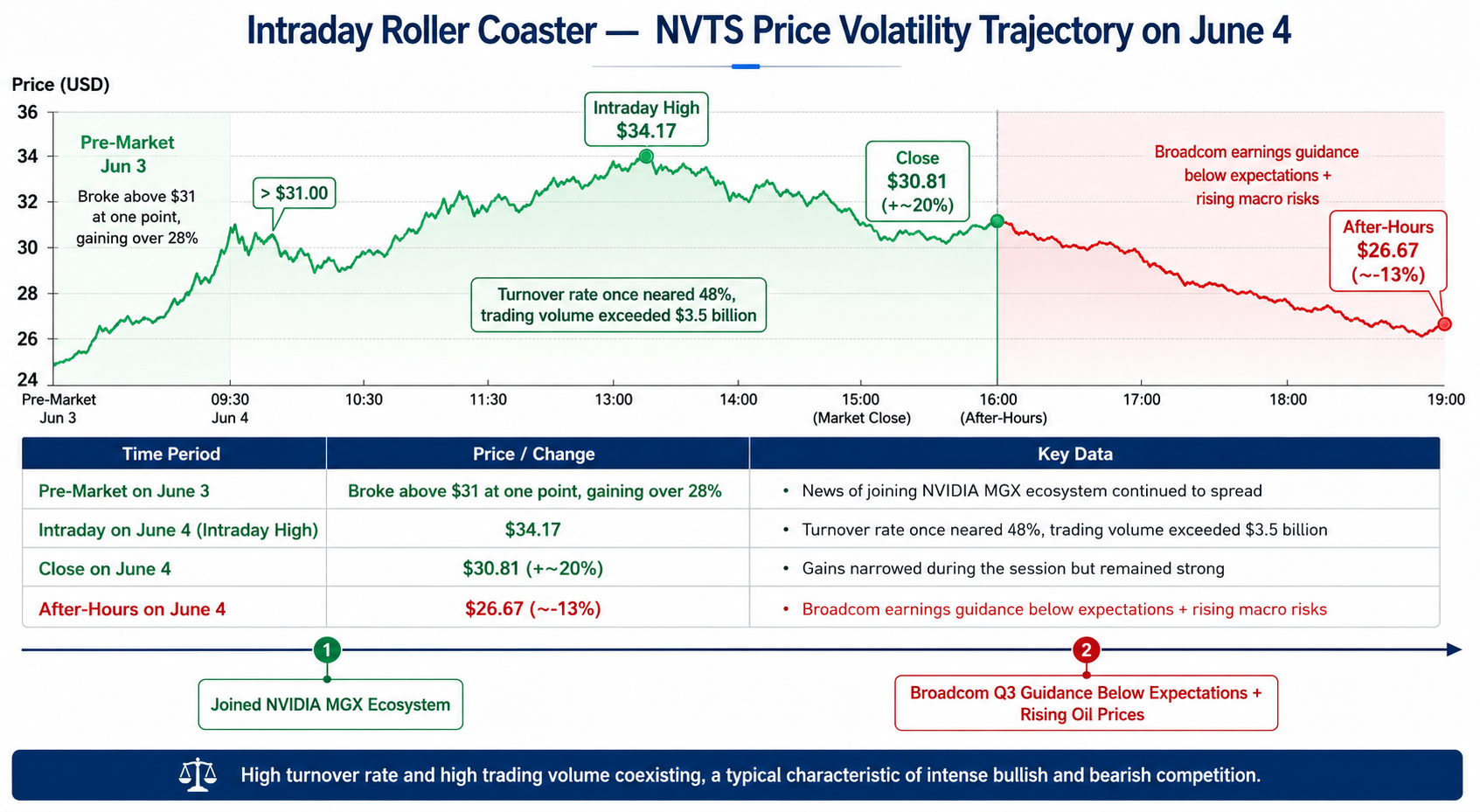
Intraday Rollercoaster—NVTS Price Movements on June 4
The expanded intraday volatility and rapid shifts between bulls and bears suggest that the market’s pricing of the same information remains unstable. Divergence is now moving beyond simple directional bets to encompass the depth of the logical narrative, valuation safety margins, and the intensity of sentiment resonance.
Strategic AI Ecosystem Integration: The Catalyst Behind the Intraday Rally
NVTS had already shown significant movement in pre-market trading on June 3, with its share price briefly breaking $31 and surging over 28%. The key catalyst: Navitas Semiconductor officially announced its inclusion in the NVIDIA MGX AI Factory ecosystem, becoming part of the NVIDIA AI Factory’s full-industry-chain stock pool.
MGX is NVIDIA’s standardized, modular reference architecture for next-generation AI factories, covering the entire spectrum from computing power and power supply to cooling and networking. Within this ecosystem, NVTS leverages its gallium nitride (GaN) and silicon carbide (SiC) power device technologies to provide efficient power solutions for NVIDIA’s new generation of AI servers and rack-level platforms, with a particular focus on supporting 800 VDC high-voltage direct current distribution architectures.
NVTS’s technology is not just theoretical. At COMPUTEX 2026, the company showcased a power distribution board designed specifically for 800 VDC architectures. Using GaNFast technology, it delivers direct step-down conversion from 800V to 6V, eliminating the need for traditional 48V intermediate bus converters. The solution achieves a peak efficiency of 97.5% and a power density of up to 2,100 watts per cubic inch. For AI data centers facing rapidly escalating power demands, systematic upgrades to power supply architecture have become a key bottleneck to scaling—this is the core rationale behind the market’s premium valuation for NVTS.
After-Hours Pullback: Is There a Shift in Fundamental Expectations?
The after-hours decline partially erased the day’s gains, prompting the market to ask: Is this a rational correction of earlier gains, or does it signal a weakening in the underlying fundamentals?
From an industry perspective, NVTS’s collaboration with NVIDIA is highly strategic and exclusive. As AI data centers shift from "compute stacking" to "system efficiency," power architecture efficiency is increasingly becoming a competitive moat. In this light, the intraday rally is underpinned by solid fundamentals, not just speculative hype.
However, the after-hours sell-off also reflects the market’s cautious stance on short-term valuations. NVTS has posted impressive year-to-date gains, with a significant gap between its 52-week low in 2025 and current levels, and volatility well above the semiconductor sector average. Investors locking in profits following positive news is largely a "buy the rumor, sell the news" pattern, rather than a fundamental rejection of the company’s story.
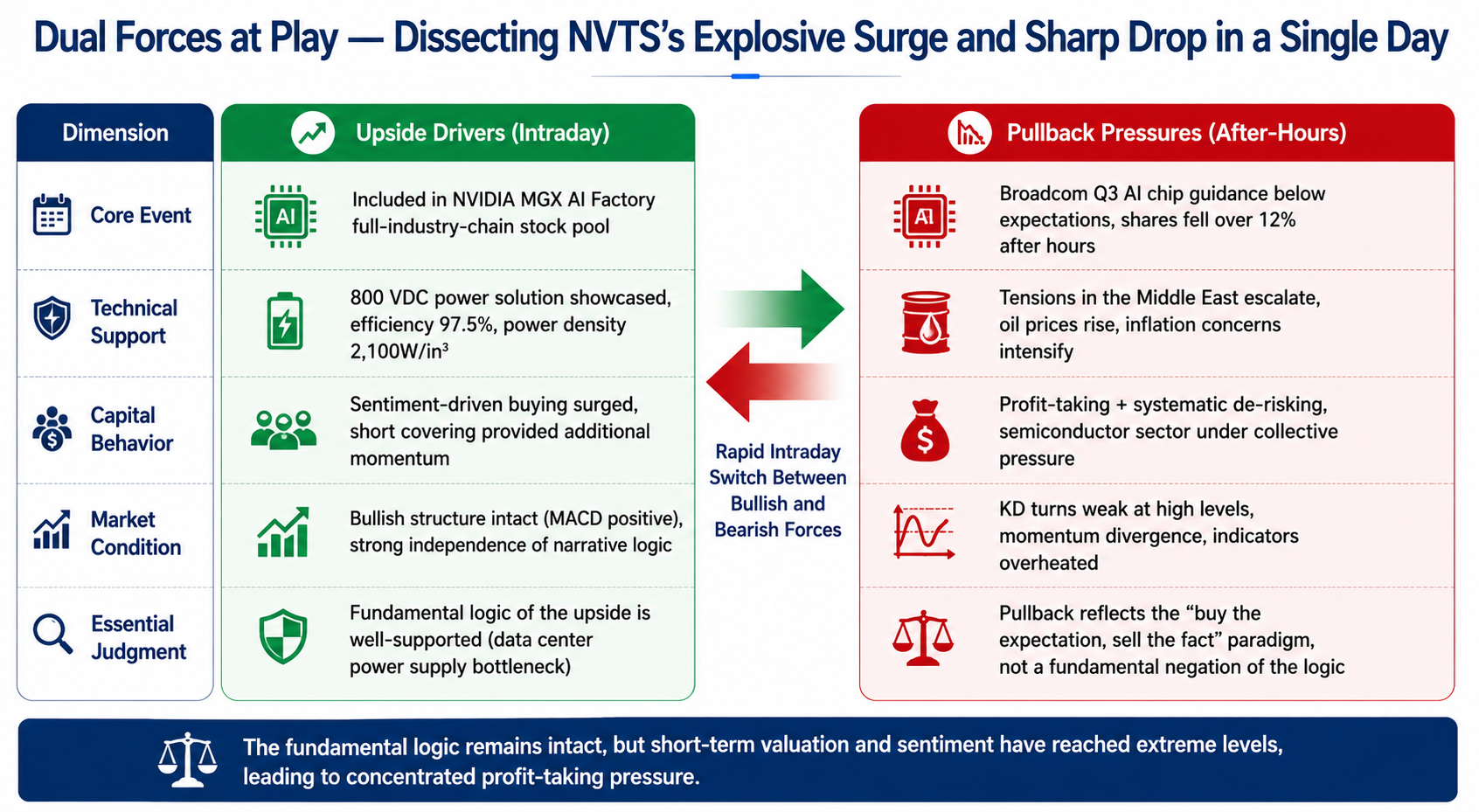
Tailwinds and Headwinds—Dissecting NVTS’s Single-Day Surge and Plunge
Macro Headwinds and Sector Divergence: External Amplifiers of Volatility?
The after-hours pullback can’t be separated from the broader macro pressures facing the US stock market.
On June 4, after the US market closed, Broadcom reported its fiscal Q2 2026 results, with Q3 AI chip revenue guidance falling short of expectations, sending its stock down over 12% in after-hours trading. Meanwhile, ongoing tensions in Iran pushed Brent crude prices sharply higher, stoking inflation fears, and tech giants like Microsoft and NVIDIA also saw notable intraday declines.
This means NVTS’s after-hours reversal was at least partially driven by two external pressures: First, sector-wide negative sentiment in semiconductors triggered by Broadcom’s guidance; second, a contraction in macro risk appetite reducing the willingness of new capital to enter the market. NVTS’s strong performance during regular trading hours reflects the independence of its narrative, while the after-hours drop is more indicative of broad-based de-risking in response to rising systemic risk premiums.
The Evolving Bull-Bear Structure: How It’s Shaping Price Action
Another key dimension of this rally is the structural shift between bullish and bearish forces. According to Wind data, NVTS hit an intraday high of $34.17, with turnover reaching nearly 48% and trading volume exceeding $3.5 billion. High turnover and volume are classic signs of intense bull-bear confrontation.
From a market depth perspective, NVTS has recently exhibited short-squeeze characteristics. Since late May, its daily K value climbed from around 50 to above 60, and the MACD indicator remained in positive territory, signaling an intact bullish structure. However, after the sharp rally, technical indicators began to show signs of overheating: the KD indicator weakened at high levels, and momentum divergence triggered selling pressure.
It’s important to note that a high short interest structure combined with weak fundamental profitability creates instability at elevated prices. Analyst reports have repeatedly highlighted risks such as persistent negative operating cash flow, high valuation, and substantial short interest. Some short covering has already occurred, but further upside requires sustained new buying—not just momentum-driven sentiment.
How Elevated Market Sentiment Influences Capital Allocation
Changes in search trends and social media discussion volumes serve as useful gauges of overheated market sentiment. While sentiment indicators differ between crypto and tech assets, NVTS has recently seen a marked rise in both community chatter and search frequency. Gate Plaza’s latest discussion data shows that NVTS has jumped from relative obscurity to become one of the most closely watched names in the AI infrastructure sector.
High sentiment alone doesn’t signal a reversal, but when both price and sentiment reach extremes, the market’s risk-reward profile can shift nonlinearly. History shows that in sentiment-driven rallies, if short-term capital loses interest, assets lacking strong fundamentals often face steeper corrections.
Can NVTS’s Fundamentals Sustain This Narrative?
Looking at a longer time horizon, the sustainability of this rally ultimately hinges on whether NVTS can translate its ecosystem partnership into measurable revenue growth and profitability.
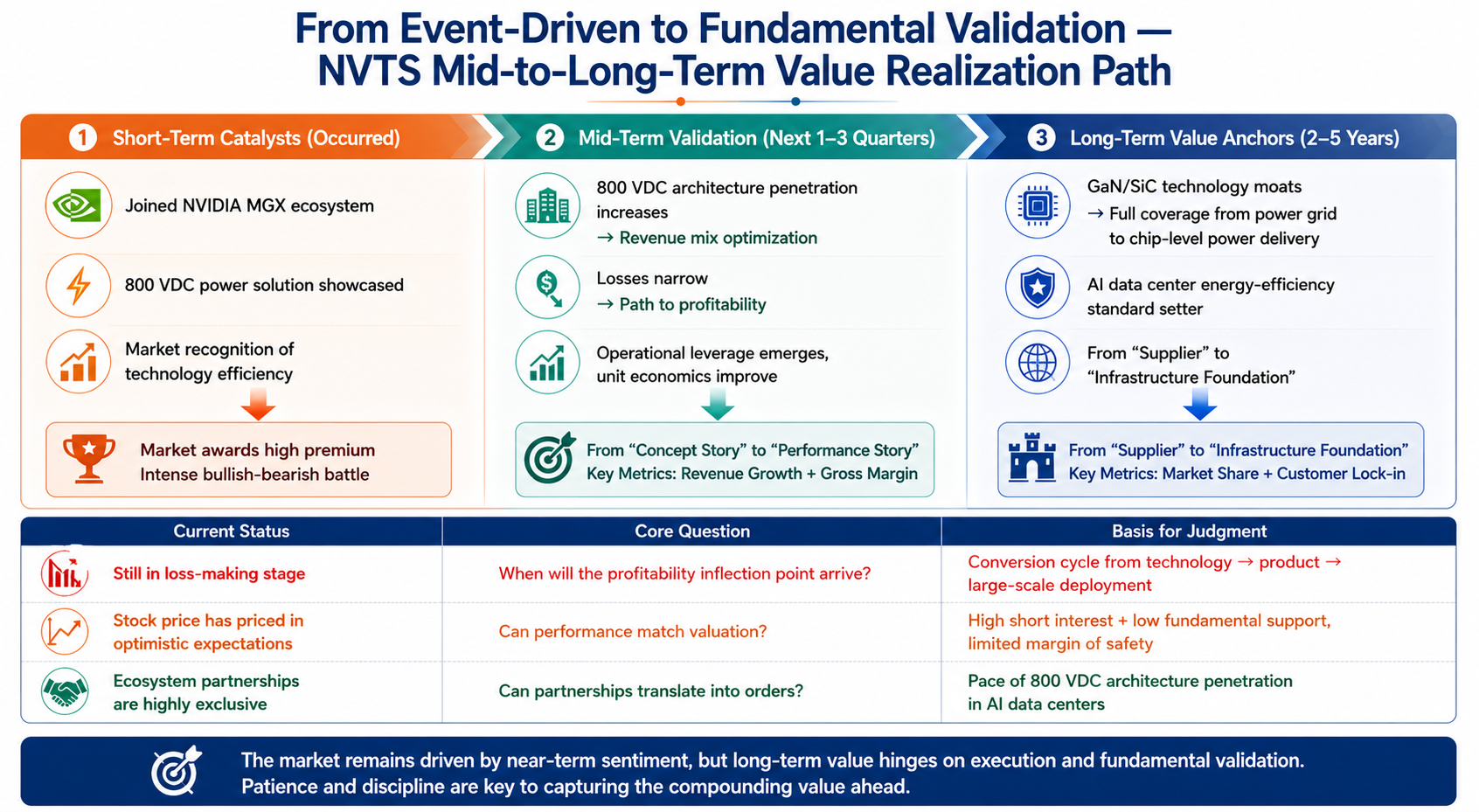
From Event-Driven to Fundamental Validation—NVTS’s Mid-to-Long-Term Value Realization Path
On the technology front, NVTS specializes in third-generation power semiconductors—gallium nitride and silicon carbide—and is one of the few independent suppliers capable of delivering end-to-end solutions from grid access to chip-level power delivery. Its product lineup includes GaNFast gallium nitride chips and GeneSiC silicon carbide solutions, offering unique positioning for high-power-density AI data center applications. The partnership with NVIDIA’s MGX ecosystem essentially provides a clear commercial pathway for this technological capability.
However, converting technology into revenue involves a full cycle from product validation and small-batch supply to large-scale deployment. Moreover, recent financial reports show the company is still operating at a loss. Investors are focused on whether, as 800 VDC architectures gain traction in AI data centers, NVTS can achieve meaningful revenue mix improvement and narrow losses over the coming quarters.
AI Infrastructure Narrative and Its Parallels in Crypto Assets
While NVTS is a semiconductor play, its price swings and value-chain logic offer useful parallels for analyzing AI-related sectors in today’s crypto markets.
Capital expenditures in AI infrastructure are increasingly characterized by "large-scale financing plus long-term growth premium," attracting significant capital away from high-volatility crypto narrative assets. For example, Alphabet recently announced an $80 billion AI infrastructure funding plan, and Berkshire Hathaway’s early investment has lent "traditional value investing" credibility to this long-term capex strategy, prompting pension, insurance, and sovereign funds to treat AI infrastructure as a defensive tech allocation for the long haul.
Within this macro capital flow framework, infrastructure suppliers with unique technological moats—especially those solving the "power bottleneck" for AI data centers—are commanding higher valuation premiums than generic concept assets. The divergence between NVTS’s intraday surge and after-hours plunge essentially reflects the market’s ongoing debate and recalibration between "AI narrative assets" and "AI infrastructure fundamental assets." This logic equally applies to crypto projects that genuinely possess computational infrastructure attributes.
Conclusion
The wild price swings of NVTS on June 4, 2026—a nearly 20% intraday surge to $30.81 followed by a roughly 13% after-hours drop to $26.67—are the result of multiple forces at play. The positive catalyst of joining NVIDIA’s MGX AI Factory ecosystem provided strong upward momentum, but after-hours trading faced sector-wide sentiment cooling, rising macro risk premiums, and profit-taking pressure from high short interest, together creating two-way volatility in the short term.
In the near term, the market will test supply-demand equilibrium in the $26–$30 range. Over the medium to long term, the key to NVTS’s fundamental validation lies in how quickly its gallium nitride and silicon carbide technologies can achieve commercial adoption in AI data centers. While the AI infrastructure narrative offers long-term momentum, with much optimism already priced in, actual fundamental progress will be the decisive factor for continued upside.
FAQ
Did NVTS’s short-term price volatility result from the broader market pullback?
Yes. In after-hours trading on June 4, Broadcom’s Q3 AI chip revenue guidance missed expectations, and heightened inflation concerns due to Middle East tensions weighed on overall sentiment in the US semiconductor sector. NVTS’s after-hours decline was, to a significant extent, a sector-wide de-risking response to rising systemic risk premiums, not solely a result of changes in its own fundamentals.
How significant is NVTS’s partnership with NVIDIA?
It’s a deep ecosystem integration, not just a customer relationship. NVTS has been added to NVIDIA’s MGX AI Factory full-industry-chain stock pool, and its power solutions directly target the 800 VDC high-voltage DC architecture—the "infrastructure foundation" of AI data centers. In terms of competitive barriers, this position is difficult to dislodge in the short term.
Can NVTS’s fundamentals support its current valuation?
The company is still operating at a loss, and a profitability inflection point has yet to arrive. Medium- to long-term investor judgment depends on two key variables: first, the pace at which 800 VDC architectures penetrate AI data centers; second, whether NVTS can translate its technological edge into quantifiable revenue growth and improved profit/loss. Much optimism is already priced in, so actual progress will be the key to sustainability.
What does NVTS’s volatility mean for AI-themed crypto assets?
It’s a useful reference. NVTS’s value proposition lies in providing "power infrastructure" for AI data centers—a critical need. Its price divergence illustrates the ongoing market debate between "AI narrative assets" and "AI infrastructure fundamental assets." This framework is equally relevant in the crypto space for AI projects with genuine computational infrastructure characteristics—during periods of heightened sentiment, it’s essential to monitor the pace of fundamental value realization.


