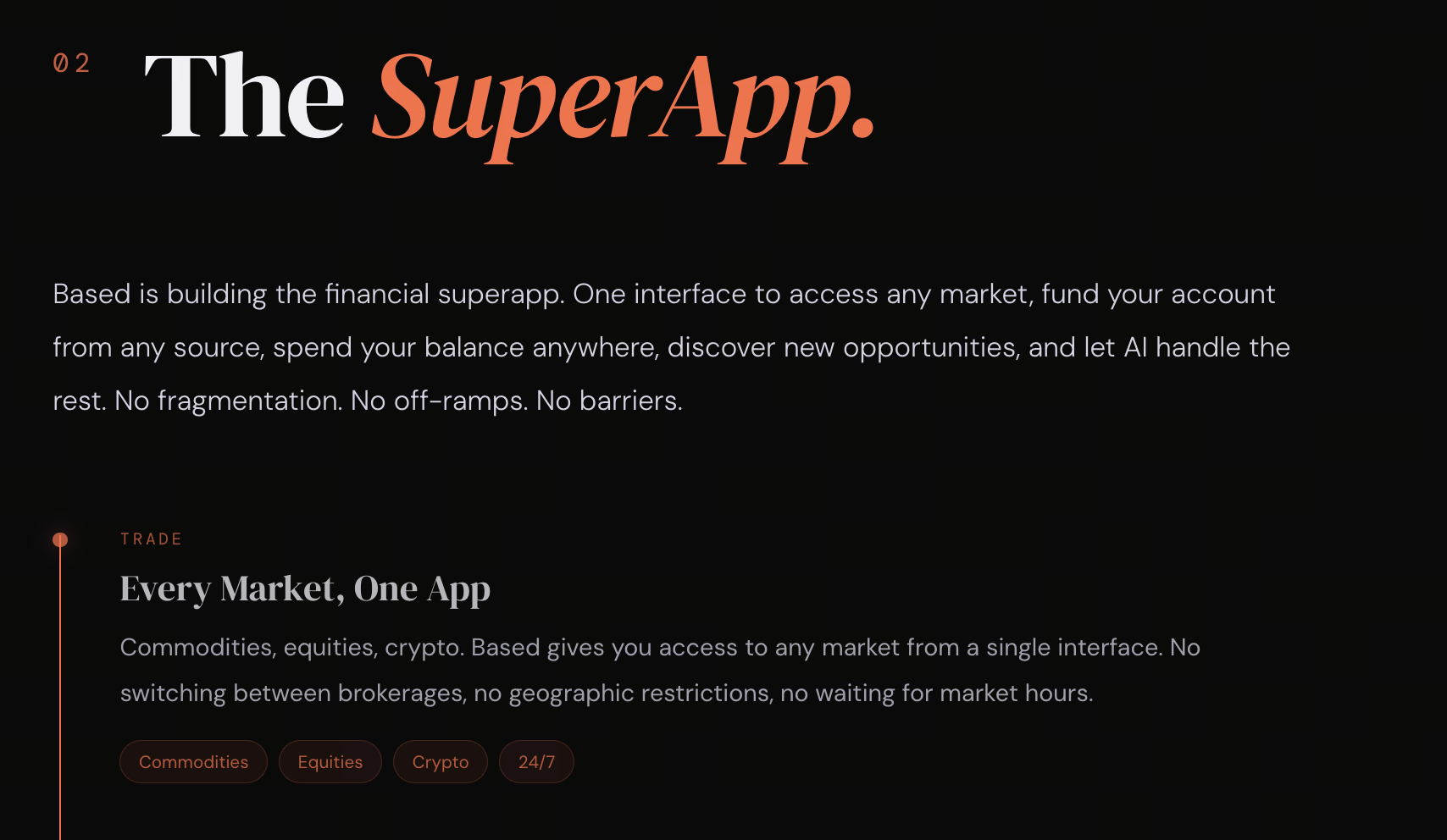
Based is a next-generation on-chain super financial app, built around Hyperliquid as its core trading and liquidity infrastructure. Rather than creating another standalone wallet or market terminal, Based leverages the Unified Account to transform the depth, speed, and composability of on-chain markets into scalable, consumer-ready products. Hyperliquid delivers the on-chain Order Book and trade execution layer, while Based drives user growth, cross-platform experiences, payment network integration, and the orchestration of commercial modules.
From an engineering standpoint, the main challenges for on-chain super financial apps are threefold: enabling order matching and risk control at on-chain scale, ensuring transparency in asset and margin models, and establishing a low-friction closed loop between on-chain returns and real-world purchasing power. Hyperliquid addresses the first two through on-chain CLOB and high-performance consensus design, while Based productizes the third by integrating card networks and unified balance semantics.
The following sections detail the division of roles and integration between Based and Hyperliquid, explain the importance of on-chain Order Book mechanisms, break down trading and payments, Perpetual Futures and Spot, prediction market integration and Visa card logic, compare these with centralized exchange models, and ultimately discuss the evolutionary direction and boundaries of the super app model.
Ecosystem Relationship Between Based and Hyperliquid
Hyperliquid functions as the protocol and infrastructure layer; Based operates as the application layer. Based’s trading experience is built on Hyperliquid’s market and matching capabilities, and it participates in the trading pipeline through mechanisms like builder code to generate sustainable revenue. This positions Based as both the user entry point and a key ecosystem builder. As frameworks like HIP-3 enable more builder-deployed Perpetual Futures markets, the relationship between application and protocol layers will increasingly resemble a “public railway network + train operator” model: the railway sets capacity and boundaries, while the operator determines product routes, customer service, and monetization strategies.
Analysis of Hyperliquid’s On-Chain Order Book Mechanism
The core advantage of the on-chain Order Book is bringing the transparency and auditability of traditional financial order books onto the blockchain. Buy and sell Maker orders, trade fills, and key risk metrics are expressed on-chain and governed by Smart Contract rules, minimizing reliance on a single operator’s opaque matching process. For Perpetual Futures, users care most about execution quality, slippage, Funding Rate, and liquidation stability. The CLOB approach delivers a more professional trading experience through high-frequency order processing and transparent Order Book depth. Hyperliquid further enhances this with proprietary chain and consensus technology, targeting latency and throughput levels that support global trading activity. The ecosystem is also evolving: HyperEVM, for example, allows applications to access native liquidity directly via Smart Contracts, expanding trading infrastructure from a single front end to a programmable suite of financial components.
How Based Integrates Trading and Payments
A super financial app’s core innovation is unified balance semantics: users no longer need to realize profits on a trading platform, switch to a banking app for withdrawal, and then use a card app to spend. Based orchestrates trading funds, Stablecoins, and spending pathways into a seamless product loop, greatly reducing the friction between “earning” and “spending.” Commercially, this aligns trading fees, builder revenue sharing, card payment interchange, and cross-border FX into parallel income streams, creating a revenue structure highly sensitive to scale. Product-wise, this demands robust compliance, risk control, and user identity systems, as payment networks impose far stricter requirements than pure on-chain transfers.
Based’s Perpetual Futures and Spot Trading Features
Within Based, users interact with a unified trading interface and account system, while Hyperliquid powers the matching and margin logic for Spot and Perpetual markets. For retail investors, differences are seen in margin, leverage, Funding Rate, and liquidation risk; for product teams, they appear in risk control reminders, order routing, fee entitlements, and cross-asset portfolio displays. As asset classes expand, the application layer must map consistent user interactions to distinct risk profiles, avoiding the pitfall of treating equity indices, commodity Perpetuals, and crypto Perpetuals as identical risk types.
Integrating Prediction Markets Into the Based Ecosystem
Prediction markets add value by commoditizing event uncertainty, enabling users to express views and manage risk through trading. For Based, incorporating prediction markets into the super app channels “macro and event-driven” demand into a unified distribution platform, increasing user engagement and cross-selling opportunities. Common engineering approaches include aggregating third-party prediction market liquidity, unifying accounts and risk controls, and enabling regional availability switches where compliant. Implementation requires careful attention to regulatory differences, disclosure, and user suitability across jurisdictions—otherwise, merging access points can increase compliance complexity rather than simply boosting user traffic.
How the Based Visa Card Works
The Visa card connects on-chain balances to the global payment network: for merchants, transactions appear as fiat payments; for users, funds are debited and converted directly from the Based balance. Typical flows include depositing or parking funds, triggering settlement and FX conversion at the point of sale, and layering in Cashback or benefit tiers. For the platform, this bridges on-chain user value to real-world payment data and interchange revenue; for users, it’s a key step in turning digital asset purchasing power into a practical product. Card products necessarily involve KYC, regional availability, fee structures, and limit rules—these terms determine whether the card can operate stably long-term, not just as a short-term marketing tactic.
How Based Differs From Traditional Centralized Exchanges
Centralized exchanges excel in fiat on/off-ramp, Customer Support, and rapid product iteration; on-chain super apps offer transparency, composability, and native on-chain asset support. Based stands out by integrating the payment loop under one brand and account, expanding competition from “trading depth” to full-chain “trading—parking—spending” user retention. The risk profile also shifts: centralized platforms concentrate counterparty and operational risk, while on-chain apps must clearly address contract, integration, bridging, and third-party dependency risks, ensuring a controllable user experience.
The Future of the Based Super App Model
Future developments will likely include stronger builder distribution, more HIP-3 ecosystem markets and app matrices, and embedding AI into trading assistance and automation. Long-term competition will focus on balancing compliance infrastructure, bank-level payment experiences, and on-chain transparency. As adoption grows, scalable interfaces between blockchain principles and real-world financial rules become essential. For industry observers, the viability of a super app ultimately depends on verifiable metrics—user base, trading volume, revenue structure, and retention—not just narrative.
Summary
Hyperliquid delivers foundational infrastructure for on-chain financial markets through its on-chain Order Book and high-performance pipeline; Based weaves trading, event-driven markets, and Visa payments into a seamless experience with its Unified Account, providing a practical blueprint for on-chain super financial apps. Understanding their boundaries and integration is the starting point for transforming the “super app” concept into real engineering and business solutions.







