ChangXin Technology (CXMT) serves as the stock abbreviation for the listed entity of ChangXin Memory in both the capital markets and Gate Futures contexts, with its core business focused on the design, manufacturing, and sales of dynamic random-access memory (DRAM). To analyze CXMT stock, it’s essential to first clarify the company’s operations, how its DRAM business generates revenue, and ChangXin’s competitive positioning within the global memory industry supply chain.
The ChangXin Technology CXMT Overview outlines three avenues for participation: A-shares, Hyperliquid Pre-IPO, and Gate Pre-market Perpetuals. This article focuses on the structure of the DRAM business and the division of labor within the industry supply chain, providing a business-level framework for understanding the fundamentals of CXMT stock. The growing demand for high-bandwidth memory driven by AI has made DRAM manufacturers’ production capacity and product mix key factors shaping the CXMT narrative during the memory supercycle.
What Is ChangXin Technology? How Does It Relate to ChangXin Memory?
ChangXin Memory Technologies is one of China’s largest DRAM manufacturers, responsible for memory chip R&D, process iteration, and wafer mass production. ChangXin Technology, as the listed or listing entity, is represented by the abbreviation CXMT in the A-share market, and serves as the primary platform for stock analysis.
The two entities have distinct roles: ChangXin Memory is responsible for DRAM manufacturing and product delivery, while ChangXin Technology, as the listed entity, consolidates financial disclosures, fundraising activities, and governance structure. When analyzing CXMT stock, it’s important not to conflate the two—operational and capacity issues pertain to ChangXin Memory, while financial reports, equity structure, and IPO progress concern ChangXin Technology.
| Entity |
Role |
Key Research Focus |
| ChangXin Memory |
DRAM R&D and manufacturing |
Products, capacity, process, market share |
| ChangXin Technology |
Listed entity / stock target |
Revenue structure, fundraising, governance, disclosures |
| CXMT (derivatives context) |
Futures ticker |
Product rules, non-equity exposure |
This table distinguishes between the manufacturing entity and the listing platform. On-chain CXMT futures track the price expectations of ChangXin Technology A-shares; holding these contracts does not confer ownership of DRAM manufacturing assets or legal shareholder rights. The Hyperliquid CXMT mechanism provides further details on contract attributes.
How Does ChangXin’s DRAM Business Generate Revenue?
The core revenue of the DRAM business comes from the combination of storage chip shipment volumes and product mix. ChangXin Memory transforms chip designs into marketable DRAM products through its wafer fabs, serving downstream customers such as server manufacturers, smartphone brands, PC makers, and AI accelerator supply chains. Revenue is driven by shipment volume, average selling price, and product mix, with the memory sector exhibiting pronounced cyclical trends.
Mature product lines (DDR4, LPDDR4) provide a shipment base, while DDR5, LPDDR5, and high-bandwidth memory drive long-term competitiveness. Fundamental analysis of CXMT stock requires breaking down the revenue contribution of each product line, rather than focusing solely on total capacity.
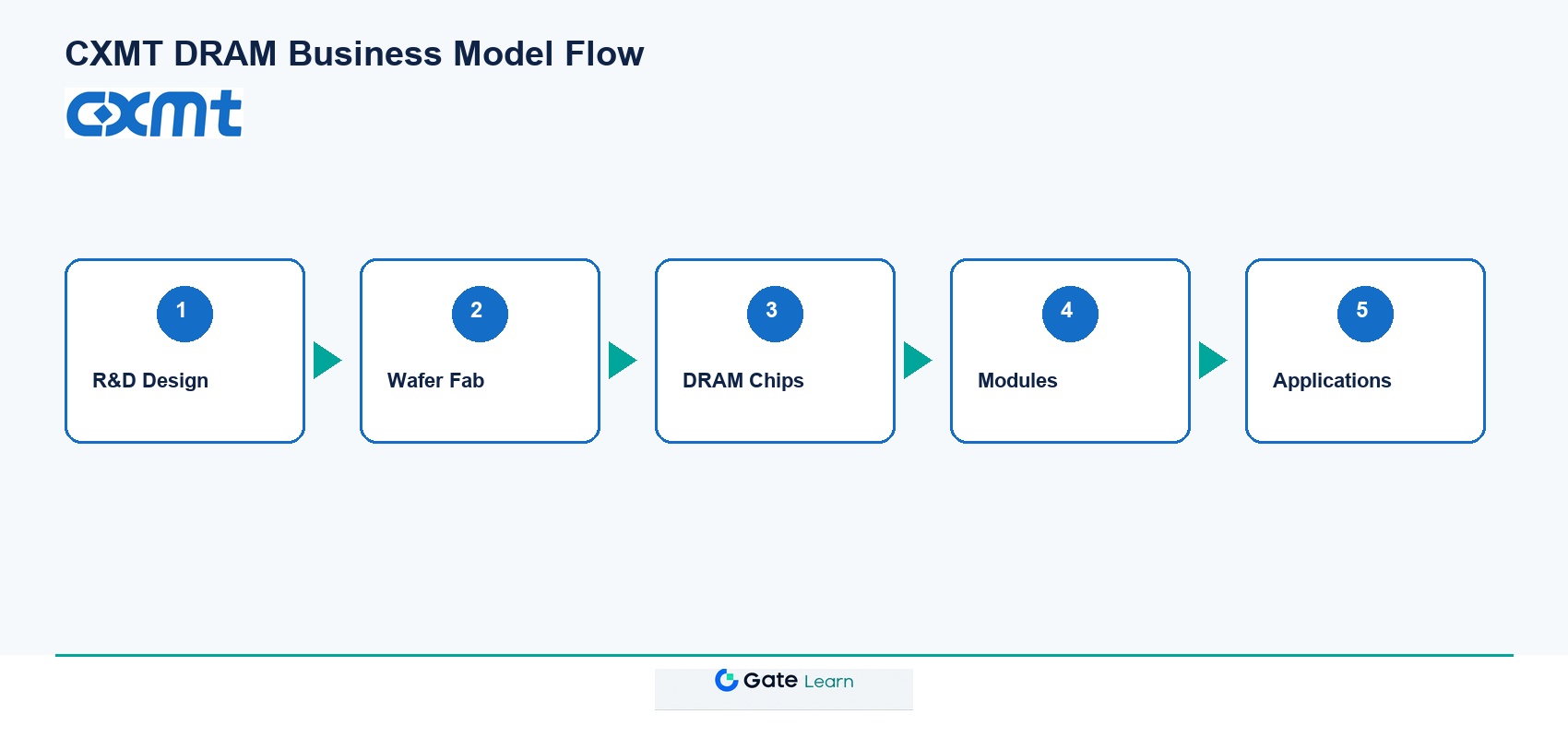 Figure 1. CXMT DRAM business model: from R&D and wafer manufacturing to product delivery and downstream applications.
DRAM manufacturing is highly capital- and technology-intensive, with yield rates and capacity ramp-up directly impacting unit costs. ChangXin’s revenue logic is similar to that of global leaders, but differs in process node, high-end product share, and equipment supply chain accessibility.
What Types of DRAM Products Does ChangXin Offer?
ChangXin Memory’s DRAM portfolio spans multiple standards and application scenarios, with each category targeting different downstream markets and exhibiting distinct price elasticity. Understanding this product matrix allows for a more concrete analysis of CXMT stock, moving beyond the generic “memory concept” to tangible products and capacity metrics.
| Product Type |
Typical Application |
Business Relevance |
| DDR4 / DDR5 |
Servers, PCs, data centers |
Mainstream DRAM, scale and cycle sensitive |
| LPDDR4 / LPDDR5 |
Smartphones, tablets, laptops |
Mobile low-power market, shipment volume tied to end demand |
| Graphics DRAM, specialty |
GPUs, dedicated devices |
Niche segments, typically a smaller share compared to standard/mobile DRAM |
The table outlines CXMT’s primary DRAM product lines, with specific models and mass production schedules subject to public disclosure. Compared to SK Hynix and Samsung in AI-centric HBM (high-bandwidth memory), ChangXin’s technological gap in high-end, high-bandwidth products is a key differentiator in the CXMT vs Samsung, SK Hynix, Micron comparison.
Where Does ChangXin Fit in the Memory Industry Supply Chain?
DRAM is positioned in the midstream manufacturing segment of the semiconductor memory supply chain: upstream dependencies include lithography, etching equipment, silicon wafers, and specialty chemicals; downstream, DRAM feeds into OEM assembly, cloud computing, and AI data centers. ChangXin Memory’s role is to convert upstream inputs into storage chips for global electronics supply chains.
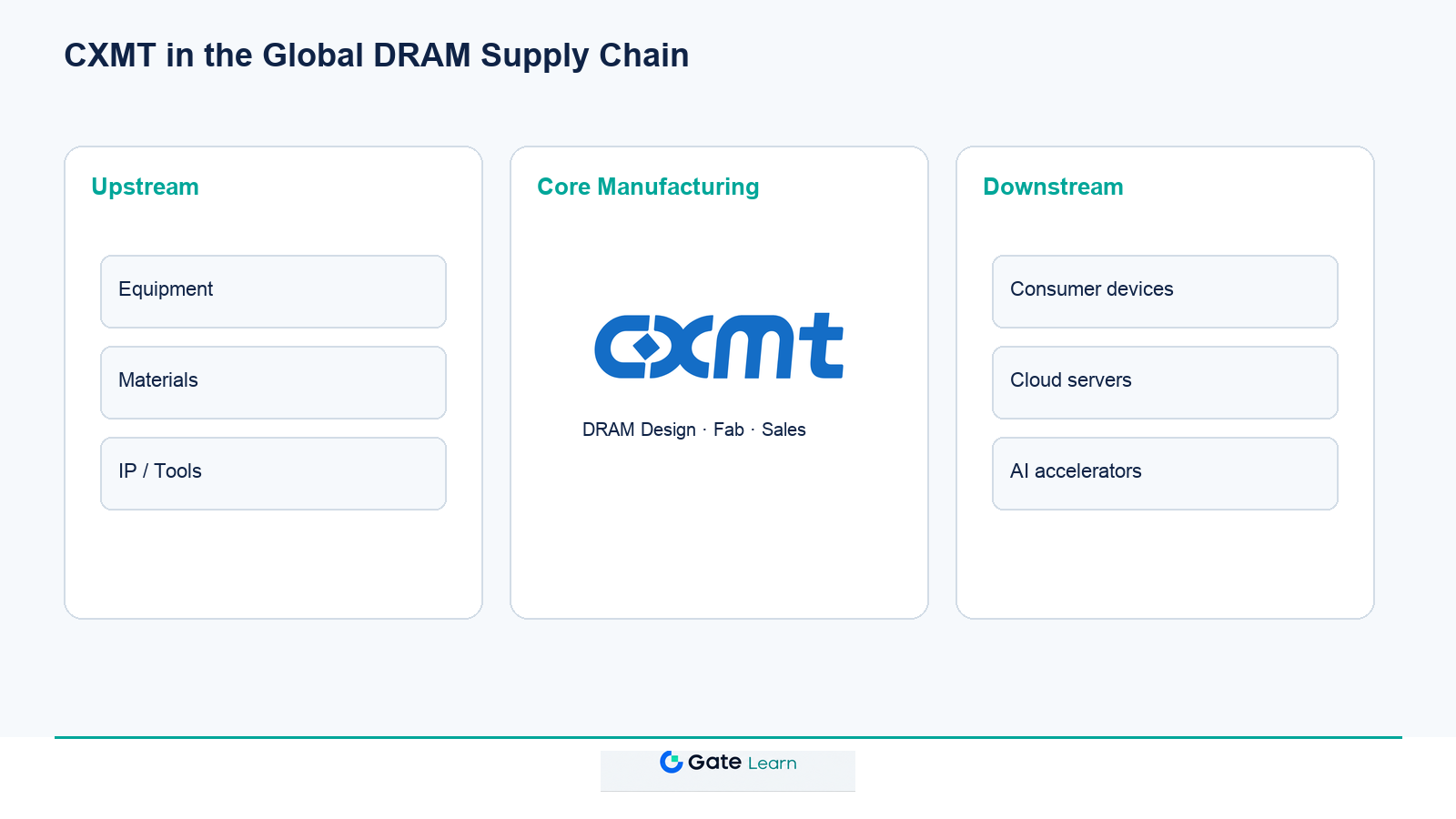 Figure 2. CXMT’s position in the global DRAM supply chain: upstream equipment and materials, core manufacturing, and downstream AI/consumer electronics demand.
Upstream equipment restrictions may delay capacity expansion, while downstream AI and smartphone shipments drive demand. As one of the few domestic players capable of large-scale DRAM mass production, ChangXin is a key figure in China’s supply chain autonomy narrative, though global competition and cyclical swings still impact its listed entity via revenue and capacity utilization.
How Should ChangXin’s Global DRAM Market Share Be Viewed?
The global DRAM market is dominated by a handful of leading manufacturers. According to TrendForce, Samsung, SK Hynix, and Micron collectively account for the majority of global DRAM supply; as a rising player, ChangXin’s market share is growing with capacity expansion, but it remains a challenger in the oligopoly landscape.
| Manufacturer |
Competitive Position |
Key Comparison Points with ChangXin |
| Samsung |
Global DRAM leader |
Full product coverage, advanced processes, HBM leadership |
| SK Hynix |
HBM and server DRAM specialist |
Core supplier for AI memory |
| Micron |
US IDM memory manufacturer |
Technology licensing, geopolitical factors |
| ChangXin Memory |
Leading Chinese DRAM supplier |
Standard DRAM expansion, still catching up in high-end segments |
Market share is dynamic, shaped by capacity, yield, product mix, and downstream customer integration. CXMT stock analysis should focus on publicly disclosed capacity plans, process developments, and product mix, rather than static rankings. When compared to SK Hynix, the focus should be on gaps in HBM and high-end server DRAM technology and revenue share, not just total revenue.
How Do ChangXin, SK Hynix, Samsung, and Micron Differ in Business Structure?
All major DRAM players operate under the IDM (integrated device manufacturing) model, controlling the full process from design to mass production. Differences emerge in process technology, HBM strategy, and customer structure. SK Hynix’s deep integration with the HBM and AI accelerator supply chain is central to the “ChangXin vs Hynix” comparison; ChangXin is expanding standard DRAM production, with high-end categories like HBM still in development. How investors can participate in ChangXin Technology explains how to distinguish among A-shares, on-chain, and Gate Futures exposures.
What Are the Key Risks and Limitations of CXMT’s DRAM Business?
Structural risks in DRAM include industry cycles, process and equipment supply chain constraints, competitive gaps in high-end categories like HBM, and changes in capacity utilization. These factors affect business fundamentals and do not constitute stock price forecasts. Derivative products such as Gate Pre-market Perpetuals introduce additional variables including contract pricing, liquidity, and platform rules, which are distinct from DRAM business risks.
Summary
ChangXin Technology (CXMT), as the listed entity of ChangXin Memory, is fundamentally driven by its DRAM business—producing standard and mobile DRAM via wafer manufacturing to supply servers, smartphones, and AI-related downstream sectors. Understanding CXMT requires distinguishing between the listed platform and the manufacturing entity, and analyzing the company within the context of the global DRAM oligopoly and supply chain. A clear business structure framework is the foundation for CXMT stock research, complemented by product-level considerations such as participation channels and contract mechanisms.
FAQ
What does ChangXin Technology (CXMT) do?
ChangXin Technology is the listed entity of ChangXin Memory, specializing in the design, manufacturing, and sales of DRAM memory chips. In the A-share market, CXMT refers to this listed platform and its stock code; analysis should focus on DRAM revenue structure, production capacity, and global competitive standing.
What is the relationship between ChangXin Memory and ChangXin Technology?
ChangXin Memory handles DRAM R&D and wafer production, while ChangXin Technology, as the listed entity, interfaces with capital markets and financial disclosures. For CXMT stock research, operational and capacity issues relate to ChangXin Memory, while equity, fundraising, and governance are the domain of ChangXin Technology.
What products are included in ChangXin’s DRAM business?
The portfolio includes standard DRAM (DDR4, DDR5) and mobile low-power categories (LPDDR4, LPDDR5), serving servers, PCs, smartphones, and AI-related devices. High-end segments like HBM remain in development relative to global leaders.
How is ChangXin’s share in the global DRAM market?
The global DRAM market is dominated by Samsung, SK Hynix, and Micron; as an emerging player, ChangXin’s market share is rising with increased capacity, but it remains a challenger. Rankings and shares should be referenced from agencies like TrendForce.
How does ChangXin’s DRAM business differ from SK Hynix?
SK Hynix has a strong presence in HBM and high-end server DRAM, closely integrated with the AI memory supply chain; ChangXin focuses on scaling standard and mobile DRAM production, with a technological gap in high-end segments like HBM. Differences are reflected in product mix and industry positioning, not just total size.
What risks should be considered when researching CXMT’s DRAM business?
Key risks include memory industry cycles, process and equipment supply chain constraints, competition in high-end categories like HBM, and shifts in capacity utilization and product mix. For derivatives, contract rules and pricing mechanisms must also be reviewed, as these risks differ from fundamental business risks.