Under the traditional stablecoin model, issuers typically keep the lion's share of reserve yields, leaving adoption-driving institutions like exchanges and payment platforms with little to show for their efforts. The Global Dollar Network (GDN) flips this dynamic by steering yield distribution toward network partners—up to 100% of reserve returns—with incremental revenue sharing tied to Mint and Accept activities. This dramatically lowers the barrier for any single platform to independently secure a stablecoin license.
From the USDG ecosystem perspective, the partner yield mechanism runs in parallel with the Paxos issuance framework and the 1:1 USD redemption rule: partners join the network through compliant channels, while end users primarily hold and transact with USDG itself. Grasping the sources and distribution boundaries of yield across these three roles is the key to understanding the rights gap between "network partners" and "ordinary token holders."
Where does GDN partner yield come from? How are reserve asset returns allocated?
USDG reserve assets are cash and cash equivalents, held in segregated accounts managed by Paxos and custodied by major banking partners like DBS. Interest or equivalent returns earned on these bank accounts form the foundational source of GDN partner yield.
Under GDN network rules, approved network partners can receive up to 100% of reserve asset returns, linked to their contributions across Hold, Mint, and Accept roles. This ratio is a significant departure from the traditional model where issuers retain most reserve yields. The exact revenue-sharing percentages, settlement cycles, and performance metrics are defined in the GDN network protocol and individual partner contracts, and may vary by role and partner type.
| Yield Tier |
Source |
Allocation Recipients |
| Base Tier |
Returns from reserve assets (cash and equivalents) |
Hold partners; share based on holdings scale |
| Incremental Tier |
Authorized minting of USDG into circulation |
Mint partners; incentivized by minting increments |
| Flow Tier |
Acceptance of USDG for payments or deposits |
Accept partners; incentivized by inbound flow |
The table above outlines the three-tier structure of GDN partner yield. The base tier targets platforms that maintain USDG balances; the incremental tier rewards minting contributions; and the flow tier incentivizes payment adoption. These tiers are cumulative—partners that simultaneously serve Hold, Mint, and Accept roles can capture network returns from multiple angles.
What is the Hold mechanism? How does holding USDG generate yield?
The Hold role is designed for institutions that hold USDG balances on their platforms. If an exchange treasury, a payment platform's settlement account, or an institutional custodial wallet registers as a Hold partner under the GDN framework, the size of its USDG holdings becomes part of the calculation basis for reserve yield distribution.
The logic is straightforward: platforms that hold USDG effectively provide liquidity and depth to the network. Keeping stablecoin balances within the ecosystem rather than immediately redeeming them helps sustain circulating supply and network activity. GDN allocates a share of reserve returns—up to the corresponding portion of 100%—based on holdings reported by partners (or verified on-chain/off-chain balances).
Hold partners typically must pass GDN admission screening, including compliance checks, KYC/AML procedures, and balance reporting obligations. Larger and more stable holdings generally earn a higher weight in the allocation formula. Hold does not require active minting or acceptance of external payments, making it ideal for platforms that already hold substantial USDG as operating capital or user assets.
What is the Mint mechanism? How does minting USDG create incentives?
The Mint role is for institutions authorized by both Paxos and GDN to convert U.S. dollars into on-chain USDG. Mint partners deposit equivalent U.S. dollars into Paxos segregated accounts, verify the reserve receipt, and then mint USDG on-chain, adding incremental supply to circulation.
Beyond the base reserve yield, the Mint mechanism provides additional revenue sharing tied to "minting increments." Each newly minted circulating USDG corresponds to an equivalent U.S. dollar in the reserve account, and Mint partners receive GDN network incentives for driving supply expansion. This design encourages exchanges, brokerages, and similar institutions to channel user deposits into circulating USDG rather than relying only on existing supply.
Mint partners must integrate the Paxos minting API and undergo compliance reviews and reserve verification. The full USDG mint and redeem flow involves Paxos accounts, on-chain contracts, and a burn mechanism. Mint partner yield is tied to minting volume, holding period, and other performance metrics defined in the network protocol.
What is the Accept mechanism? Why is accepting USDG payments valuable?
The Accept role is for platforms and merchants that accept USDG as a payment method, deposit channel, or settlement currency. When users make payments, deposits, or cross-border settlements using USDG, Accept partners earn GDN network incentives based on inbound flow—the volume of incoming USDG.
The Accept mechanism rewards "adoption scenarios" rather than "holdings scale" or "minting increments." Payment gateways, e-commerce platforms, and DeFi protocol deposit interfaces that include USDG as an accepted payment method have their processed USDG flow counted toward Accept yield distribution. This path promotes USDG circulation in real-world business and on-chain scenarios, complementing Hold and Mint.
Accept partners must register their acceptance scenarios with GDN and comply with flow reporting and compliance reviews. Accept yield is tied to inbound flow; larger and more stable flows generally lead to higher allocation weights. Accept can be combined with Hold: when a platform both accepts USDG payments and holds balances internally, it can earn returns from both the flow tier and the base tier.
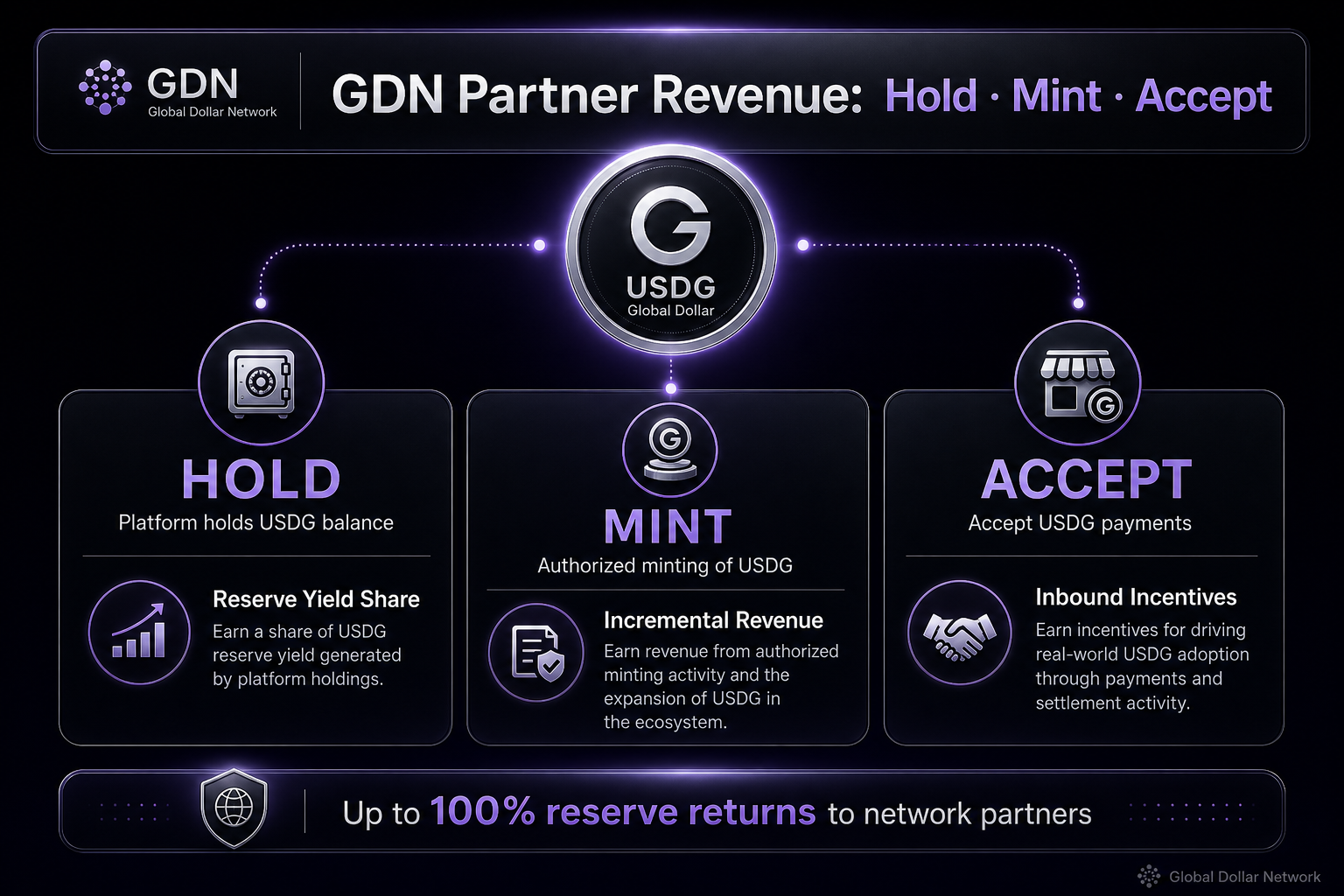 Figure 1. GDN partner revenue model: Hold, Mint, and Accept roles share reserve asset returns.
Which institutions can become GDN partners? What are the common types?
GDN network partners can be classified by function and scale into founding partners, authorized Mint institutions, Hold platforms, and Accept scenario parties. Founding partners provide initial liquidity, adoption scenarios, and compliance infrastructure during the network launch phase, while subsequent expansion opens to eligible enterprises through the Network Directory.
| Partner Type |
Typical Function |
Common Yield Path |
| Founding Partners |
Liquidity, trading, payments, issuance |
Hold + Mint + Accept combination |
| Exchanges/Brokerages |
User deposits, trading pairs, custody |
Hold, Mint, Accept |
| Payment/Merchant Gateways |
Cross-border settlement, deposit acceptance |
Accept, Hold |
| Institutional Custody |
Cold/hot wallet USDG balances |
Hold |
GDN launched in November 2024 with seven founding partners: Anchorage Digital, Bullish, Galaxy Digital, Kraken, Nuvei, Paxos, and Robinhood—covering custody, trading, payments, and retail brokerage. Eligible enterprises can apply to join the Network Directory and participate as Hold, Mint, or Accept roles, sharing reserve yield distribution and accessing Paxos's MAS and MiCA compliant issuance framework. The comparison of USDG with PYUSD and USDP further distinguishes USDG from other Paxos-ecosystem stablecoins in terms of issuance jurisdictions and network models.
Can ordinary users earn GDN reserve yield?
According to the USDG whitepaper, ordinary on-chain token holders do not directly earn interest generated by reserves—this is also a key difference between USDG and the stablecoin economics of USDC and USDT. Reserve return distribution is directed exclusively to approved Hold, Mint, and Accept partners within the GDN network, not automatically distributed to any USDG holder. The core right of end users holding USDG is the 1:1 USD redemption right, not a share of reserve yields.
Some partners may pass on network returns to end users in product form. For example, platforms like Kraken can pass reserve returns earned through the Hold role to users holding USDG on their platform via account rewards or specific product terms. This pass-through depends entirely on each partner's business decisions and product rules; it is not a mandatory obligation under the GDN or USDG protocol, and strategies may differ across platforms.
For end users, it is critical to distinguish between "holding USDG directly on-chain" and "holding or trading USDG within a GDN partner platform." On-chain self-custody only guarantees the redemption right. Whether any form of yield or reward is available must be verified against each platform's product descriptions and terms. It cannot be assumed that all USDG holders are entitled to reserve interest.
Summary
GDN partners participate in the Global Dollar Network through three roles—Hold, Mint, and Accept—earning network returns from reserve asset yields and additional incentives for Mint and Accept activities, with allocation reaching up to 100% of reserve returns. Hold measures contributions by holdings scale, Mint by minting increments, and Accept by inbound flow. Ordinary on-chain USDG holders do not directly earn reserve interest, though some partners may pass returns to platform users in product form. The seven founding partners provide the initial adoption foundation, and subsequent enterprises can join via the Network Directory according to their roles.
FAQ
What is the maximum reserve yield a GDN partner can receive?
GDN network rules allow approved network partners to receive up to 100% of reserve asset returns. The exact percentage depends on their Hold, Mint, and Accept role contributions and partner contract terms. In addition to the base allocation, Mint and Accept roles can earn extra incentives for minting increments and inbound flow.
Can Hold, Mint, and Accept be performed simultaneously?
The three roles can be engaged independently or in combination. Exchanges and similar platforms often serve Hold (holding USDG balances), Mint (authorized minting), and Accept (accepting USDG deposits) all at once, earning network returns from multiple dimensions. The specific roles a platform can take are subject to GDN admission review and Paxos authorization scope.
Can ordinary users holding USDG earn reserve interest?
According to the USDG whitepaper, ordinary on-chain token holders do not directly earn interest generated by reserves. Reserve return distribution is directed to GDN network partners. Some partners (e.g., Kraken) may pass on Hold returns as product rewards to platform users, but this pass-through is not mandatory under the protocol—users must review each platform's specific terms.
Who are the GDN founding partners?
GDN launched in November 2024. Founding partners include Anchorage Digital, Bullish, Galaxy Digital, Kraken, Nuvei, Paxos, and Robinhood, spanning institutional custody, trading, payments, and retail brokerage. Eligible enterprises can apply to join through the Network Directory.
How do Mint partners earn additional returns?
Mint partners are authorized to convert U.S. dollars into on-chain USDG, injecting incremental supply into circulation. GDN sets additional revenue sharing for minting increments to incentivize partners to drive USDG supply expansion. Mint operations require reserve verification and on-chain minting via the Paxos minting API.
How are Accept partner returns calculated?
Accept partners earn GDN network incentives based on inbound flow of USDG accepted for payments or deposits. Once payment gateways, merchant platforms, and others include USDG as an accepted method, the flow they process is counted toward Accept yield distribution. Larger and more stable flows generally result in higher allocation weights.