The fundamental distinction between Holo and Holochain is their respective layers: Holo serves as a community-driven distributed hosting and Web bridging infrastructure for Holochain applications, while Holochain is an open-source, agent-centric P2P application framework where application logic and peer validation remain at the framework level. Although the two are frequently discussed together, their roles are distinct and not interchangeable.
This division of responsibilities aligns with the "framework—hosting—payment design" structure highlighted by Holo (HOT). Understanding this distinction is essential: developers focus on application rules and validation, while hosts and guests are primarily concerned with hosting accessibility and bridging configurations. This also helps prevent the misconception that HOT is Holochain’s mining-native token.
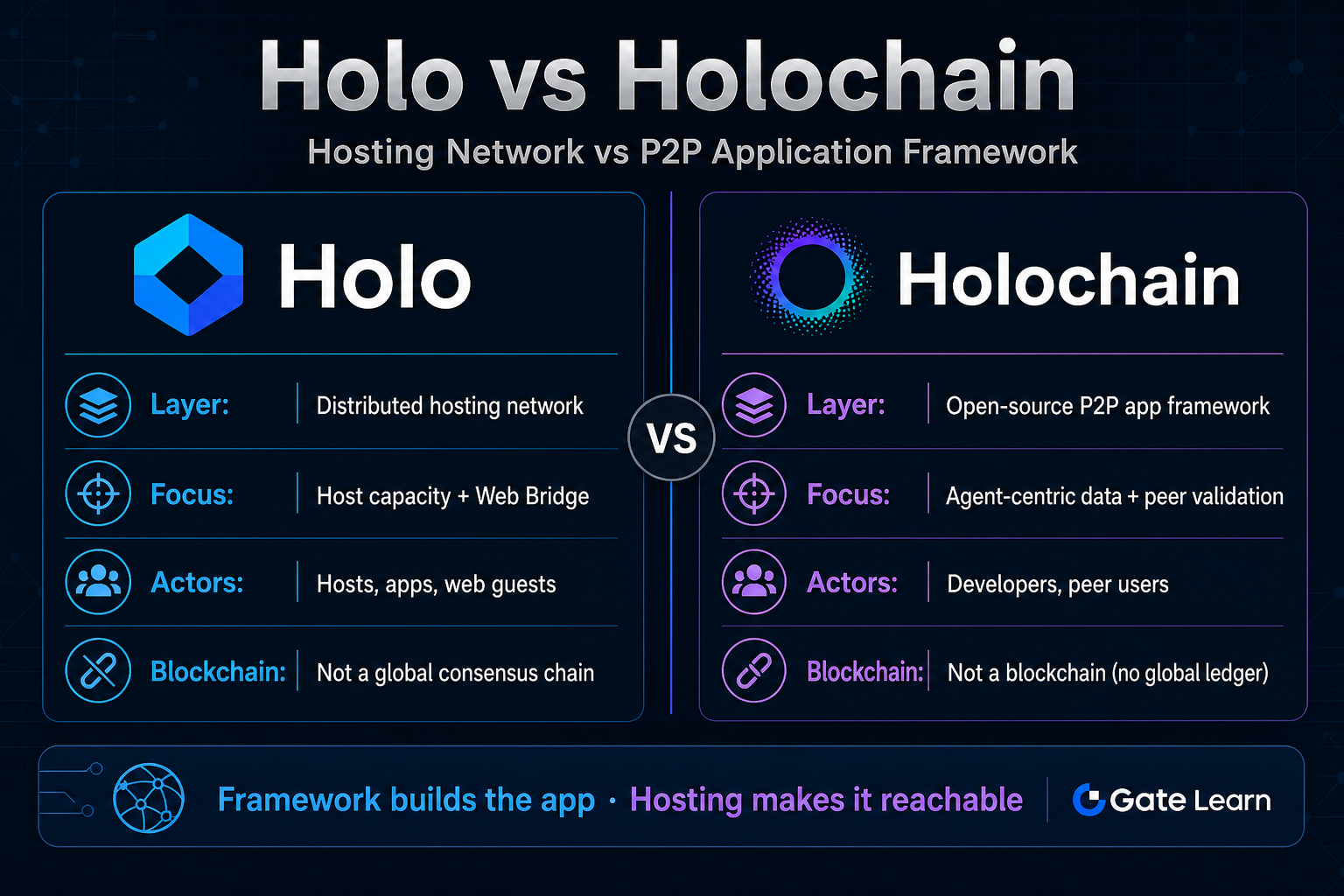
Figure 1. Comparison of Holo (hosting network) and Holochain (P2P application framework) by layer, role, and technical assumptions.
What Is Holo?
Holo operates as a community-powered distributed cloud hosting network within the Holochain Foundation ecosystem, managed by Holo Limited. Its primary function is to aggregate host capacity for Holochain applications and, through the Web Bridge, expose these capabilities to browser-based guests via standard HTTP—enabling access to public interfaces without the need for users to run a full P2P node.
Holo addresses the challenge: "Once applications run on edge data and peer validation, how can users who are occasionally online or unwilling to operate their own nodes remain reachable?" Hosting options include HoloPort hardware and software hosts; capacity and online status determine the load each host can handle. As the hosting layer, Holo does not redefine how Holochain applications are built, nor is it a separate global consensus blockchain.
What Is Holochain?
Holochain is an open-source P2P application framework designed with an agent-centric approach: data is signed and stored locally by each agent, and peer nodes validate according to application-specific rules, not global ledger consensus. Referring to Holochain as a "blockchain" is inaccurate—its technical foundation is local sharing and rule validation, not a unified on-chain state machine.
Holochain addresses the question: "How can collaborative applications function without global consensus?" Developers define DNA/application logic and validation rules within the framework; each peer maintains their own source chain. The framework layer focuses on data sovereignty and distributed collaboration; whether to make applications accessible via hosting is a separate product and infrastructure consideration.
How Are Roles Divided? Framework Layer vs Hosting Layer
In short: Holochain handles how applications are built, Holo handles how applications are hosted and made accessible to web users. Developers build and validate at the framework layer; hosts and the hosting network provide runtime capacity and bridging; web guests access public interfaces via HTTP. These two layers are independent: pure peer-to-peer scenarios can bypass Holo, and using Holo hosting does not alter Holochain’s fundamental "non-global blockchain" premise.
This collaboration is typical for products requiring both distributed resilience and browser accessibility: applications are still governed by Holochain rules, but web access depends on the Holo hosting process, including host onboarding, capacity aggregation, and Web Bridge exposure. Confusing the names leads to misunderstandings—for example, assuming that joining hosting is the same as running a public chain validator, or that browsing a web page makes you a full peer node.
Core Differences at a Glance
| Dimension |
Holo |
Holochain |
| Role / Layer |
Community-based distributed hosting and Web bridging infrastructure |
Open-source P2P application framework |
| Core Issue |
How to host and provide web access |
How to validate and collaborate without global consensus |
| Technical Assumption |
Host capacity, online status, HTTP bridging |
Agent-centric data, peer rule validation |
| Typical User Touchpoints |
Hosts, application operators, web guests |
Application developers, peer users |
| Relation to Blockchain |
Hosting/bridging layer, not another public chain |
Non-global consensus blockchain architecture |
| Common Asset Narrative |
HOT / HoloFuel relates to hosting payment design |
Framework does not rely on "on-chain mining tokens" |
This table contrasts their roles, technical assumptions, touchpoints, and blockchain relationships. Similar names do not mean they are interchangeable: deploying Holochain application logic and ensuring stable web access are distinct challenges. Token and exchange narratives should be understood in the context of the hosting economy, not as part of the framework’s definition.
Which Layer Does Each User Interact With? Developer / Host / Web Guest
Developers primarily engage with Holochain: designing application rules, data structures, and validation logic to define how collaboration occurs within the peer network. If the product must support users without a P2P client, developers will integrate Holo’s hosting and bridging during deployment and configuration, but the framework remains the source of application rules.
Hosts mainly interact with Holo: they contribute hashrate and uptime through HoloPort or software hosts, supporting application loads. Hosts do not automatically become "blockchain miners" by connecting hardware; they provide hosting capacity and availability, not global ledger block production.
Web guests typically interact only with Holo’s HTTP interface: browser requests are routed through the Web Bridge to the public features of deployed applications. This experience is similar to standard web browsing and does not mean the user is running a full Holochain node. While these roles can overlap (e.g., someone may develop and self-host), responsibilities and boundaries should remain clearly defined by layer.
What Cognitive Traps and Limitations Exist in Comparison?
Trap 1: Equating Holo, Holochain, and public chain node hosting. Public chain node hosting typically serves global ledger synchronization and RPC; Holochain does not assume global consensus, and Holo is more akin to community application hosting with web access. Trap 2: Name confusion—assuming HOT is Holochain’s "native mining token," or mistaking the framework for a hosting company product. Trap 3: Believing that holding HOT equals redeemed HoloFuel credits; intentions, licensed entities, and roadmap execution must be considered separately. Trap 4: The Web Bridge standardizes access but does not automatically centralize applications or replace data sovereignty.
On limitations: web experience depends on host capacity and bridging configuration; conceptual barriers can cause confusion with DeFi or public chain terminology; HoloFuel settlement and exchange are subject to public roadmaps and compliance constraints. When reviewing these issues, refer to mechanism explanations and Holo risks and limitations, focusing on boundaries rather than price or recommendations.
Summary
The essential distinction between Holo and Holochain is their layer: the framework determines how applications are built, while the hosting network determines how web users can access them. Holochain, as an agent-centric P2P framework, does not rely on global consensus; Holo, as the community hosting and Web Bridge layer, aggregates hosts and enables browser access. Developers, hosts, and web guests interact with different interfaces; HOT/HoloFuel narratives pertain to hosting payments and should not be conflated with framework-layer mining tokens. Clear separation of the framework, hosting, and token layers avoids most confusion regarding naming and roles.
FAQ
What Is the Difference Between Holo and Holochain?
Holochain is an open-source P2P application framework, organizing collaboration with agent-centric data and peer validation. Holo is a community-driven distributed hosting and Web bridging infrastructure, providing host capacity and browser accessibility for Holochain applications. The former addresses how applications are built; the latter addresses how applications are hosted and accessed by web users.
Is Holo a Blockchain?
Holo, as a hosting infrastructure, is not a global consensus public chain. Holochain likewise does not rely on global blockchain consensus, but on principal data and peer rule validation. Directly labeling them as "blockchain projects" can misrepresent their technical assumptions and participation models.
What Is Holo (HOT)?
Holo refers to the community-based distributed cloud hosting network and related operational entities; HOT usually refers to the ERC-20 placeholder token created in 2018, intended for future conversion to HoloFuel. The hosting network, framework, and token trading are separate layers and should be considered independently.
What Is the Purpose of the HOT Token?
HOT is designed to serve as a claim for HoloFuel credits when conditions are met; hosting services may also accept HOT as a payment method. This use case is part of the hosting economy and does not make HOT a mining-native token within the Holochain framework. Holo Limited does not operate a token exchange; any conversions must be handled by licensed entities.
Why Is Distributed Hosting Like Holo Needed?
Pure P2P applications are sensitive to end-user online quality, while many users prefer simple browser access. Holo aggregates community host capacity and connects via the Web Bridge over standard HTTP, lowering the barrier for running a full node while preserving Holochain’s application rules and data validation. When web access is needed, the hosting layer fills the gap; when it’s not, applications can still run peer-to-peer.







