In Web3 bug bounty competitions, researchers need not only expertise in smart contract security analysis but also the ability to keep pace with project updates—factors that can directly impact their chances of discovering vulnerabilities and earning rewards. As more blockchain projects continuously update their code on GitHub, real-time tracking of these changes has become a critical element of security research. BountyHunt.xyz was created to address this need, offering a comprehensive monitoring platform that integrates multiple bug bounty sources, provides real-time GitHub repository monitoring, and delivers Telegram notifications and automation integration tools to help researchers capture vulnerability research opportunities more efficiently.
Why Is Real-Time Monitoring Essential for Bug Bounty Research?
The core objective of Web3 bug bounty programs is for security researchers to proactively identify vulnerabilities in smart contracts or infrastructure before a project suffers an attack. Unlike traditional penetration testing, bug bounty programs are typically open to the public, allowing any qualified researcher to participate—making the competition fierce. Most bug bounty platforms operate on a “first to submit, first to be rewarded” basis. Even if two researchers discover the same vulnerability, only the one who submits a valid report first will be eligible for a reward, while the other’s findings may not qualify. Thus, success depends not only on technical skills but also on who can begin code analysis sooner.
Because most Web3 projects continuously update their smart contracts and related code on GitHub, every commit, pull request, or release can represent a new research opportunity. Minimizing the time between code updates and the start of research has become a key challenge for security professionals. BountyHunt.xyz was designed as a real-time monitoring platform to meet this demand.
 (Source: bountyhunt.xyz)
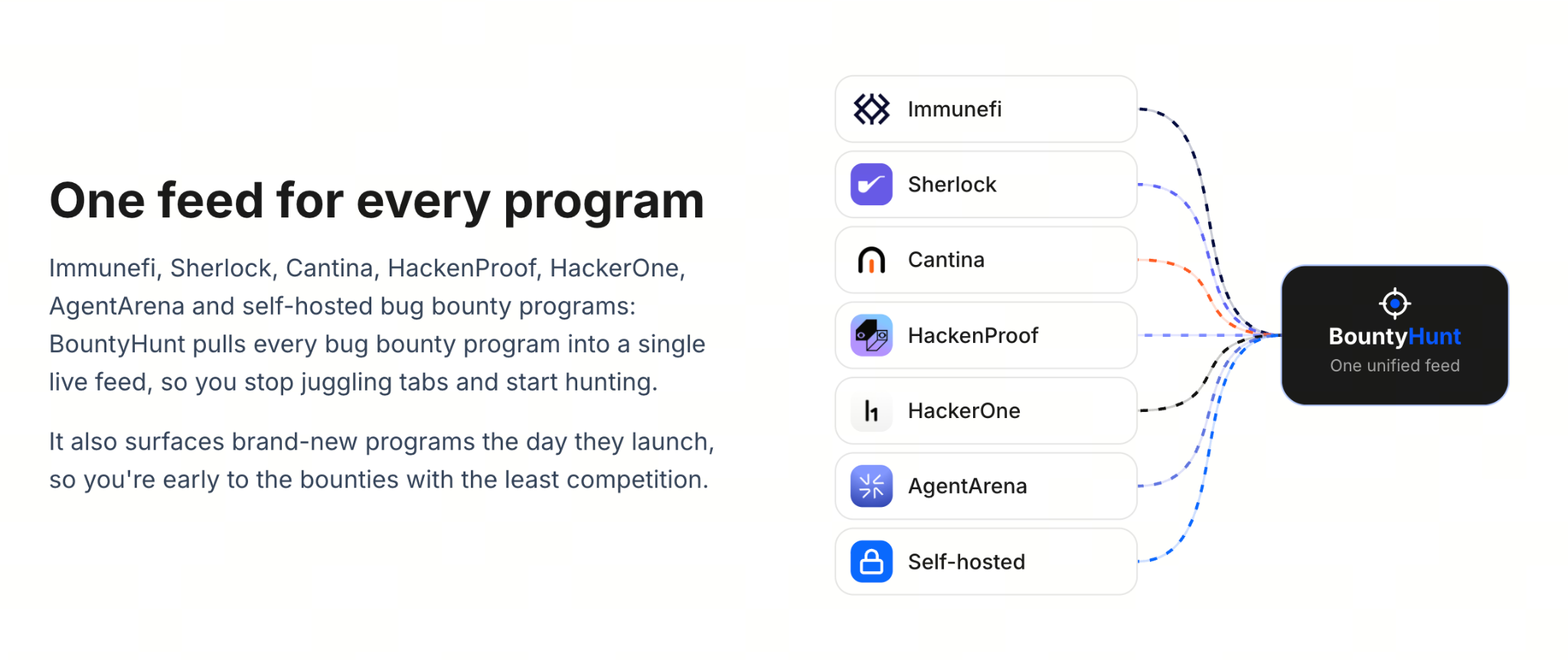
Web3 projects may use different bug bounty platforms—such as Immunefi, Sherlock, Cantina, or HackerOne—so researchers seeking more opportunities must often monitor several sites at once. BountyHunt.xyz’s first step is to consolidate publicly available bug bounty programs from multiple platforms. The platform continuously tracks new and existing programs, as well as related GitHub repositories, across all major bug bounty sites. This allows researchers to view all ongoing bug bounty activities through a single interface, eliminating the need to browse each platform individually. Centralized management not only reduces the cost of searching for information but also makes it easier to build personalized watchlists, allowing researchers to focus on projects of real interest instead of spending excessive time organizing sources.
How Does the GitHub Real-Time Monitoring System Work?
GitHub is the primary code management platform for most Web3 projects and a critical resource for vulnerability research. BountyHunt.xyz continuously monitors the GitHub repositories associated with each bug bounty program. When code changes are detected, the platform instantly synchronizes the information. Compared to manually checking GitHub at intervals, this continuous monitoring significantly reduces the time it takes for researchers to learn about important updates and helps ensure they never miss a critical change.
The platform primarily tracks the following events:
-
New commits
-
Pull request updates
-
Release publications
-
Tag version updates
While these events do not always indicate the presence of vulnerabilities, they typically reflect ongoing development or feature adjustments and may signal new code worth reviewing. For security researchers, every update can present a new starting point for analysis.
How Do Real-Time Notifications Shorten Research Response Time?
If monitoring data remains confined to the website interface, researchers must log in to check for updates, which prevents true real-time responsiveness. That’s why BountyHunt.xyz integrates its notification system with Telegram. When the system detects a project code update, it immediately pushes the relevant information to the user’s Telegram account, enabling researchers to receive updates instantly—even when away from their computers. This design is intended not just for convenience but to streamline the information delivery process. From a GitHub change to a researcher receiving a notification, there’s no need to repeatedly refresh web pages or wait for community updates; the system proactively pushes the latest information. In the highly competitive bug bounty landscape, this time advantage can allow researchers to start code analysis earlier and improve their chances of being first to submit a vulnerability report.
How Do Filtering Features Enhance Research Efficiency?
The Web3 ecosystem generates a high volume of project updates daily, and not every bug bounty program is relevant to every researcher. Security professionals may specialize in Solidity, Rust, Move, or other programming languages, or focus on certain blockchain ecosystems or high-value bounty programs. If all notifications are pushed indiscriminately, information overload can result. BountyHunt.xyz addresses this with robust filtering options, allowing users to set monitoring criteria based on their research focus. Users can filter by bug bounty platform, reward amount, project type, or programming language, ensuring notifications are highly relevant. This enables researchers to concentrate their limited time on the most valuable targets, rather than being distracted by irrelevant updates.
How Do MCP, Webhook, and API Support Automated Workflows?
 (Source: bountyhunt.xyz)
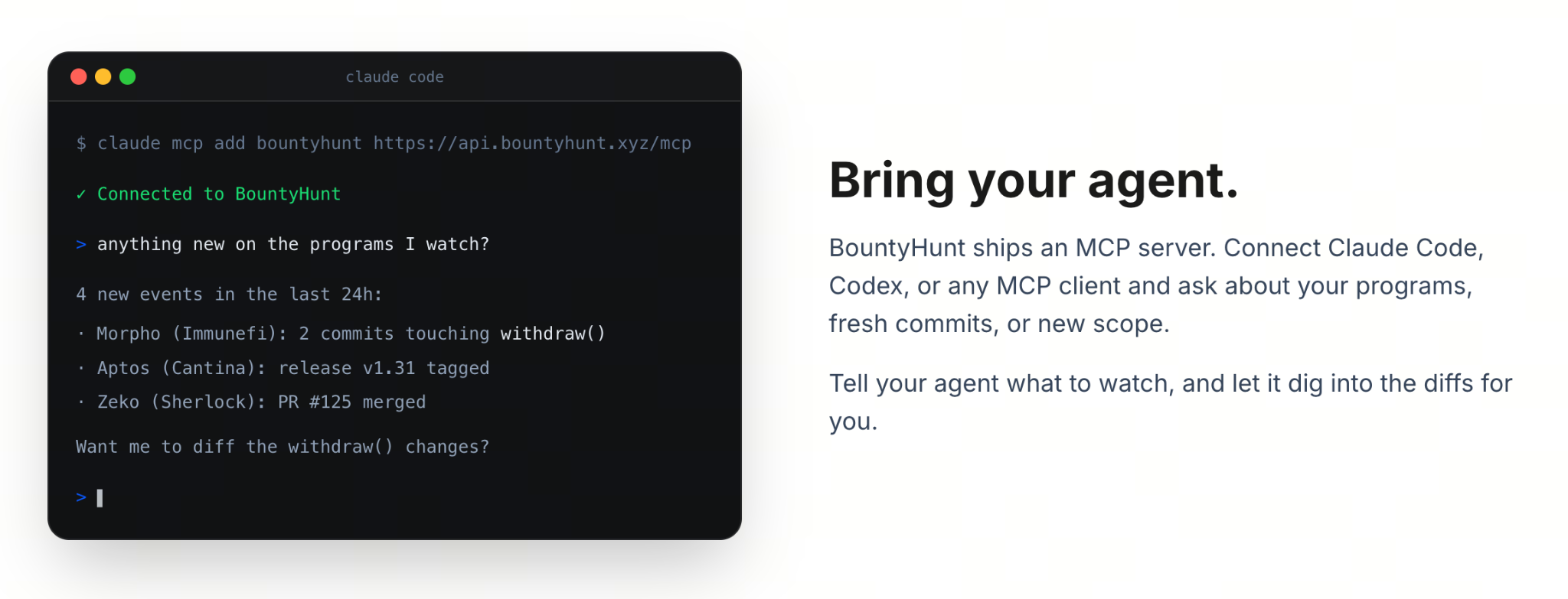
Beyond the web interface and Telegram notifications, BountyHunt.xyz offers integration options such as MCP Server, Webhook, and REST API, enabling seamless incorporation into advanced security research workflows. For example, MCP (Model Context Protocol) allows compatible AI tools to access platform data, supporting automated analysis processes. Webhooks can automatically send notifications to other services when events occur, while the REST API lets developers integrate monitoring data into their own analysis platforms, dashboards, or security tools. As AI-assisted code analysis becomes more widespread, these open integration capabilities make BountyHunt.xyz not just an information hub, but a fully integrated component of the security research workflow.
The Complete BountyHunt.xyz Workflow
BountyHunt.xyz operates through several key stages. First, the platform continuously tracks multiple bug bounty sites and public GitHub repositories, building a comprehensive monitoring list. When the system detects a commit, pull request, release, or new bug bounty event, it immediately updates the platform database. The system then filters updates based on user-defined criteria and pushes relevant notifications via Telegram. Simultaneously, Webhook, REST API, and MCP Server can synchronize this information to other tools, supporting automated workflows. Once researchers receive notifications, they can immediately analyze the latest code, assess for new vulnerabilities, and submit bug reports as soon as issues are validated. The core principle is to minimize the time between “code update” and “research initiation,” maximizing responsiveness in security research.
Traditionally, security researchers relied on manually browsing GitHub, following community channels, or periodically checking bug bounty sites for updates. While these methods provided information, inconsistent update frequencies often led to missed research opportunities. BountyHunt.xyz automates these manual processes through continuous monitoring, real-time notifications, and a suite of integration tools. The platform reduces the time researchers spend gathering information, allowing them to focus on code analysis and vulnerability discovery. As the Web3 ecosystem grows and the number of bug bounty projects increases, the importance of real-time monitoring tools will only continue to rise, making them foundational infrastructure for modern security research workflows.
Summary
BountyHunt.xyz combines real-time GitHub monitoring, bug bounty platform integration, Telegram notifications, and automation capabilities—including MCP, Webhook, and API—to deliver an information monitoring platform purpose-built for Web3 security research. While the platform does not directly assist in vulnerability analysis or guarantee outcomes, it accelerates information delivery, enabling researchers to quickly identify code updates and new bug bounty opportunities, and ultimately boosting research efficiency and responsiveness. As demand for smart contract security grows, real-time monitoring and automated integration tools are poised to become indispensable pillars of the Web3 security research ecosystem.
FAQ
Q1: What are the main features of BountyHunt.xyz?
BountyHunt.xyz is a Web3 bug bounty monitoring platform that aggregates data from multiple bug bounty sites, provides real-time GitHub repository tracking, and helps researchers quickly seize new research opportunities via Telegram notifications.
Q2: Which types of GitHub updates does BountyHunt.xyz monitor?
The platform primarily tracks commits, new pull requests, release publications, tag updates, and newly launched bug bounty programs, enabling researchers to promptly identify code changes worth analyzing.
Q3: What are the functions of MCP Server, Webhook, and REST API?
These integration tools connect BountyHunt.xyz’s monitoring data to AI tools, automated workflows, or other security analysis systems, helping researchers build a more robust Web3 vulnerability research process.