Traditional single-chain PoW only retains a single block at each height, with other competing blocks becoming orphaned and discarded. blockDAG enables multiple parallel blocks to coexist. Building on this, GHOSTDAG solves the core challenge of establishing a unique order among parallel blocks, allowing Kaspa to achieve higher throughput and shorter confirmation times while preserving the security model of PoW.
To understand GHOSTDAG, you need to grasp the blockDAG data structure, Blue/Red coloring logic, confirmation depth accumulation, and the fundamental differences from single-chain Nakamoto consensus.
What Is GHOSTDAG?
GHOSTDAG (Greedy Heaviest Observed SubTree DAG) is the consensus protocol used by Kaspa (KAS). It’s based on the GHOST concept and is part of the PHANTOM protocol family. GHOSTDAG computes a Blue Set and Red Set for each new block in the blockDAG. Blue blocks are included in the main order chain and participate in consensus, while Red blocks are processed or excluded according to specific rules. This mechanism extracts a globally consistent transaction order from a parallel block graph.
Miners still compete for block rights through PoW, using GHOSTDAG rules to select the heaviest subtree and assign block colors. New blocks maintain DAG connectivity via multi-parent references. Unlike single-chain protocols, GHOSTDAG processes the entire block graph, ordering blocks based on the Blue Set and cumulative hashrate.
| GHOSTDAG Core Elements |
Description |
| blockDAG |
Directed acyclic graph structure supporting parallel blocks |
| Blue Set |
Blocks included in the main order and consensus |
| Red Set |
Blocks in conflict with or pending for the main order |
| Heaviest Subtree |
Hashrate metric for determining the main chain direction |
| Multi-parent Reference |
New blocks reference multiple predecessors to maintain DAG connectivity |
| k-cluster |
Local clustering parameter for blue coloring |
The table above outlines key GHOSTDAG concepts. The Blue Set determines which parallel blocks are included in the ordered ledger, the heaviest subtree establishes hashrate dominance, and the k-cluster parameter sets the local consistency boundary for blue coloring.
How Does blockDAG Differ from a Single Chain?
blockDAG (block directed acyclic graph) lets each new block reference one or more existing blocks, creating a mesh of references rather than a single-parent chain. Miners can broadcast blocks within similar timeframes, and the network no longer enforces a single winner per height.
Shortening block intervals in a single chain increases orphaned blocks and wastes hashrate. blockDAG, however, allows multiple parallel blocks to coexist and be included in the final ordering. The core differences between Kaspa and Bitcoin focus on data structure, block production rate, orphan block handling, and confirmation logic: Bitcoin uses a single block per height and targets a 10-minute interval, while Kaspa supports parallel blocks and targets around 10 blocks per second.
| Category |
PoW blockDAG (Kaspa) |
Single Chain PoW (Bitcoin) |
| Data Structure |
Directed acyclic graph, multi-parent references |
Linear block header chaining |
| Block Production |
Multiple parallel blocks |
Single block per height |
| Consensus Protocol |
GHOSTDAG |
Nakamoto longest chain |
| Orphan Block Handling |
Blue/Red rules for inclusion/exclusion |
Usually discarded as orphan blocks |
| Target Block Rate |
~10 blocks/sec |
~10 minutes/block |
| Confirmation Logic |
DAG depth accumulation |
Linear block height waiting |
This table summarizes the architectural differences: blockDAG supports parallel recording, while GHOSTDAG establishes the ordered ledger.
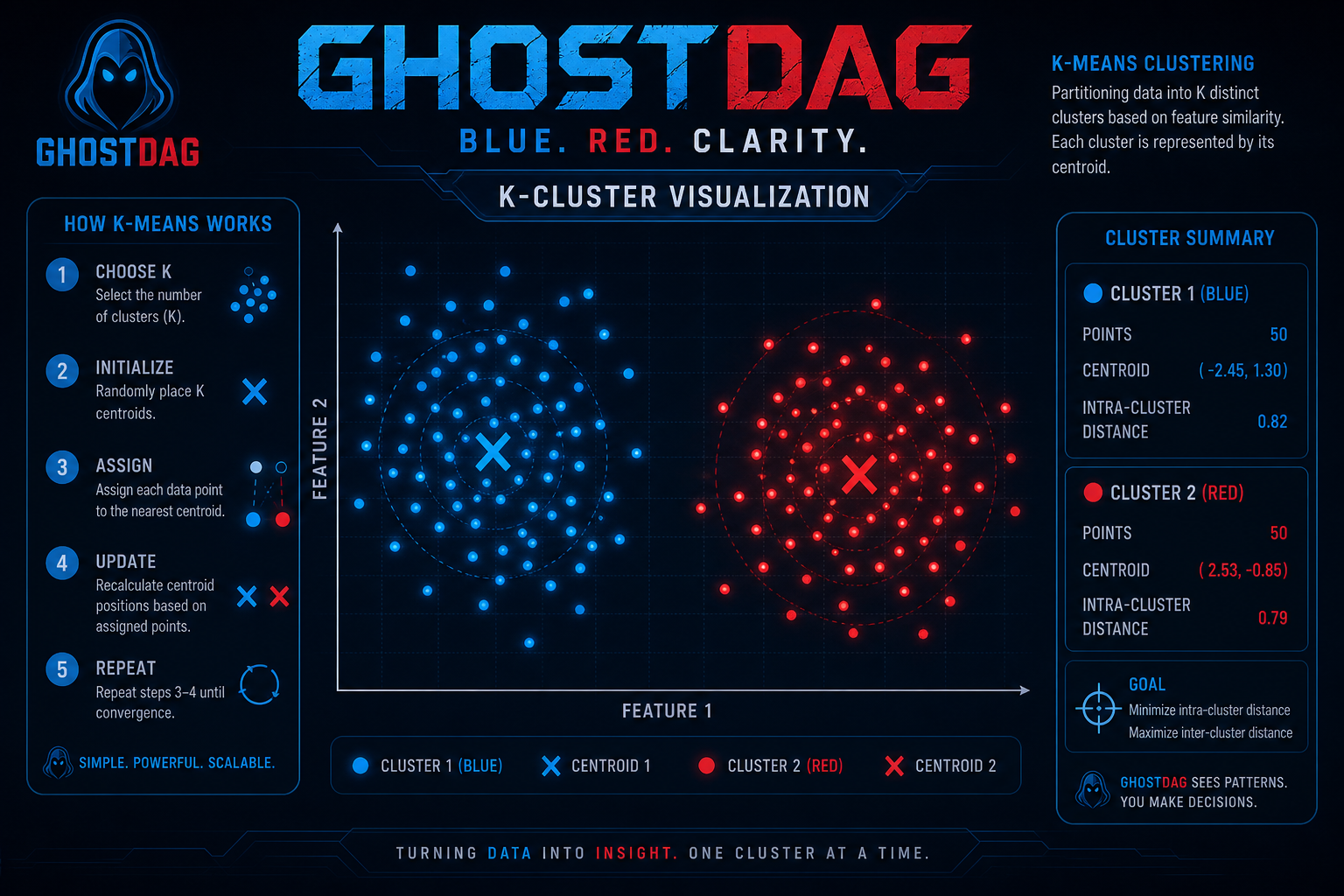
Figure 1. GHOSTDAG classifies blocks as Blue or Red in the blockDAG, with the k-cluster parameter defining the local clustering boundary for the Blue Set.
How Do Blue/Red Blocks and k-cluster Work?
GHOSTDAG assigns a blue or red label to each block in the blockDAG. Blue blocks are included in the main order chain and their transactions are executed globally; red blocks conflict with the blue main order and are usually not included, though some transactions in red blocks can still be indirectly confirmed by subsequent blue blocks.
The k-cluster parameter is essential for blue coloring, defining the local clustering boundary. When a new block joins the DAG, GHOSTDAG checks its ancestor subgraph: if too many parallel competing blocks appear within a blue block’s k-cluster range, subsequent conflicting blocks are marked as red. A larger k-cluster increases tolerance for parallel blocks, while a smaller k-cluster narrows the main order chain.
Blue blocks are included in the main order chain for global transaction execution; red blocks, in conflict with the main order, are usually excluded, though some transactions may be indirectly confirmed by later blue blocks. The cumulative hashrate of blue blocks forms the heaviest subtree, which determines the global main order direction.
How Is Confirmation Depth Accumulated?
In single-chain PoW, confirmation depth is typically measured as the difference between the current height and the block height containing the transaction; each new block reduces the risk of reorgs. In Kaspa, confirmation depth is based on the DAG structure: after a transaction’s blue block, a sufficient number of subsequent blue blocks must be added for the confirmation to stabilize.
Kaspa targets about 10 blocks per second, so the DAG extends by roughly 10 new blocks per second, making confirmations much faster than the minute-level waits of single-chain PoW. Full nodes (RustyKaspa) verify PoW, parent references, Blue/Red coloring, and UTXO consistency; most wallets count confirmations by blue block depth. KAS tokenomics and mining with KHeavyHash mining and block rewards incentivize DAG extension.
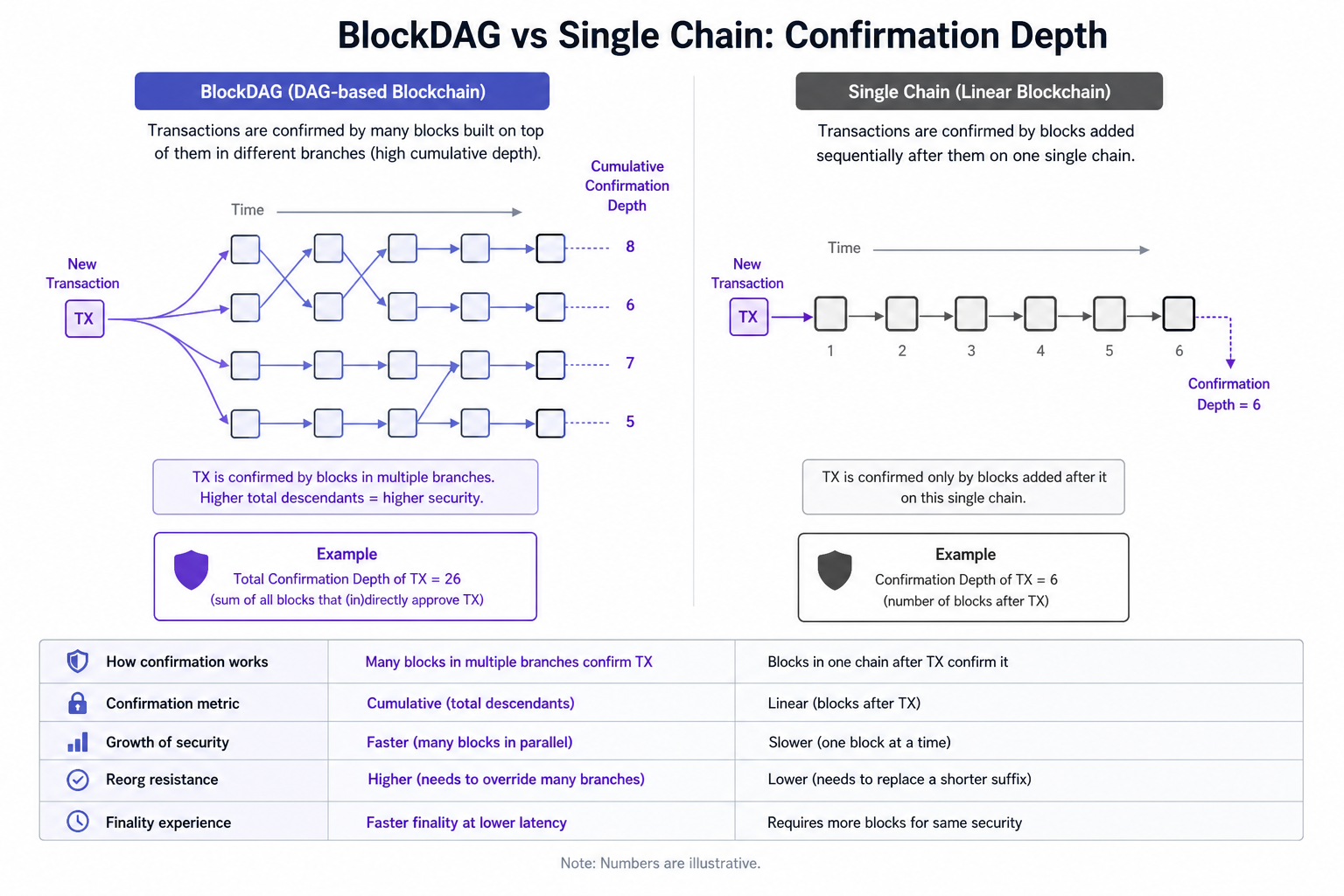
Figure 2. blockDAG confirmation depth accumulates as the blue chain extends, compared with the linear waiting model of single-chain PoW.
| Confirmation Metric |
blockDAG (Kaspa) |
Single Chain PoW |
| Depth Measurement |
Number of subsequent blue blocks |
Block height difference |
| Block Frequency |
~10 blocks/sec |
~10 minutes/block |
| Parallel Tolerance |
Multiple blocks valid at once |
Single block per height |
| Reorg Risk |
Depends on DAG coloring and propagation |
Depends on longest chain switch |
This table compares confirmation logic in both systems. DAG depth accumulation gives Kaspa a structural advantage for faster confirmation, but actual speed still depends on network propagation quality.
What Are the Ideal Use Cases for PoW blockDAG and GHOSTDAG?
PoW blockDAG and GHOSTDAG are ideal for scenarios requiring fast confirmations while maintaining the PoW security model and fair launch principles. Kaspa is positioned as a Layer 1 settlement layer, with KAS used for transaction fees and miner rewards. The network features a fair launch with no premine. High-frequency, small-value payments are a typical use case: shorter confirmations bring peer-to-peer transfers closer to real-time settlement, while parallel block production offers more reward opportunities for miners.
For applications requiring robust account models, complex smart contracts, or a mature DeFi ecosystem, Kaspa mainnet still has limitations. blockDAG integration with wallets and explorers is more complex than with traditional single-chain systems.
What Are the Limitations of PoW blockDAG and GHOSTDAG?
Parallel propagation dependence: High block rates demand greater network bandwidth and propagation speed; under extreme delays, reorgs or color reclassification can occur.
Integration complexity: Explorers and wallets must adapt to DAG coloring logic, making development more challenging than for single chains.
Ecosystem maturity: DeFi and smart contract infrastructure are still developing; cross-chain solutions like wKAS introduce bridge risks.
Storage pressure: With about 10 blocks per second, data grows rapidly—full node costs require ongoing assessment.
Hashrate concentration: PoW chains remain theoretically vulnerable to 51% attacks; GHOSTDAG changes only fork handling, not the risk of hashrate centralization.
Summary
GHOSTDAG transforms a parallel block graph into an ordered ledger through Blue/Red classification and k-cluster parameters. Confirmation depth accumulates as the blue chain extends. Compared with single-chain consensus, blockDAG supports multiple valid parallel blocks with a target rate of about 10 blocks per second. These advantages come with trade-offs in network propagation, integration complexity, and ecosystem maturity.
FAQ
What Is blockDAG?
blockDAG is a directed acyclic graph structure where each block can reference multiple predecessors, enabling miners to produce blocks in parallel. Kaspa uses PoW blockDAG, allowing multiple valid blocks to coexist in the same timeframe, with GHOSTDAG consensus imposing a global transaction order on parallel blocks.
What Is GHOSTDAG Consensus?
GHOSTDAG is the consensus protocol Kaspa uses on blockDAG, part of the PHANTOM protocol family. GHOSTDAG sorts parallel blocks using Blue Set and heaviest subtree rules; blue blocks are included in the main order chain, while red blocks are handled according to conflict rules, allowing PoW networks to boost throughput while maintaining security.
What’s the Difference Between Blue and Red Blocks?
Blue blocks are included in the GHOSTDAG main order chain, with transactions executed globally and eligible for block rewards. Red blocks conflict with the blue main order and are usually excluded, though some transactions may be indirectly confirmed by later blue blocks. The k-cluster parameter controls the local clustering boundary for blue coloring.
How Fast Are KAS Transaction Confirmations?
Kaspa targets about 10 blocks per second, and confirmation depth accumulates as the blue chain extends—usually much faster than the minute-level waits of traditional single-chain PoW. Actual confirmation time is influenced by hashrate distribution, network propagation, node sync status, and transaction fees.
What’s the Difference Between Kaspa and Bitcoin?
Bitcoin uses a single-chain structure with a 10-minute block interval, and competing blocks typically become orphaned. Kaspa employs PoW blockDAG for parallel block production, with GHOSTDAG ordering parallel blocks into a ledger, targeting about 10 blocks per second and using the KHeavyHash mining algorithm instead of SHA-256.
What Are the Limitations of blockDAG?
High block rates require stronger network propagation and node bandwidth. blockDAG integration is more complex than with traditional single chains. The application layer is less mature than account-model chains like Ethereum. On-chain data grows more quickly, increasing full node storage demands. PoW hashrate concentration risk remains.







