Blockchain consensus requires every validator to repeatedly execute identical computations, making direct, on-chain processing of complex logic both costly and constrained. The value of zkVM is in shifting execution off-chain, with only a succinct proof verified on-chain, thereby breaking through the computational ceiling of individual transactions.
As the universal execution layer for Brevis (BREV) verifiable computation, Pico zkVM leverages a glue-and-coprocessor architecture that balances flexibility and performance, offering a unified programming and proof toolchain for data processing, signature verification, machine learning inference, and Ethereum block proof scenarios.
What Is Pico zkVM?
Pico zkVM, serving as Brevis’s universal verifiable computation execution layer, merges "program writing" and "proof of correct execution" into a single open-source toolchain. Developers can describe computation logic in Rust without designing low-level circuits; Pico handles off-chain execution and proof generation.
Modularity operates on two levels: the universal core can execute any program, while pluggable dedicated coprocessors are optimized for high-frequency operations. This design enables Pico to support broad computations and approach the performance of specialized circuits for critical operations, avoiding the typical "flexible but slow" limitations of general-purpose zkVMs.
What Is the Glue-and-Coprocessor Architecture?
The glue-and-coprocessor architecture is central to Pico zkVM’s design: a universal core acts as "glue," connecting the entire program flow, while computation-intensive, high-frequency tasks are delegated to dedicated coprocessors or precompiled circuits.
The universal RISC-V core executes any Rust program, ensuring flexibility. When the program encounters operations like Keccak-256 hashing, signature verification, machine learning inference, or blockchain data processing, Pico routes these tasks to specialized circuits, bypassing the need for proof generation on each RISC-V instruction.
Instruction-level proofing is resource-intensive and represents the primary bottleneck for general-purpose zkVMs. By substituting this process with circuits optimized for zero-knowledge proofs, Brevis reports proof speeds improve by approximately 10x to 80x, dramatically reducing proof costs without sacrificing versatility.
How Do the Universal Core and Dedicated Coprocessors Work Together?
The universal core and dedicated coprocessors combine "flexible execution" with "efficient proof": the core handles any logic, while coprocessors accelerate high-frequency operations.
| Component |
Role |
Computation |
Proof Method |
| Universal RISC-V Core (Glue) |
Glue Layer |
Any Rust program flow |
Instruction-level proof |
| Keccak-256 Precompiled Circuit |
Dedicated Coprocessor |
Hash computation |
Optimized circuit |
| Signature Verification Coprocessor |
Dedicated Coprocessor |
Signature validation |
Optimized circuit |
| ML Inference Coprocessor |
Dedicated Coprocessor |
Machine learning inference |
Optimized circuit |
| Blockchain Data Coprocessor |
Dedicated Coprocessor |
On-chain/historical data processing |
Optimized circuit |
As shown above, the universal core ensures Pico can execute any program, while dedicated coprocessors transform high-frequency operations—hashing, signature verification, ML inference, and data processing—from instruction-level proofing to whole-circuit proofing. Routing is handled automatically, so developers rarely need to manually switch execution paths.
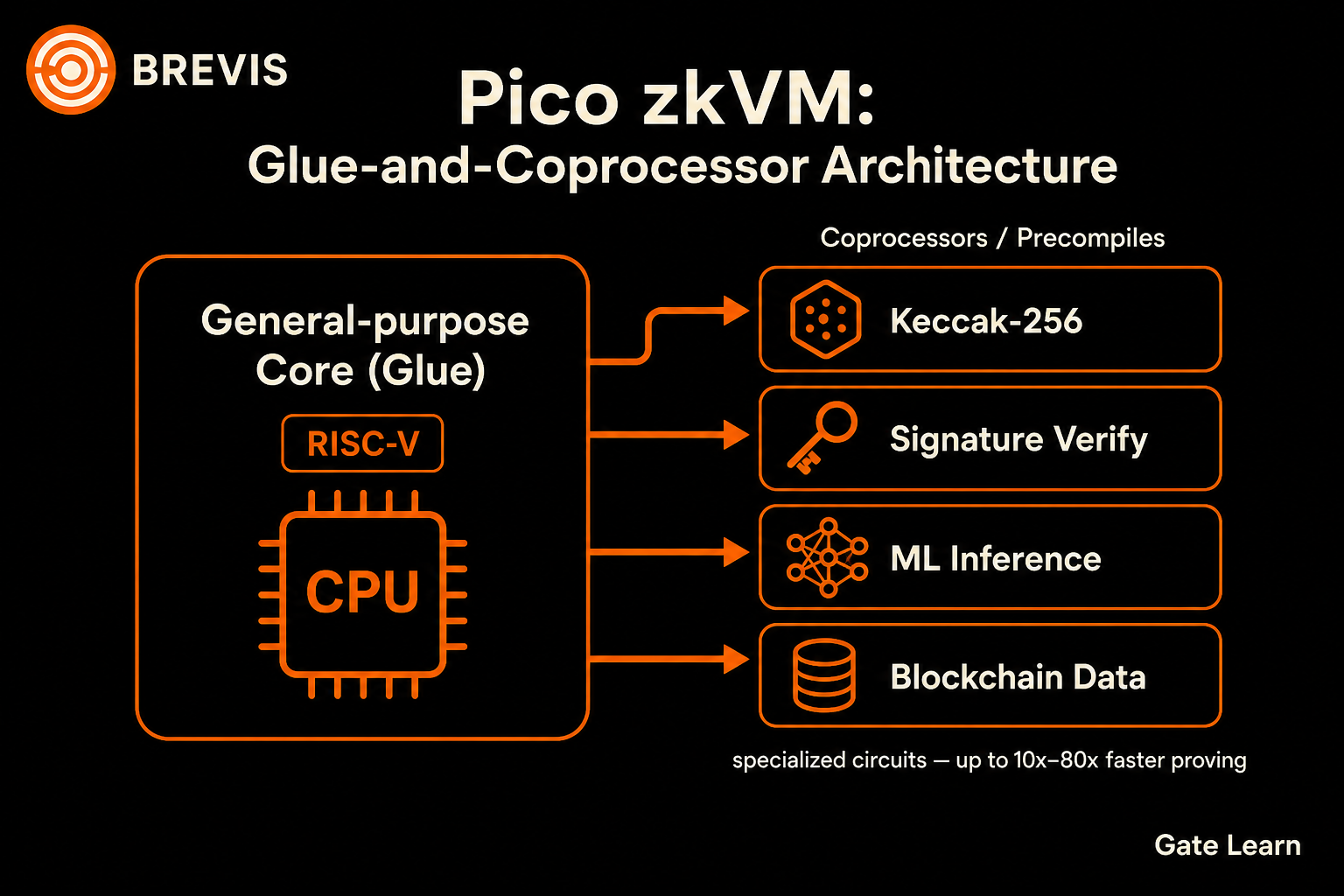
Figure 1. Pico zkVM glue-and-coprocessor architecture: The universal RISC-V core (glue) executes any program, routing Keccak-256, signature verification, ML inference, and blockchain data tasks to dedicated coprocessors or precompiled circuits.
How Can Developers Build Verifiable Programs with Pico?
Pico’s development workflow centers on "off-chain execution, on-chain verification" in four steps: write computation in Rust, Pico executes off-chain and produces results, generate a cryptographic proof of correct execution, and finally, a smart contract verifies the concise proof on-chain.
The critical step is the final one: on-chain contracts verify the proof, not the entire program. Verifying a succinct proof takes only milliseconds and is largely independent of the original computation’s scale, allowing complex logic to be validated on-chain at minimal cost.
For developers, Pico lowers the zero-knowledge development barrier by using Rust. There’s no need to master circuit design to create verifiable programs—cryptographic complexity is contained within the toolchain.
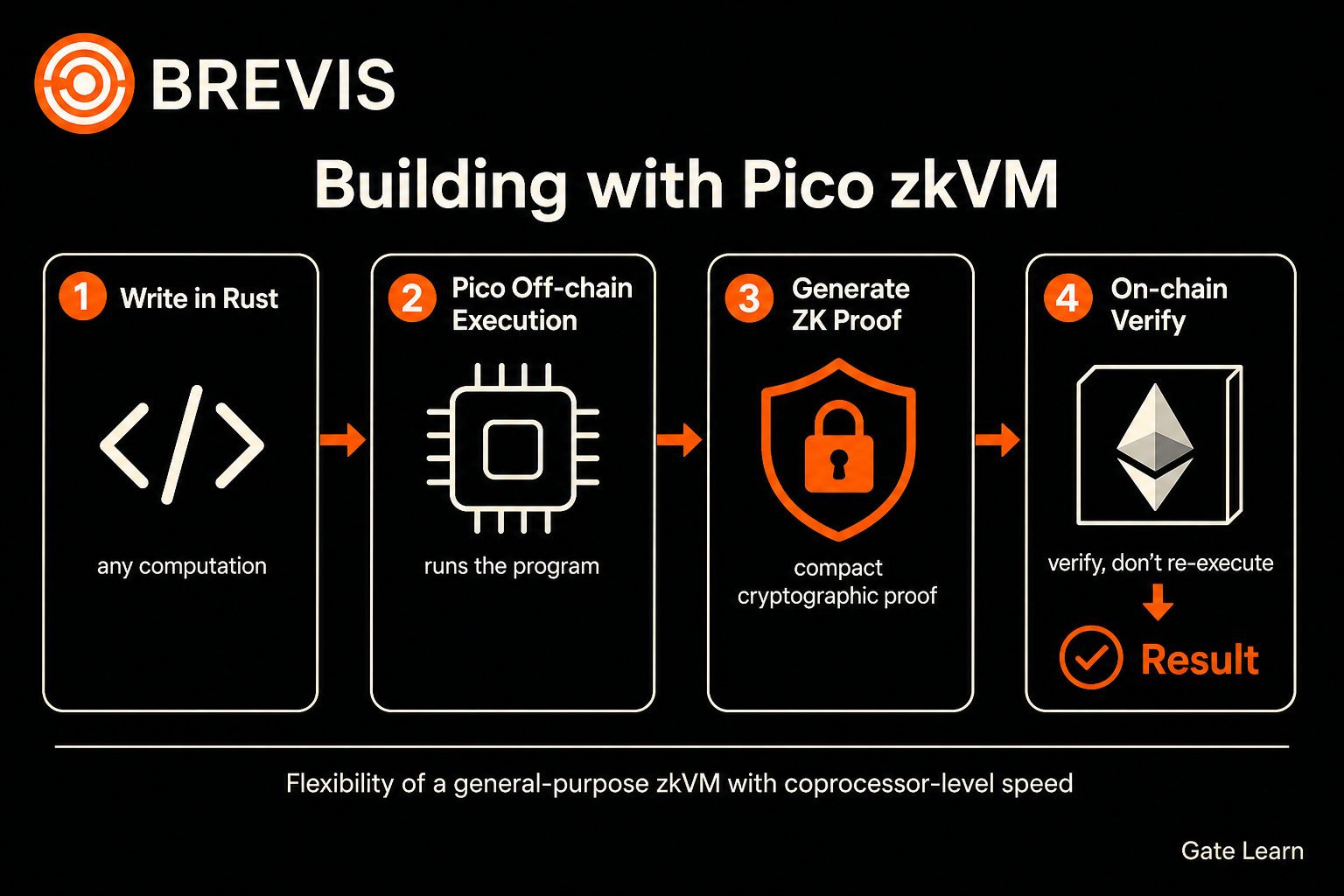
Figure 2. Pico zkVM development workflow: Write program in Rust → Pico executes off-chain → Generate ZK proof → Smart contract verifies on-chain.
What Is the Relationship Between Pico and ZK Data Coprocessors?
Pico zkVM and application-level coprocessors form a "universal glue" and "dedicated engine" relationship. The ZK Data Coprocessor is a prime example: it accesses historical and cross-chain data off-chain, completes computation, and attaches cryptographic proofs of data authenticity and correctness.
In this division of labor, Pico acts as glue, efficiently routing data between dedicated modules while maintaining the flexibility of a general-purpose zkVM. Application logic can call the universal core for custom computation or leverage the data coprocessor for efficient access to on-chain history.
In summary, Pico offers universal computation capability, while application-level coprocessors deliver specialized, high-speed processing for specific scenarios. Together, they comprise Brevis’s verifiable computation execution stack.
What Are the Use Cases for Pico zkVM?
Pico zkVM is ideal for scenarios requiring "trusted computation + on-chain verification," with data processing, signature verification, machine learning inference, and Ethereum block proof as four typical applications.
| Scenario |
Pico’s Role |
Representative System or Circuit |
| Data Processing |
Aggregating and analyzing on-chain history and cross-chain data |
ZK Data Coprocessor |
| Signature Verification |
Batch signature validation |
Signature Verification Coprocessor |
| ML Inference |
Generating verifiable results for off-chain model inference |
ML Inference Coprocessor |
| Ethereum Block Proof |
Real-time Ethereum block proof generation |
Pico Prism |
The table above outlines four typical scenarios and their corresponding execution components. Data processing and signature verification rely on dedicated coprocessors for acceleration, ML inference attaches proofs to off-chain model outputs, and Ethereum block proof is the most prominent use case.
Ethereum block proof is handled by Pico Prism, a real-time proof system built on Pico. According to Brevis, it achieves around 99.8% real-time coverage on 16 GPUs, matching the Ethereum Foundation’s $100,000 hardware target. Unlike oracles that bring off-chain data on-chain, Pico focuses on verifiable computation of on-chain data. The difference between Brevis and oracles is that Pico emphasizes verifiable computation of blockchain data rather than external price feeds. The Ethereum Foundation’s On-Prem Proving Initiative (Ethproof) selected Brevis as one of four teams in March 2026.
What Are the Advantages and Considerations of Using Pico zkVM?
Pico zkVM’s core advantage is its blend of flexibility and performance: the universal core enables any program to run, dedicated coprocessors push high-frequency operations toward specialized circuit efficiency, and the Rust toolchain reduces the zero-knowledge development barrier.
Considerations mainly relate to the coverage of specialized circuits and proof market dynamics. Coprocessors and precompiled circuits only apply to optimized operations; programs heavily dependent on unsupported computations must revert to instruction-level proofing with the universal core, diminishing performance gains. Prover staking and slashing in BREV tokens and coChain bind proof delivery reliability to token collateral.
Proof costs are another structural constraint. Zero-knowledge proof generation requires specialized hardware and hashrate, and proof overhead for general-purpose computation remains higher than native execution. The cost and latency of complex logic should be considered during design. These are objective mechanism-level constraints and do not constitute investment advice.
Summary
Pico zkVM, Brevis’s open-source modular zero-knowledge virtual machine, integrates the universal RISC-V core and dedicated precompiled circuits in a glue-and-coprocessor architecture: the core executes any Rust program, high-frequency tasks are routed to specialized coprocessors, and Brevis reports proof speeds improve by 10x to 80x. Developers write computation in Rust, execute off-chain, and generate proofs, with only concise proofs verified on-chain. Together with application-level coprocessors like the ZK Data Coprocessor and deployed systems like Pico Prism, Pico forms the universal execution layer for Brevis’s verifiable computation.
FAQ
What Is Pico zkVM?
Pico zkVM, Brevis’s open-source modular zero-knowledge virtual machine (zkVM), enables developers to write any computation logic in Rust, execute off-chain, and generate zero-knowledge proofs. Smart contracts only need to verify concise proofs on-chain, eliminating the need to re-execute entire programs.
How Does the Glue-and-Coprocessor Architecture Accelerate Proofs?
The architecture uses the universal RISC-V core as glue to execute programs, routing common operations like Keccak-256 hashing, signature verification, and ML inference to dedicated coprocessors (precompiles). Optimized circuits for zero-knowledge proofs replace instruction-level proofing, improving proof speed by 10x to 80x according to Brevis.
How Can Developers Build Verifiable Programs with Pico?
Developers write computation logic in Rust, Pico executes off-chain and produces results, then generates a cryptographic proof of correct execution. Smart contracts verify this concise proof on-chain, with verification overhead at the millisecond level and essentially independent of the original computation’s scale.
What Is the Relationship Between Pico zkVM and ZK Data Coprocessors?
Pico zkVM acts as glue, efficiently routing data between dedicated modules while maintaining generality. ZK Data Coprocessors are the most prominent application-level coprocessors, accessing historical and cross-chain data off-chain and attaching proofs of correct computation. Together, they form the complete execution stack.
What Is Pico Prism?
Pico Prism, built on Pico, is a real-time Ethereum block proof system. According to Brevis, it achieves approximately 99.8% real-time coverage on 16 GPUs, matching the Ethereum Foundation’s $100,000 hardware target. The Ethereum Foundation’s On-Prem Proving Initiative (Ethproof) selected Brevis as one of four teams in March 2026.







