In the digital asset space, users often depend on centralized cloud services for accessibility, while agent-centric frameworks aim to keep data and validation on the user side. Holo bridges these models: community hosts supply hashrate, which is then made available to browser users. To fully understand this topic, it's important to distinguish between Holochain (the framework), Holo (the hosting layer), and HOT/HoloFuel (the payment design), and not conflate their roles.
What Is Holo (HOT) and What Problems Does It Solve?
Holo is a distributed hosting network designed to answer the question: when applications run on Holochain via edge devices and peer validation, how can users who are not always online or who don't want to manage their own nodes still access these apps? Hosts—both hardware and software—contribute capacity and uptime, while the network delivers cloud-like availability akin to a "community cloud."

The core challenge is that pure P2P apps are sensitive to endpoint quality, while web users expect to access services directly through their browsers. Holo connects hosting resources with web entry points, lowering the barrier for users to operate their own nodes, and aligns with Holochain’s focus on data sovereignty. Holo Limited operates as a hosting provider, with its narrative positioned under the Holochain Foundation ecosystem.
Holochain is an open-source P2P app framework built on an agent-centric model: data is signed and stored on user devices, and peers validate according to app-specific rules—there is no global ledger consensus. Calling it a "blockchain" is inaccurate.
Their roles break down as follows: Holochain provides the foundation for building applications; Holo delivers hosting and web accessibility. The distinction between Holo and Holochain is typically "framework vs. hosting": developers create app logic, while hosts and the hosting layer enable operation and bridging.
| Dimension |
Holochain |
Holo |
| Layer |
Open-source P2P application framework |
Distributed/community hosting infrastructure |
| Core Question |
How to validate and collaborate without global consensus |
How to host and make apps accessible to web users |
| Typical Actors |
App developers, peer users |
Hosts, app providers, web guests |
| Blockchain Status |
Not a global consensus blockchain |
Hosting/bridging layer, not a "public chain" |
As shown above, the two are not interchangeable. Confusing their names may lead to the mistaken belief that HOT is Holochain’s "native on-chain token" or that joining Holo is equivalent to running a consensus node.
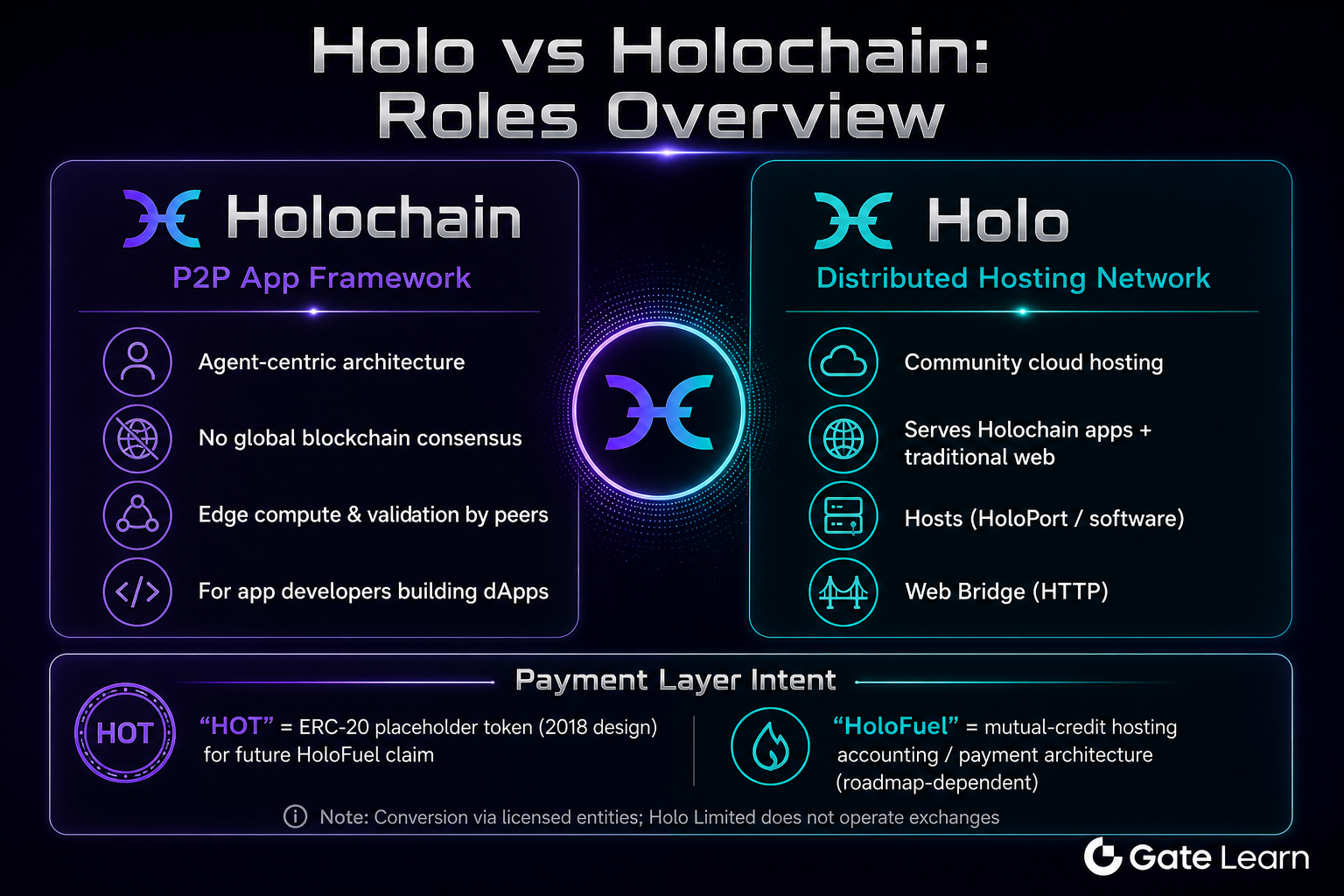
Figure 1. Role division between Holochain (application framework) and Holo (hosting network), including the intent behind the HOT/HoloFuel payment layer.
How Does the Holo Hosting Network Work? From Host to Web Bridge
The hosting process can be summarized as: hosts provide capacity → the network aggregates resources → applications remain accessible → the Web Bridge exposes APIs via standard HTTP → web users access the service. Hosts can be either HoloPort hardware or software-based; their capacity and uptime determine the load they can handle.
The Web Bridge ensures protocol compatibility, packaging distributed data capabilities as HTTP APIs so even users without a P2P client can access public interfaces via their browser. The Holo hosting process can be reviewed step-by-step: host onboarding—app deployment—bridge exposure—user request.
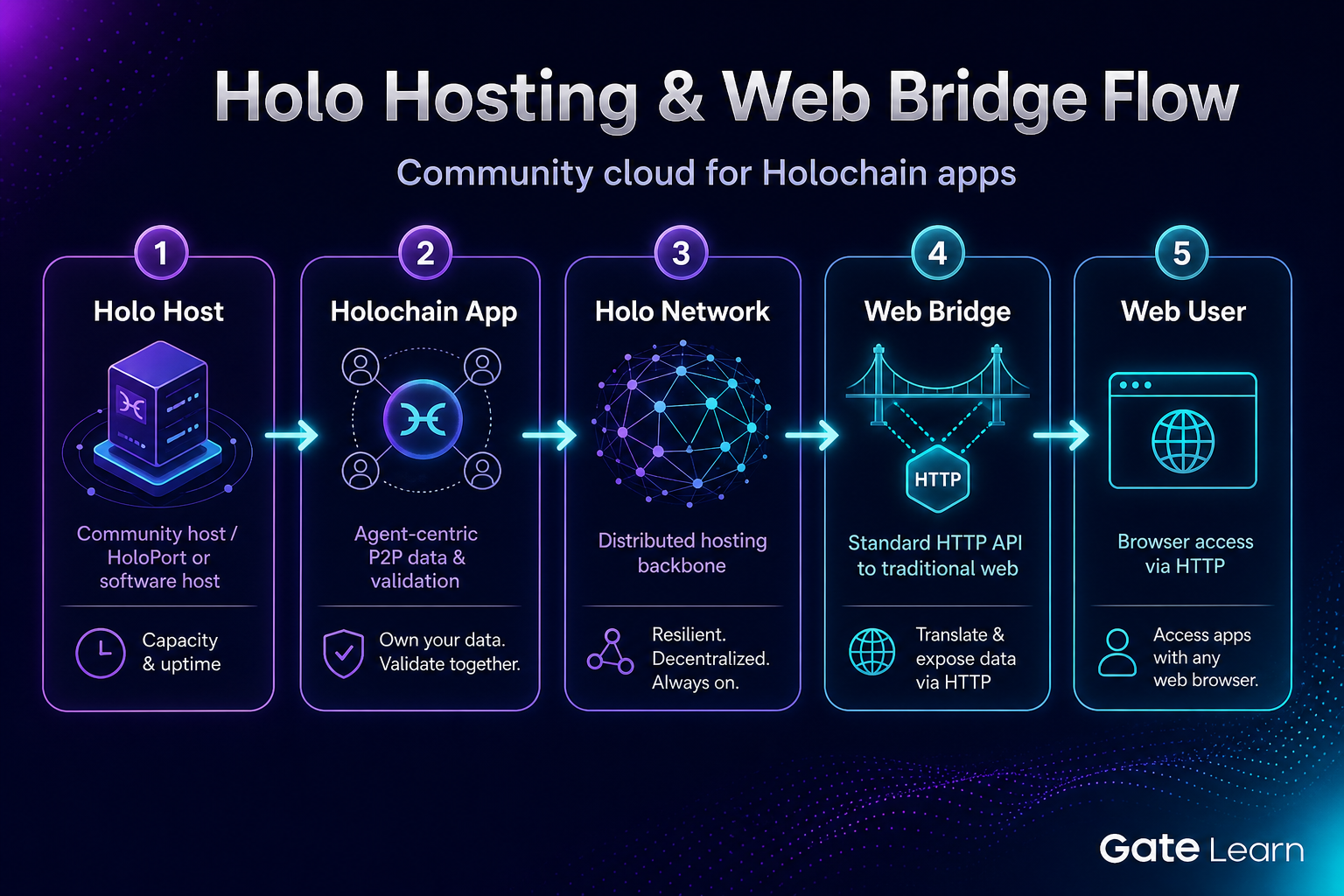
Figure 2. Illustration of the hosting and bridging path from Holo host and Holochain app to Web Bridge and web user.
What Are the Roles of HOT and HoloFuel?
HOT was created in 2018 as an ERC-20 placeholder token, intended to be exchanged for HoloFuel once that becomes operational (historically, a 1:1 swap was discussed). HOT is not a native "mining" token built into the Holochain framework.
HoloFuel is designed as a mutual-credit accounting and payment system for the hosting economy, enabling pricing, resource allocation, and high-frequency micro-settlements, with host-side pricing supporting peer-to-peer payments. The implementation status follows the public roadmap and should not be assumed to be fully operational; until the full accounting system is live, micropayments and direct user-to-host payments are not fully enabled.
If conversion services are offered, they must be handled by licensed third parties; Holo Limited, as a hosting provider, does not operate a token exchange. When evaluating the token, it’s crucial to separate design intent, implementation status, and conversion parties.
| Element |
HOT |
HoloFuel |
| Form |
2018 ERC-20 placeholder token |
Mutual-credit hosting/accounting/payment system |
| Design Intent |
Claim for HoloFuel conversion |
In-network pricing, payment, resource allocation |
| Operational Scope |
Trading/conversion involves licensed entities |
Rollout follows the public roadmap |
| Holo Limited’s Role |
Does not operate a token exchange |
Does not directly offer conversion services |
This table distinguishes the on-chain token HOT from the hosting settlement system HoloFuel. Holding HOT does not automatically entitle holders to redeemable HoloFuel.
What Are Typical Use Cases and Scenarios for Holo?
Common use cases involve the need for "distributed resilience and web accessibility," such as verifiable, portable documents or creator content distribution. Organizations want to reduce dependence on a single cloud provider while serving a wider audience. Holo Cloud Nodes target app operators who require availability and redundancy; Web Bridge services must connect to products compatible with standard HTTP. Developers focus on deployment and validation, hosts on providing capacity, and web users on seamless access—Holochain determines how apps are built, Holo determines how they are hosted and exposed.
How Does Holo Differ from Mainstream Blockchain Cloud/Node Hosting?
Public chain node hosting typically serves the global ledger: running validators or full nodes, providing broadcast, sync, and RPC. Holo, by contrast, is designed for Holochain’s non-global consensus framework—"edge data + peer validation + HTTP bridging"—and is more like community application hosting and a web access layer, not a public chain validator. Key differences include consensus assumptions, pricing units (gas vs. HoloFuel), and user entry (wallet on-chain vs. browser via Web Bridge).
What Are the Benefits, Risks, and Limitations of Using or Understanding Holo/HOT?
Benefits: lowers the entry barrier for users to run nodes; Web Bridge expands accessibility; both hardware and software hosts can participate; focus on data sovereignty and resistance to single-provider cloud dependency. Limitations: user experience depends on host capacity and bridge configuration; HoloFuel settlement is subject to the roadmap; conceptual barriers may cause confusion with public chains. Risks: HOT is subject to price volatility, account security issues, and counterfeit assets; conversion depends on regulatory and licensing arrangements. When reviewing Holo risks and limitations, focus on system boundaries rather than price speculation.
What Are Common Misconceptions About Holo (HOT)?
Misconception 1: Equating Holo, Holochain, and public blockchains—they are, respectively, a hosting network and a P2P framework. Misconception 2: Holding HOT is equivalent to owning usable HoloFuel—redemption depends on technical and regulatory factors, and the hosting company does not operate conversions. Misconception 3: HoloPort is the only hosting option—software hosts are also available. Misconception 4: Web Bridge makes apps into centralized websites—bridging solves protocol compatibility and does not alter data ownership or validation rules at the app level.
Summary
Holo is a community-driven distributed hosting infrastructure for Holochain applications, bridging them to the traditional web; Holochain provides the agent-centric app framework layer. HOT is designed as a future claim for HoloFuel, which is a mutual-credit accounting and payment system for hosting—both must be understood within the boundaries of licensed conversion and the public roadmap. Hosts supply capacity, and the Web Bridge connects web users via HTTP—clarifying the differences between framework, hosting, and tokens is essential to avoid common misunderstandings.
FAQ
What Is Holo (HOT)?
Holo is a community-based distributed cloud hosting network in the Holochain Foundation ecosystem, operated by Holo Limited. Its main function is to provide hosting capacity for Holochain apps and increase accessibility by connecting to the traditional web. HOT is the related ERC-20 placeholder token, but the hosting network and token trading are separate layers.
What Is the Difference Between Holo and Holochain?
Holochain is an open-source P2P app framework with an agent-centric data and peer validation model; it is not a global consensus blockchain. Holo provides the distributed hosting, host resources, and web bridging infrastructure. Holochain answers how apps are built; Holo answers how apps are hosted and accessed by web users.
What Is the Purpose of the HOT Token?
HOT was created in 2018 as a placeholder token, intended to be exchanged for HoloFuel when the conditions are right. Hosting services may also accept HOT and fiat currency as payment methods. Holo Limited does not operate a token exchange; any conversion services must be provided by licensed entities.
What Is HoloFuel? How Does It Relate to HOT?
HoloFuel is the mutual-credit accounting and payment system for the hosting network, used for pricing, resource allocation, and high-frequency settlements. HOT was designed as a placeholder claim for HoloFuel; whether and how conversion happens depends on technical, regulatory, and licensing factors. Holding HOT does not automatically entitle you to HoloFuel.
How Does Holo Work?
Hosts (HoloPort or software-based) provide hashrate and online capacity; the network aggregates availability; the Web Bridge exposes apps to browsers via standard HTTP. Developers configure hosting and bridging, while web users typically access apps using standard web protocols.
Is Holo a Blockchain? What Are the Risks of Using or Holding HOT?
Holo is not a global consensus blockchain; Holochain also does not rely on global blockchain consensus. HOT, as an ERC-20 asset, is subject to price volatility, account security risks, counterfeit assets, and uncertainty around conversion. Always verify information sources and understand that Holo Limited does not operate token conversion services.







