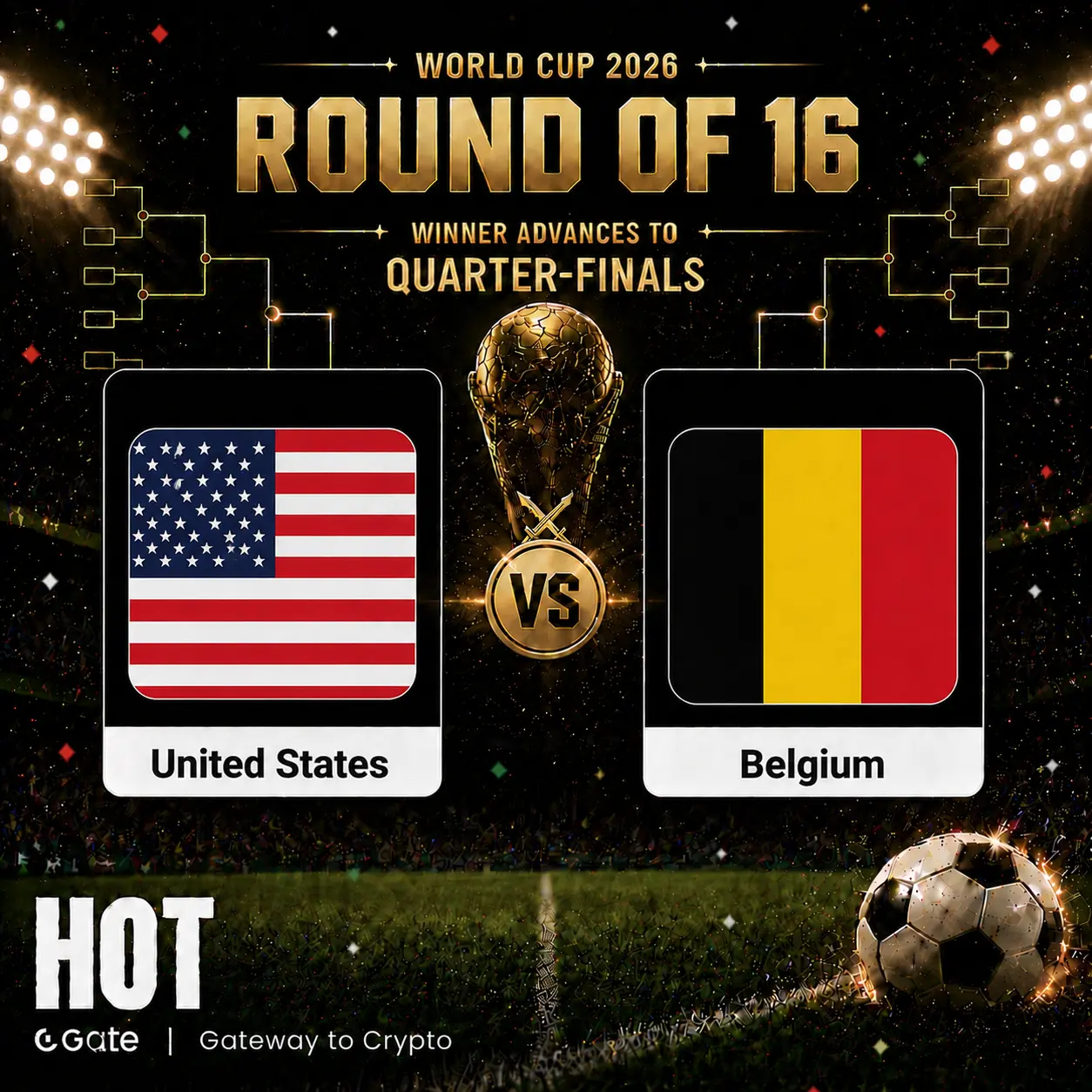
Strength Close but Logic Opposite: What Lies Behind the Even Probabilities
The pricing structure of 39% vs. 35% means the market believes there is no clear advantage in this match. It is not that the market lacks information; on the contrary – there is too much information, pointing in different directions.
From a paper-strength perspective, there is a clear gap between the two teams. Belgium is ranked 9th in the World Cup, with a total squad value of approximately €550 million; the USA is ranked 17th, with a total squad value between €350 million and €430 million. Belgium boasts world-class players such as De Bruyne, Lukaku, and Courtois, and this is the last World Cup for the "Golden Generation". The US team, centered around Pulisic, McKennie, and Weah, is overall younger and has stronger running ability.
However, the paper advantage did not gain a corresponding probability premium in the prediction market. The reason is that the market simultaneously factors in multiple offsetting factors.
Home-field factor is the most significant variable. The USA, as the host, plays this match at Lumen Field in Seattle, giving the team a true home advantage. In their four matches in the group stage and Round of 32, the USA scored a total of 10 goals, showing an active offense. In their last match, they defeated Bosnia 2-0 while down a man, winning a knockout stage match for the first time since 2002, boosting team morale. The impact of home atmosphere in a knockout match cannot be underestimated – in a single-elimination format, fan support can directly translate into physical and psychological advantages for the players.
Physical fitness reserve is another variable priced by the market. The USA's overall exertion in the group stage and Round of 32 was relatively manageable, while Belgium experienced a hard-fought comeback against Senegal in extra time during the Round of 32. In the dense knockout schedule, fitness differences could become a decisive factor in the final 30 minutes.
Historical encounters provide a completely opposite signal. The two teams have met 7 times in history, with Belgium holding an overwhelming advantage of 6 wins and 1 loss. In the 2014 World Cup round of 16, the two teams drew 0-0 after 90 minutes, and Belgium eliminated the USA 2-1 in extra time. In a friendly match in March 2026, Belgium defeated the USA 5-2. This historical record gives Belgium a clear psychological advantage and tactical reference – they know how to beat the USA in a knockout stage.
The market prices all these factors simultaneously: home-field USA, more experienced Belgium, physically superior USA, historically dominant Belgium. These opposing forces cancel each other out in the pricing system, ultimately forming the balanced pattern of 39% vs. 35%.
What Does the 29% Draw Probability Mean?
In the pricing system of prediction markets, a 29% draw probability is a number that should be taken seriously.
The draw probability in knockout stages is usually systematically suppressed – because market participants naturally tend to price for a "decisive result". In the group stage, a draw can be a rational outcome where both sides earn a point; but in the knockout stage, a draw means at least 30 minutes of extra time and possibly a penalty shootout, with uncertainty sharply rising. Therefore, the market usually assigns a higher probability weight to "one side winning within 90 minutes".
However, the draw probability for this match is as high as 29%, nearly one-third. This means the market believes there is a real possibility that the two sides cannot decide a winner within 90 minutes, and the probability is not low.
This judgment has solid tactical basis. The style of play in knockout stages is markedly different from the group stage – defensive weight increases significantly, attacking sides tend to avoid risks, and both teams become more cautious. The 2014 World Cup round of 16 match between the USA and Belgium is a classic example: the two teams played to a 0-0 draw after 90 minutes. The trend of that match provides a direct reference for this encounter – the USA has the ability to drag the match into a low-scoring stalemate, and Belgium also has the patience to wait for opportunities.
Furthermore, the 29% draw probability also reflects the market's cautious assessment of both teams' offensive efficiency. The USA's top scorer Balogun (who has scored 3 goals this World Cup) previously faced a suspension risk. Although FIFA ultimately revoked the penalty, the incident itself has reminded the market: the USA's offensive firepower has uncertainty. Belgium's attack is more complete, but when facing the USA's home defense, whether they can efficiently convert chances is also questionable.
The 29% draw probability is actually the market pricing the scenario of "the match might go into extra time". In the knockout stage, this is a signal that cannot be ignored.
Who Is More Likely to Get On-the-Spot Funding Support
A core feature of prediction markets is that price movements in the 24 hours before the match often reflect true information more than the initial pricing. The flow of last-minute funds is a key window to observe whether market consensus is forming.
From the current pricing structure, the USA leads Belgium slightly with a 39% win probability versus 35%. This gap itself indicates that the market tends to view the USA as the slightly favored side – though the advantage is extremely limited. Home atmosphere, physical advantage, and the psychological boost of being the host in a knockout stage are the main supports for the USA's slight lead.
But Belgium's supporting logic is equally solid. De Bruyne, Lukaku, and Courtois are all playing in their last World Cup, and this "last dance" narrative may inspire the entire team. Belgium's squad depth is superior to the USA, and in an extra time scenario, bench depth could become a decisive factor. Moreover, Belgium came back from a two-goal deficit in the Round of 32, and the team's morale is at its peak.
The direction of last-minute funding support will depend on which side's information is more impactful in the final 24 hours before the match – whether it's the actual state of the USA's offense after Balogun's return, or the market's recognition of Belgium's Golden Generation's last stand.
What Factors Might Break the Balance
The pricing of prediction markets is a dynamic process. The current balanced pattern of 39% vs. 35% could be broken by several key variables.
The timing of the first goal is the most direct turning point. In a knockout match, the team that scores first can switch to a counter-attack mode, while the trailing team is forced to push forward, often leading to an expanded score gap. The market's pricing of "who is more likely to score first" will directly affect the direction of win probability changes.
The quality of substitutions is another underestimated variable. Substitutions in knockout matches are not just about replenishing energy; they are carriers of tactical changes. Belgium's bench depth is superior to the USA, meaning in the later stages of the match, Belgium may have more room for tactical adjustments.
The weight of set pieces increases significantly in knockout stages. When both teams struggle to create chances in open play, corner kicks and free kicks often become the most effective means to break the deadlock. The execution efficiency of both teams' set-piece tactics is a variable that is difficult for the market to precisely quantify in pre-match assessments.
The probability of a penalty shootout is directly related to the 29% draw probability. If the match goes into extra time and still cannot decide a winner, a penalty shootout will determine the advancement. The outcome of a penalty shootout is essentially highly random – which is one of the fundamental reasons why the market struggles to form a consensus expectation. When a match has nearly a one-third chance of going into extra time, and extra time has a considerable chance of leading to a shootout, the win probability for either side is hard to break through the 45% ceiling.
What Is Most Worth Watching in the Prediction Market
For users following the prediction market, the 24 hours before the match are the most critical observation window. The following indicators are worth continuously tracking.
Whether the win probability shows a clear tilt is the primary observation point. If the USA's win probability rises from 39% to above 42%, it indicates that last-minute funds are forming a mainstream flow toward the USA; if Belgium's win probability rises from 35% to above 38%, it means the market's pricing of experience and squad depth is strengthening. Any unidirectional movement of more than 3 percentage points deserves careful interpretation.
The trend of draw probability changes is also crucial. If the draw probability further rises from 29% to above 32%, it indicates the market is assigning higher weight to the "extra time" scenario – which usually means neither side is expected to win easily. Conversely, if the draw probability drops below 26%, it indicates the market expects a quicker decision.
Whether the market starts forming a one-sided expectation is the most alarming signal. In knockout stages, balanced pricing is often more "honest" than one-sided pricing – because one-sided pricing often means information on one side has been overreacted. If there is a massive unidirectional inflow of funds before the match, it might be a signal of market overconfidence rather than a more accurate prediction.
Under the current pricing structure of 39% vs. 35%, the market has not formed a consensus expectation. This is precisely where prediction markets are most valuable – the price itself is the most honest expression of uncertainty. Users participating in prediction trades can simultaneously monitor the above dynamics and sign up for "Gate World Cup Prediction King Competition", winning additional rewards through score rankings, so that every accurate judgment yields dual value.
FAQ
How are the win probabilities in prediction markets calculated?
Prediction markets price through trading contracts. The contract price floats between $0 and $1, directly read as an implied probability. For example, if the USA win contract is quoted at $0.39, the market believes the USA has a 39% probability of winning within 90 minutes. The price is determined by the trading activities of buyers and sellers, reflecting the collective estimation of event probabilities by market participants.
What does the 39% vs. 35% gap mean?
A 4 percentage point gap in the pricing system of prediction markets can almost be considered "fifty-fifty". This means the market believes the two teams are extremely close in strength, with no clear advantage. In the knockout stage, this balanced pricing structure better reflects real uncertainty than a one-sided tilted pricing.
Why is the draw probability as high as 29%?
Both sides become more cautious in knockout stages, with defensive weight significantly increasing. The 2014 World Cup round of 16 match between the USA and Belgium is a classic example – the two teams drew 0-0 after 90 minutes. The 29% draw probability is actually the market pricing the scenario of "the match might go into extra time".
Which signals deserve attention before the match?
Focus on three indicators: whether the win probability of the USA or Belgium shows a unidirectional movement of more than 3 percentage points in the 24 hours before the match; whether the draw probability is rising or falling; and whether trading volume shows an abnormal increase. These signals can help determine whether market consensus is forming.
How to participate in the "Gate World Cup Prediction King Competition"?
After logging into Gate, enter the event page and click 立即报名, then go to the Gate Polymarket World Cup zone, select knockout stage predictions or fun prediction markets, and complete a single prediction trade of ≥ 10 USDT. The system calculates scores based on return multiples: (return multiple - 1) × 100, with no score for losses. The event has two independent leaderboards: match predictions and fun predictions, each with a prize pool of 50,000 USDT. Users can participate in both, and if they appear on both leaderboards, rewards are cumulative. Note that the trade is only valid after registration, and a single leaderboard requires cumulative valid trades of ≥ 50 USDT to be eligible for ranking.