According to Lookonchain monitoring data on July 20, a mysterious whale created a brand-new wallet 10 hours ago and placed a $1.95 million bet on Spain to win the 2026 World Cup at 59.1% odds. As Spain won the title, the whale made $1.35 million in profit within a few hours. Ferran Torres scored in extra time at MetLife Stadium, and Spain defeated Argentina 1-0.
Lookonchain monitoring data: Mysterious whale’s new wallet bets $1.95 million
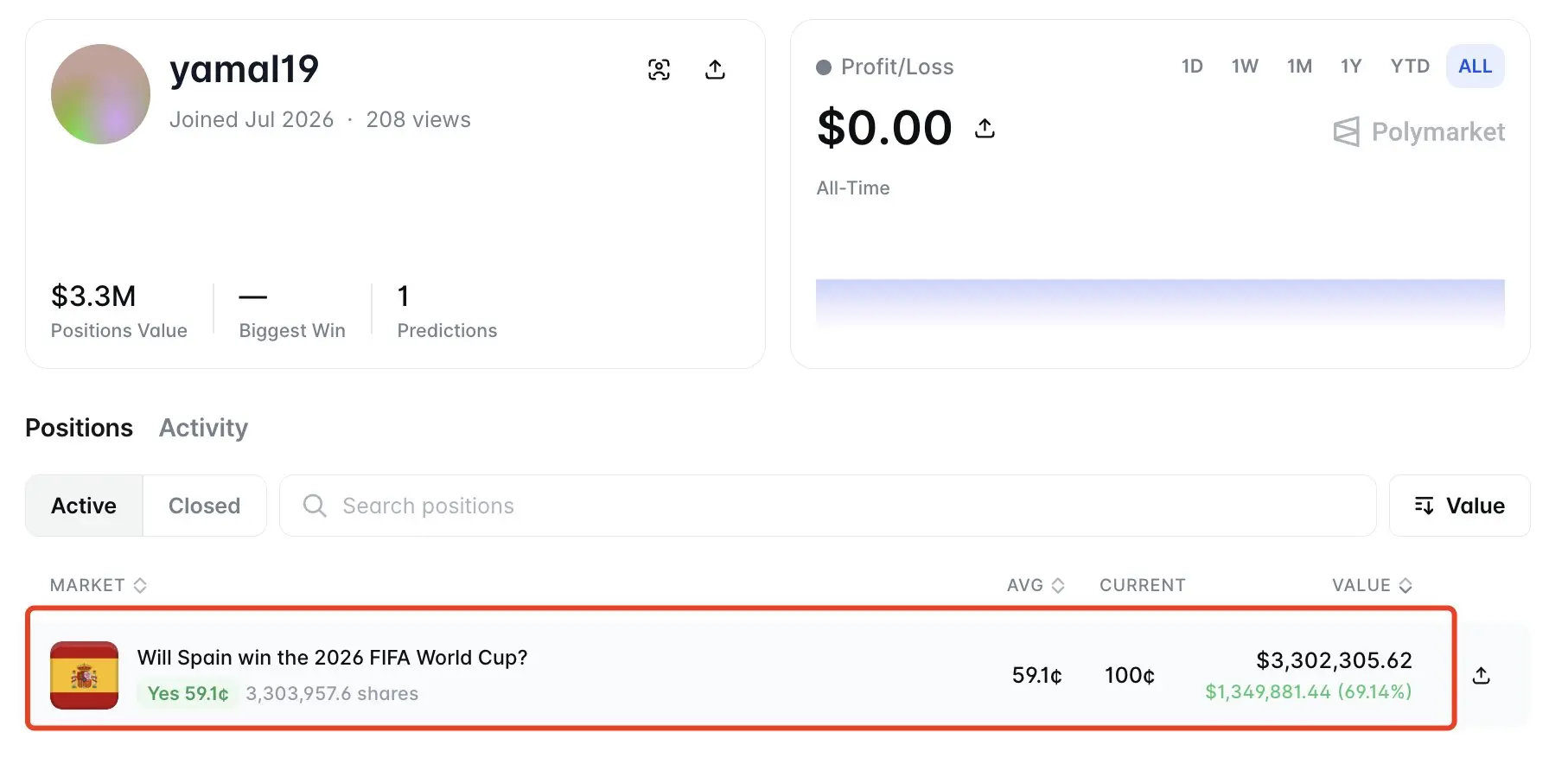 (Source: Polymarket)
According to Lookonchain’s July 20, 2026 monitoring report, the mysterious whale created a new wallet about 10 hours before the final and placed a bet on Spain to win the 2026 World Cup at 59.1% odds (i.e., betting $1.95 million, with an expected payout of about $3.3 million). After Spain won, it profited $1.35 million within a few hours.
On July 19, 2026, in the World Cup final held at MetLife Stadium, Ferran Torres scored in extra time to defeat Argentina 1-0 and win the men’s World Cup title. After a hard-fought 120 minutes, there were no goals in the 90 minutes of regulation, and the match was decided after extra time; Spain advanced after beating France 2-0 in the previous semifinal.
Polymarket: Accumulated over $4.2 billion before the World Cup final
According to Polymarket data, the cumulative trading volume for the 2026 World Cup champion market exceeded $4.2 billion before the final began. As a decentralized prediction platform built on Polygon, Polymarket’s $4.2 billion trading volume has reached a scale that could draw attention from financial regulators, and the legal status of such prediction platforms remains a gray area across multiple jurisdictions.
For fan token holdings, tokens such as $ARG on the Socios.com platform saw significant growth in price and trading volume during the knockout stage. By tying tokens to club governance voting and exclusive experiences, Socios.com shows stronger market persistence than NFTs. After Argentina narrowly lost in extra time, the championship-driven momentum behind $ARG faded away.
2026 World Cup crypto sponsorship landscape: No top-tier FIFA crypto partners, NFTs absent
There is a clear gap in how broadly the crypto industry participated between the 2026 World Cup and the 2022 Qatar World Cup:
2022 Qatar: Crypto exchanges spent billions of dollars to buy naming rights and establish global partnership ties, and FIFA launched its own NFT platform
2026 FIFA sponsorship: Among FIFA’s seven global partners and eight official sponsors, none is a crypto company
NFT: No 2026 World Cup NFT products are evident; FIFA’s 2022 NFT platform was not carried over to this edition
Kraken: Participated as a non-top-tier FIFA partner, getting exposure at a cost far below that of top-tier partners
Fan tokens: Socios.com remains active in high-interest matches, becoming the most persistent crypto presence in this edition
Frequently asked questions
Where did the monitoring data on the mysterious whale’s bet on Spain come from?
According to Lookonchain’s July 20, 2026 monitoring report, the mysterious whale created a new wallet about 10 hours before the final and placed a bet at 59.1% odds on Spain to win the World Cup, betting $1.95 million. After Spain won, it made $1.35 million in profit within a few hours.
What was the trading scale of the Polymarket World Cup champion market?
According to Polymarket data, the cumulative trading volume for the 2026 World Cup champion market exceeded $4.2 billion before the final began; this trading scale has already reached attention thresholds for financial regulators in multiple jurisdictions, and the legal status of the prediction platform remains a gray area.
What are the main differences between 2026 World Cup crypto sponsorship and 2022?
In the 2022 Qatar World Cup, crypto exchanges heavily sponsored and FIFA launched an NFT platform; in 2026, among FIFA’s seven global partners and official sponsors, there is no crypto company. Kraken participated indirectly as a non-top-tier partner, and NFT products are completely absent.


