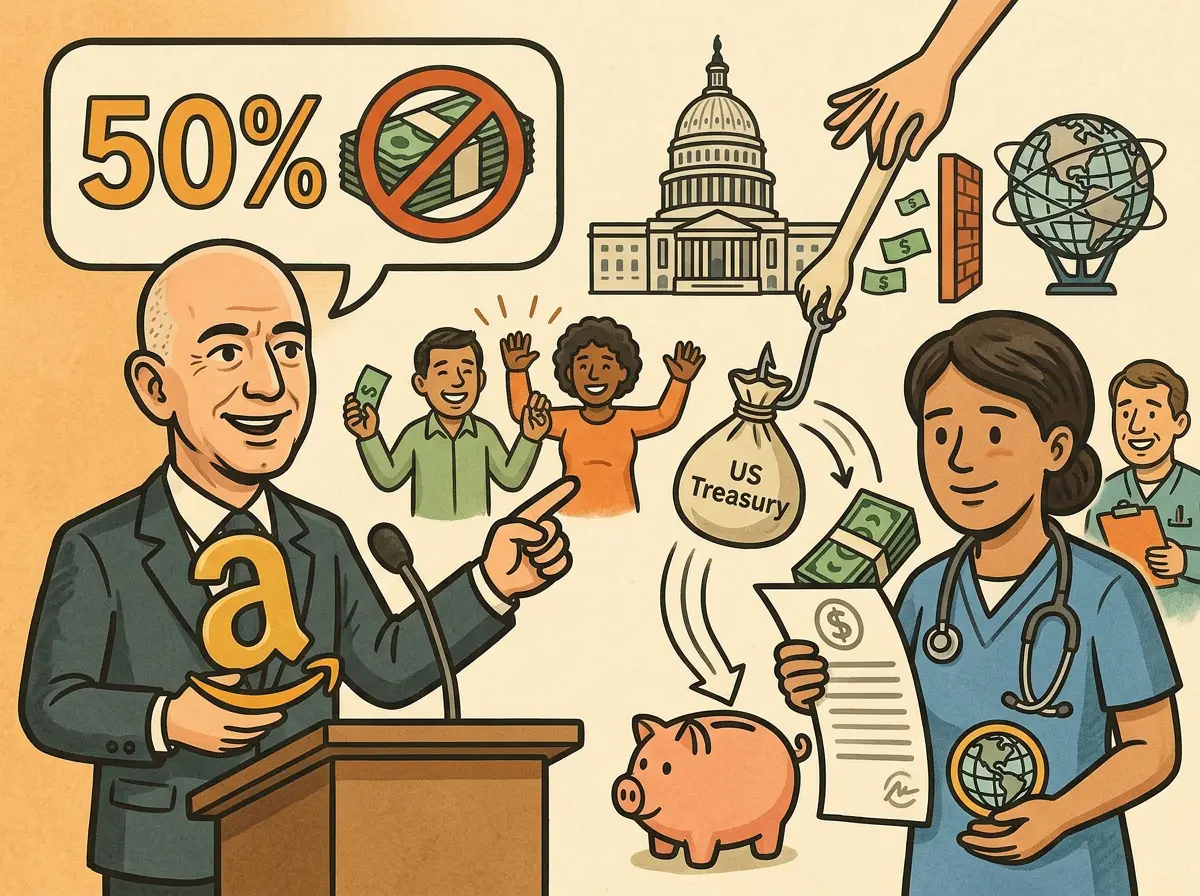
Amazon founder Jeff Bezos, during a CNBC interview on May 20, publicly called for exempting the lowest 50% of income earners in the United States from all federal income taxes, using as an example a nurse in Queens earning $75,000 a year who pays over $12,000 in taxes annually, and saying, “A Queens nurse shouldn’t wire money to Washington.”
Tax Foundation data: confirmed figures of the current federal tax structure
The Tax Foundation data Bezos cited in the interview has been confirmed by public records: in 2022, the top 1% of income earners in the United States paid 40.4% of all federal income tax; the bottom 50% paid 3.3%. With annual federal personal income tax revenue close to $2.4 trillion, a 3.3% share is about $80 billion.
Bezos pointed out that for the Treasury, $80 billion is only a sliver of total federal income tax revenue, but for individual taxpayers in the bottom 50% it has a “100% life-changing” impact. Taking the Queens nurse example from the interview, a $12,000 annual tax bill translates to more than $1,000 per month—an amount equivalent to covering rent or everyday grocery expenses.
The core of his proposal is: “The best way to help others save money is to not let them take the money in the first place.”
“A spending problem, not a revenue problem”: Bezos’s policy framework and New York City education spending data
Bezos clearly said in the interview that the core issue for federal finances is too much spending, not insufficient taxation. The figure he cited is that annual spending per student in New York City public schools is roughly $44,000, and he noted that this spending level exceeds Chicago, Boston, Los Angeles, Miami, and Houston—but education outcomes do not outperform the cities mentioned above. Data from the Federal Reserve Bank of New York shows that New York City’s recent per-capita student education spending is about $39,304, ranking among the top cities nationwide, and this partly supports the basis of Bezos’s argument.
When responding to the rebuttal that “taxing billionaires can reduce the deficit,” Bezos said: even if his own tax bill were doubled, it would not have “any impact” on a federal deficit on the scale of $2 trillion. This position is consistent with the views he expressed when criticizing the inflation policy during the Biden administration’s term—Bezos has consistently argued that spending reform should be prioritized over wealth-tax proposals.
At present, there are no confirmed congressional proposals, legislative process developments, or executive-support trends for Bezos’s tax-exemption proposal.
Frequently Asked Questions
What is the actual scale of the fiscal impact of exempting the bottom 50% from federal income tax?
Based on Tax Foundation data and an estimated annual federal personal income tax revenue of about $2.4 trillion, the bottom 50% of the population’s 3.3% share amounts to about $80 billion. This is equivalent to 4% of the projected $2 trillion federal deficit in fiscal year 2026. In the interview, Bezos used this to emphasize that this amount has an extremely limited impact on federal finances, but for each family in the bottom 50% it is a “100% life-changing” difference.
What types of taxes do the U.S. bottom 50% income group currently pay, and is exempting federal income tax the same as exempting them in full?
Bezos’s proposal targets federal income tax. Working-class Americans pay multiple kinds of taxes, including federal income tax, federal payroll taxes (FICA, covering Social Security taxes and Medicare taxes), state income taxes, and local taxes. Exempting federal income tax is not the same as fully exempting them. Out of the $12,000 in taxes paid annually by the nurse in Queens, federal income tax is only a part; federal payroll taxes and New York state local taxes would still apply.
Does this interview reflect consistency with Bezos and the Trump administration’s policy positions?
In this interview, Bezos emphasized a framework of spending reform and tax cuts for working people, which overlaps with the Trump administration’s policy direction of cutting government spending at the narrative level. Bezos previously publicly sparred with the Biden administration over its inflation policy, and his stance in the CNBC interview continues his consistent position of “reducing fiscal intervention.” At present, no confirmed public documents show that this interview directly coordinated with any specific legislative plans of the Trump administration.


