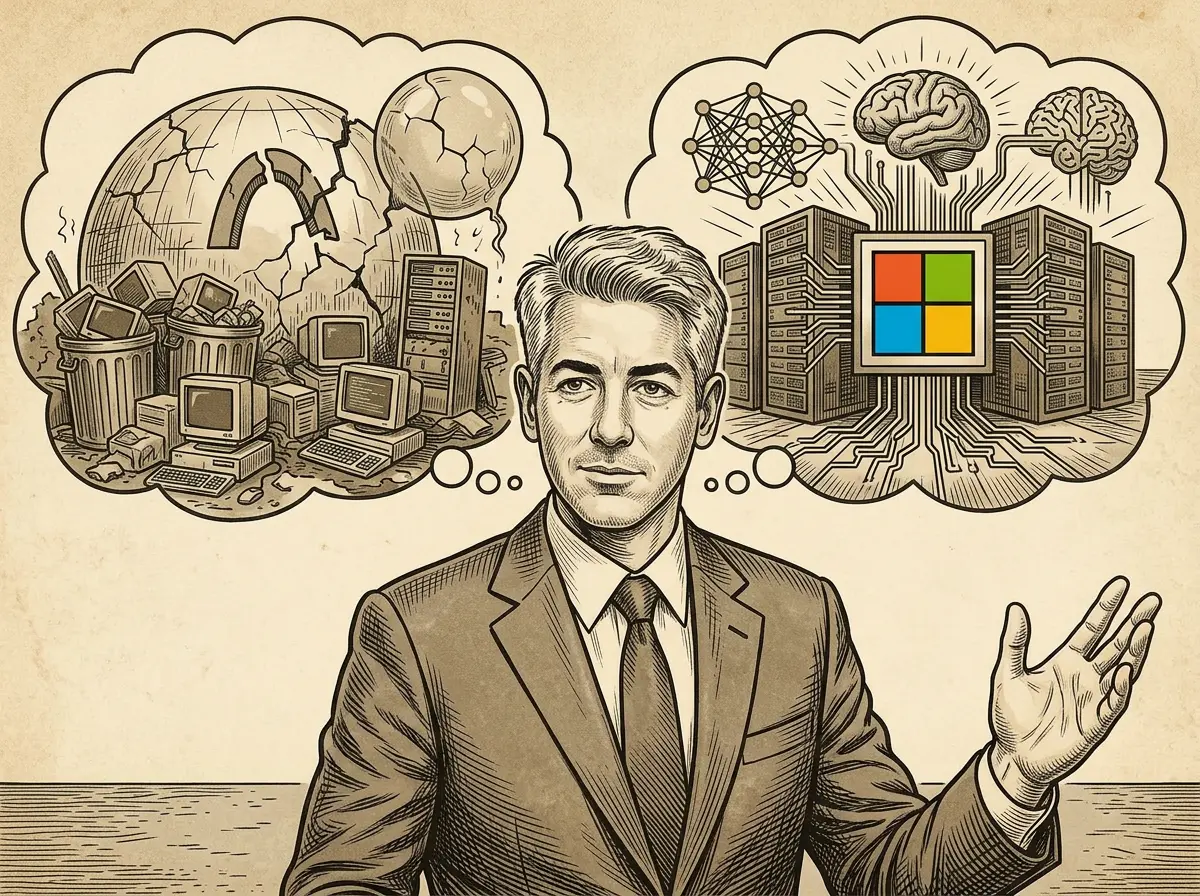
Bill Ackman, founder and CEO of Pershing Square Capital Management, said on June 3 on the “All In” podcast that the current market is replaying the investment psychology of the 2000 internet bubble. Funds are concentrating and flowing into hot sectors such as chips, semiconductors, and energy. He also opened new positions in February when Microsoft’s stock price fell after the release of its earnings, and said that Microsoft is one of the winners in the AI era.
Ackman’s Confirmed Positioning and Market Assessment
Ackman’s specific stances disclosed on the podcast:
Microsoft: Opened new positions when the stock price fell after the February 2026 earnings report; Ackman said Microsoft is “one of the winners in the AI era”
Amazon, Meta: Ackman said he holds them and believes both are currently undervalued by the market
Salesforce-type software companies: Ackman said he would “be concerned,” believing that a model where companies rely on niche software products to charge customers high fees faces significant disruption risk in the AI era
SpaceX (potential IPO): Ackman said SpaceX is “close to a monopoly” in the low-cost space launch business; his interest lies in what the company looks like five years from now
OpenAI (potential IPO): Ackman said OpenAI has an interesting business model, but needs to explain to the market more clearly how capital will be deployed
Software Industry Differentiation: Ackman’s Framework for Assessing AI Readiness
Ackman said on the podcast that the market’s sell-off in software stocks today requires “very detailed analysis,” rather than treating everything the same. He said that if a company is a software business today, it “must become as AI-enabled as possible.” His concerns focus on software companies from the past that relied on their ability to price within niche markets, calling them “indeed facing substantial risk.”
Ackman also said that in the AI wave, what truly deserves attention are high-quality enterprises with moats, cash flow, and the ability to transition to AI—companies that can withstand technological disruption. About a month ago, he said that during a weak market he saw “abnormally cheap, really very cheap” high-quality stocks.
FAQ
Where exactly are the “similarities” between the AI hype Ackman mentioned and the 2000 internet bubble?
Ackman explained on the podcast that the similarities mainly lie in investment psychology: back then, investors were excited about internet stocks, and when money chased “new things,” Berkshire Hathaway fell to historically low undervaluation; he believes the same investment psychology today is causing funds to concentrate flowing into chips, semiconductors, and energy, while high-quality companies such as Amazon, Meta, and Microsoft are being ignored by the market.
Why did Ackman open positions when Microsoft fell after its earnings report?
Ackman opened new positions when Microsoft released its February 2026 earnings report and the stock price dropped, because he believes Microsoft is one of the winners in the AI era. He pointed out on the podcast that in the AI wave, investors either invest directly or indirectly in AI, or else face threats brought by AI— and Microsoft belongs to the former.
How does Ackman’s attitude differ toward a SpaceX IPO and an OpenAI IPO?
For SpaceX, Ackman said he is clearly interested, calling it “close to a monopoly” in the low-cost space launch field; his focus is on what the company looks like five years from now. For OpenAI, Ackman acknowledged that its business model is interesting, but noted that OpenAI needs to explain more clearly to the market how it will deploy capital, with relatively more cautious wording.


