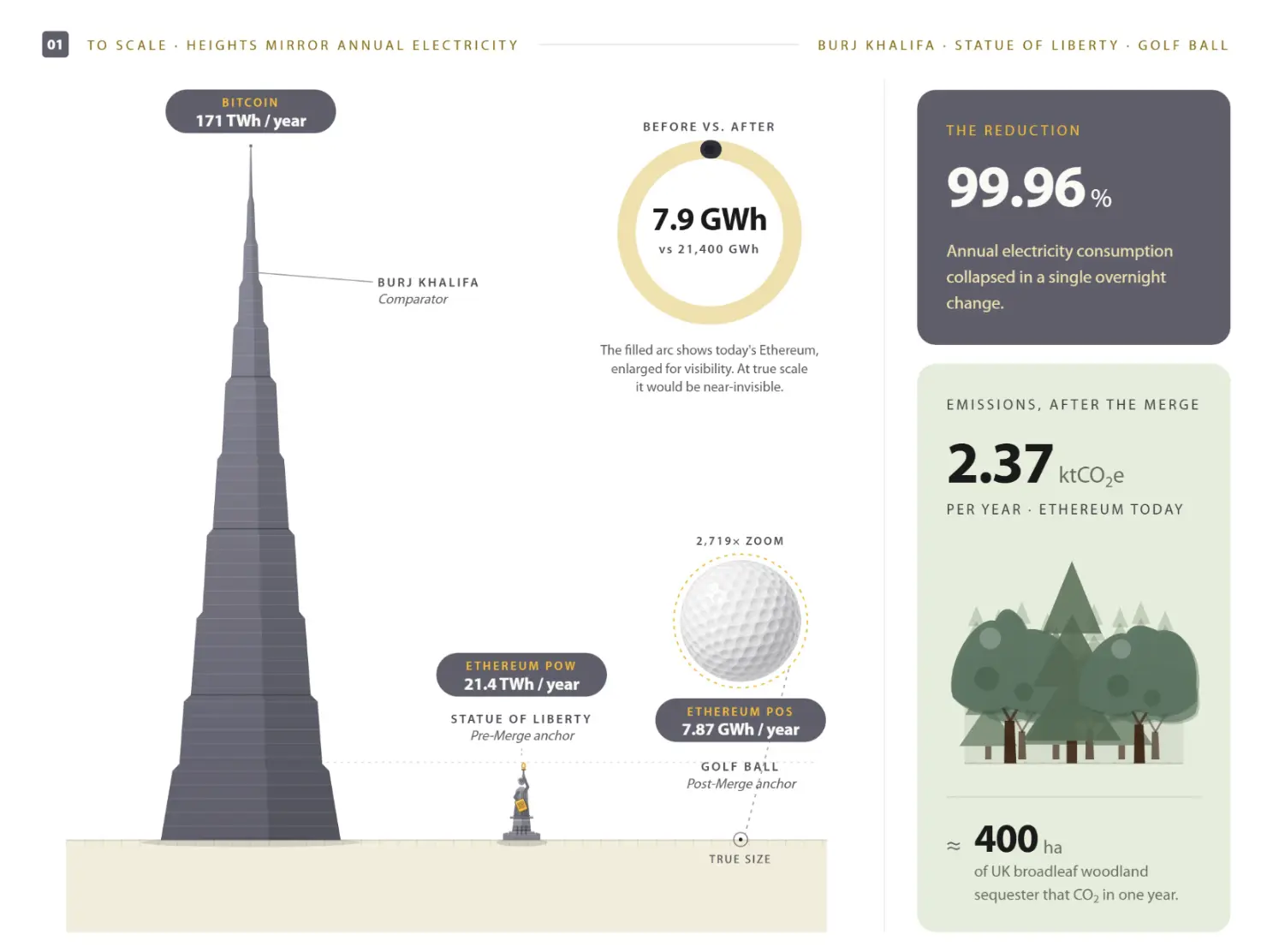
A recent study from the Centre for Alternative Finance at the University of Cambridge shows that after Ethereum completed The Merge on September 15, 2022, and transitioned to the PoS (proof-of-stake) consensus mechanism, its electricity demand dropped by more than 99.9% compared to the PoW (proof-of-work) mining era. Current annual power consumption is approximately 7.87 GWh; compared to the roughly 2.4 GW level before the transition, energy usage has decreased to a very small fraction of the original.
Research methodology: real-world tests with 20 client combinations, 8,522 full nodes, and geographic distribution data
(Source: University of Cambridge report)
According to the research methodology described by the Centre for Alternative Finance at the University of Cambridge, the report’s estimation approach is based on real hardware measurements. Researchers tested 20 combinations of Ethereum’s main execution clients and consensus clients and observed power consumption under different hardware configurations.
The Cambridge team identified 8,522 discoverable Ethereum full nodes, with the following geographic distribution: United States 31%, Germany 16%, Finland 8%, France 6%; the top four countries combined account for nearly 62%.
In terms of node types, 64% run on cloud or enterprise-grade data centers, while 36% are from residential environments. The study also notes that Ethereum’s remaining carbon emissions are largely determined by the electricity grid source: renewables account for 39.4%, nuclear for 17% (together 56.4%), and fossil fuels for 43.6%, with natural gas at 27.7% as the largest single source.
Cross-chain comparison of PoS public chains: 33 kWh per million in Ethereum market value
Based on the Cambridge report’s multi-chain comparison data, the main PoS chains’ annual electricity consumption is as follows:
Solana: about 13.48 GWh (highest among the comparison group)
Ethereum: about 7.87 GWh (second)
NEAR, Tron, TON: about 3.6 to 5.1 GWh
Cardano, BNB Chain: below 1 GWh
Overall comparison group: about 38 GWh
If adjusted by energy intensity relative to market value, Ethereum consumes about 33 kWh per million in market value, making it the second-lowest among the evaluated PoS networks. Solana is about 283 kWh per million in market value, roughly 8.5 times Ethereum’s figure.
This indicates that while Ethereum’s total electricity consumption remains relatively high due to the scale of its nodes, its energy efficiency based on market value is among the leading PoS chains.
FAQ
How does the Cambridge report calculate Ethereum’s energy consumption?
According to the Centre for Alternative Finance at the University of Cambridge, the research is based on real hardware measurements. Researchers tested 20 combinations of the main execution clients and consensus clients. Cambridge identified 8,522 discoverable Ethereum full nodes and, based on the proportion of residential nodes versus cloud enterprise data center nodes (36% vs 64%), estimated the average power consumption per node at about 105 W, leading to an estimated total annual electricity consumption of approximately 7.87 GWh.
How significant is the energy consumption difference before and after Ethereum’s The Merge?
According to the report, before Ethereum switched to PoS via The Merge (September 15, 2022), its electricity demand was about 2.4 GW. After the transition, annual electricity consumption is about 7.87 GWh (continuous power demand of 0.90 MW). Energy savings exceed 99.9%, and annual greenhouse gas emissions drop to about 2,370 metric tons of CO₂ equivalent.
Why doesn’t the Cambridge report use “electricity consumption per transaction” as the main comparison metric?
The report states that approximately 92% of transaction activity in the Ethereum ecosystem has moved to Layer 2 scaling networks. Counting only mainnet transactions would significantly underestimate the overall activity and distort the results. Therefore, the study uses total electricity consumption and energy intensity based on market value as the primary metrics.


