
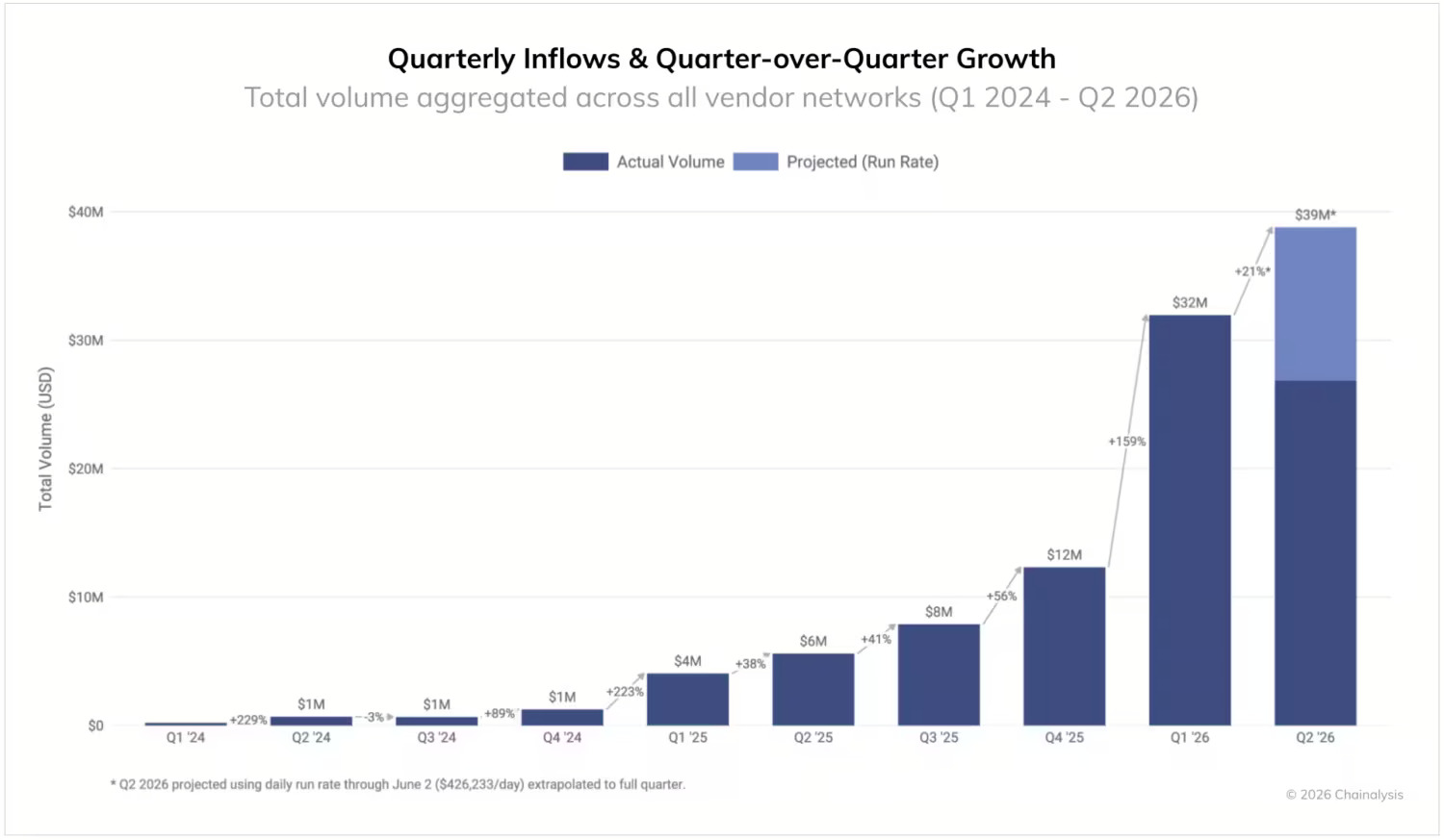
On June 4, blockchain analytics company Chainalysis reported that the gray-market peptide industry, where cryptocurrencies are used as the primary payment method, has exceeded an annual run rate of $100 million. In Q1 2026, crypto procurement for peptide-type products reached $32 million. The report shows that on-chain records from some gray-market peptide suppliers indicate links to Chinese chemical manufacturers that had previously participated in the sales of fentanyl and amphetamine precursor chemicals.
Market size data: confirmed quarterly figures
 (Source: Chainalysis)
According to a Chainalysis report: the crypto procurement amount for gray-market peptides accelerated after the start of 2025, rising from an average of about $200,000 per month for all of 2024. In Q1 2026, procurement reached $32 million (up 159% quarter-over-quarter; $12 million in the previous quarter). Q2 2026 is expected to reach $39 million, and full-year processed volume is projected to exceed $100 million. Chainalysis notes that the market is highly concentrated, with a small number of large suppliers at the top accounting for a significant share of transaction volume.
Payment patterns: confirmed trend of stablecoins replacing volatile cryptocurrencies
Analysis of on-chain activity by Chainalysis shows that as suppliers grow, large suppliers increasingly prefer using stablecoins rather than volatile cryptocurrencies. When filtering for suppliers with average deposits of $1,000 or more per transaction, the asset mix shifts heavily toward stablecoins, aiming to reduce the impact of cryptocurrency price volatility on large upstream supply chain orders.
Chainalysis says leading suppliers use both Bitcoin and stablecoins to process large volumes of transactions and demonstrate more complex on-chain financial strategies.
Security risks: links to fentanyl precursors and test failures
Chainalysis reports the following confirmed security risks: before Shanghai Sigma Audley expanded into peptide business, it earned at least $1 million in Bitcoin and $3.59 million in stablecoins, and the company has on-chain links to organizations that previously participated in fentanyl precursor sales.
Chainalysis points out that on-chain data shows that some gray-market peptide suppliers are recently abandoning supplying Chinese chemical manufacturers—who had been supplying fentanyl and amphetamine precursor chemicals to international drug-trafficking organizations. As new buyers quickly pour in, the average testing spend per buyer has dropped from a peak to about $8 (a decline of 88%). Chainalysis warns that the combination of unregulated products and crypto payments poses a growing risk to inexperienced entrants into the market.
FAQ
Why did cryptocurrencies become the primary payment method for gray-market peptide transactions?
According to Chainalysis’ analysis, traditional banks and credit card processing institutions typically prohibit the sale of prescription-grade compounds and unregulated substances, making it difficult for gray-market suppliers (many located in China) to obtain standard financial services. Cryptocurrencies fill this payment gap, becoming a core payment channel connecting overseas manufacturers and international buyers.
What risk does the sharp drop in testing spend for peptide products mean for buyers?
Chainalysis says the proportion of buyers who previously paid Janoshik (a Czech chemical purity testing laboratory) in parallel fell sharply after the market exploded, with average testing spend dropping to about $8, down 88%. This means more and more buyers are purchasing and using injectable chemicals without independent purity verification, creating a risk of exposure to non-sterile or out-of-spec products.
What specific supply-chain security concerns does Chainalysis’ on-chain tracking reveal?
Chainalysis’ report confirms that Shanghai Sigma Audley has on-chain links with organizations that previously participated in fentanyl precursor sales, and its cryptocurrency income before entering the peptide business can be tracked in a quantifiable way. The report also notes that some gray-market peptide suppliers are recent Chinese chemical manufacturers that transitioned from fentanyl and amphetamine precursor businesses, shifting operational risk by leveraging the surge in demand in the peptide market.


