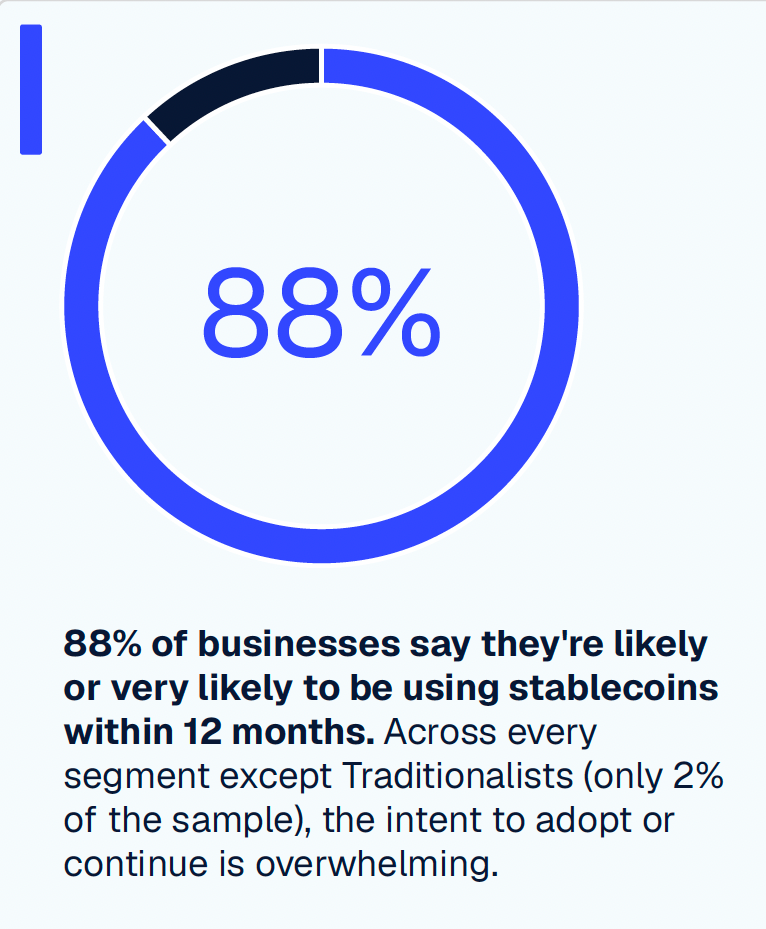
Payments infrastructure company Cybrid released a survey report on June 30 covering 468 corporate executives, showing that 42% of surveyed companies have already used stablecoins for cross-border payments. Large enterprises with monthly settlement volumes exceeding $100 million save an average of 47% on costs, while average enterprises save 35%. 88% of executives said they plan to adopt stablecoin settlements within the next 12 months.
Core Quantitative Data from the Cybrid Survey
 (Source: Cybrid)
The main quantitative indicators of this survey are as follows:
Current enterprise adoption rate: 42% (surveyed companies already use stablecoins for cross-border payments)
Proportion sticking with traditional SWIFT/wire transfers: Only 2%
Adoption intention in the next 12 months: 88% of executives said they are "likely" or "very likely" to adopt
Average cost savings for general enterprises: 35%
Average cost savings for large cross-border enterprises (monthly settlement over $100 million): 47%
Adoption bottleneck: 71% of companies cited "regulatory clarity" as the biggest obstacle
The report reveals that 71% of respondents cited "regulatory clarity" as the biggest obstacle to scaling adoption, ranking higher than "finding a trusted infrastructure provider" and "integration with existing ERP systems." In terms of use cases, the frequency from high to low is: payroll and cross-border contractor payments, supplier payments, customer settlements, investment and yield generation, and treasury management.
Third-Party Corroborating Data from McKinsey and Paybis
McKinsey research estimates that the global stablecoin payment volume in 2025 is approximately $390 billion, with B2B transactions accounting for 60%. Data from payment platform Paybis shows that in the first four months of 2026, corporate clients accounted for nearly 98% of its platform's stablecoin payment volume (compared to just 36% in 2023). The total global stablecoin market cap is currently about $307.6 billion, with USDT at $184.7 billion and USDC at $73.5 billion.
Institutional Follow-Up Developments After the GENIUS Act
The GENIUS Act, the first U.S. federal regulatory framework for payment stablecoins, has been passed, and the market cap of compliant stablecoins has quickly surpassed $76 billion. Traditional financial institutions are following suit: BNY Mellon has expanded its digital asset platform to fully support USDC storage, transfer, minting, and redemption; Falcon Finance has partnered with Anchorage Digital Bank to launch the fUSD stablecoin.
Frequently Asked Questions
@E1# Why do large enterprises save more on cross-border payment costs than average enterprises (47% vs 35%)?
Large enterprises using traditional SWIFT wire transfers must go through multiple correspondent banks, each charging fees and exchange rate spreads. Stablecoins settle directly on the blockchain, bypassing the correspondent bank layer; the larger the settlement scale, the higher the proportion of intermediary costs saved. Enterprises with monthly settlement volumes over $100 million thus see the most significant savings.
@E1# What is the impact of the GENIUS Act's passage on stablecoin enterprise adoption?
The GENIUS Act is the first U.S. federal regulatory framework for payment stablecoins. After its passage, the market cap of compliant stablecoins exceeded $76 billion. The Cybrid survey shows that 71% of companies cited "regulatory clarity" as the biggest obstacle to scaling adoption, and regulatory certainty directly reduces companies' compliance concerns.
@E1# What are the sources and scale of respondents in the Cybrid survey?
The survey was conducted from April 28 to May 4, 2026, with 468 corporate executives and leaders, primarily from the United States, Canada, and the United Kingdom, concentrated in the technology, financial services, and e-commerce industries. This survey is Cybrid's own research.


