When Ethereum’s staking ratio crosses the 30% threshold and heads toward 33%, it’s no longer just a number about network participation rate—it’s a structural signal marking the Proof-of-Stake economic model entering the “deep water” zone. As of May 27, 2026, Validatorqueue data shows that Ethereum has staked a record 39.2 million ETH, accounting for 32.19% of the total supply. In addition, about 3.3 million ETH is also queued and waiting to enter the staking queue.

From the perspective of historical evolution, the significance of this level goes far beyond a simple “more locked up.” In early 2023, when total network staking was only around 15 million ETH, the staking ratio hovered in the 12% to 13% range, with staking participants mainly technical early ecosystem supporters. Now, a 32.19% share means more than one-third of the ETH supply is locked into the consensus mechanism. This not only substantially raises the economic cost of attacking the Ethereum network—attackers need to obtain more than 33% of the network’s staked权益 (staking power/rights) for finality to be affected—but also means Ethereum’s PoS model has effectively moved from an “exploration phase” into a “mature application phase.”
Judging from the power structure, this ratio also touches a core governance boundary: when the staking ratio approaches 33%, the staked权益 of a single entity or a small coalition nears the critical point of a finality threat, which puts higher coordination demands on decentralized governance. Therefore, 32.19% is not merely a data milestone, but a key node that requires a reassessment of network economic parameters and participant behavior patterns.
How the rise in staking affects Ethereum’s security foundation
From a security standpoint, a 32.19% staking ratio brings Ethereum’s PoS network economic security to an unprecedented level. The security of a Proof-of-Stake network directly depends on the total value staked: the higher the cost to attack the network, the safer the network is. The dollar-value estimate of Ethereum’s current total staked amount is in the range of $80 billion to $89 billion, meaning that any attempt to accumulate staking power to launch a 33% attack would already cost close to the $30 billion scale.
This security level is leading across the PoS public chain ecosystem. Among higher-staking chains, Solana’s staking ratio is about 68%, but its total value locked is about $39.5 billion. With a 32.19% staking ratio and a larger market-cap base, Ethereum constructs an economic security wall with the highest absolute value.
Another notable security dimension is client diversity. As of May 2026, the distribution of clients in Ethereum’s consensus layer is relatively healthy: Lighthouse at about 43%, Prysm at about 31%, and Teku at about 14%, with no single client holding a majority share. However, there is still a centralization risk at the execution layer: Geth holds about 50% of the market share. When an execution client reaches 66% or more, a severe vulnerability could lead to chain forks or finality stalling. The growth in staked amount and the continual increase in validator numbers (currently active validators are close to 1 million) further highlights the importance of client diversity, and it is also a core proposition that the Ethereum community continues to focus on.
How the validator queue size reveals supply-demand imbalance
What’s worth paying attention to now is not only the 39.2 million ETH already staked, but also the queue waiting to enter staking. About 3.3 million ETH is still queuing in the staking queue. The size of this wait period alone reveals a key fact: relative to the demand to enter staking, the validator activation throughput of the Ethereum network faces a structural bottleneck.
Ethereum’s protocol sets a rate limit on the number of validators that can be activated per epoch (about 6.4 minutes). The daily cap on newly added validators is constrained by design. The mechanism aims to prevent instability caused by dramatic fluctuations in the validator set, but it also means that when entry demand spikes, waiting time will be significantly extended. In early 2026, the amount of validators entering the queue at one point exceeded 3.1 million ETH, and the expected wait time was as long as 54 days.
The other side of the supply-demand imbalance is changes in the exit queue. Compared with the exit peak of around 2.67 million ETH in September 2025, the current exit queue has fallen significantly. This “in more than out less” pattern in 2026 shows an obvious structural characteristic: long-term participants are replacing short-term speculators, while the continued inflow of institutional capital is reshaping the full picture of the validator set.
How the Pectra upgrade reshapes the staking logic of large participants
To understand the drivers behind the current staking all-time high, you have to go back to the Pectra hard fork activated in May 2025. This upgrade integrates 11 EIPs, and among them, EIP-7251 has the deepest impact on staking economics: it increases the maximum effective balance of a single validator from 32 ETH to 2,048 ETH.
Before this, large holders or institutions needed to split each 32 ETH into an independent validator node. If an institution held 100,000 ETH, it would need to deploy about 3,125 validators, and each validator required independent signing, broadcasting messages, and bearing operating costs. This not only creates significant operational burden, but also dramatically increases network communication load.
After the Pectra upgrade, institutions can consolidate their staking positions into fewer validators and roll the excess ETH into the same validator account as “excess balance.” This change directly lowers operational barriers for large participants, and it also explains why multiple large-scale institutional staking deployment events emerged in the first half of 2026. By statistics, as of May 2026, more than 26% of validators have chosen to adopt a composite mode, with a total of about 3,580,916 ETH staked in the form of composite credentials.
In addition, EIP-6110 and EIP-7002 move validator deposits to the execution layer, and implement the withdrawal mechanism through standard execution-layer transactions, further reducing the operational complexity and time costs of staking. Taken together, these changes lower the participation threshold for Ethereum staking, shifting the staking ecosystem from a “game for technical elites” to a “scalable asset management tool for institutions.”
The supply-demand relationship between rising staking ratios and changes in circulating supply
From a macroeconomics perspective, a 32.19% staking ratio means the circulating ETH supply available for trading effectively decreases by an equivalent proportion. When more than one-third of the supply is locked in consensus contracts, the total amount of ETH that can be freely traded is constrained significantly.
This supply compression effect has been observed empirically in the first half of 2026. Since early 2026, the ETH staking ratio has risen from around 29% to 32.19%, while circulating supply has continued to tighten over the same period. With no significant change yet on the demand side, reducing supply should theoretically help stabilize prices. However, crypto market pricing is far more complex than a simple supply-demand model—leverage structures, derivatives positions, and macro liquidity can all exert profound influence on prices.
A more complex layer comes from the introduction of liquid staking derivative products. Staking credentials such as Lido’s stETH, Rocket Pool’s rETH, and GTETH provided by the Gate platform partially offset the locking effect on circulating supply. These tokens can be used as collateral in DeFi, for borrowing, or traded in secondary markets—essentially creating a “shadow liquidity layer” for staked ETH. As of early 2026, liquid staking accounts for about 31.1% of all staked ETH; centralized exchanges account for about 24%; staking pools account for about 17.7%; and liquid staking further accounts for about 6.6%. This means that roughly one-third of staked ETH is actually still participating in market circulation in the form of derivatives.
Therefore, the actual impact of staking on supply follows a layered logic: direct circulating supply does decrease, but staking derivatives create an intermediate market layer that preserves staking yield while maintaining capital liquidity. For investors analyzing the supply-demand landscape, distinguishing between “native ETH circulating supply” and the “total scale of ETH risk exposure” has become more important than ever.
Will yield compression affect future staking participation intent
A 32.19% staking ratio also raises another core question: as more and more ETH enters the staking system, where will the annualized yield go? Yield compression is PoS network’s most basic dynamic law— the larger the total staked amount, the fewer rewards are distributed to each validator.
Ethereum’s current network-wide base staking annualized yield has fallen from the previous peak above 5% to the 2.8% to 3.3% range. This level of yield loses absolute attractiveness when compared with the global risk-free rate (for example, U.S. Treasury yields around 4% to 5%). Its special feature is that the yield is denominated in ETH. For holders who are bullish on ETH long term, staking rewards provide ETH-denominated compounding growth; when the asset price rises, they can also capture additional appreciation. Some analysts describe Ethereum in 2026 as a “bond with a growth option,” where a 3% to 4% staking yield combined with the potential upside of ETH creates a risk-reward profile completely different from traditional fixed-income products like bonds.
Another factor affecting participation intent is improved staking liquidity. After the Shanghai upgrade, validators can flexibly withdraw staked ETH and accumulated rewards, without the risk of funds being frozen for a long period. Data shows that the net inflow after the Shanghai upgrade completion was about 3.6 million ETH, indicating that the introduction of withdrawal mechanisms actually strengthened new participants’ willingness to enter. With liquidity rising and yields falling in parallel, a new two-way influence pattern emerges for potential participants.
Why all-time high staking volume diverges from market performance
A notable phenomenon is that while Ethereum’s staking volume has hit an all-time high, ETH market performance shows a certain degree of mismatch. Since 2026, the ETH price has experienced a pullback to some extent, while the staking ratio has continued to climb. This divergence between supply-demand data and price trends has sparked widespread discussion among industry observers.
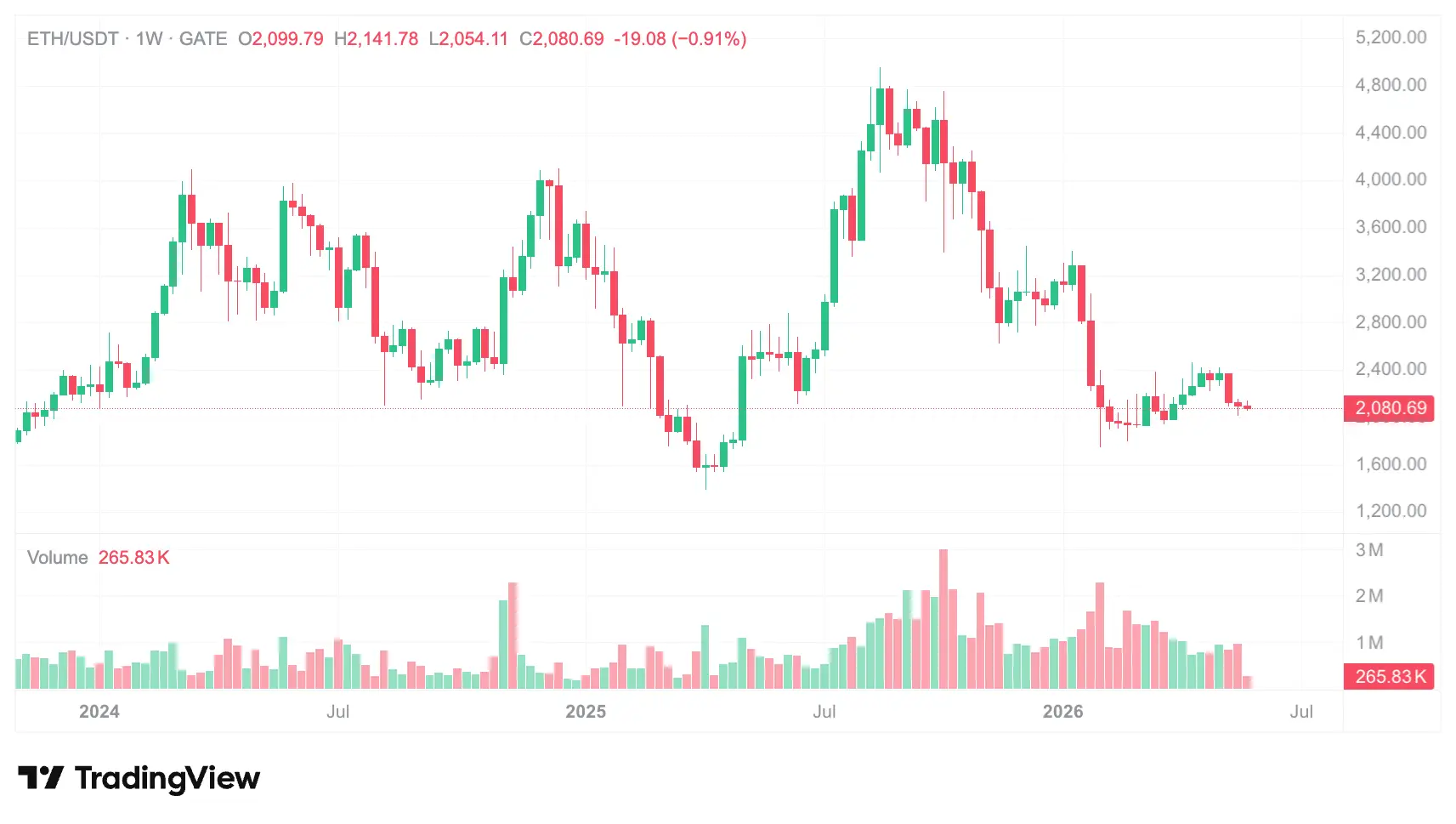
ETH 1W chart
Structurally, the growth in staking volume reflects the choices of long-term holders. Locking means these holders focus on value growth of the network over longer time horizons rather than short-term price fluctuations. In the crypto market, this behavioral pattern is often seen as a kind of “faith indicator.” On the other hand, price volatility is influenced by a combination of macro liquidity, leverage structures, the derivatives market, and sentiment factors, and in the short term it may not fully reflect changes in staking data.
Reexamining from the supply perspective: a 32.19% staking ratio compresses tradable circulating supply. Crypto analysts point out that the staking-created supply floor does limit downside magnitude, because more than 39 million ETH will not appear in sell orders on the market. But the ultimate direction of the price still depends on real spot demand and network activity. At present, Ethereum’s on-chain transaction fees and transaction volumes are both relatively low, which means the price relies more heavily on derivatives leverage. The growth in staking volume can be understood as a form of long-term value support, but it does not directly equal a short-term price driver.
Frequently Asked Questions (FAQ)
Q1: What does Ethereum’s 32.19% staking ratio mean?
It means that more than one-third of the total ETH supply is locked in PoS consensus contracts, used to maintain the Ethereum network’s operation and validate blocks. This ratio is relatively high within the PoS blockchain ecosystem, significantly increasing the economic cost of attacking the network while also reducing circulating supply in the market.
Q2: With another 3.3 million ETH in the queue for Ethereum staking, why do they need to wait?
Ethereum’s protocol sets a rate limit on the number of new validators that can be activated per epoch in order to maintain the stability of the validator set. When many participants apply at once to become validators, an entry queue forms, and the wait time can reach weeks or even longer.
Q3: What is the current Ethereum staking yield?
As of May 2026, Ethereum’s network-wide base staking annualized yield is approximately in the 2.8% to 3.3% range. The combined yield across different platforms varies due to additional incentives. The yield data here is for informational reference only and does not constitute any investment advice.
Q4: How can investors participate in Ethereum staking?
Investors can participate in Ethereum staking in various ways, including but not limited to: running a validator node themselves (requires staking at least 32 ETH), obtaining staking derivatives through liquid staking protocols, or participating through staking products offered by centralized exchanges. The Gate platform provides ETH staking products; when users stake ETH, they receive an equivalent GTETH staking credential and it supports instant redemption.
Q5: Can staked ETH be withdrawn at any time?
After the Shanghai upgrade, Ethereum’s staking withdrawal mechanism has been officially enabled. Validators can make partial withdrawals (withdrawing reward portions beyond 32 ETH) or full withdrawals (exiting staking completely). However, note that a complete exit must go through the exit queue and the withdrawal delay period, so it is not an instant settlement.
Q6: Will Ethereum’s staking ratio continue to rise?
Whether the staking ratio continues to rise depends on multiple variables, including: the ratio between staking yield and the global risk-free rate, the market maturity of liquid staking derivatives, ETH price expectations, and the continued capital inflow from institutional capital. Based on the current queue size and institutional participation trends, there is still room for the staking ratio to rise further.


