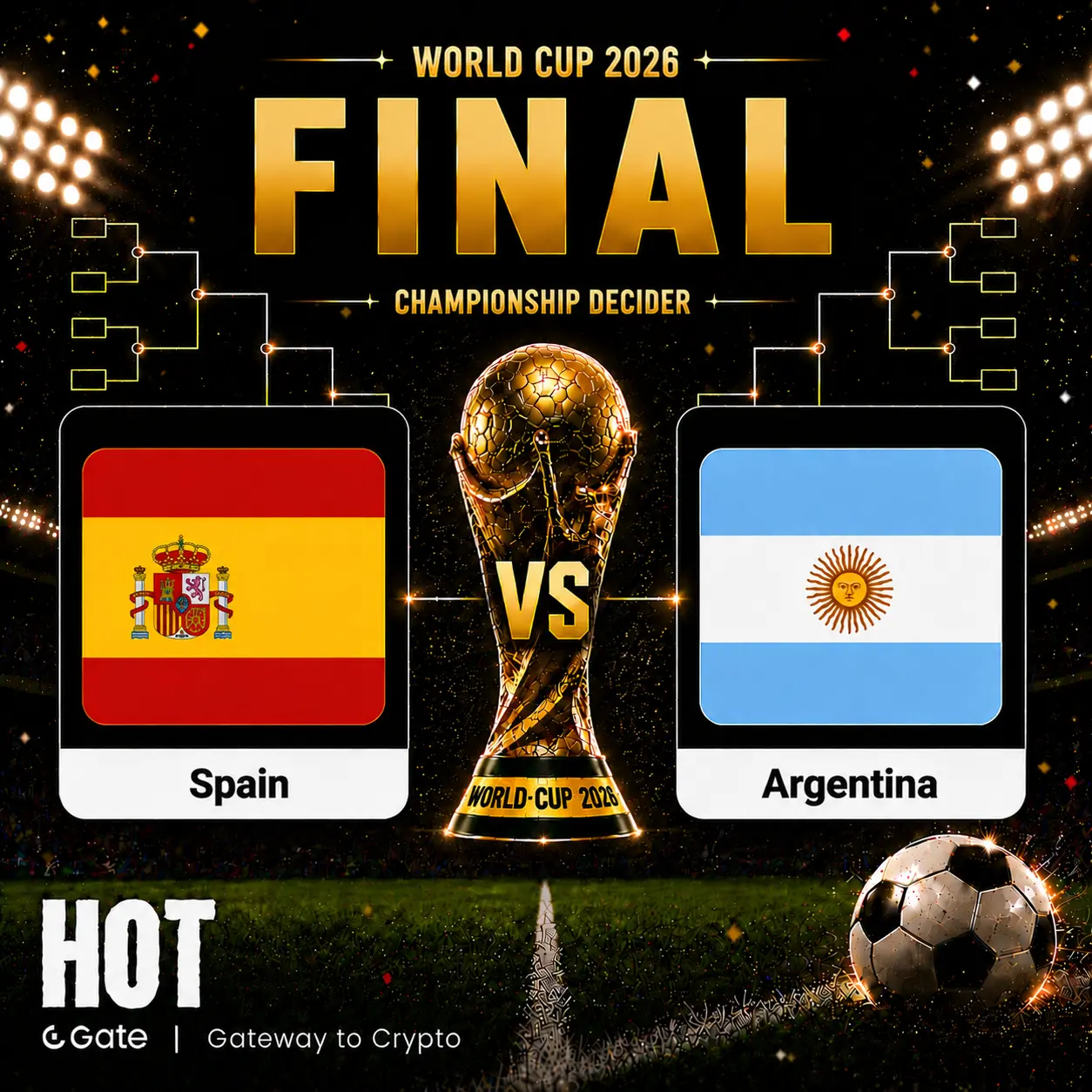
How the 58% vs. 42% probability distribution reflects market expectations
58% vs. 42%—this is the probability distribution for winning the title that Gate’s prediction market provided after the final matchup was confirmed. On the surface, Spain has an approximate 14-percentage-point advantage in probability, but what that gap actually means needs to be understood within the pricing logic of prediction markets.
In essence, the price in a prediction market is the aggregated set of views expressed with real money by market participants. Each trade corresponds to a specific risk judgment, and the 58% vs. 42% distribution implies that, in a sufficiently traded market, participants overall believe Spain’s chances of winning the title are about 38% higher than Argentina’s (relative difference). This probability already incorporates all possibilities across regular time, extra time, and a penalty shootout, making it a comprehensive win-rate assessment.
It’s also worth noting that Spain’s 58% probability advantage does not mean Spain has an overwhelming edge—in a single-elimination final, a 42% implied probability is still a considerable number. The market pricing is more like saying: Spain is the more favored side, but Argentina still has ample room for an upset.
Why Spain’s path to the final is priced higher by the market
Spain’s advancement path from the group stage to the final shows a high degree of stability. In the semifinal against France, Spain won 2-0 convincingly and kept the opponent’s expected goals to within 0.3. Across the tournament, Spain’s defensive system is the team’s biggest highlight: they concede very few goals per game, and even when their key player Yamal is not at his best, they can still consistently win. The maturity of this system—one that doesn’t rely on a single star—is one of the core reasons the market gives Spain a higher probability.
From a data perspective, Spain didn’t just achieve strong results; its underlying metrics—possession rate, defensive expected goals, and the stability of chance creation—are also comprehensively superior. In the pricing logic of prediction markets, “sustainable performance” is more likely to earn a premium than “incidental highlights”—and Spain fits the former.
Why the market gives Argentina a probability discount on its way to defending the title
Compared with Spain’s steady progression, Argentina’s knockout run has been full of drama. In the round of 16 against Egypt, after falling behind 0-2, Argentina scored three goals in the last 12 minutes to complete the comeback. In the quarterfinal, they advanced in extra time thanks to the opponent’s red card. In the semifinal against England, it was again a comeback built on an equalizer in the 85th minute and a decisive goal in stoppage time.
This narrative of “surviving in the brink and pulling off comebacks” is undoubtedly moving, but from the standpoint of prediction market pricing logic, repeatedly depending on goals at the last moment suggests a potential risk that offensive efficiency could be stretched too thin. The data shows Argentina scored 19 goals in this tournament, while expected goals (xG) were only 14.6. Their actual goals being significantly higher than expected goals is typically interpreted by the market as a “not sustainable” signal—in a high-intensity, high-density final, the risk of efficiency reverting is an important reason the market applies a probability discount to Argentina.
In addition, factors such as Messi’s age and the accumulated fatigue from Argentina having multiple knockout matches that went to extra time are also variables the market cannot ignore.
What value prediction markets offer as an information aggregation mechanism
The World Cup champion prediction market has become the largest single event in the sports prediction market category by volume. Large amounts of capital are allocated across different outcomes, forming a real-time updated system of collective intelligence, with money as the expression medium.
The core value of prediction markets lies in their “incentive compatibility” feature—only when participants are willing to place bets with real money for their judgments does the price truly contain informational value. Verbal predictions and social media sentiment can be expressed freely at no cost, but each trade in a prediction market involves real risk. This gives prediction market price signals unique advantages in aggregating dispersed information and reducing individual bias.
The 58% vs. 42% distribution essentially reflects equilibrium pricing formed by thousands upon thousands of independent decision-makers, each operating under their own information sets, analytical frameworks, and risk preferences. It may not be a “correct answer,” but it is the greatest common divisor formed after a game from all available information in the market.
The commercial value of the World Cup final and the resonance effect of prediction markets
The 2026 US-Canada-Mexico World Cup is the first World Cup in history jointly hosted by three countries. Participating teams increased from 32 to 48, and the number of matches rose from 64 to 104. A research report jointly released by FIFA and the World Trade Organization indicates this World Cup will create $80.1 billion in economic output, drive GDP growth of about $40.9 billion, attract nearly 6.5 million on-site spectators, and provide 824,000 full-time jobs.
Within this enormous business ecosystem, prediction markets are becoming a new dimension of event economics. Prediction markets not only give fans a new way to participate, but also create a pricing mechanism that reflects market sentiment in real time. As a leading global digital asset trading platform, Gate has deeply integrated into this ecosystem. As of July 5, 2026, Gate is the core integrated access channel for Polymarket; cumulative trading volume for World Cup-related predictions has surpassed $251 million, ranking first in nominal trading volume among more than 300 partner channels on Polymarket globally.
In addition, Gate launched real US stock trading services in June 2026. Users can directly use USDT to trade stocks and ETF assets in the platform’s US mainstream securities market, supporting more than 10,000+ US stock symbols. This setup enables Gate to build a complete closed-loop within a single account system that connects digital assets, prediction markets, and traditional finance.
What market volatility the final result could trigger
The result of the World Cup final matters not only for football honors, but could also ripple across multiple market layers.
From the perspective of prediction markets themselves, once the final result is determined, the championship contract settles immediately to 1 or 0. That means among the 58% and 42% probabilities, one side will go to zero and the other will become certain. This dramatic shift from probability to certainty may trigger large-scale position closures and capital reallocations in related prediction market contracts.
From a broader market perspective, the allocation of the World Cup championship may also have some short-term impact on national sentiment, consumer confidence, and even volatility in capital markets. Historical data shows that in many cases, the stock market of the World Cup champion country tends to show positive reactions in the short term after winning. Spain’s IBEX 35 index and Argentina’s S&P Merval index have a huge difference in size—about $3.8 trillion for the former and only about $26 billion for the latter—which implies that the same emotional shock could translate into very different price elasticity across markets of different magnitudes.
Gate’s 24/7 US stock trading service allows users to react immediately to related market changes right after the event results are announced. This cross-market instant response capability is changing the interaction pattern between traditional finance and sports event outcomes.
Summary
Argentina advanced to the final with a 2-1 late winner against England, setting up a clash with Spain for the 2026 World Cup championship. Gate’s prediction market data shows the current market has Spain’s title probability at 58% and Argentina’s at 42%. This probability distribution reflects the market’s comprehensive assessment of both teams’ paths to the final, underlying data performance, and sustainability—Spain’s stability earns a premium, while Argentina’s “tense script” is priced with a probability discount.
As an information aggregation mechanism, the value of prediction market price signals comes from real-money trading games and risk-taking. Within the World Cup commercial ecosystem of $80.1 billion in economic output, prediction markets are becoming an important part of the event economy. And through connecting digital assets, prediction markets, and real US stock trading, Gate is building a multi-asset trading ecosystem.
The final will kick off at 3:00 a.m. Beijing time on July 20 at MetLife Stadium in New York-New Jersey. Regardless of the final outcome, the 58% vs. 42% probability distribution itself is already a collective judgment about who will be champion—written by market participants with real money.
FAQ
Q: How are Gate prediction market’s 58% and 42% data derived?
A: This data comes from Gate’s integrated prediction market real-time pricing after the final matchup is set. The price in a prediction market is determined by participants’ buy and sell trades, and 58% and 42% represent the market’s overall pricing of the chances of Spain and Argentina winning the title. This probability already incorporates all possibilities across regular time, extra time, and a penalty shootout.
Q: Does a 58% probability mean Spain will definitely win?
A: No. 58% only represents the market participants’ collective judgment, not a certain prediction. In a football match, a 42% implied probability still means Argentina has a substantial chance to win the title. Prediction market prices are the result of information aggregation, not a guarantee of the future.
Q: Why might Gate prediction market data differ from data on other platforms?
A: Differences in prediction market liquidity, participant composition, and trading depth can lead to slightly different pricing for the same event across platforms. As a leading global digital asset trading platform, Gate’s integrated prediction market data has higher liquidity and reference value.
Q: How are Gate’s US stock trading services related to prediction markets?
A: Gate has launched real US stock trading services, supporting more than 10,000+ US stock symbols. Users can directly use USDT to trade stocks and ETFs in the US mainstream securities market. Major sports event outcomes like the World Cup final may cause short-term impacts on the share prices of related listed companies, and Gate’s 24/7 US stock trading service enables users to respond to these market changes in a timely manner.
Q: Where can I view Gate’s latest prediction market data?
A: Users can view the latest probability distributions and trading data for events such as the World Cup champion in Gate’s prediction market section. Gate continues to roll out daily featured event prediction challenges around the World Cup schedule.