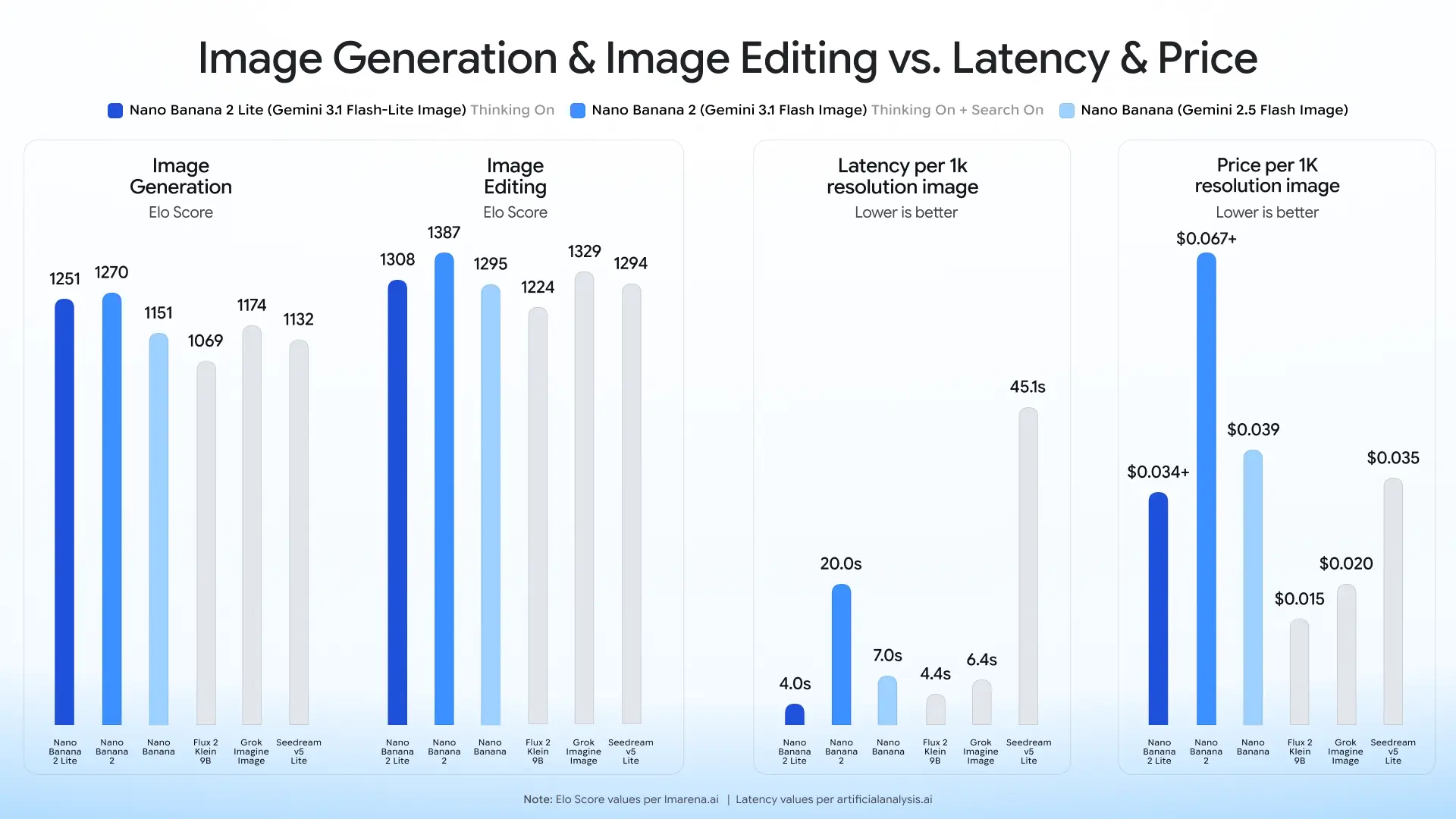
Google launched Nano Banana 2 Lite on June 30, costing just $0.034 per 1,000 images generated, capable of producing standard 1K images within 4 seconds. It is positioned as a "high-throughput infrastructure workhorse," specifically designed for software engineers, programmatic advertising platforms, and digital commerce applications.
Three Core Capability Upgrades of Nano Banana 2 Lite and Resolution Cap Limits
Nano Banana 2 Lite is built on the Gemini 3.1 Flash Lite architecture, with a maximum resolution limited to 1K canvas, and does not support 2K/4K quality found in standard NB2 or NB Pro. As a trade-off between speed and cost, the model features significant upgrades in the following three enterprise core capabilities:
Character Consistency: Maintains high consistency in the appearance of objects and characters across continuous image streams, storyboards, or e-commerce digital try-ons.
Text Rendering: Generates clear, readable text within images, suitable for rapid creation and instant validation of multilingual ad layouts.
World Knowledge: Quickly produces accurate data visualization charts and contextual mockups for specific locations.
In performance benchmarks, the single-image editing Elo score reaches 1308, and the multi-image editing Elo score reaches 1294.
Google Image Generation Model Family Pricing Comparison: $0.034 to $0.134 Gap
 (Source: Google)
Pricing for Google’s four official models (per 1,000 images) is as follows: Nano Banana 2 Lite ($0.034, latest lightweight version), previous-gen NB1 ($0.039), standard NB2 ($0.067, supports higher resolution), high-end NB Pro ($0.134, flagship quality).
The high-end NB Pro price is approximately four times that of NB2 Lite. Google's internal assessment indicates that Nano Banana 2 Lite delivers about 60–70% of the general capabilities of high-end models at a significantly reduced cost. According to reports, Google hopes to attract enterprises to its ecosystem through this low-price strategy, competing with startups like Krea 2 Turbo.
Gemini Omni Flash Also Debuts, Available on Three Platforms Immediately
Google also released the public preview of Gemini Omni Flash on the same day, featuring multimodal conversational video generation and editing, showcasing Google's dual AI strategy in static images and dynamic video. Nano Banana 2 Lite operates in a closed API mode and does not support local deployment. It is immediately available via Google AI Studio, Gemini API, and the Gemini Enterprise Agent Platform (GEAP).
Frequently Asked Questions
Why does Nano Banana 2 Lite have a higher Elo score than the high-end NB Pro?
Nano Banana 2 Lite's Text-to-Image Elo score is 1251, slightly surpassing the high-end NB Pro's 1245 and the previous NB1's 1151. Google did not explain why the lightweight model outperforms the high-end version in Text-to-Image Elo, but this gap may reflect different optimization directions for various task types across models.
Why does Nano Banana 2 Lite not support 2K/4K resolution?
Google strategically limits the maximum resolution to 1K canvas to achieve a generation speed of 4 seconds and keep costs at $0.034 per thousand images. 2K/4K quality support is only available in the standard NB2 and high-end NB Pro. Google explains that this model is tailored for high-throughput enterprise automation scenarios, not for artistic creation seeking ultimate image quality.
Which platforms can Nano Banana 2 Lite be used on immediately?
As of June 30, 2026, Nano Banana 2 Lite is available via Google AI Studio, Gemini API, and the Gemini Enterprise Agent Platform (GEAP). It operates in a closed API mode and does not support local deployment.


