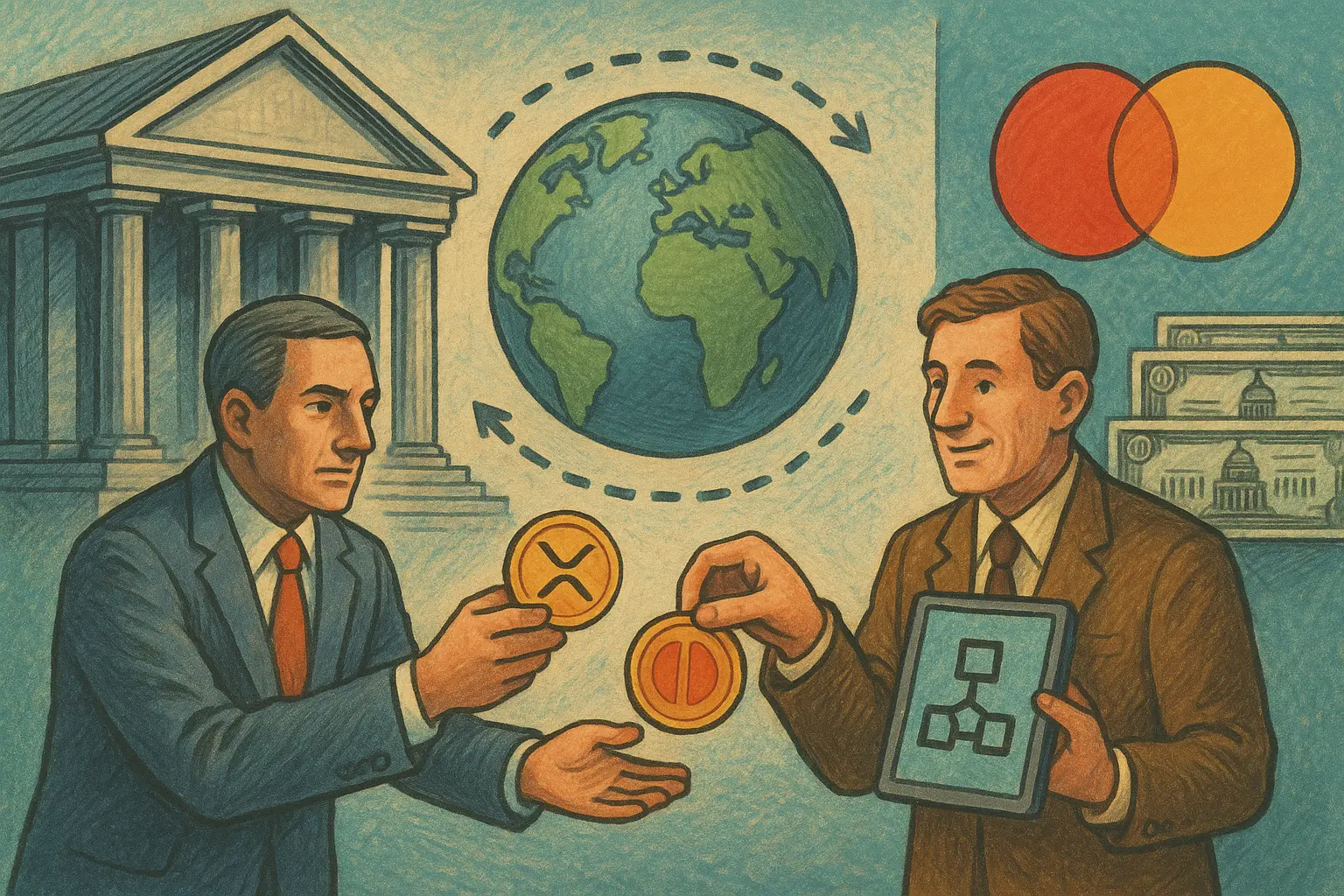
According to an official statement released by Ondo Finance on May 6 (Wednesday), JPMorgan and Mastercard have completed the first cross-border, cross-bank redemption of an on-chain tokenized U.S. Treasury fund, using Ripple’s XRP ledger and the interbank settlement system.
Transaction Structure and Participating Institutions
(Source: Ondo Finance)
According to Ondo Finance’s official statement, the settlement process for this pilot transaction is as follows:
· Ondo Finance’s Ondo short-term U.S. government bond fund (OUSG) is exchanged on the XRP ledger for Ripple tokens
· Mastercard’s Multi-Token Network (Multi-Token Network, MTN) routes the settlement instruction to JPMorgan’s blockchain platform Kinexys
· Kinexys delivers U.S. dollars to Ripple’s new Singapore bank account
According to Ondo Finance’s statement, this pilot was built on earlier pilot efforts in which JPMorgan and Ondo Finance participated in May 2025, when tokenized U.S. Treasury funds were transferred via a permissioned public blockchain network.
Current Status of the Tokenization Market for Real-World Assets (RWA)
According to data from RWA.xyz, as of the time of reporting, more than $31.1 billion in real-world assets have already been tokenized on-chain, excluding stablecoins. According to a 2022 market estimate by Boston Consulting Group (BCG), the tokenization market could reach $16 trillion by 2030; McKinsey’s estimate is more conservative, with the market size in the same period at about $2 trillion.
According to public reports, Intercontinental Exchange (ICE) announced in January this year that it would roll out a tokenized platform to enable 24/7 trading of stocks and ETFs with real-time settlement.
IMF Regulatory Concerns and Industry Outlook
In a report published by the International Monetary Fund (IMF) in April 2026, the IMF noted that tokenization shifts risks from the banking system to shared ledger and smart contract code, making intervention more difficult during “stress events.” Without clear legal guidance on ownership records and settlement finality, there is a risk that the tokenization market will be “fragmented and marginalized.”
According to a report from the Consensus Miami 2026 conference, Kevin O’Leary, an investor in Shark Tank, said at the conference on Wednesday that there will not be large amounts of capital tokenized in the U.S. until legislation is passed to define the crypto market structure and it aligns with the requirements of the U.S. Securities and Exchange Commission (SEC). He said: “When that happens, everything changes.”
Frequently Asked Questions
What is the significance of the “first” meaning of the transaction completed via the XRP ledger? How does Ondo Finance describe it?
According to Ondo Finance’s official statement, this is the first time that a cross-border tokenized fund transaction is settled in real time through joint settlement between a public blockchain and global banking infrastructure; specifically, after Ondo Finance’s OUSG fund is exchanged on the XRP ledger, cross-border U.S. dollar delivery is completed through Mastercard’s MTN and JPMorgan’s Kinexys platform.
How large is the tokenization market for real-world assets currently?
According to RWA.xyz data, excluding stablecoins, more than $31.1 billion in real-world assets have been tokenized on-chain. BCG estimated in 2022 that the market size could reach $16 trillion by 2030, while McKinsey estimated it at about $2 trillion in the same period.
What are the main regulatory concerns about tokenization according to the IMF?
In the IMF’s April 2026 report, the IMF pointed out that tokenization transfers risk to smart contract code, making intervention more difficult during stress events; without clear legal clarity on ownership records and settlement finality, there is a risk that the tokenization market will be “fragmented and marginalized.”


