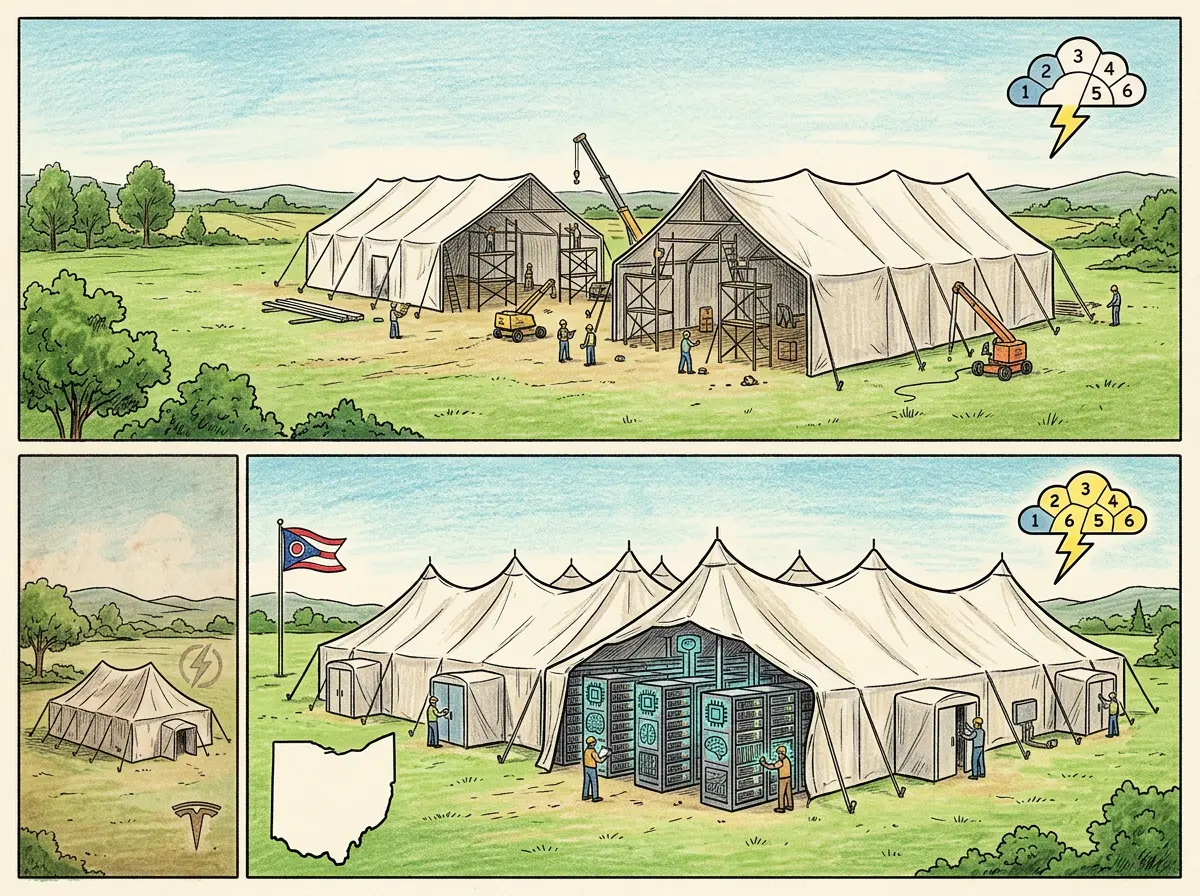
Cleanview, a market intelligence company focused on U.S. power infrastructure, founder Michael Thomas found through tracking building permits and satellite imagery that Meta has been gradually applying for construction permits for five industrial tent structures of 125,000 square feet each in New Albany, Ohio, between April and June. All six tents are currently fully completed, with internal AI chips worth billions of dollars installed and operating 24 hours a day.
Tent Construction Specifications and Permit Details
Construction records confirmed by Michael Thomas: Meta applied for construction permits for five tents between April and June 2026, with each tent covering 125,000 square feet (about 11,600 square meters). Satellite imagery shows that all six tents are fully completed. For Meta’s first five permanent data center buildings in New Albany, each building requires 2-3 years to complete, while the tent solution is scheduled to be finished in 4-6 months.
The “Socrates” power system: modular setup to bypass the grid wait
Confirmed equipment for the Socrates power system:
· Solar Turbines Titan 250 gas turbine engines
· Siemens Energy SGT400
· Caterpillar 3520 series reciprocating engines: 15 units total
· Total capacity: 200 Megawatts
This modular gas turbine power solution was first adopted by xAI, Musk’s company, for the Colossus supercomputing cluster in Memphis, Tennessee. Its core advantage is avoiding the multi-year wait for traditional grid interconnection, such as waiting for utilities’ scheduling and the laying of new lines; instead, it is set up on-site directly, measured in months.
Tesla’s 2018 tent precedent and the xAI Colossus example
Two confirmed precedents for Meta’s tent strategy: in 2018, Tesla built tent-style production lines in the parking lot at its Fremont, California plant, for an emergency expansion during the Model 3 delivery sprint, with Musk himself overseeing on the factory floor at the time. xAI’s Colossus supercomputing cluster in Memphis adopted the same modular gas turbine fast-power supply approach, and Meta’s Socrates system copied this architecture.
Common Questions
What are the main differences between Meta’s industrial tent data centers and traditional data centers?
According to Cleanview’s analysis, traditional permanent data center construction takes 2-3 years, while the completion time for Meta’s Ohio tent project is 4-6 months. The tents use industrial canvas structures and rely on on-site power with modular gas turbine engines (no need to wait for grid interconnection), but the permanent and long-term maintenance costs may be higher than traditional brick-and-mortar construction (long-term maintenance data for the tent solution has not been disclosed yet).
How does the 200MW Socrates power system achieve rapid deployment?
Modular gas turbine engines and reciprocating engines can be installed on-site directly, with deployment time measured in months. By contrast, traditional grid interconnection requires waiting for utility scheduling and the installation of new lines, which typically takes years. The Colossus supercomputing cluster in Memphis is the precedent for this approach, and Meta’s Socrates system adopted the same architecture.
How can the existence and completion status of Meta’s Ohio tents be confirmed?
Cleanview founder Michael Thomas confirmed the completion status of the six tents by tracking local building permits (the five construction permits applied for between April and June 2026) and satellite imagery, and shared related satellite images publicly on the X platform.


